TEL:+86 132 6656 7067





An optical transceiver does not become industrial grade simply because its product label includes the words "industrial temperature." Equipment deployed in substations, factory automation systems, outdoor telecom cabinets and transportation networks must operate under conditions that are often very different from those in a climate-controlled data center. Temperature changes, humidity, vibration, electrical disturbances and limited maintenance access can all influence long-term network performance.
A genuine industrial-grade optical transceiver should therefore be supported by more than a wide operating-temperature specification. Its internal components must be suitable for the intended environment, its optical performance must remain within specified limits, and its design should undergo appropriate environmental and reliability qualification. Manufacturing controls and product-level traceability are equally important when consistent operation is required across production batches.
For network engineers and equipment manufacturers, the distinction is between a module that can operate at an extreme temperature during a basic test and one that has been designed, qualified and manufactured to maintain its specified performance under defined industrial conditions.
1. Industrial Grade Is a Product Qualification, Not Just a Temperature Label
Industrial-grade classification describes the environmental and reliability requirements a product is designed to meet. For optical transceivers, temperature is usually the most visible specification, but it is only one part of the qualification.
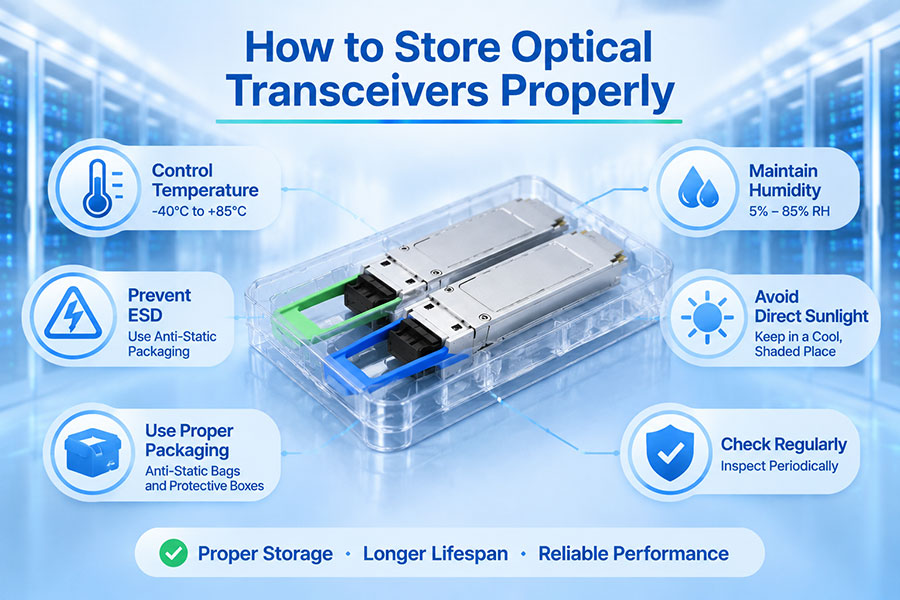
A commonly used industrial optical temperature range is -40°C to +85°C case temperature. This wider range is intended for equipment that may experience severe cold, elevated internal cabinet temperatures or substantial seasonal changes.
However, an industrial-grade evaluation should also consider whether the module maintains its optical and electrical performance across that range, whether it has been tested for relevant environmental stresses, and whether the manufacturer has appropriate production quality controls.
| Qualification Area | What It Covers | Why It Matters |
|---|---|---|
| Temperature capability | Specified operating case-temperature range and startup conditions | Ensures the module is suitable for the thermal environment. |
| Component selection | Lasers, photodiodes, drivers, amplifiers and control ICs | Components must operate within their qualified limits. |
| Optical performance | Transmit power, wavelength, receiver sensitivity and BER | Maintains the required link performance under environmental stress. |
| Environmental robustness | Temperature cycling, humidity, shock and vibration where required | Evaluates resistance to conditions beyond normal indoor operation. |
| Reliability qualification | Defined stress testing and performance measurements | Provides evidence of product durability and design suitability. |
| Manufacturing control | Component screening, production inspection and traceability | Helps maintain consistent quality across production batches. |
| System compatibility | Host interface, management behavior and optical interoperability | Ensures the module works in its intended network equipment. |
These areas form a more complete basis for evaluating industrial optical products. The exact qualification requirements depend on the installation environment and the equipment manufacturer's application specifications.
2. Wide-Temperature Components and Thermal Design
The internal components of an industrial optical transceiver must tolerate a wider range of operating conditions than components selected only for conventional commercial environments.
Important components include laser diodes, photodiodes, transimpedance amplifiers, laser drivers, clock and data recovery circuits, digital signal processors and control ICs. Their electrical and optical characteristics can change with temperature.
Component selection and screening
Manufacturers may select components specifically designed for wider temperature operation or use screening and binning processes to identify parts that meet the required performance limits. Component qualification should cover the parameters relevant to the final optical module, rather than relying only on a supplier's general temperature claim.
Laser and receiver stability
Laser wavelength and output power can vary with temperature. Receiver sensitivity and electronic noise characteristics can also change. The module design must keep these parameters within the specified operating limits throughout its rated temperature range.
Some optical designs use temperature-control techniques such as thermoelectric coolers to help stabilize laser characteristics. These are design-dependent solutions, not mandatory features of every industrial transceiver.
Thermal management inside the module
Electrical power consumption contributes to heat generation. Package design, heat conduction, component placement and the host switch's airflow all influence the temperature experienced by the module.
This becomes especially important in densely populated switches and higher-power optical interfaces. A transceiver may meet its standalone specifications but still need adequate host-system cooling to remain within its operating limits.
3. Operating Temperature Must Be Supported by Performance Testing
The commonly used temperature classifications for optical modules include commercial, extended and industrial grades. In Cisco's published classification, these ranges refer to the module's case temperature.
| Temperature Grade | Typical Case-Temperature Range | Typical Environment |
|---|---|---|
| Commercial (C-Temp) | 0°C to +70°C | Controlled indoor network equipment and data centers |
| Extended (E-Temp) | -5°C to +85°C | Telecom equipment rooms and less-controlled installations |
| Industrial (I-Temp) | -40°C to +85°C | Outdoor cabinets, industrial Ethernet and remote infrastructure |
These are common reference ranges, not a universal classification system used identically by every manufacturer. Some suppliers define extended grades differently, and certain industrial products have model-specific upper limits above +85°C.
More importantly, a temperature rating should mean that the transceiver maintains its specified performance across the operating range. Simply powering on a module at -40°C or +85°C does not prove that its transmitter, receiver and electrical interface meet all required specifications.
Temperature-related testing should evaluate parameters such as:
Transmit optical power across the specified temperature range.
Center wavelength and wavelength stability where applicable.
Receiver sensitivity and overload limits.
Laser bias current and supply voltage.
Extinction ratio and eye quality.
Bit error rate under the defined test conditions.
Module startup and link establishment at low temperature.
4. Environmental Qualification Beyond Temperature
Industrial networks can expose optical modules to mechanical and environmental stresses that are uncommon in standard data center racks. Depending on the application, a qualification program may need to address humidity, vibration, mechanical shock and electrostatic discharge in addition to temperature.
| Environmental Test | What It Evaluates | Potential Application Relevance |
|---|---|---|
| Temperature cycling | Performance and structural integrity after repeated temperature changes | Outdoor cabinets with large seasonal and daily temperature variation |
| Thermal shock | Response to rapid changes between defined temperature conditions | Installations exposed to abrupt thermal transitions |
| High-temperature operating life | Behavior during extended operation at elevated temperature | Equipment installed in warm or poorly ventilated enclosures |
| Humidity and damp heat | Resistance to specified moisture and humidity exposure | Industrial facilities and environments with high humidity |
| Mechanical shock | Resistance to defined mechanical impact conditions | Transportation equipment and mechanically demanding installations |
| Vibration | Functional and structural response to specified vibration profiles | Railway, industrial machinery and vehicle-mounted systems |
| ESD testing | Electrostatic discharge robustness | Manufacturing, installation and maintenance handling conditions |
Not every industrial deployment requires the same environmental test plan. A stationary utility cabinet, a railway communication system and a factory automation network may have different vibration, humidity, contamination and temperature requirements.
Qualification should be based on the actual application specification. A -40°C to +85°C rating alone does not demonstrate resistance to every mechanical or environmental condition.
5. Reliability Standards and Qualification Evidence
Reliability standards provide structured methods for evaluating optoelectronic devices. One important reference for telecommunications components is Telcordia GR-468-CORE, which addresses reliability assurance requirements for optoelectronic devices used in telecommunications equipment.
Depending on the applicable device category and qualification plan, evaluations may involve environmental stress, mechanical integrity and operating-life testing. Optical and electrical characteristics are measured before, during or after applicable stresses to identify degradation or failure.
Examples of reliability evaluation items include:
High-temperature operating life testing.
Temperature cycling and thermal shock.
High-temperature storage and low-temperature storage.
Damp heat and humidity-related testing.
Mechanical shock and vibration.
Electrical and optical performance measurements before and after stress tests.
GR-468-CORE should not be treated as a universal industrial-grade certificate. It is a reliability assurance framework for optoelectronic devices, and the applicable test scope depends on the product, device category and qualification requirements. Other industry or customer-specific standards may also apply.
6. Manufacturing Quality and Production Consistency
Even a well-designed industrial optical module can become unreliable if manufacturing processes do not maintain consistent component quality and assembly control.
Industrial-grade production therefore requires defined procedures for material selection, assembly, calibration, testing and final inspection. Production records help manufacturers identify differences between batches and investigate problems reported from deployed networks.
| Manufacturing Control | Purpose | Useful Evidence |
|---|---|---|
| Approved component sourcing | Maintain consistency in critical optical and electronic components | Component specifications and supplier qualification records |
| Assembly process control | Reduce variation during optical and electronic assembly | Work instructions and process inspection records |
| Calibration control | Ensure measurement equipment provides reliable results | Calibration certificates and equipment records |
| Production testing | Verify individual modules against defined product specifications | Test records for optical and electrical parameters |
| Final inspection | Identify nonconforming products before shipment | Inspection and release records |
| Traceability | Connect finished products with their manufacturing and test history | Serial numbers, production batches and test records |
| Corrective action | Address recurring production or field issues | Failure analysis and corrective-action records |
100% factory testing and design qualification serve different purposes. Factory testing checks individual manufactured units against defined production limits. Design qualification evaluates whether the product design meets its intended requirements under specified test conditions. A strong quality system needs both appropriate product qualification and consistent production control.
7. Optical Performance, DOM and Host Compatibility
Industrial-grade reliability also depends on how the module performs as part of a complete network connection. A transceiver that passes environmental tests in isolation may still encounter problems when installed in a particular switch or connected to an incompatible remote optical interface.
Optical performance should be checked using the parameters relevant to the module type, including transmit power, receiver sensitivity, wavelength, eye quality and bit error rate.
Digital Optical Monitoring (DOM), when supported, provides useful operating information. Common monitored values include:
Module case temperature.
Supply voltage.
Laser bias current.
Transmit optical power.
Receive optical power.
Warning and alarm thresholds.
DOM helps operators monitor module condition and investigate abnormal behavior, but it does not replace environmental qualification or optical performance testing.
Host compatibility must also be considered. The module needs to match the switch or router's supported form factor, data rate, electrical interface, management protocol and optical requirements. For third-party modules, the test result should identify the exact host model and software version rather than suggesting universal compatibility across a network equipment brand.
8. Industrial Grade Does Not Automatically Mean Fully Ruggedized
Several product descriptions use terms such as industrial grade, rugged, outdoor rated and harsh-environment ready. These terms should not be treated as equivalent.
An industrial-temperature optical module may be qualified for -40°C to +85°C case operation without having a separate enclosure ingress-protection rating or certification for a particular transportation or utility application.
| Specification or Qualification | What It Addresses | What It Does Not Automatically Prove |
|---|---|---|
| Industrial temperature rating | Operating performance within a defined case-temperature range | Dustproof, waterproof or vibration-certified construction |
| Telcordia GR-468-CORE qualification | Reliability assurance testing for applicable optoelectronic devices | Automatic compliance with every industrial application standard |
| CE or FCC documentation | Applicable regulatory conformity or electromagnetic requirements | Industrial temperature capability by itself |
| RoHS compliance | Restrictions on specified hazardous substances in electrical and electronic equipment | Long-term operation under severe environmental stress |
| IP rating | Ingress protection for the enclosure or product to which the rating applies | Optical performance across a wide temperature range |
| Vibration or shock qualification | Response to specified mechanical test conditions | Compliance with every railway, automotive or utility requirement |
For this reason, industrial optical modules should be evaluated against the actual project specification. If a railway installation requires a particular vibration standard, or a utility project requires defined environmental and electromagnetic performance, those requirements need separate supporting evidence.
9. C-LIGHT Industrial Optical Transceiver Solutions
C-LIGHT offers industrial-temperature optical products in several form factors and data-rate categories. The following examples illustrate how temperature grade, optical reach and application requirements can differ between products.
Industrial CSFP optical transceivers
The C-LIGHT industrial CSFP product range covers 1.25G, 2.5G and 10G product categories. Its published product information identifies industrial-temperature versions with a -40°C to +85°C operating range and references Telcordia GR-468-CORE reliability qualification for the CSFP series.
The product range includes multiple wavelengths and reach options for access networks, fiber distribution and industrial Ethernet applications. Individual models should be checked for their exact optical specifications and temperature grade.
Industrial 40G QSFP+ optical transceivers
C-LIGHT's industrial temperature QSFP+ range supports 40Gbps connectivity for demanding network environments. The published product information specifies -40°C to +85°C operating temperature, with multimode and single-mode reach options.
These products can be considered for industrial aggregation, transportation networks and outdoor communication infrastructure where 40G optical uplinks are required.
Industrial 10G SFP+ optical transceivers
The C-LIGHT 10G SFP+ portfolio includes industrial temperature configurations for different wavelengths and transmission distances.
| Model | Data Rate | Wavelength | Fiber Type | Distance | Published Case Temperature |
|---|---|---|---|---|---|
| CLSFP1510GZR-S | 9.95–11.1G | 1550nm | SMF | 80km | -40°C to +100°C |
| CLSFP1510GZR | 9.95–11.1G | 1550nm | SMF | 80km | Commercial / Industrial options listed |
| CLSFP1310GLR | 1G / 10.3G | 1310nm | SMF | 10km | Commercial / Industrial options listed |
| CLSFP8510GSR | 1G / 10.3G | 850nm | MMF | 300m | Commercial / Industrial options listed |
The CLSFP1510GZR-S is a model-specific example of an industrial SFP+ module with a published -40°C to +100°C case-temperature range. Other models in the same product family have different temperature classifications. The selected part number and its corresponding datasheet must therefore be checked before deployment.
Reliability and performance testing
C-LIGHT's published optical transceiver reliability testing information describes high- and low-temperature chamber testing, temperature cycling, thermal shock, ESD testing, mechanical shock and vibration testing, and long-duration powered operation.
Its optical module performance testing capability covers measurements such as spectrum, eye diagram, optical power, bit error rate and receiver sensitivity at different temperatures.
These published capabilities provide useful information when evaluating a supplier's industrial product qualification process. For a specific purchasing or engineering project, request the test report and confirm which tests apply to the selected model, what conditions were used, and whether the results cover the finished transceiver.
10. How to Evaluate an Industrial-Grade Optical Transceiver
Before approving a module for an industrial network, engineers should review the product datasheet and supporting qualification records together. A product description alone is not sufficient evidence of industrial suitability.
A practical evaluation should cover the following points:
Operating temperature: Confirm the case-temperature range and any cold-start limitations.
Optical performance: Review Tx power, wavelength, receiver sensitivity and BER across relevant temperatures.
Component qualification: Request information about component selection and screening where applicable.
Environmental tests: Check the temperature, humidity, shock and vibration test scope relevant to the project.
Reliability standards: Identify the standards referenced and the exact product or component covered.
Production controls: Review factory testing, calibration, inspection and product traceability.
Host compatibility: Confirm the switch or router model, port type and software requirements.
Supporting documents: Request datasheets, test reports and applicable compliance declarations.
For critical infrastructure, it is also useful to evaluate a complete link under representative operating conditions. This includes the optical modules at both ends, the installed fiber, host equipment and the expected thermal environment.
11. Conclusion
An industrial-grade optical transceiver is defined by a combination of environmental capability, component selection, optical performance, reliability qualification and manufacturing consistency. A wide operating-temperature range such as -40°C to +85°C is an important starting point, but it does not independently demonstrate resistance to humidity, vibration, shock or every industrial operating condition.
Reliable industrial optics should maintain specified optical and electrical performance across their rated environment. They should also be supported by relevant qualification evidence, controlled production processes and compatibility validation for the intended host equipment.
C-LIGHT provides industrial optical solutions across CSFP, SFP+ and QSFP+ product categories, with different data rates, wavelengths, reach options and temperature configurations. Reviewing the exact model specification and supporting test documentation helps engineers select products that match the requirements of industrial and outdoor networks.
Looking for industrial-grade optical transceivers for demanding network environments?
C-LIGHT provides industrial optical module options, product specifications, reliability testing information and technical support for application-specific selection.
 >

 >
 >
 >
 >
 >
 >
 >