TEL:+86 132 6656 7067





Optical circuit switching (OCS) establishes direct optical connections between selected network ports, allowing data to travel through a configured lightpath without conventional packet-by-packet processing inside the optical switch. Unlike an Ethernet switch, which examines packet headers and forwards individual frames, an OCS device changes the physical connectivity of the optical network. This approach is gaining attention in hyperscale data centers and AI clusters, where large volumes of traffic between computing groups can justify dedicated, high-capacity optical connections.
1. What Is Optical Circuit Switching?
Optical circuit switching is a networking method that establishes a dedicated optical path between an input and an output. Once the connection is configured, optical signals pass through the switching fabric along that path until the circuit is released or reconfigured.
In a conventional electronic packet network, switches receive packets, inspect their headers, determine forwarding destinations and transmit the packets through available ports. An OCS device performs a different function: it directs an incoming optical signal toward a selected output without interpreting the packet contents.
Depending on the equipment design, an optical circuit switch may connect entire input and output fibers or route selected optical channels. In a common MEMS-based implementation, movable mirrors steer light between fiber ports. The switching device itself does not need to understand whether the signal carries Ethernet, InfiniBand or another supported data format.
This makes OCS useful for network connections that carry substantial traffic over a period of time. It is less suitable for applications that require a new forwarding decision for every packet or frequent changes between many destinations.
2. How an Optical Circuit Switch Works
An OCS device contains an optical switching mechanism that connects selected input ports to output ports. The exact mechanism depends on the product architecture. In MEMS-based systems, optical beams are redirected using micro-electromechanical mirrors. Other designs use integrated photonic components or electrically controlled optical elements.
A typical optical circuit connection follows several stages:
Connection request: A network controller identifies two network endpoints that require a direct optical path.
Resource allocation: The controller checks whether the required input and output ports are available and whether the proposed connection is valid.
Switch configuration: The OCS receives a configuration command and adjusts its optical switching elements.
Optical path establishment: Light from the selected input is directed toward the designated output.
Link verification: The endpoints and monitoring systems confirm optical power, link status and communication readiness.
Data transmission: Traffic travels through the established optical connection.
Connection release: When the circuit is no longer required, the controller can release or reassign the optical resources.
Unlike packet switching, this process does not require the OCS to inspect every frame or packet. The control system handles connection setup and reconfiguration, while the optical fabric provides the physical path.
3. MEMS Technology in Optical Circuit Switching
Micro-electromechanical systems (MEMS) are widely associated with high-port-count optical circuit switches. A MEMS-based OCS uses very small movable mirrors to redirect optical beams between input and output fibers.
In a common free-space optical design, light from an input fiber is collimated into a beam. One or more mirror arrays adjust the beam direction so that it reaches the optical path associated with the selected output fiber. The optical system then couples the beam into that output.
The controller determines the mirror positions needed for each connection. Once the mirrors reach their configured positions, they can maintain the optical path without continuously processing the transmitted data.
MEMS technology is attractive for OCS because it can support many optical ports while keeping the data path in the optical domain. However, mechanical movement introduces a finite reconfiguration time. The optical path also has to meet requirements for alignment, insertion loss, repeatability and long-term reliability.
4. Optical Circuit Switching vs. Packet Switching
OCS and electronic packet switching are designed for different levels of network operation. Packet switching provides fine-grained forwarding flexibility, while circuit switching establishes a connection that can carry sustained traffic between selected endpoints.
| Feature | Optical Circuit Switching | Electronic Packet Switching |
|---|---|---|
| Basic operation | Establishes an optical path between selected ports | Receives, processes and forwards individual packets |
| Forwarding granularity | Configured optical connection | Packet or frame |
| Data interpretation | Does not inspect packet headers inside the optical switching fabric | Uses packet or frame information for forwarding |
| Buffering | Typically does not provide packet buffering within the optical path | Can use electronic packet buffers and scheduling |
| Reconfiguration | Changes physical optical connections when instructed | Forwarding decisions are made continuously as packets arrive |
| Protocol transparency | Can carry different supported signal formats without interpreting their protocols | Depends on the switch's supported protocols and interfaces |
| Traffic characteristics | Best suited to sustained or scheduled high-volume connections | Suitable for dynamic, bursty and diverse traffic flows |
| Typical application | Reconfigurable data center fabrics and optical transport connections | Ethernet and InfiniBand network fabrics |
OCS should not be regarded as a direct replacement for all packet switches. It does not provide the same packet-level routing, buffering and statistical multiplexing functions. Instead, it can complement an electronic network by providing configurable high-capacity paths between selected network blocks.
5. Optical Circuit Switching vs. Optical Packet Switching
Optical circuit switching and optical packet switching both operate in the optical domain, but their switching granularity is different. OCS establishes a connection that remains in place for a period of time. Optical packet switching (OPS), by contrast, aims to make forwarding decisions for individual packets while keeping data in the optical domain.
| Technical aspect | Optical Circuit Switching | Optical Packet Switching |
|---|---|---|
| Switching unit | Optical circuit or configured path | Individual optical packet |
| Connection behavior | Connection is established before sustained data transmission | Packets are switched according to their destinations |
| Control requirements | Connection setup, resource allocation and topology management | Fast packet recognition, forwarding and contention management |
| Buffering challenge | Requires traffic scheduling because the optical path generally has no packet buffer | Optical packet contention is difficult to resolve without practical optical buffering |
| Typical switching timescale | Technology-dependent; many MEMS systems operate at millisecond-scale reconfiguration | Designed for packet-level operation, potentially at much shorter timescales |
| Deployment status | Commercially deployed in data center and optical transport environments | More challenging to implement at scale and remains an active research area |
OCS has a clearer deployment path for many large-scale data center applications because it can use established optical switching technologies and coordinate circuit changes through a network controller. OPS faces additional challenges involving optical packet recognition, buffering, synchronization and contention resolution.
6. Why Optical Circuit Switching Matters for Data Centers
Large data centers connect thousands of servers, storage systems and network devices. AI facilities add another layer of demand because accelerator clusters exchange large amounts of data during distributed training and inference-related workloads.
Traditional packet networks can support these environments, but increasing traffic volumes may require more electrical switching capacity, additional network stages and higher power budgets. OCS provides an alternative for selected connections by allowing the network to establish direct optical paths between aggregation blocks or computing groups.
Its potential benefits include:
High-capacity connections: An optical circuit can carry high-rate traffic without requiring packet-level processing inside the OCS fabric.
Reduced intermediate processing: The optical path can avoid repeated optical-electrical-optical conversion at the circuit-switching stage.
Topology flexibility: Physical connections can be changed to match evolving traffic demand or computing arrangements.
Protocol transparency: The optical path can carry supported signal formats without interpreting the underlying packet protocol.
Potential power savings: Replacing selected electrical switching stages may reduce the power consumed by packet-processing hardware and associated transceivers.
Network expansion: Reconfigurable optical connections can support changes to network structure without permanently fixing every physical connection.
These benefits depend on how the OCS layer is integrated into the complete network. The optical switch does not eliminate endpoint transceivers, packet processing at network endpoints or the need for traffic management.
7. The Role of OCS in AI and GPU Clusters
AI training clusters generate intensive communication among accelerators. Operations such as AllReduce, AllGather, ReduceScatter and All-to-All require data to move between multiple GPUs or groups of compute nodes. Depending on the parallelization strategy, some communication relationships can remain active for significant periods or repeat across training phases.
An OCS layer can establish direct optical connections between selected network blocks when their traffic demand justifies a dedicated circuit. This can supplement the packet-switched fabric and provide additional connectivity without requiring every communication path to pass through the same fixed electrical topology.
For example, a controller may identify two accelerator groups exchanging large volumes of data. If suitable optical ports and fiber paths are available, it can configure an OCS connection between their network blocks. Electronic switches continue to handle ordinary packet forwarding, while the optical circuit provides a dedicated path for the selected traffic.
This architecture is especially relevant when communication patterns are predictable enough to coordinate circuit setup with workload scheduling. If traffic destinations change too frequently, the time and resource overhead of circuit reconfiguration may reduce the benefit.
8. How Optical Circuit Switching Changes Network Topology
Conventional data center networks commonly use leaf-spine or Clos topologies. These architectures provide multiple paths between network endpoints and scale through additional switches and links. However, their physical connections are generally fixed after installation.
OCS introduces a reconfigurable optical layer between selected network blocks. By changing the input-to-output mapping, the controller can create different logical network topologies over the same physical optical switching infrastructure.
Google's Jupiter network is a well-known example. Its architecture uses MEMS-based optical circuit switches to connect aggregation blocks dynamically. This enables the network to adapt its logical connectivity through software-controlled optical paths rather than relying exclusively on a fixed hierarchy.
| Network architecture | Physical connectivity | Role of OCS |
|---|---|---|
| Traditional leaf-spine | Fixed links between leaf and spine switches | Can provide additional configurable connections between selected blocks |
| Hybrid packet-circuit fabric | Electronic packet switches combined with optical circuit switches | Supports high-capacity optical paths alongside packet-level forwarding |
| Reconfigurable mesh | Optical paths connect selected network blocks in a changing topology | Adjusts connectivity according to traffic and resource requirements |
| AI cluster fabric | Network connections reflect accelerator groups and workload placement | Provides direct optical connectivity for selected communication relationships |
A reconfigurable topology still requires careful planning. Network engineers must evaluate path diversity, available port capacity, oversubscription, failure domains and how traffic is rerouted when a circuit is unavailable.
9. Switching Time and Circuit Utilization
One of the most important OCS design considerations is reconfiguration time. A circuit switch must physically or photonicly change its optical connections before a new path can carry traffic. The time required depends on the switching technology and the complete control process.
Many commercially deployed MEMS-based optical circuit switches operate with millisecond-scale reconfiguration. This is suitable for connections that remain active long enough to justify the setup overhead, but it is not suitable for switching every individual Ethernet packet.
The effective value of a circuit depends on how long it can be used after setup. If a connection is established for a very short data transfer and immediately released, reconfiguration overhead may consume a significant portion of the available time.
Faster photonic switching technologies are being researched to support more dynamic network configurations. However, faster optical switching alone is not sufficient. The controller, endpoint synchronization, receiver recovery and traffic scheduling must also operate within the required timescale.
10. Optical Loss, Fiber Connectivity and Link Validation
Although OCS does not perform conventional packet processing, it remains part of the optical transmission path. Every optical connection must meet the requirements of the connected transmitters and receivers.
Insertion loss is a particularly important parameter. Light passing through connectors, fiber assemblies and switching components experiences attenuation. The total loss must remain within the available optical link budget.
Engineers should evaluate the following factors:
Insertion loss: Measures the optical power lost as the signal passes through the switching path.
Return loss: Evaluates reflected optical power that can affect transmitter performance and link stability.
Port mapping: Confirms that each input is connected to the intended output.
Connector cleanliness: Prevents contamination from increasing insertion loss or causing unstable connections.
Fiber compatibility: Checks fiber type, wavelength range and connector interface against the optical equipment specifications.
Path continuity: Verifies that the configured optical route is physically complete.
Environmental stability: Evaluates the effects of operating temperature, vibration and other deployment conditions where relevant.
For high-port-count OCS systems, automated port mapping and optical monitoring are valuable. A configuration error affecting one connection can disrupt traffic between network blocks even when the switching hardware itself is operating normally.
11. Control Software and SDN Integration
OCS requires a control system to determine which optical connections should be established and when they should change. Software-defined networking (SDN) provides a framework for coordinating optical connectivity with the logical network.
A network controller can collect information about link utilization, traffic demand, port availability and network topology. It can then calculate a suitable circuit configuration and instruct the optical switch to establish the connection.
A typical control workflow includes:
Network monitoring: Collects traffic statistics, link status and optical telemetry.
Demand analysis: Identifies sustained high-volume traffic relationships.
Path calculation: Determines which optical ports and links can support the requested circuit.
Configuration: Sends connection instructions to the OCS device.
Verification: Confirms that the optical path is established and operational.
Traffic coordination: Updates network forwarding or scheduling so traffic uses the new path correctly.
Fault recovery: Recalculates connections when a port, fiber or switching component becomes unavailable.
The Open Compute Project (OCP) has established an OCS sub-project focused on open hardware and software specifications, SDN integration, telemetry, monitoring and interoperability. These efforts are important because practical OCS deployments need coordination between optical devices, network operating systems and management platforms.
12. Main Challenges of Optical Circuit Switching
OCS offers a different way to build network connectivity, but it also introduces operational and architectural limitations. Its value depends on matching circuit switching to traffic patterns that can benefit from dedicated optical paths.
| Challenge | Why it matters | Engineering response |
|---|---|---|
| Reconfiguration delay | New optical connections cannot necessarily be established as quickly as packet forwarding decisions | Use traffic prediction and scheduling to reduce unnecessary changes |
| Limited buffering | Optical circuit switches generally cannot queue packets like electronic switches | Coordinate traffic scheduling and retain packet-switching resources where needed |
| Port contention | Multiple connection requests may compete for the same optical ports | Use resource allocation and path-selection algorithms |
| Optical loss | Switching elements and fiber interfaces consume link-budget margin | Validate insertion loss and maintain adequate receiver margin |
| Control complexity | Physical topology changes must be coordinated with network forwarding | Integrate OCS with SDN and automated monitoring |
| Fault recovery | A failed optical path can interrupt traffic until an alternative is configured | Design alternate paths and define recovery procedures |
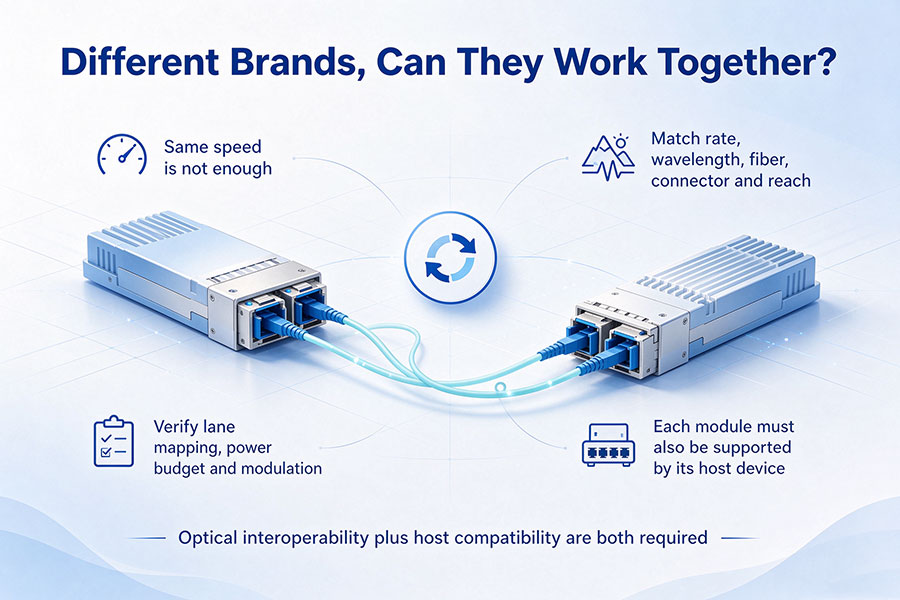
| System integration | OCS hardware, transceivers and network software must work together | Validate interfaces, port mapping and end-to-end interoperability |
These considerations explain why many practical deployments use a hybrid architecture. Electronic switches provide flexible packet forwarding, while OCS supplies reconfigurable optical connections for selected high-volume traffic.
13. Where Optical Circuit Switching Is Used
OCS is relevant to environments where large volumes of data move between a relatively defined set of network endpoints. Its deployment is not limited to AI training, although AI clusters have increased interest in the technology.
Hyperscale data centers: Reconfigurable connections between aggregation blocks help adapt network topology as traffic and infrastructure requirements change.
AI and machine learning clusters: Dedicated optical paths can support selected high-volume communication relationships between accelerator groups.
High-performance computing: Optical circuits can provide additional connectivity between computing and storage resources when communication patterns justify circuit allocation.
Data center campuses: Optical switching can support configurable connections between buildings or network facilities, subject to the equipment's reach and optical specifications.
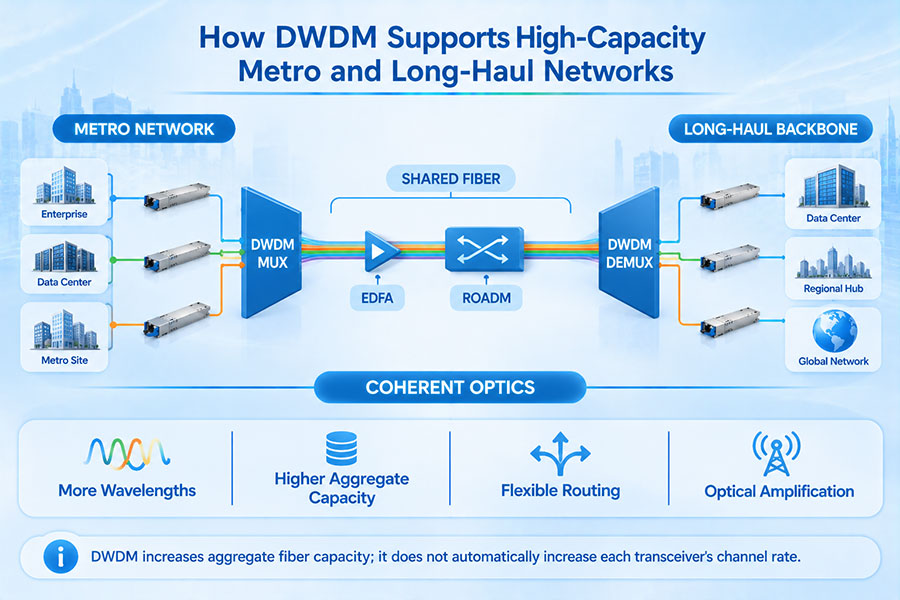
Optical transport networks: Optical cross-connects and related switching systems establish lightpaths across larger fiber networks.
The exact architecture differs across these applications. Data center OCS often focuses on reconfigurable connectivity between packet-switch blocks, while carrier optical transport uses wavelength routing, protection and restoration mechanisms over metro or long-haul infrastructure.
14. Optical Circuit Switching and the Future of Network Connectivity
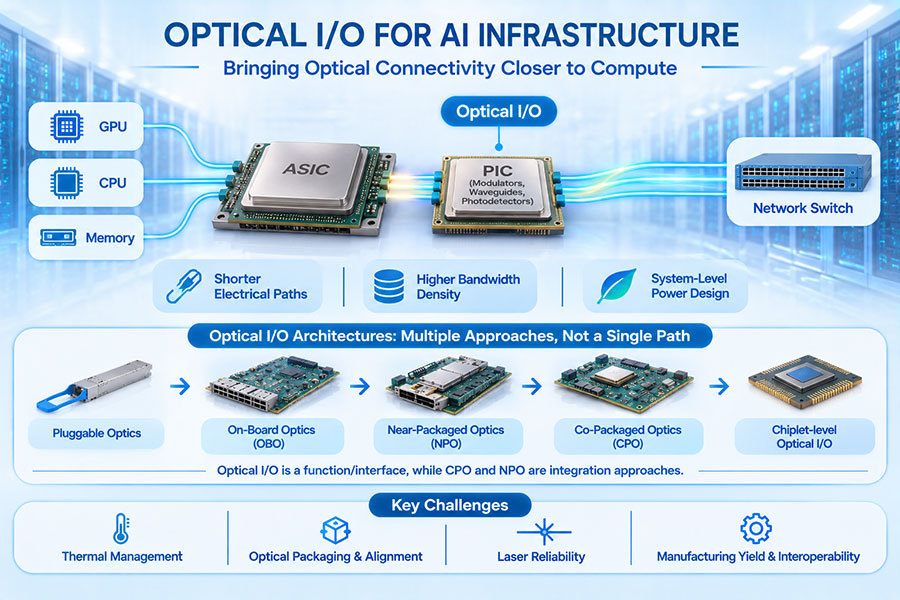
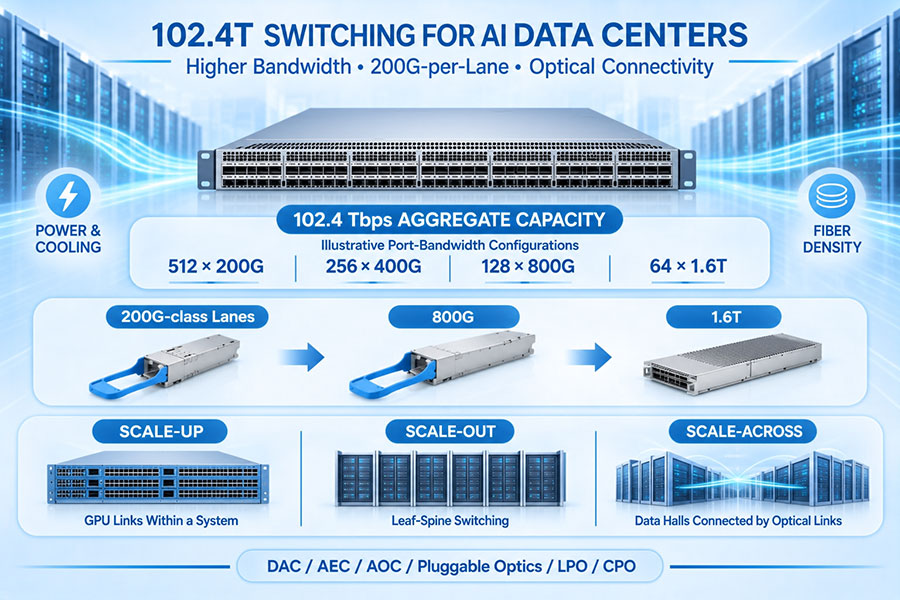
As data center bandwidth requirements increase, network architecture is becoming more diverse. Electronic packet switches remain essential for flexible forwarding, while high-speed optical transceivers and fiber links provide the physical capacity needed to connect distributed systems. OCS adds another layer by making selected optical connections configurable through software.
Future deployments will depend on improvements in optical port density, switching reliability, control software, telemetry and interoperability. Faster photonic technologies may also expand the range of traffic patterns that can benefit from optical reconfiguration.
For network architects, the key question is not whether optical switching can replace every electronic switch. It is whether particular traffic relationships are large and stable enough to justify a dedicated optical path. When that condition is met, OCS can provide a useful combination of bandwidth transparency, topology flexibility and reduced intermediate electrical processing.
C-LIGHT provides optical connectivity solutions for data center and telecommunications networks. Visit the optical transceiver portfolio for pluggable optical connectivity requirements, or Contact C-LIGHT to discuss network applications.
 >

 >
 >
 >
 >
 >
 >
 >