TEL:+86 132 6656 7067





An optical transceiver installed in an outdoor communication cabinet can experience conditions very different from those inside a temperature-controlled data center. In summer, sunlight, enclosed equipment racks and limited ventilation can raise internal temperatures. In winter, remote installations may be exposed to freezing conditions for extended periods. Under these circumstances, a conventional commercial-temperature optical module may operate outside its specified range even when the network equipment itself remains powered on.
An industrial temperature optical transceiver is designed to maintain its specified operating performance across a wider temperature range. A commonly used industrial temperature classification is -40°C to +85°C case temperature, compared with the typical commercial range of 0°C to +70°C.
These modules are used in industrial Ethernet, telecommunications, transportation, power distribution, outdoor wireless infrastructure and other networks where environmental conditions cannot always be controlled. Temperature qualification is an important part of their design, but selecting an industrial optical module also requires attention to wavelength, transmission distance, optical power, host compatibility and the environmental rating of the complete system.
1. What Is an Industrial Temperature Optical Transceiver?
An industrial temperature optical transceiver is a fiber optic communication module designed to operate within a specified temperature range that is wider than the range of a typical commercial-temperature module.
Its basic transmission function is the same as that of a standard optical transceiver. The transmitter converts electrical signals into optical signals, while the receiver converts incoming optical signals back into electrical signals. The main difference is the environmental operating range for which the module has been designed and qualified.
Industrial temperature modules are commonly specified for a case-temperature range of -40°C to +85°C. This wider range allows them to operate in equipment installed in locations without conventional heating, ventilation or air conditioning.
| Characteristic | Commercial Optical Transceiver | Industrial Temperature Optical Transceiver |
|---|---|---|
| Typical case-temperature range | 0°C to +70°C | -40°C to +85°C |
| Common installation | Temperature-controlled data centers and equipment rooms | Outdoor cabinets, industrial facilities and remote sites |
| Low-temperature capability | Limited to the specified commercial range | Designed for operation at substantially lower temperatures |
| High-temperature capability | Typically up to +70°C case temperature | Typically up to +85°C case temperature |
| Component requirements | Components qualified for the commercial operating range | Components and design qualified for a wider operating range |
| Typical application priority | Indoor network connectivity | Environmental operating margin and reliability in demanding locations |
The temperature ranges shown are commonly used classifications. Individual manufacturers may define or qualify their products differently, so the actual operating limits must always be confirmed using the specific module datasheet.
2. Commercial, Extended and Industrial Temperature Grades
Optical transceivers are commonly grouped into commercial, extended and industrial temperature categories. These classifications help network designers select modules according to the thermal conditions expected at the installation site.
| Temperature Grade | Typical Case-Temperature Range | Common Applications |
|---|---|---|
| Commercial (C-Temp / COM) | 0°C to +70°C | Data centers, enterprise switches and indoor network equipment |
| Extended (E-Temp / EXT) | -5°C to +85°C | Telecom equipment rooms, access networks and less-controlled installations |
| Industrial (I-Temp / IND) | -40°C to +85°C | Outdoor cabinets, industrial Ethernet, transportation and utility networks |
These are the classifications used in Cisco's published industrial optics guidance. Other manufacturers may define extended-temperature ranges differently. The term E-Temp should therefore not be treated as one universal specification across all suppliers.
Commercial temperature
Commercial-temperature modules are commonly specified from 0°C to +70°C case temperature. They are suitable for conventional indoor installations where network equipment operates in a relatively controlled environment.
Typical applications include data center racks, enterprise switching rooms, office networks and indoor fiber distribution systems.
Extended temperature
Extended-temperature modules provide additional environmental tolerance without necessarily covering the full industrial low-temperature range. A commonly referenced Cisco E-Temp range is -5°C to +85°C.
They can be appropriate for telecom equipment rooms, access network cabinets and installations where the temperature may exceed the commercial upper limit but does not regularly reach severe freezing conditions.
Industrial temperature
Industrial-temperature modules are commonly specified for -40°C to +85°C case operation. They are intended for installations where both low-temperature startup and elevated operating temperatures need to be considered.
This range is particularly relevant to outdoor telecommunications equipment, railway infrastructure, power substations, industrial automation and remote network nodes.
3. Case Temperature vs. Ambient Temperature
One of the most important details when selecting an industrial optical transceiver is the difference between ambient temperature and case temperature.
Ambient temperature refers to the temperature of the surrounding air near the equipment. Case temperature refers to the temperature measured at the specified location on the optical transceiver housing.
The two values are not necessarily the same. A switch or router generates heat, and the optical module also dissipates electrical power. Restricted airflow, high port density and nearby heat-producing components can cause the module case temperature to rise above the surrounding air temperature.
Cisco's industrial optics guidance also highlights this difference and uses approximately 20°C of additional case temperature as a practical rule of thumb in certain equipment deployments. Actual temperature rise depends on the host platform, module power consumption, airflow, port density and installation conditions.
| Temperature Parameter | Meaning | Why It Matters |
|---|---|---|
| Ambient temperature | Temperature of the surrounding air | Defines the environmental conditions around the network equipment. |
| Case temperature | Temperature measured at the specified point on the module housing | Determines whether the optical transceiver is operating within its rated case-temperature range. |
| Storage temperature | Permitted temperature range when the module is not operating | Defines storage and transportation limits, not live network operating capability. |
| Cold-start condition | Specified behavior when equipment starts at low temperature | Determines whether the module can initialize and carry traffic at the minimum temperature. |
Storage temperature and operating temperature must never be treated as interchangeable. A module may tolerate a particular temperature while powered off but require a different range for active optical transmission.
4. Why Industrial Optical Modules Need Different Designs
Wide-temperature operation places additional demands on the electronic and optical components inside a transceiver. Semiconductor devices, laser diodes, photodiodes, amplifiers and control circuits must maintain suitable performance across a broader temperature range.
Temperature changes can affect laser output, wavelength, receiver sensitivity, component bias current and electrical characteristics. If these parameters move beyond their permitted limits, the link may experience reduced optical margin, increased bit errors or unstable operation.
Component selection and qualification
Industrial-temperature designs use components selected and qualified for the intended operating range. Manufacturers may apply temperature screening, component binning and additional reliability evaluation to reduce the risk of performance variation at temperature extremes.
Thermal compensation
Some optical designs use temperature compensation techniques to maintain transmitter performance. Depending on the wavelength and module architecture, this may involve control circuitry or other optical and thermal design measures. Thermoelectric cooling is used in certain laser applications, but it is not a universal feature of every industrial optical transceiver.
Optical performance across temperature
The transmitter and receiver must remain within their specified performance limits throughout the operating range. Relevant parameters include:
Transmit optical power.
Center wavelength and wavelength stability.
Receiver sensitivity.
Receiver overload limit.
Laser bias current.
Extinction ratio and optical signal quality.
Bit error rate under the specified test conditions.
Passing a basic room-temperature functional test is not enough to demonstrate industrial-temperature qualification. The optical performance should be evaluated at relevant low- and high-temperature conditions according to the product's test specification.
5. What Happens When a Commercial Module Is Used in an Industrial Environment?
A commercial optical module may work normally when first installed in an outdoor network cabinet. However, if the case temperature later exceeds its rated range, its operating characteristics may no longer remain within the manufacturer's specifications.
The resulting issue may be intermittent rather than immediate. A connection can operate during moderate weather and develop errors only during periods of extreme heat or cold.
| Environmental Condition | Potential Optical Module Impact | Possible Network Symptom |
|---|---|---|
| Very low temperature | Component operating characteristics may shift outside qualified limits | Difficulty initializing or maintaining a stable link |
| High temperature | Laser, receiver and electronic component performance may change | Optical power variation or increased error rates |
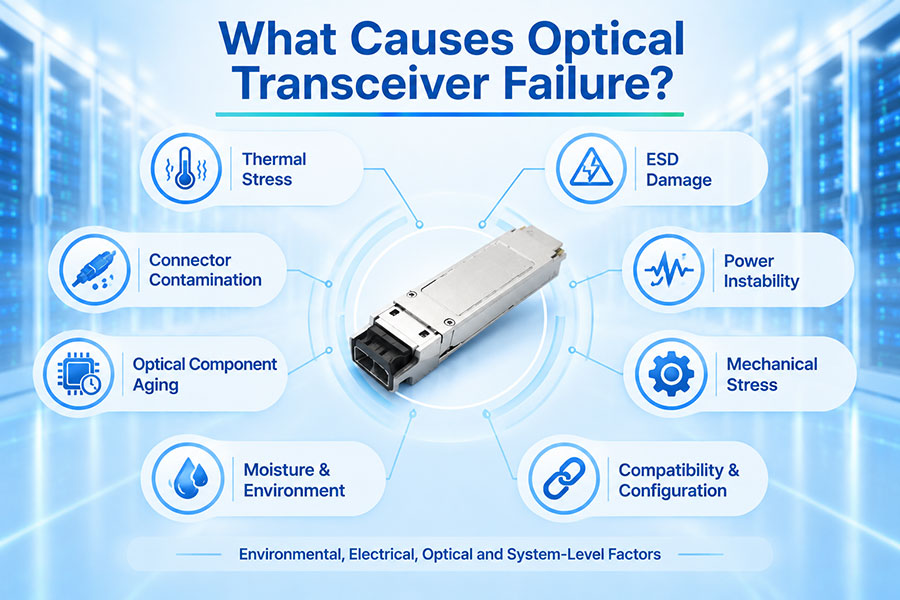
| Repeated temperature cycling | Thermal expansion and contraction stress components and connections | Intermittent faults or degradation over time |
| Limited cabinet airflow | Higher module case temperature | Temperature warnings, reduced operating margin or unexpected link issues |
These are potential failure mechanisms, not guaranteed outcomes. The actual response depends on the transceiver design, component specifications, operating duration and thermal environment.
Using an industrial-temperature module that matches the installation conditions helps reduce the risk of temperature-related optical faults. However, it does not eliminate failures caused by poor fiber connections, incorrect optical budgets, electrical problems or unsupported host configurations.
6. Key Specifications to Check Before Selecting an Industrial Optical Transceiver
Temperature grade is only one part of an optical transceiver specification. The selected module must also match the network interface, fiber infrastructure and transmission requirements.
| Specification | What to Verify | Deployment Consideration |
|---|---|---|
| Form factor | SFP, SFP+, SFP28, CSFP, QSFP+ or QSFP28 | Must match the host port and supported module type. |
| Data rate | 100M, 1G, 2.5G, 10G, 25G, 40G or higher | Must match the switch or router interface configuration. |
| Temperature range | Operating case-temperature limits | Must cover the expected thermal conditions. |
| Wavelength | 850nm, 1310nm, 1490nm, 1550nm or specified WDM channel | Must match the optical interface at the remote endpoint. |
| Fiber type | Multimode or single-mode | Must match the transceiver and installed fiber plant. |
| Transmission distance | Specified reach and optical budget | Must support the actual link distance and attenuation. |
| Connector | LC, SC, MPO/MTP or other specified interface | Must match the patch cord and equipment connection. |
| Power consumption | Maximum module power and host-port capability | Must remain within the host equipment's supported limits. |
| DOM/DDM | Temperature, voltage, bias current and optical power monitoring | Helps monitor module operating conditions when supported. |
| Host compatibility | Device model, port type and software version | Must be validated for the target switching or routing platform. |
Operating temperature and host compatibility are separate requirements
An industrial-temperature module is not automatically compatible with every industrial switch or router. The module may meet the required temperature range but still use a form factor, data rate, coding profile or optical standard that the host does not support.
For Cisco, Juniper, HPE, Nokia and other network platforms, check the exact device model and port requirements. For third-party modules, the compatibility result should be tied to the tested product and host configuration rather than assumed across an entire equipment family.
7. Applications of Industrial Temperature Optical Transceivers
Industrial-temperature optics are important wherever fiber connectivity must operate outside conventional temperature-controlled equipment rooms. Their applications span several infrastructure sectors.
Industrial Ethernet and factory automation
Factories use fiber networks to connect industrial switches, programmable logic controllers, sensors, monitoring systems and production equipment. Network devices may be installed near production machinery, in electrical cabinets or in facilities with limited cooling.
Industrial-temperature SFP and SFP+ modules can provide fiber connectivity between these devices while supporting the environmental conditions specified for the installation.
Outdoor telecommunications and 5G infrastructure
Cell sites, remote radio locations and outdoor aggregation cabinets often experience significant seasonal temperature changes. Fiber links connect radios, access equipment and transport networks, making wide-temperature optical modules important where equipment is not housed in a climate-controlled building.
Depending on the required interface, industrial optics may be available in 1G, 10G, 25G and other data-rate categories.
Railway and transportation networks
Railway communication systems support signaling, surveillance, passenger information, station networks and operational monitoring. Fiber links may extend along outdoor routes, trackside cabinets and tunnels where environmental conditions vary considerably.
Industrial-temperature modules help address thermal requirements for these distributed network installations. Other railway-specific environmental and safety requirements must still be evaluated separately.
Power utilities and substations
Electricity distribution networks use communication systems for substation automation, protection, monitoring and supervisory control. Optical connections may be installed in equipment cabinets with limited climate control.
Industrial-temperature transceivers can help maintain the required optical link performance across the expected temperature range. Electrical, electromagnetic compatibility and equipment certification requirements should also be checked for the relevant utility application.
Oil, gas, mining and remote infrastructure
Remote industrial facilities often have long fiber routes and equipment locations that are difficult to access. Network maintenance can require additional planning when a site is far from a service center.
Industrial optical modules are suitable for consideration in these applications when their temperature, optical, mechanical and environmental specifications match the actual installation conditions.
8. Reliability Testing for Industrial Temperature Optical Modules
An industrial temperature label should be supported by product-specific specifications and appropriate qualification evidence. A module that functions at room temperature has not automatically demonstrated reliable performance across its full rated range.
Industrial optical transceiver evaluation may include several test categories:
| Test Category | Purpose | Typical Evaluation |
|---|---|---|
| High-temperature operation | Verify operation at the upper temperature limit | Monitor optical power, wavelength, temperature and error performance. |
| Low-temperature operation | Verify operation at the lower temperature limit | Check startup behavior, optical output and receiver performance. |
| Temperature cycling | Evaluate performance through repeated temperature changes | Monitor functional and optical parameters across cycles. |
| High-temperature operating life | Evaluate reliability under sustained elevated-temperature conditions | Track changes in performance during the specified test period. |
| Humidity testing | Evaluate performance under specified humidity exposure | Check for degradation or failure under the defined test conditions. |
| ESD testing | Evaluate electrostatic discharge robustness | Check the product against the applicable ESD test requirements. |
| Optical performance testing | Verify that the optical interface meets its specifications | Measure Tx power, Rx sensitivity, wavelength and BER. |
Environmental qualification should be performed against the applicable product specification and test standards. A statement that a module uses industrial-grade components does not replace test evidence for the finished product.
For example, the C-LIGHT industrial CSFP product information identifies Telcordia GR-468-CORE reliability qualification and lists high-temperature operating life, damp heat, temperature cycling, humidity-bias and ESD evaluation. The exact qualification scope should be confirmed for the selected model and product revision.
9. DOM Monitoring and Temperature Management
Digital Optical Monitoring (DOM), also commonly called Digital Diagnostics Monitoring (DDM), provides information about the operating condition of supported optical transceivers.
Depending on the module and host implementation, monitoring data may include:
Module case temperature.
Supply voltage.
Laser bias current.
Transmit optical power.
Receive optical power.
Warning and alarm thresholds.
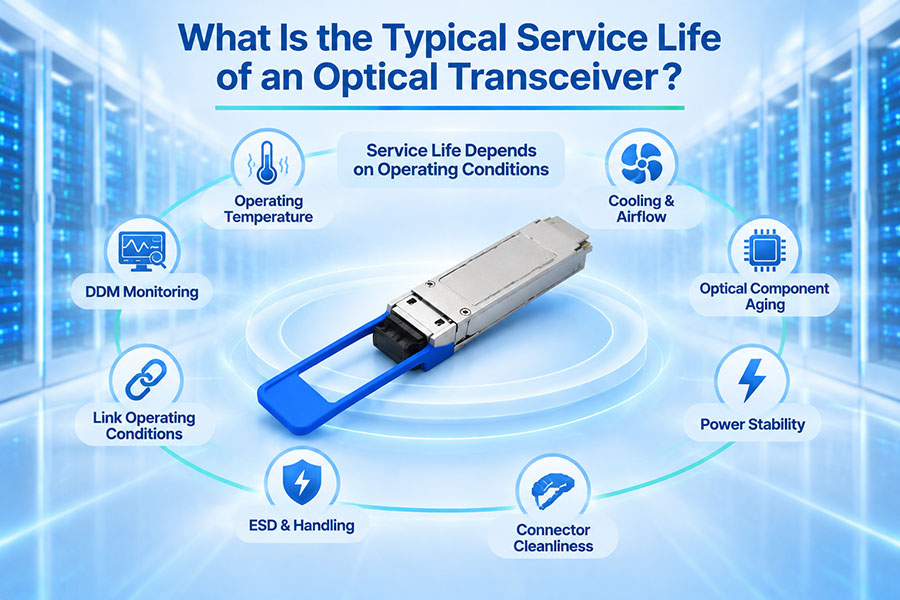
These readings can help operators identify when a module approaches or exceeds its specified operating limits. For example, a temperature warning can indicate that cabinet cooling or airflow needs attention before optical performance becomes unstable.
DOM is a monitoring function, not a substitute for industrial qualification. A module can report its temperature correctly while still being unsuitable for an environment outside its rated range.
Temperature management should also consider the complete equipment enclosure. Switch power consumption, port density, fan operation, air circulation, neighboring components and cabinet design all influence the temperature experienced by an optical transceiver.
10. C-LIGHT Industrial Temperature Optical Transceiver Solutions
C-LIGHT provides industrial-temperature optical transceiver solutions across several form factors and transmission categories. These products address different network speeds, fiber types and deployment distances.
Industrial temperature 40G QSFP+ modules
The C-LIGHT Industrial Temperature QSFP+ product range is designed for 40Gbps optical connectivity in demanding network environments. The published product information specifies an operating temperature range of -40°C to +85°C.
The product datasheet lists the following industrial QSFP+ models:
| Model | Data Rate | Optical Interface | Fiber Type | Distance | Temperature Range |
|---|---|---|---|---|---|
| CLQSFP40GLRM4I | 40G | 40G LRM4 | MMF | 200m | -40°C to +85°C |
| CLQSFP40GLR402I | 40G | 40G LR4 | SMF | 2km | -40°C to +85°C |
| CLQSFP40GLR410I | 40G | 40G LR4 | SMF | 10km | -40°C to +85°C |
| CLQSFP40GER440I | 40G | 40G ER4 | SMF | 40km | -40°C to +85°C |
| CLQSFP40GER460I | 40G | 40G ER4 | SMF | 60km | -40°C to +85°C |
These modules are intended for applications such as industrial Ethernet, telecom networks, transportation and outdoor communication infrastructure. The exact link budget, optical performance and host compatibility should be checked against the product datasheet for each model.
Industrial CSFP optical transceivers
The C-LIGHT Industrial CSFP product range covers 1.25G, 2.5G and 10G product categories, with commercial and industrial temperature options described in its product information.
The industrial versions are specified for -40°C to +85°C operation. The product range is relevant to access networks, industrial Ethernet, communication infrastructure and fiber distribution systems where compact transceiver density is important.
CSFP is a distinct form factor and should not be confused with standard SFP. Before selecting a module, verify the host port type, number of optical channels, wavelength configuration and supported data rate.
Industrial multi-rate DWDM SFP and SFP+ modules
For long-distance transmission and wavelength division multiplexing applications, C-LIGHT's industrial multi-rate DWDM module series supports 1G, 2.5G, 4G, 8G, 10G and 12G rate categories.
The product information describes optional -40°C to +85°C case-temperature configurations, fixed or tunable C-band wavelengths, and transmission distances of 40km, 80km, 100km and 120km over G.652 single-mode fiber.
These modules are relevant to 5G fronthaul, telecom aggregation, industrial private networks and long-distance WDM transmission. The precise rate, wavelength, channel spacing, temperature grade and link budget depend on the selected configuration.
For industrial deployments, C-LIGHT's product-specific specifications should be reviewed together with the host equipment requirements. Compatibility, temperature qualification and optical performance should be confirmed for the exact part number rather than inferred from a product-family description.
11. How to Select the Right Industrial Temperature Optical Module
The best module is not necessarily the one with the widest published temperature range. It is the module that matches the actual environment, optical link and host equipment.
A practical selection process begins with the expected thermal conditions. Measure or estimate the ambient temperature around the equipment and account for internal cabinet heating. Then determine the required operating case-temperature range.
Next, match the optical requirements:
Select the correct SFP, SFP+, CSFP, QSFP+ or other form factor.
Confirm the required Ethernet or transport data rate.
Choose the appropriate wavelength and optical architecture.
Match multimode or single-mode fiber to the selected module.
Verify the transmission distance and optical power budget.
Check the host device, software release and module compatibility.
Review DOM support and available environmental qualification evidence.
Where a network is critical to industrial operations, the complete installation should also be evaluated. An industrial-temperature optical module cannot compensate for a commercial-rated switch, an unsuitable enclosure or inadequate thermal management elsewhere in the network.
12. Conclusion
An industrial temperature optical transceiver is designed to maintain its specified optical and electrical performance across a wider operating temperature range than a conventional commercial module. A commonly used industrial classification is -40°C to +85°C case temperature, making these modules suitable for outdoor cabinets, industrial Ethernet, transportation, utility networks and other demanding installations.
Choosing the correct module involves more than checking its temperature rating. Engineers should distinguish ambient temperature from case temperature, verify cold-start behavior where relevant, and evaluate wavelength, fiber type, reach, optical power, DOM capability and host compatibility.
C-LIGHT offers industrial-temperature optical solutions in 40G QSFP+, CSFP and multi-rate DWDM product categories. By matching the exact module specifications to the network environment, operators can build fiber links that are better suited to the thermal and transmission requirements of industrial infrastructure.
Looking for industrial temperature optical transceivers for outdoor or harsh-environment networks?
C-LIGHT provides industrial optical module options across different data rates, wavelengths, form factors and transmission distances, along with technical support for product selection and compatibility evaluation.
 >

 >
 >
 >
 >
 >
 >
 >