TEL:+86 132 6656 7067





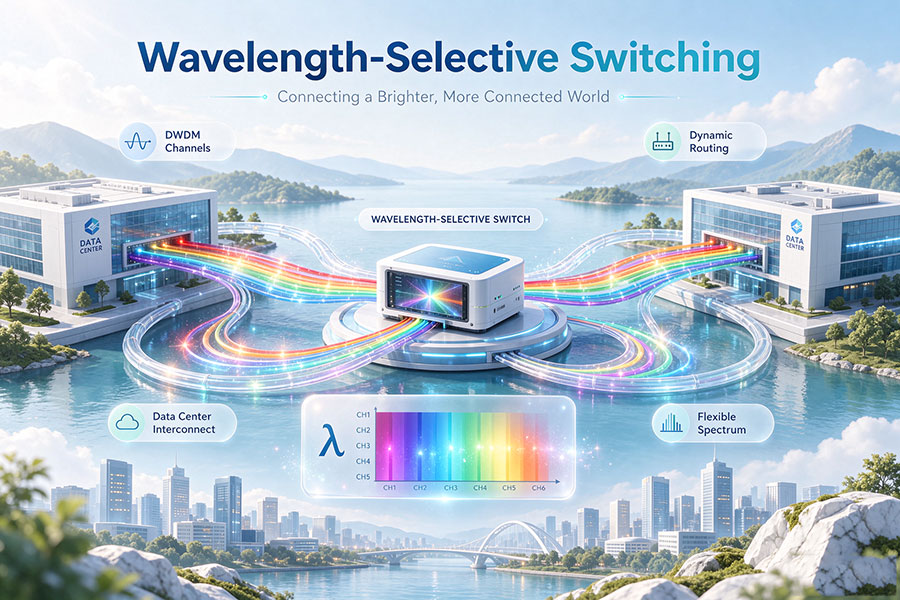
Data center interconnect (DCI) networks increasingly need to allocate optical capacity according to changing traffic patterns, service priorities and available fiber resources. Wavelength-selective switching provides a way to redirect individual DWDM channels between optical paths without rebuilding the physical fiber infrastructure. By combining wavelength-level routing with software-controlled network management, operators can provision capacity more flexibly across data centers, metropolitan facilities and regional sites.
1. Why Dynamic DCI Needs Wavelength-Selective Switching
Traditional DCI deployments often use fixed optical paths. Transponders, mux/demux equipment and fiber connections are configured for specific destinations, with capacity assignments remaining relatively stable even when traffic demand changes. This approach is straightforward to operate, but it can leave some wavelengths underused while other routes approach their available capacity.
Dynamic DCI introduces a different operational model. Network capacity can be reassigned as traffic demand changes, new data center sites come online or existing links require maintenance. Wavelength-selective switching supports this model by allowing individual optical channels to be directed toward different output fibers or network directions.
Typical applications include:
Inter-data-center replication: Reassigning optical capacity as backup and storage traffic changes between sites.
Cloud and enterprise connectivity: Provisioning high-capacity optical paths for changing customer requirements.
AI and high-performance computing: Connecting geographically distributed compute and storage facilities with scalable optical transport.
Disaster recovery: Redirecting selected services through alternative optical routes when a network segment becomes unavailable.
Capacity expansion: Activating additional wavelengths without replacing the entire fiber route.
2. How Wavelength-Selective Switching Works
A wavelength-selective switch (WSS) receives a wavelength-division multiplexed optical signal containing multiple channels. It separates the wavelengths spatially inside the device, directs selected channels toward designated output ports and recombines them into output optical signals.
Unlike an electronic packet switch, a conventional WSS does not need to decode Ethernet frames or inspect IP addresses. Its switching decision is made at the optical wavelength level. The payload remains in the optical domain while passing through the switching element.
A typical WSS includes several functional elements:
Optical input and wavelength separation: Incoming WDM signals are dispersed into individual wavelength components, commonly using diffraction-based optics.
Switching element: A spatial light modulator, such as liquid crystal on silicon (LCoS), or another optical steering technology changes the path of selected wavelength channels.
Output routing: Each selected wavelength is directed toward a configured output port.
Optical recombination: Routed wavelengths are combined into the outgoing fiber signal.
Power control: Per-channel attenuation can help equalize optical power across channels and output paths.
MEMS-based and LCoS-based implementations are established WSS technology approaches. Their optical designs, port configurations, switching characteristics and spectrum-control capabilities differ. The appropriate implementation depends on network scale, channel plan and operational requirements.
3. WSS, DWDM and ROADM in a DCI Architecture
Wavelength-selective switching is closely associated with dense wavelength-division multiplexing (DWDM) and reconfigurable optical add-drop multiplexers (ROADMs), but these technologies perform different functions.
| Technology | Primary function | Role in DCI |
|---|---|---|
| DWDM | Combines multiple optical wavelengths onto one fiber. | Increases the capacity carried by existing fiber infrastructure. |
| WSS | Routes individual wavelengths between optical ports and controls channel power. | Provides wavelength-level path selection and flexible spectrum allocation. |
| ROADM | Adds, drops and express-routes optical channels at network nodes. | Enables remotely reconfigurable optical connectivity across multiple sites. |
| Optical transponder | Converts client signals into optical transport signals and performs line-side functions. | Provides the transmission interface for Ethernet and other client services. |
| Optical amplifier | Compensates for optical loss along transmission paths. | Supports longer fiber routes and multi-span transport systems. |
A WSS is commonly deployed as a building block inside a ROADM. The ROADM combines wavelength switching with add/drop interfaces, multiplexing functions and network control. This allows a DCI operator to manage optical channels across multiple directions rather than relying on fixed point-to-point wavelength connections.
For example, a regional DCI node may receive a DWDM signal from one data center, route selected wavelengths toward a second site and allow other channels to continue toward a third site. Local add/drop ports can connect additional transponders without requiring every wavelength to terminate at the same location.
4. Wavelength Routing and Dynamic Path Allocation
Dynamic wavelength routing involves selecting an available optical path for a service while respecting the physical and spectral constraints of the network. A connection request is not simply a matter of choosing an unused wavelength. The selected channel must be available along the complete route and meet the transmission requirements of the optical system.
Network controllers typically consider several factors:
Route availability: Whether a continuous physical path exists between the source and destination.
Wavelength availability: Whether the required frequency slot is free on every relevant fiber segment.
Spectrum continuity: Whether the same wavelength or frequency slot can be maintained across the route when wavelength conversion is unavailable.
Optical performance: Whether accumulated loss, filtering, dispersion and optical signal-to-noise ratio remain within the receiver's operating requirements.
Resource contention: Whether another service already occupies the required wavelength or switching resource.
Protection requirements: Whether a suitable alternative path and sufficient spectrum are available for recovery.
These constraints are part of the routing and wavelength assignment (RWA) problem. In flexible-grid systems, the allocation problem also includes the width and position of the frequency slot, rather than only a fixed channel number.
5. Fixed Grid and Flexible Grid Spectrum Management
Traditional DWDM systems commonly use fixed channel spacing, such as 50 GHz or 100 GHz. This simplifies planning and provides a predictable frequency arrangement, but it can limit how efficiently spectrum is assigned to services with different transmission requirements.
Flexible-grid optical networks allow channel slots to use different spectral widths and center frequencies within the supported optical band. This is particularly relevant for high-baud-rate coherent signals and superchannels that may require more spectrum than a conventional fixed-grid channel.
| Characteristic | Fixed-grid DWDM | Flexible-grid DWDM |
|---|---|---|
| Channel spacing | Defined fixed spacing, such as 50 GHz. | Configurable frequency slots based on a supported grid. |
| Spectrum allocation | Channels occupy predetermined spectral positions. | Slot width and center frequency can be assigned dynamically. |
| Bandwidth matching | May reserve more spectrum than some services need. | Can better match spectrum allocation to signal requirements. |
| Planning complexity | Relatively straightforward channel planning. | Requires more detailed spectrum and interference management. |
| Typical use | Established DWDM systems with stable channel plans. | Flexible coherent transport and dynamically provisioned optical networks. |
Flexible-grid capability does not mean that spectrum can be assigned without constraints. Guard bands, filter passband characteristics, adjacent-channel interference and transponder specifications still determine how closely channels can be placed.
6. Optical Performance Constraints in Dynamic Switching
Every switching element introduces optical characteristics that must be considered when planning a route. A path that is logically available may still be unsuitable if its accumulated optical impairments exceed the receiver's tolerance.
Insertion loss
Insertion loss represents the reduction in optical power caused by a device or connection. WSS modules, connectors, patch panels, multiplexers and other optical components all contribute to the end-to-end loss budget. Additional switching stages can reduce the available power margin.
Passband narrowing and filtering effects
Optical filters have finite passbands. When a signal passes through multiple filtering stages, the combined filtering response can narrow the usable bandwidth or distort the signal spectrum. This becomes especially important for high-baud-rate coherent signals and tightly spaced channels.
Optical signal-to-noise ratio
Amplifiers compensate for transmission loss but also introduce amplified spontaneous emission noise. The accumulated OSNR must remain sufficient for the selected modulation format, baud rate and FEC configuration.
Channel power equalization
Different optical paths may have different losses. Per-channel attenuation and power monitoring help maintain a balanced signal level, reducing the risk of some channels becoming excessively strong or weak relative to others.
Wavelength and frequency accuracy
Transmitter frequency stability, WSS filter alignment and the assigned frequency slot must be compatible. Frequency deviations can reduce the effective passband margin, especially in flexible-grid deployments.
7. Dynamic DCI Control and Automation
WSS hardware provides the physical switching capability, but a dynamic DCI network also needs a control system to coordinate routing, resource allocation and device configuration.
A typical control workflow includes:
Service request: An application or network operator requests a new connection, capacity change or restoration path.
Topology discovery: The controller collects information about fiber links, optical nodes, WSS ports and available spectrum.
Path computation: A routing engine evaluates candidate routes against wavelength, spectrum and optical-performance constraints.
Resource reservation: The selected route and frequency slot are reserved to prevent conflicting assignments.
Device configuration: The controller sends configuration instructions to the relevant WSS and ROADM nodes.
Service verification: Optical power, signal quality and endpoint status are checked before the service is considered operational.
Continuous monitoring: Telemetry and alarms support ongoing optimization and fault response.
Control-plane and management-plane technologies can provide different levels of automation. GMPLS-based approaches, software-defined networking (SDN) controllers and transport network management systems may all play a role, depending on the operator's architecture.
Standards-based information models are important because they help controllers represent wavelength labels, port restrictions and switching constraints consistently across network equipment.
8. Protection, Restoration and Network Resilience
Dynamic wavelength switching can support network restoration by moving services onto alternative optical paths when a fiber span or network node becomes unavailable. However, switching capability alone does not guarantee successful recovery. The alternate route must have sufficient spectrum, acceptable optical performance and compatible endpoint interfaces.
Protection planning generally considers:
Dedicated protection: Capacity is reserved in advance for a backup path.
Shared protection: Multiple services share backup resources under defined failure assumptions.
Restoration: The controller computes and configures an alternative path after a failure is detected.
Path diversity: Primary and backup routes avoid common-risk fiber ducts, facilities or intermediate nodes where required.
Recovery coordination: Optical switching, transponder behavior and higher-layer routing must be coordinated to avoid inconsistent service states.
Restoration time depends on fault detection, control-plane processing, path computation, device configuration and endpoint recovery. It should be measured across the complete service rather than inferred from the WSS switching time alone.
9. WSS Deployment Considerations for High-Capacity DCI
As DCI systems move toward higher per-wavelength capacity, the optical switching layer must accommodate more demanding signal characteristics and more complex spectrum plans. The following areas deserve attention during architecture design.
| Design area | Key consideration | Operational impact |
|---|---|---|
| Port count | Number of network directions, add/drop ports and expansion requirements. | Determines switching capacity and node scalability. |
| Frequency-slot resolution | Supported flexible-grid granularity and channel-width control. | Affects spectrum efficiency and service compatibility. |
| Insertion loss | WSS loss and cumulative path loss. | Influences amplifier placement and optical margin. |
| Passband performance | Filter shape, bandwidth and cascading effects. | Impacts high-baud-rate signal transmission. |
| Power management | Channel attenuation and output power balance. | Supports stable operation across different routes. |
| Control integration | Management interfaces, telemetry and automation support. | Determines how efficiently paths can be provisioned and maintained. |
| Reliability | Redundancy, fault monitoring and component serviceability. | Influences availability and recovery procedures. |
It is also important to distinguish optical switching capability from transponder compatibility. A WSS may route a wavelength without understanding the client protocol, but the transmitting and receiving equipment must still support the signal's line rate, modulation, frequency range and optical power requirements.
10. WSS and the Evolution of AI Data Center Interconnects
AI infrastructure is increasing the importance of high-capacity connections between geographically separated data center facilities. Training datasets, model checkpoints, distributed storage, inference services and replicated applications can create substantial traffic between sites.
Wavelength-selective switching can help operators allocate optical capacity to these changing requirements. For example, a network may provision additional wavelength channels between two facilities during a planned data migration, then reassign available spectrum to other services after the transfer is complete.
However, WSS-based DCI should not be confused with optical circuit switching inside an AI cluster. A ROADM-based WSS generally operates within a DWDM transport system, routing wavelength channels across optical network links. Cluster-level optical circuit switching may instead establish direct optical connections between selected endpoints or switching fabrics. The two approaches operate at different network layers and have different switching requirements.
For inter-site AI traffic, coherent transponders, DWDM line systems, optical amplifiers and WSS-based ROADMs can work together to provide high-capacity transport. The best architecture depends on distance, fiber availability, traffic predictability, required protection and the economics of the optical infrastructure.
11. Limitations and Engineering Trade-Offs
Wavelength-selective switching improves optical network flexibility, but it also introduces engineering and operational considerations.
Equipment cost: WSS-based ROADM nodes require optical switching hardware, control interfaces and associated monitoring functions.
Power budget: Additional optical components can increase path loss and may require careful amplifier planning.
Control complexity: Dynamic provisioning requires accurate topology, spectrum inventory and device-state information.
Contention: Multiple services may request the same wavelength or output resource, requiring coordinated allocation.
Optical impairments: Cascaded filters and amplifiers can affect signal quality, particularly on demanding coherent links.
Interoperability: Transponders, ROADMs and controllers must support compatible frequency plans, interfaces and management models.
Operational validation: Reconfiguration must be followed by service verification to confirm that the intended path is functioning correctly.
For relatively small DCI networks with stable traffic, fixed DWDM mux/demux systems may remain more economical and easier to operate. WSS-based switching becomes more attractive when the value of remote provisioning, route flexibility, spectrum reuse and network scalability justifies the additional complexity.
12. Conclusion
Wavelength-selective switching provides a foundation for dynamic optical connectivity in modern data center interconnects. By routing individual DWDM channels between network directions, WSS-based ROADMs allow operators to adjust optical paths, allocate spectrum and support service restoration without manually rebuilding every fiber connection.
Successful deployment depends on more than switching hardware. Spectrum continuity, filter performance, insertion loss, OSNR, transponder compatibility and automated control must be considered together. As data center traffic becomes more distributed and capacity requirements continue to evolve, wavelength-selective switching offers a practical way to make optical transport networks more adaptable while retaining the capacity and reach advantages of DWDM.
Evaluate optical transceiver interfaces, transmission distances and link requirements for your DCI deployment. Contact C-LIGHT
 >

 >
 >
 >
 >
 >
 >
 >