TEL:+86 132 6656 7067





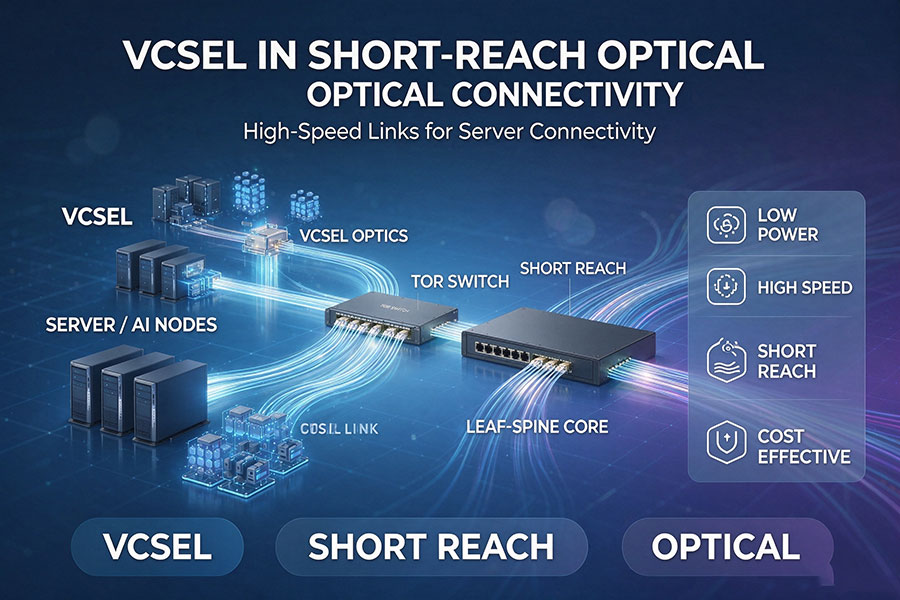
Short-reach optical connectivity is a fundamental part of modern data center infrastructure. Connections between servers, top-of-rack switches and high-density switching systems often require substantial bandwidth over distances where multimode fiber can provide a practical and cost-efficient alternative to single-mode solutions. Vertical-cavity surface-emitting laser (VCSEL) technology has played a central role in this environment by enabling compact, low-power optical transmitters that work with multimode fiber. Its development from early 10G links to 25G, 50G and 100G-per-lane applications has helped support successive generations of Ethernet connectivity. As AI clusters increase the demand for short-reach bandwidth, VCSEL technology is also attracting attention for higher-speed optical interfaces and integrated optical engines.
1. Why VCSEL Technology Matters in Short-Reach Networks
Data centers contain large numbers of short-distance connections. Server network interfaces connect to access switches, switches connect to aggregation layers, and high-performance computing systems require extensive internal network links. Although individual connections may cover only several meters or tens of meters, their combined bandwidth and port count can be substantial.
VCSEL-based transceivers are widely used in these applications because they combine several useful characteristics:
Low power consumption: VCSELs can operate efficiently at the optical output levels required by many short-reach links.
Direct modulation: Electrical drive current can directly modulate the emitted light, allowing relatively simple transmitter architectures.
Compact structure: Their vertical-emission geometry supports dense laser arrays and integration into compact optical engines.
Multimode fiber compatibility: VCSELs are well suited to short-reach transmission over laser-optimized multimode fiber.
Manufacturing efficiency: Wafer-level fabrication and testing can support repeatable production and cost-effective volume manufacturing.
These properties make VCSEL technology particularly relevant to short-reach links where power, cost, port density and installation efficiency are important. It does not replace every optical transmitter technology, but it provides a strong solution for a defined range of data center applications.
2. What Is a Vertical-Cavity Surface-Emitting Laser?
A vertical-cavity surface-emitting laser is a semiconductor laser that emits light perpendicular to the surface of its wafer. This differs from an edge-emitting laser, where light travels parallel to the wafer surface and exits through a cleaved or processed edge.
The VCSEL structure contains an active region positioned between two distributed Bragg reflector (DBR) mirrors. When an appropriate electrical current is applied, carriers recombine in the active region and generate photons. Optical feedback between the mirrors supports laser oscillation, producing light that exits through the surface of the device.
The short resonant cavity and vertical emission geometry give VCSELs several advantages for optical communication. Devices can be fabricated and tested in arrays, and their emission can be coupled into multimode fiber using compact optical assemblies.
Main structural elements
| Component | Function | Importance in optical transmission |
|---|---|---|
| Active region | Generates photons through carrier recombination | Determines important laser characteristics, including gain and modulation behavior |
| Distributed Bragg reflectors | Provide optical feedback within the vertical cavity | Support laser oscillation and control the optical cavity |
| Current confinement structure | Restricts current flow to the active emission region | Helps control threshold current and optical efficiency |
| Oxide aperture | Provides electrical and optical confinement in common VCSEL designs | Influences current distribution, mode behavior and device performance |
| Contact layers | Provide electrical connections for laser operation | Deliver the drive current required for direct modulation |
VCSEL manufacturing can use wafer-level processing, allowing multiple devices to be produced and tested before final assembly. This is particularly useful for parallel optical modules that require several matched transmitter channels.
3. How VCSELs Generate and Modulate Optical Signals
In a typical VCSEL-based transmitter, an electrical data signal controls the current supplied to the laser. Changes in drive current alter the optical output, encoding information onto the emitted light. The resulting optical signal is coupled into multimode fiber and transmitted toward the receiver.
For NRZ modulation, the transmitter uses two primary signal levels to represent binary data. PAM4 uses four optical amplitude levels and carries two bits per symbol, allowing a higher data rate without requiring the symbol rate to increase by the same proportion as the bit rate.
As signaling speeds rise, the VCSEL must respond to faster current changes while maintaining suitable optical power, extinction ratio, linearity and signal quality. The driver circuit must also provide the required modulation current without introducing excessive noise or distortion.
Important transmitter characteristics include:
Modulation bandwidth: Determines how quickly the laser can respond to changes in the electrical drive signal.
Threshold current: The current level at which laser oscillation begins.
Slope efficiency: Describes the change in optical output power relative to the change in drive current above threshold.
Relative intensity noise: Measures fluctuations in optical intensity that can affect signal quality.
Extinction ratio: Indicates the optical power contrast between signal levels.
Temperature stability: Determines how consistently the device performs as operating temperature changes.
These parameters must be considered together. Increasing modulation speed alone does not guarantee a reliable link if optical power, noise, receiver sensitivity or fiber bandwidth becomes the limiting factor.
4. Why VCSELs Are Commonly Used at 850 nm
The 850 nm wavelength is widely associated with short-reach VCSEL-based optical communication. It is supported by a mature ecosystem of multimode fiber, optical connectors, transceiver components and test equipment.
Laser-optimized multimode fibers such as OM3 and OM4 are designed to support high-speed transmission at wavelengths around 850 nm. Their graded-index core helps control modal dispersion, allowing multiple optical modes to propagate while maintaining a usable bandwidth-distance performance.
Using 850 nm VCSELs with multimode fiber offers several practical advantages:
A mature supply chain for lasers, photodetectors, fiber and transceiver assemblies.
Compatibility with established short-reach Ethernet applications.
Compact optical coupling arrangements for parallel transmission.
Potential reuse of existing multimode fiber infrastructure when the installed fiber and link loss meet the new interface requirements.
However, 850 nm is not the only wavelength used in VCSEL-based systems. Some multimode bidirectional and short-wavelength-division-multiplexing designs use additional wavelengths to increase capacity over a smaller number of fiber strands.
5. VCSEL Technology and Multimode Fiber
Multimode fiber has a larger core than conventional single-mode fiber. A typical multimode fiber has a nominal 50 μm core, allowing multiple optical modes to propagate. This makes it suitable for coupling with VCSEL transmitters and helps simplify optical alignment in short-reach applications.
Different multimode fiber grades provide different bandwidth-distance characteristics. OM3, OM4 and OM5 are commonly used in data center environments, with OM4 and OM5 offering higher bandwidth performance than OM3 under their specified conditions.
| Fiber type | Core / cladding | General characteristics | Common application context |
|---|---|---|---|
| OM3 | 50/125 μm | Laser-optimized multimode fiber with a defined minimum modal bandwidth at 850 nm | Established short-reach data center links |
| OM4 | 50/125 μm | Higher specified 850 nm modal bandwidth than OM3 | Higher-speed and longer-reach multimode links |
| OM5 | 50/125 μm | Wideband multimode fiber specified for multiple short wavelengths | Applications using suitable short-wavelength multiplexing systems |
Fiber selection should be based on the optical interface specification, not simply the fiber category. The required reach depends on data rate, modulation format, transmitter characteristics, receiver performance, connector loss and the fiber's bandwidth-distance properties.
Multimode fiber also has a practical limitation: modal dispersion. Different optical modes travel through the fiber along different paths and can arrive at different times. This broadens the received signal and can cause inter-symbol interference at high data rates. Laser-optimized fiber and controlled VCSEL launch conditions help manage this effect, but the available link margin becomes more demanding as signaling rates increase.
6. The Evolution of VCSEL-Based Ethernet Connectivity
VCSEL technology has supported multiple generations of short-reach Ethernet. As Ethernet rates increased, improvements in laser modulation, receiver bandwidth, signal processing and multimode fiber enabled higher data rates over established optical cabling systems.
| Ethernet generation | Representative multimode interface | VCSEL technology role |
|---|---|---|
| 10G | 10GBASE-SR | Established 850 nm VCSEL transmission for short-reach multimode links |
| 40G | 40GBASE-SR4 | Parallel optical transmission using multiple VCSEL channels |
| 100G | 100GBASE-SR4 | Four-lane parallel transmission over multimode fiber |
| 400G | 400GBASE-SR8 and other multimode implementations | Higher lane counts and faster VCSEL channels support aggregate bandwidth growth |
| 800G | 800GBASE-SR8 | 100G-per-lane signaling extends VCSEL-based multimode connectivity |
This table lists representative standardized multimode Ethernet interfaces. Exact lane mapping, connector requirements and supported reach depend on the specific PHY and fiber grade.
IEEE 802.3db and IEEE 802.3df established important multimode Ethernet interfaces using 100G-per-lane signaling. These developments are relevant to AI data center networks, where short-reach multimode links can provide an alternative to some single-mode optical configurations.
The next development step is higher per-wavelength capacity. In July 2025, the IEEE 802.3 Working Group considered a call for interest in 200 Gb/s-per-wavelength multimode fiber optical PHYs. This activity reflects interest in extending VCSEL-MMF technology toward future 200G-per-lane applications, but a call for interest is not itself a completed Ethernet standard or proof that every proposed interface is commercially deployed.
7. Parallel Optical Transmission and VCSEL Arrays
One of the strongest advantages of VCSEL technology is its suitability for array-based optical transmission. A single module can contain multiple VCSEL devices, with each laser transmitting an independent data channel through a corresponding fiber.
Parallel optical transmission increases aggregate bandwidth by using multiple optical lanes rather than requiring one laser to carry the entire data rate. For example, a four-lane architecture can combine four optical channels into a single high-speed interface, while an eight-lane design uses more channels to achieve a higher aggregate capacity.
Parallel transmission offers several benefits:
Multiple channels can operate at the same nominal wavelength.
Optical components can be replicated in a structured array.
High aggregate bandwidth can be achieved without requiring wavelength multiplexing in every lane.
Manufacturing and testing can be organized around repeatable optical channel assemblies.
The trade-off is fiber count. Parallel interfaces typically require multiple transmit and receive fibers, often connected through MPO-family connectors. This makes fiber polarity, connector cleanliness and cable management important parts of deployment.
8. VCSEL-Based Transceiver Architectures
VCSEL technology can be used in several optical module architectures. The selected design depends on the required aggregate data rate, number of optical lanes, fiber infrastructure and connector arrangement.
SR4 and SR8 parallel optics
SR4 and SR8 architectures use multiple optical lanes for transmission and reception over multimode fiber. Each lane uses a VCSEL transmitter at the sending end and a corresponding photodetector channel at the receiving end. Multi-fiber connectors support the parallel optical paths.
Multimode bidirectional optics
Some bidirectional multimode designs use two wavelengths, commonly around 850 nm and 910 nm, to transmit and receive signals over a duplex multimode fiber connection. Wavelength-selective optical components separate the two directions. This can reduce the number of fiber strands required compared with conventional parallel interfaces.
Short-wavelength-division-multiplexing optics
Short-wavelength-division-multiplexing (SWDM) systems use multiple wavelengths over multimode fiber. VCSELs operating at different wavelengths provide separate channels that are combined or separated by optical multiplexers and demultiplexers.
| Architecture | Optical approach | Fiber arrangement | Main consideration |
|---|---|---|---|
| SR4 | Parallel VCSEL channels | Multiple transmit and receive fibers | Fiber count and polarity |
| SR8 | Higher-count parallel VCSEL channels | More parallel fiber paths | Connector density and cable management |
| Multimode BiDi | Two wavelengths for bidirectional transmission | Duplex multimode fiber | Wavelength isolation and link budget |
| SWDM | Multiple short wavelengths multiplexed over fiber | Duplex multimode fiber in representative designs | Multiplexer loss and wavelength performance |
These architectures should not be treated as interchangeable. Their optical lane mapping, wavelengths, connector types and interoperability requirements differ. The module datasheet and host platform documentation should determine the correct cabling arrangement.
9. VCSEL Compared with DFB and EML Laser Technologies
VCSEL, distributed-feedback (DFB) and electro-absorption modulated laser (EML) technologies are used in different optical transmission environments. Their differences relate to cavity structure, wavelength characteristics, modulation method, optical performance and manufacturing approach.
| Characteristic | VCSEL | DFB laser | EML |
|---|---|---|---|
| Emission structure | Vertical cavity, surface emission | Edge-emitting laser with distributed feedback | Integrated laser and electro-absorption modulator |
| Common wavelength context | 850 nm for multimode short reach | Commonly 1310 nm or other application-specific wavelengths | Commonly used in high-speed single-mode applications |
| Modulation | Direct current modulation | Direct modulation in suitable designs | Separate electro-absorption modulation |
| Fiber application | Primarily multimode fiber in mainstream data center products | Primarily single-mode fiber in many data communication products | Single-mode fiber in high-speed and longer-reach applications |
| Typical strength | Low-cost, compact short-reach transmission | Wavelength control and single-mode transmission | High-speed modulation and performance over demanding optical links |
VCSELs are attractive where multimode fiber and short transmission distances are suitable. DFB and EML technologies are more commonly used in single-mode applications requiring different reach, wavelength and optical performance characteristics.
The choice is therefore not a simple ranking of one laser as better than another. A VCSEL may be the more economical solution for a short multimode link, while an EML or DFB-based transmitter may be more appropriate for a single-mode link requiring a different reach or optical budget.
10. Signal Integrity and Link Budget Considerations
High-speed VCSEL links require careful control of both optical and electrical signal quality. A transmitter may meet its nominal output-power specification while the complete link still fails because of fiber bandwidth, connector loss, modal behavior or receiver limitations.
Important parameters include:
Transmitter optical power: The optical power launched into the fiber must satisfy the interface specification.
Receiver sensitivity: The receiver must detect the incoming signal at the required optical power and error performance.
Optical channel loss: Connectors, splices and fiber attenuation consume the available link budget.
Modal bandwidth: The fiber must support the signal bandwidth over the intended distance.
Modal dispersion: Differences in mode propagation time can distort high-speed signals.
Launch conditions: The distribution of optical power among fiber modes affects transmission performance.
Bit error rate: The complete link must maintain the specified error performance under the defined test conditions.
Encircled flux (EF) is an important concept in multimode fiber testing. It characterizes the distribution of optical power across the fiber core and helps control launch conditions during optical loss measurements. A test setup that does not meet the required launch conditions can produce results that do not accurately represent the behavior of the installed link.
At higher data rates, fiber cleanliness and connector quality become increasingly important. Contaminated end faces, excessive connection loss, poor alignment and uncontrolled modal conditions can reduce the available margin. Testing should follow the relevant interface and cabling standards rather than relying on a generic continuity check.
11. VCSEL Technology in AI Data Center Networks
AI data centers require extensive connectivity between accelerator servers, network switches and storage systems. Their network designs often contain many short-reach connections within racks and across adjacent racks, creating opportunities for multimode optical solutions.
VCSEL-based transceivers can support selected links in these environments, particularly where distances and bandwidth requirements align with multimode interface specifications. Their power and cost characteristics can be attractive for high-volume short-reach connections.
However, AI network architecture is not based on one optical technology. A typical deployment may combine:
DAC and active electrical cables for suitable short electrical connections.
VCSEL-based multimode optics for supported short-reach fiber links.
Single-mode pluggable optics for links requiring different distances or higher optical performance.
Coherent optics for data center interconnect and longer-distance transport.
Emerging NPO and CPO architectures for higher-density optical integration.
VCSELs are also being investigated for use in optical engines closer to compute and switching components. Their array geometry and short-wavelength multimode compatibility make them relevant to certain near-package and co-packaged optical concepts. These developments do not mean that every CPO design will use VCSELs; the selected light source depends on the required wavelength, reach, coupling architecture and system-level performance.
12. Higher-Speed VCSEL Development and the 200G-per-Wavelength Direction
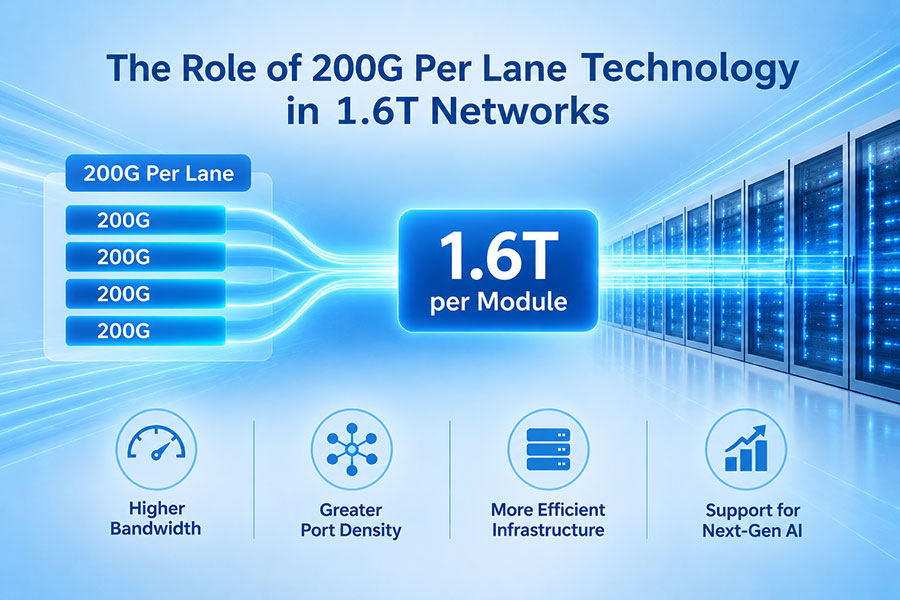
As AI cluster bandwidth requirements increase, the industry is investigating higher per-lane optical rates. Moving from 100G to 200G per wavelength over multimode fiber would allow future parallel optical interfaces to achieve higher aggregate capacity without simply doubling the number of fibers.
This development requires improvements across several areas:
Laser bandwidth: The VCSEL must support faster modulation while maintaining sufficient optical performance.
High-speed driver design: Electrical drive circuits must deliver the required signal with controlled distortion and power consumption.
Receiver bandwidth: Photodetectors and receiver electronics must support the higher signaling rate.
Fiber performance: Multimode fiber must provide adequate bandwidth and modal behavior at the target data rate and distance.
Signal processing: Equalization and FEC may be needed depending on the interface architecture and link requirements.
Packaging: Optical coupling and thermal management must remain reliable as component density increases.
IEEE's July 2025 call for interest in 200 Gb/s-per-wavelength multimode optical PHYs highlighted the potential for VCSEL-MMF technology to support future AI and data center networks. The activity was intended to assess market requirements and technical feasibility. It should not be confused with a finalized standardized 200G-per-wavelength multimode Ethernet interface.
Higher-speed VCSEL research also explores different device structures, wavelengths and integration methods. The commercial success of these approaches will depend on whether the complete transmitter, fiber, receiver and host system can meet practical cost, power, reach and reliability requirements.
13. Deployment and Maintenance Considerations
Successful VCSEL deployment depends on the quality of the complete multimode optical channel. Even when the transceiver and fiber types are nominally compatible, incorrect polarity, excessive loss or poor connector condition can prevent a link from operating reliably.
Before deployment, network engineers should verify:
The exact optical interface and supported fiber grade.
Maximum reach for the selected OM3, OM4 or OM5 fiber.
Connector type, fiber count and polarity mapping.
Optical channel loss against the transceiver's specified budget.
Connector end-face cleanliness and inspection results.
Host switch compatibility, firmware and module identification support.
Operating temperature and module power requirements.
Link performance using the appropriate optical and Ethernet test procedures.
For parallel interfaces, correct MPO polarity is especially important because multiple transmit and receive lanes must connect to their intended counterparts. For bidirectional multimode designs, the specified wavelength arrangement and duplex fiber mapping must also be followed.
When troubleshooting, engineers should distinguish between a module fault and a physical-channel problem. A link that repeatedly drops may be affected by optical loss, contamination, fiber damage, connector mismatch or insufficient modal performance. Replacing the transceiver without checking the channel can leave the underlying problem unresolved.
14. Future Prospects for VCSEL-Based Optical Connectivity
VCSEL technology is likely to remain relevant to short-reach optical connectivity as data center networks continue to increase in bandwidth. Its established manufacturing ecosystem, compatibility with multimode fiber and suitability for parallel optical arrays provide a foundation for continued development.
Several trends will shape its future role:
Higher per-lane data rates: Research into 200G-per-wavelength multimode transmission may extend the technology toward future high-capacity interfaces.
Improved multimode fiber: Fiber designs with higher bandwidth and more controlled modal behavior can help support faster signaling.
Advanced optical packaging: Dense VCSEL arrays may be integrated into optical engines for selected NPO and CPO architectures.
Alternative wavelengths: Longer-wavelength VCSELs and multi-wavelength designs may expand application possibilities, although their maturity and reach vary.
Lower energy per bit: Improvements in laser efficiency, driver circuits and receiver electronics can help reduce total link power.
More integrated testing: Wafer-level and module-level testing can improve manufacturing consistency and production efficiency.
VCSELs will continue to compete and coexist with other optical transmitter technologies. Their long-term position will depend on the distance, bandwidth, fiber infrastructure and cost requirements of each application. For very short links, electrical connections may remain more economical; for longer single-mode links, DFB, EML or coherent technologies may be more appropriate.
15. Conclusion
VCSEL technology has become an important foundation of short-reach optical connectivity. Its vertical-emission structure, direct modulation capability, low-power potential and compatibility with multimode fiber have supported multiple generations of data center Ethernet interfaces.
As networks move toward 400G, 800G and future 1.6T systems, VCSEL development is increasingly focused on higher per-lane signaling rates, improved laser bandwidth, advanced multimode fiber and denser optical integration. The proposed study of 200G-per-wavelength multimode PHYs demonstrates continued industry interest in extending this technology.
For network operators, the key is to select VCSEL-based optics when the fiber type, link distance, optical budget and host interface match the intended application. With appropriate cabling design, testing and compatibility verification, VCSEL technology can continue to provide a practical option for high-volume short-reach optical links.
Planning short-reach optical connectivity for a data center? The right transceiver depends on data rate, fiber grade, reach, connector type and host compatibility. Visit C-LIGHT optical transceivers for product information, or Contact C-LIGHT for technical and application support.
 >

 >
 >
 >
 >
 >
 >
 >