TEL:+86 132 6656 7067





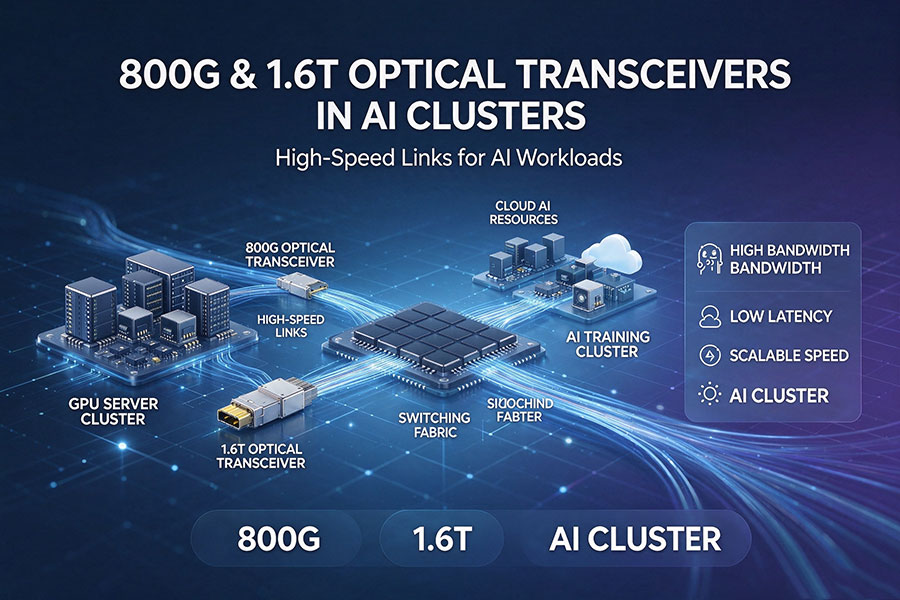
AI clusters depend on high-bandwidth communication between GPUs, accelerators, servers and network switches. As model sizes and distributed computing workloads increase, the network must move larger volumes of data while maintaining predictable performance across thousands of connections. 800G optical transceivers are becoming important building blocks in these high-capacity environments, while 1.6T interfaces are emerging to support the next generation of switching platforms. Their role extends beyond increasing link speed: they influence network topology, port density, fiber infrastructure, power consumption and the scalability of AI computing systems.
1. Why AI Clusters Need High-Speed Optical Connectivity
Large AI models are commonly trained across multiple GPUs or specialized accelerators. These devices divide computational tasks and exchange intermediate results throughout the training process. Communication takes place between accelerators within a server, between servers in the same rack and across different racks in a data center.
Distributed training operations such as AllReduce, AllGather and ReduceScatter can generate substantial traffic between compute nodes. When a large cluster performs these operations repeatedly, network bandwidth and communication efficiency become important factors in overall training performance.
Traditional electrical connections remain suitable for many short-distance links. However, as data rates and connection distances increase, electrical channels face greater challenges involving signal attenuation, equalization, power consumption and electromagnetic interference. Optical fiber provides an alternative for connections where higher bandwidth and longer reach are required.
High-speed optical transceivers help AI clusters by providing:
High link bandwidth: Support for 400G, 800G and emerging 1.6T connections between network devices.
Longer transmission reach: Fiber links connect equipment across racks and network rows beyond the practical reach of many passive copper connections.
High port density: Higher data rates increase the bandwidth available from each optical interface.
Electromagnetic immunity: Optical fiber is less susceptible to electromagnetic interference than electrical cabling.
Network scalability: Optical links allow operators to expand high-capacity switching fabrics as accelerator clusters grow.
Optical connectivity does not independently guarantee high application performance. Network protocols, switch architecture, congestion control, routing, server interfaces and workload scheduling also determine how efficiently an AI cluster uses its available bandwidth.
2. Scale-Up, Scale-Out and Scale-Across: Where Optical Transceivers Are Used
AI cluster networking can be divided into three broad communication domains. Each has different distance, bandwidth and latency requirements, so the role of optical transceivers varies across the architecture.
| Network Domain | Primary Connections | Typical Technologies | Optical Connectivity Role |
|---|---|---|---|
| Scale-Up | Accelerators within a server, rack or tightly coupled compute domain | NVLink-class fabrics and specialized accelerator interconnects | Optical approaches are emerging, while copper remains important in many current systems |
| Scale-Out | Servers, racks and leaf-spine network switches | Ethernet/RoCE or InfiniBand | 800G and 1.6T optics support high-capacity network links |
| Scale-Across | Separate data centers or geographically distributed facilities | Coherent optics, DWDM and data center interconnect | Optical transport provides high-capacity connectivity over longer distances |
Scale-out is currently one of the most important application areas for high-speed pluggable optical transceivers. These links connect network switches and distributed compute resources across a data center. Scale-up systems often use specialized electrical connections for short-reach accelerator communication, although optical scale-up technologies are under development.
Scale-across connectivity serves a different purpose. It connects facilities or distributed computing locations and may use coherent optical transmission rather than the same short-reach direct-detect modules deployed inside a data center.
3. The Role of 800G Optical Transceivers in AI Networks
800G optical transceivers provide high-capacity connections for AI cluster scale-out networks. They are particularly relevant to links between leaf and spine switches, aggregation layers and other network devices that carry traffic from large numbers of servers.
Many 800G pluggable designs use eight electrical lanes operating at approximately 100G-class signaling per lane. Their optical implementations vary according to transmission distance, fiber type and module architecture. Parallel optics and wavelength-multiplexed designs provide different ways to deliver the aggregate bandwidth.
| 800G Optical Type | Fiber Type | Transmission Architecture | Typical Network Application |
|---|---|---|---|
| 800G SR8 | Multimode fiber | Eight parallel optical channels | Short-reach data center connectivity |
| 800G DR8 | Single-mode fiber | Eight parallel optical channels | High-density switch and rack connections |
| 800G 2DR4 | Single-mode fiber | Two groups of four optical channels | Short-reach single-mode links |
| 800G 2FR4 | Single-mode fiber | Wavelength-multiplexed channels over duplex fiber | Duplex-fiber data center connections |
The choice of optical type depends on the network design. SR8 can serve short-reach multimode connections, while DR8 and 2DR4 use single-mode fiber with parallel optical channels. 2FR4 uses wavelength multiplexing to transmit multiple channels over a duplex fiber pair.
For AI clusters, 800G links can increase the capacity of switch-to-switch connections and help support higher-radix network designs. They can also reduce the number of physical links needed to deliver a given aggregate bandwidth, depending on the topology and port configuration.
4. How 1.6T Optical Transceivers Extend AI Cluster Capacity
1.6T optical transceivers represent the next bandwidth generation for high-density AI networking. Their development is closely connected to switch ASICs and electrical interfaces capable of supporting higher per-lane data rates.
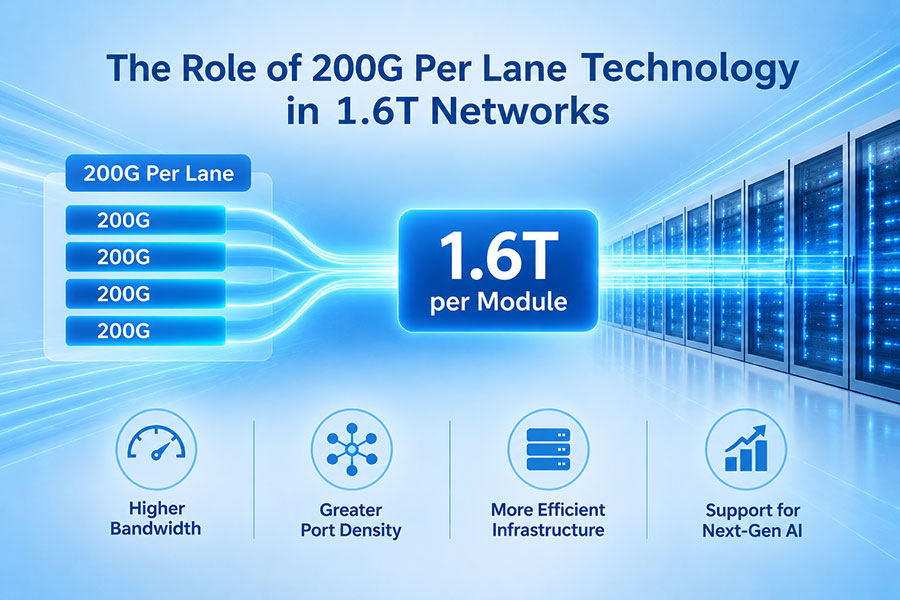
Many 1.6T designs use eight electrical lanes operating at approximately 200G-class signaling per lane. This doubles the per-lane rate of common 800G implementations based on eight 100G-class electrical lanes. The optical architecture, however, depends on the specific module design and product standard.
Higher per-port bandwidth can provide several system-level benefits:
Greater bandwidth per switch port: Each interface carries more data, supporting higher aggregate network capacity.
Reduced port-count pressure: Higher-speed connections can reduce the number of physical ports required for a target bandwidth.
Improved front-panel density: More aggregate bandwidth can be delivered within a constrained switch faceplate area.
Support for larger clusters: High-capacity links help network fabrics scale as the number of accelerators and servers increases.
Migration flexibility: New switch generations can introduce higher-speed interfaces while retaining lower-speed links where they remain appropriate.
However, 1.6T deployment requires more than a compatible optical module. Switch SerDes, host electrical channels, module DSPs, photonic components, firmware and cooling systems must all support the intended interface.
As a result, 1.6T adoption is tied to the maturity of the entire system ecosystem. Early availability and qualification do not mean that every AI cluster is ready to replace its 800G infrastructure.
5. 800G and 1.6T in the AI Cluster Network Architecture
High-speed optical transceivers are most visible in the scale-out fabric, where network switches connect distributed servers and accelerator systems. A typical architecture uses a leaf-spine topology or a related multi-stage Clos design.
Server-to-Leaf Connections
Servers connect to leaf switches through network interface cards (NICs). Depending on the system design and required distance, these connections may use DACs, active copper cables, AOCs or optical transceivers. Short electrical links can remain practical within a rack, while optical links become more important as distances and bandwidth requirements increase.
Leaf-to-Spine Connections
Leaf switches aggregate traffic from servers and forward it toward the spine layer. These uplinks carry traffic between racks and are important points for high-capacity optical connectivity. 800G and 1.6T modules can provide the bandwidth required by newer switch platforms.
Spine and Fabric Interconnection
Spine switches provide paths between leaf switches and help distribute traffic across the cluster. High-speed optical interfaces support these connections, while topology design, routing and congestion management determine how effectively the fabric handles distributed workloads.
The exact placement of 800G and 1.6T interfaces depends on the switch generation and network design. Some clusters may use 800G at both leaf and spine layers, while others introduce 1.6T first on selected high-capacity uplinks.
6. How Optical Bandwidth Supports Distributed AI Workloads
Distributed AI training requires frequent data exchange between accelerators. The communication pattern depends on the model architecture, parallelization strategy and training framework.
Data Parallelism and AllReduce
In data-parallel training, multiple devices process different portions of a training batch. They periodically exchange gradients or updated parameters so that the model can remain synchronized. AllReduce operations combine data from multiple devices and distribute the results across the group.
Tensor and Model Parallelism
Tensor parallelism divides operations within model layers across multiple accelerators. Model parallelism distributes different portions of a model across devices. These approaches can generate frequent communication between accelerators, making the bandwidth and latency characteristics of the interconnect important.
Pipeline Parallelism
Pipeline parallelism divides a model into stages that run on different devices. Intermediate activations and gradients move between stages during training. Network requirements depend on the number of stages, batch size, model structure and placement of compute resources.
800G and 1.6T optical links help provide the network capacity required for communication between distributed compute nodes. However, the impact on training time depends on more than interface speed. Collective communication algorithms, message size, congestion, topology and accelerator utilization all influence performance.
7. Ethernet/RoCE and InfiniBand in Optical AI Networks
AI clusters commonly use high-performance Ethernet or InfiniBand fabrics for communication between compute nodes. Both can support large-scale networking, but their protocol stacks, congestion management and operational models differ.
| Network Technology | Characteristics | Optical Connectivity | Deployment Considerations |
|---|---|---|---|
| Ethernet with RoCE | Ethernet-based networking with RDMA capabilities | 400G, 800G and higher-speed Ethernet optics | Congestion control, loss management and end-to-end configuration |
| InfiniBand | High-performance fabric designed for low-latency computing and RDMA communication | High-speed optical transceivers and supported copper interconnects | Fabric topology, subnet management and platform compatibility |
RoCE enables Remote Direct Memory Access over Ethernet, allowing supported systems to transfer data between memory regions with reduced CPU involvement. InfiniBand provides its own fabric architecture and RDMA capabilities.
Both technologies depend on suitable physical connectivity. An 800G optical transceiver does not determine whether a network uses Ethernet or InfiniBand; the protocol and interface support are defined by the host NIC, switch platform and system configuration.
For large AI clusters, the selection should consider application requirements, available equipment, operational expertise, congestion management and the complete network architecture.
8. Optical Transceiver Form Factors and High-Speed Interfaces
Form factors determine how optical modules fit into networking equipment and how they interact with host electrical interfaces and cooling systems. OSFP and QSFP-DD800 are important platforms in the 800G ecosystem, while OSFP-based designs are also prominent in emerging 1.6T development.
| Form Factor | Typical Speed Applications | Key Considerations |
|---|---|---|
| QSFP-DD | 400G and platform-dependent 800G variants | Compact design, host-specific electrical and thermal support |
| QSFP-DD800 | 800G | Higher-speed electrical interface within the QSFP-DD mechanical family |
| OSFP | 400G, 800G and emerging 1.6T designs | Thermal design, power allowance and high-speed host support |
Form factor alone does not establish compatibility. A module must match the host port's supported data rate, electrical lane configuration, firmware, management interface and thermal requirements.
At 1.6T, the move toward 200G-class electrical lanes increases the demands on module electronics and host signal integrity. This makes platform-level qualification particularly important.
9. Optical Transceivers, DACs, AOCs and Active Copper Links
AI clusters use several types of interconnect products. Optical transceivers are important for fiber-based links, but DACs, AOCs and active copper cables remain relevant in shorter-distance applications.
| Interconnect Type | Transmission Medium | Typical Strengths | Common Application |
|---|---|---|---|
| DAC | Passive copper twinax | Low power, simple connection and cost efficiency over short distances | Server-to-switch links within racks |
| AEC / ACC | Active copper | Signal conditioning can extend copper reach compared with passive DAC | Short-reach rack and equipment connections |
| AOC | Optical fiber with integrated active components | Longer reach than many copper options and immunity to electromagnetic interference | Rack and switch interconnections |
| Optical transceiver | Optical module with separate fiber cabling | Flexible fiber infrastructure and replaceable module design | Switch-to-switch and longer-reach data center links |
DACs are often suitable for short connections where power and cost are priorities. AOCs combine optical transmission with integrated active electronics, while pluggable transceivers provide a modular interface that connects to separately managed fiber cabling.
The correct choice depends on link distance, host support, bandwidth, power budget, cable routing and maintenance requirements. Not every connection in an AI cluster needs to be optical, and not every optical link needs to use the highest available data rate.
10. Power Consumption and Thermal Challenges
High-speed optical connectivity introduces significant power and cooling considerations. As the number of optical ports increases, the combined power consumed by transceivers becomes an important part of switch and rack-level thermal planning.
800G and 1.6T modules must support higher bandwidth while remaining within the power and temperature limits of their host platforms. DSP processing, laser operation, optical components and electrical interfaces all contribute to module power consumption.
Key engineering considerations include:
Module power budget: Check typical and maximum power consumption against the switch port specification.
Airflow management: Confirm that the module's cooling design matches the host equipment's airflow direction and chassis layout.
Thermal density: Evaluate the combined heat generated by densely populated optical ports.
Operating temperature: Validate optical performance across the specified module temperature range.
Power efficiency: Consider bandwidth delivered per watt at both module and system levels.
Reducing transceiver power can improve the overall energy efficiency of an AI network, but the effect must be evaluated across the entire system. Switch ASICs, NICs, cables, cooling infrastructure and network utilization also contribute to total energy consumption.
11. The Role of Silicon Photonics, LPO and CPO
As AI networks move toward higher data rates, conventional pluggable optics face increasing challenges in electrical signal integrity, power consumption and front-panel density. Several technologies are being developed to improve optical integration and reduce the distance that high-speed electrical signals must travel.
Silicon Photonics
Silicon photonics integrates optical waveguides and other photonic functions on silicon-based platforms. It can support compact optical engines and high-density integration. Depending on the design, external laser sources, photodetectors, drivers and DSPs may still be required.
Linear Pluggable Optics (LPO)
LPO reduces or removes conventional DSP retiming inside suitable pluggable optical modules. This can lower power consumption and latency, but it places greater responsibility on the host electrical interface and signal-integrity design. Compatibility between the switch ASIC and optical module is essential.
Co-Packaged Optics (CPO)
CPO places optical engines close to or within the same package assembly as the switch ASIC. Shorter electrical paths can help address bandwidth-density and power challenges. However, CPO introduces different requirements for thermal management, laser delivery, manufacturing and field maintenance.
These technologies serve different system architectures. Pluggable transceivers remain valuable because they can be replaced and maintained independently of the switch ASIC. LPO and CPO offer alternative approaches where power, density and electrical channel limitations become more restrictive.
12. Optical Circuit Switching in Large AI Clusters
Optical circuit switching (OCS) is another technology being applied to large-scale AI network architectures. Instead of forwarding individual packets through an electronic switching fabric, an OCS system establishes optical paths between selected ports or fiber connections.
MEMS-based OCS systems use movable micromirrors to redirect optical signals between input and output ports. This can provide configurable optical connectivity without repeatedly converting traffic between optical and electrical forms inside the circuit-switching stage.
In an AI cluster, OCS can complement conventional packet switches by providing reconfigurable high-capacity paths for selected traffic patterns. It is particularly relevant where communication flows are large and predictable enough to benefit from circuit-level allocation.
OCS does not replace all electronic switching. It generally does not perform the same packet-level forwarding and buffering functions as an Ethernet or InfiniBand switch. The control plane must also manage path allocation, reconfiguration and failure recovery.
The choice between conventional packet switching and optical circuit switching depends on workload traffic patterns, topology, reconfiguration requirements and the complexity of network operations.
13. Market Adoption and the 800G-to-1.6T Transition
The adoption of 800G and 1.6T optical transceivers is closely linked to investment in AI infrastructure. As operators expand accelerator clusters and deploy higher-capacity switch platforms, optical connectivity is becoming a central part of network planning.
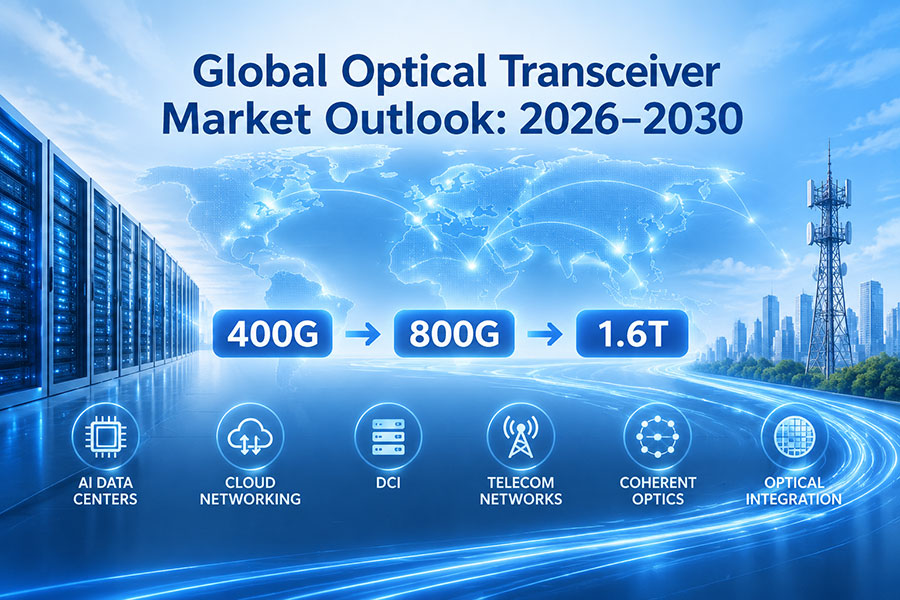
An October 2025 optical components market update presented to the IEEE 802.3 Ethernet study work cited Omdia forecasts for AI scale-up and scale-out optical modules. The forecast estimated a 36% compound annual growth rate from 2024 to 2030 across the covered optical-module categories, with 800G projected to grow faster. It also anticipated some 1.6T deployments in 2025–2026 and stronger adoption from 2027. These are analyst estimates, not confirmed shipment results. IEEE market update.
TrendForce's February 2026 analysis projected that 800G-and-above optical transceivers would account for more than 60% of global shipments in 2026. This forecast reflects the growing importance of high-speed optical connectivity in AI-focused data centers, although actual market results depend on deployment schedules and supply availability. TrendForce market analysis.
Several trends are shaping the market:
800G expansion: Wider use in AI scale-out networks and high-capacity switch interconnections.
1.6T qualification and deployment: Increasing availability of 200G-class electrical interfaces and supporting optical components.
Photonic integration: Greater use of silicon photonics and advanced packaging in high-density optical systems.
Power optimization: More attention to performance per watt across modules, switches and network fabrics.
Supply-chain development: Greater demand for DSPs, lasers, photodetectors, optical packaging and high-speed testing capacity.
The transition will not happen at the same pace across all AI facilities. Some operators will continue using 800G as their primary high-speed interface, while others will introduce 1.6T on selected network layers as compatible platforms become available.
14. Deployment Considerations for AI Data Center Operators
Deploying 800G or 1.6T optics requires coordinated planning across the network, hardware and physical infrastructure. Selecting a module based only on its nominal data rate can create compatibility or performance problems during deployment.
| Evaluation Area | Key Questions |
|---|---|
| Network architecture | Which links connect servers, leaf switches, spine switches and distributed facilities? |
| Host compatibility | Does the switch support the module form factor, lane configuration, firmware and power requirements? |
| Optical reach | Does the selected optical type support the required distance and fiber plant? |
| Fiber infrastructure | Are connector type, polarity, fiber count and insertion loss within specification? |
| Protocol support | Is the interface qualified for the intended Ethernet/RoCE or InfiniBand platform? |
| Thermal management | Can the host maintain suitable module temperatures under full port population? |
| Reliability testing | Have link stability, optical power, diagnostics and error performance been validated? |
| Upgrade planning | Can the deployment combine existing 400G and 800G links with new 1.6T interfaces where supported? |
For large clusters, qualification should include the exact switch model, firmware version, optical module configuration and fiber path. Testing should also consider the impact of multiple active links operating simultaneously in a fully populated system.
Operators planning a phased migration should identify high-utilization links first, preserve network redundancy and maintain accurate port and fiber documentation throughout the upgrade.
For available optical connectivity options, review optical transceiver solutions and confirm the required speed, reach, form factor and host compatibility before deployment.
15. Conclusion
800G and 1.6T optical transceivers are becoming important components in the development of larger and more capable AI clusters. They provide the high-bandwidth fiber connections required by scale-out networks, support higher-capacity switch platforms and help data center operators expand network capacity as distributed computing workloads grow.
The transition involves more than increasing optical link speed. Host electrical interfaces, switch architecture, fiber infrastructure, power consumption, cooling and network protocols must work together. While 800G is expanding across AI data center deployments, 1.6T is developing as the next step for systems designed to support higher per-port bandwidth and density.
As AI infrastructure continues to evolve, optical transceivers will remain an important part of the connectivity ecosystem, alongside copper interconnects, advanced switching silicon, silicon photonics and emerging optical integration technologies.
For optical connectivity requirements, product information or technical discussions, Contact C-LIGHT.
 >

 >
 >
 >
 >
 >
 >
 >