TEL:+86 132 6656 7067





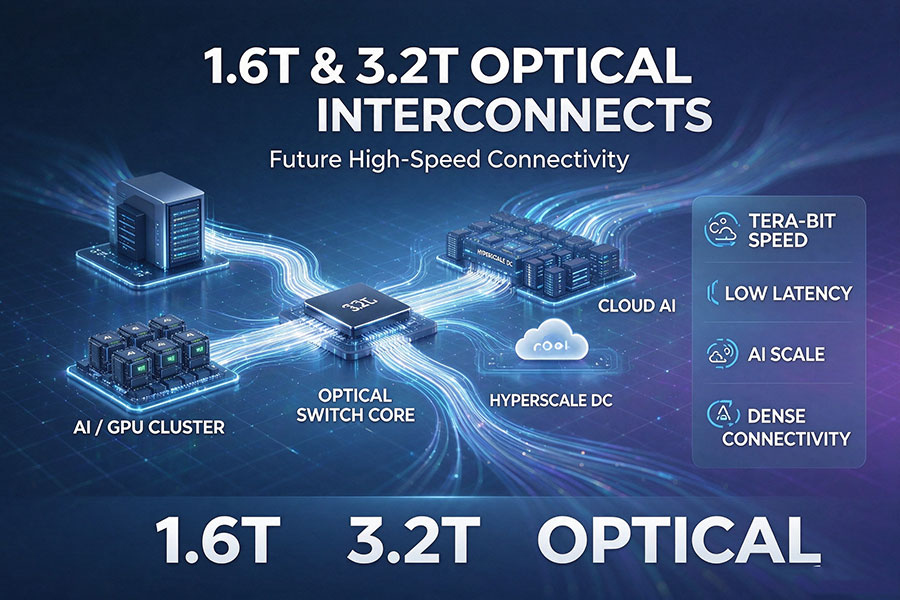
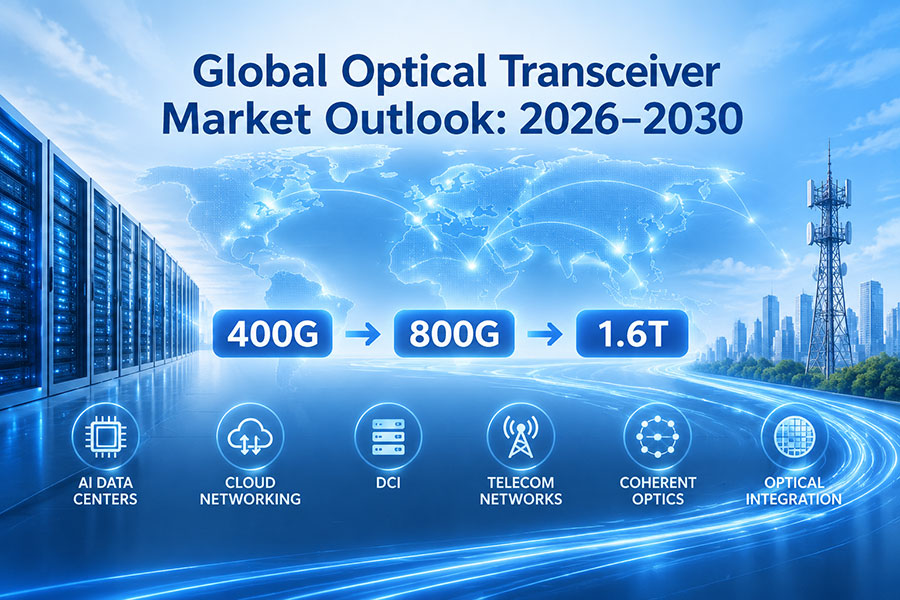
The next phase of optical interconnect development is being shaped by the bandwidth requirements of AI clusters, high-density data center fabrics and increasingly powerful switching systems. As 800G connectivity moves into broader deployment and 1.6T platforms advance, the industry is already preparing for 3.2T interfaces. These generations will require more than faster lasers: they depend on coordinated progress in electrical signaling, photonic integration, digital signal processing, packaging, thermal management and network architecture.
The transition is also changing where optical conversion takes place. Conventional pluggable transceivers will remain important because of their modularity and serviceability, while near-package optics (NPO), co-packaged optics (CPO) and other integrated approaches are being developed to shorten high-speed electrical paths. The future network is therefore likely to contain several optical architectures rather than one universal transceiver design.
1. Why Optical Interconnects Are Moving Toward 1.6T and 3.2T
AI training and inference systems exchange large volumes of data among accelerators, memory, storage and network switches. Distributed training operations such as AllReduce, AllGather and All-to-All can generate substantial east-west traffic. As accelerator counts and cluster sizes increase, the network must provide higher aggregate bandwidth without allowing connectivity, power consumption or physical cabling to become limiting factors.
Increasing port bandwidth is one way to address this demand. Moving from 800G to 1.6T can double the capacity of an individual interface, potentially reducing the number of ports and physical connections required for a given aggregate throughput. A further move to 3.2T could provide another capacity increase, although the benefits depend on switch architecture, endpoint capabilities, network topology and actual traffic patterns.
Higher data rates also create engineering pressure. Electrical signals become more difficult to transmit across circuit boards, connectors and module interfaces as lane speeds rise. Insertion loss, crosstalk, reflections, equalization requirements and power consumption all become more demanding. Optical transmission helps address reach and signal-integrity constraints, but the optical engine and its electrical interfaces must also evolve.
2. The 1.6T Generation: Building on 200G-Class Lanes
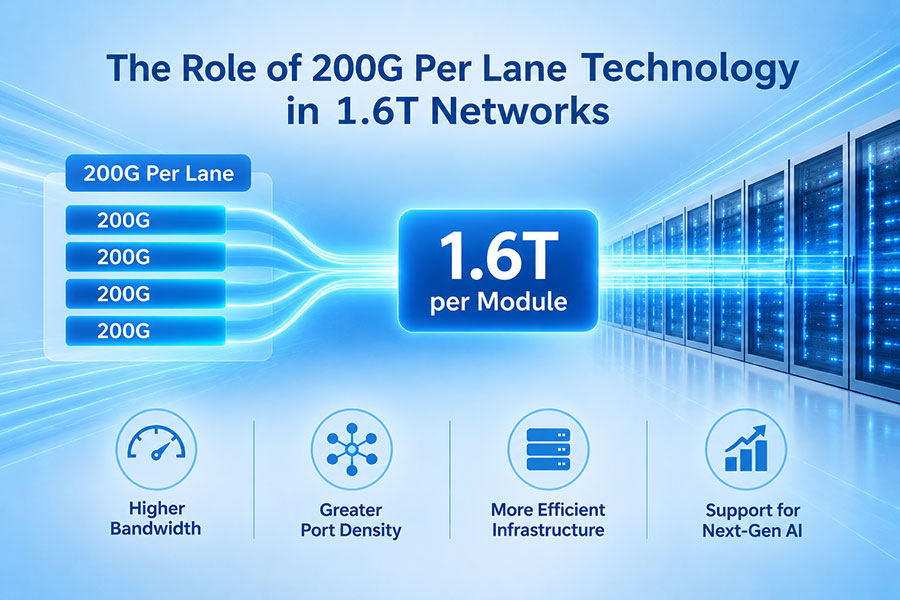
1.6T optical interconnects are an important next step because they can build on the 200G-per-lane signaling ecosystem. A common architecture uses eight lanes operating at approximately 200Gb/s each to reach an aggregate rate of 1.6Tb/s. The exact implementation depends on the electrical interface, optical modulation method, transceiver design and physical-layer specification.
IEEE P802.3dj has addressed Ethernet operation at 1.6Tb/s and physical-layer specifications for 200G, 400G, 800G and 1.6T operation. Its work provides an important standards foundation for the 200G-class lane generation. In parallel, optical component suppliers are advancing lasers, modulators, photodetectors, drivers and DSPs capable of supporting these higher rates.
Key technologies behind 1.6T
200G-class electrical interfaces: Higher-speed SerDes links connect switch ASICs and host systems to optical modules. Signal integrity and host-channel design become increasingly important.
Advanced modulation and DSP: PAM4 and digital signal processing support high data rates, while equalization, clock recovery and error correction help manage transmission impairments.
Silicon photonics: Integrated waveguides, modulators and other photonic components can support compact multi-lane optical engines and higher levels of integration.
Advanced laser technology: EML and other laser approaches continue to be developed for high-speed optical transmission, with performance, yield, power and manufacturing cost influencing platform choices.
Thermal and package engineering: Higher bandwidth density increases the importance of heat removal, electrical routing, optical alignment and mechanical reliability.
Initial 1.6T applications are expected to focus on high-bandwidth data center links, including connections between switches and large AI computing clusters. Pluggable designs retain an important advantage in these environments: optical modules can be replaced or upgraded independently of the host switch, supporting flexible deployment and maintenance.
3. The 3.2T Generation: Moving Toward 400G-Class Signaling
3.2T represents a more demanding stage of optical interconnect development. One possible lane arrangement is eight lanes at approximately 400Gb/s each. Other architectures may use a greater number of lower-rate lanes, depending on the electrical interface, optical engine and packaging approach. These configurations should not be treated as interchangeable: lane count, modulation, wavelength plan, fiber mapping and host interface all affect the final design.
At 400G-class signaling rates, the available electrical and optical bandwidth becomes a central challenge. Transmitter and receiver components must maintain adequate signal quality while controlling noise, distortion, power and temperature. The required analog bandwidth, packaging parasitics and manufacturing tolerances become more difficult to manage.
IEEE has already approved the project authorization for P802.3dv, which covers 400G, 800G and 1.6T electrical and single-mode fiber optical interfaces based on 400G-per-lane signaling, with specified reaches up to 500 meters. This is an important indication of the industry's direction, but it should not be interpreted as a completed 3.2T Ethernet standard. The broader 3.2T ecosystem still requires further development and alignment across standards, components, module formats and host platforms.
| Development stage | Representative lane approach | Main engineering focus | Deployment position |
|---|---|---|---|
| 800G | Commonly 8 × 100G-class lanes, with implementation variations | 112G-class electrical interfaces, optical lane integration, power and density | Established deployment generation with continuing expansion |
| 1.6T | Commonly 8 × 200G-class lanes | 200G-class SerDes, optical modulation, DSP, packaging and thermal design | Advancing through sampling, qualification and early deployment |
| 3.2T | Potentially 8 × 400G-class lanes or alternative lane arrangements | 400G-class signaling, advanced photonic materials, integration and power efficiency | Longer-term development; ecosystem and standards work continue |
Lane configurations are representative architectural directions, not universal specifications for every product. Aggregate line rate, host electrical lane rate and optical wavelength rate are separate design parameters.
4. Silicon Photonics and Next-Generation Optical Engines
Silicon photonics is expected to remain an important platform for higher-density optical interconnects. It uses semiconductor manufacturing techniques to integrate photonic functions such as waveguides, modulators and optical couplers on a silicon-based platform. Electronic driver and receiver circuits can be integrated or closely connected to the photonic components, depending on the architecture.
For 1.6T systems, silicon photonics can support compact multi-lane optical engines and help address manufacturing scale. Mach-Zehnder modulators are one important device option for high-speed operation. Heterogeneous integration can also combine silicon photonics with III-V materials, which are used for laser generation and other functions that silicon does not provide efficiently on its own.
The requirements become more demanding at 3.2T. Higher symbol rates and wider electrical bandwidth place pressure on modulator performance, driver design, optical coupling and process variation. Research into alternative materials, including thin-film lithium niobate and other high-bandwidth photonic platforms, may contribute to future implementations. However, laboratory performance does not automatically translate into high-volume manufacturing readiness.
Laser integration is another important consideration. Some optical engines use integrated lasers, while others rely on external laser sources. External laser architectures can separate the light source from the high-temperature switching package, but they introduce additional optical interfaces, distribution paths and system-level reliability requirements.
5. Pluggable Optics, NPO and CPO Will Develop in Parallel
Increasing bandwidth does not automatically make conventional pluggable transceivers obsolete. Pluggables provide front-panel serviceability, modular upgrades and a mature operational model. These characteristics are valuable in data centers where operators need to replace modules, change reach options or qualify products from multiple suppliers.
However, higher electrical lane rates increase the difficulty of routing signals from a switch ASIC to a front-panel module. Longer electrical paths can require more equalization and consume additional power. This creates opportunities for optical engines to move closer to the switching silicon.
Pluggable optical modules
Pluggable modules keep optical conversion at the equipment front panel. They offer a familiar maintenance model and allow the host platform and optical module to be upgraded separately. Their continued evolution will depend on improved DSPs, optical engines, module cooling and higher-density form factors.
Near-package optics
NPO places optical engines close to the main processing or switching ASIC, shortening the electrical connection between them. This can reduce electrical channel loss and support higher bandwidth density. NPO still requires careful attention to optical fiber routing, replaceability, thermal isolation and service procedures.
Co-packaged optics
CPO integrates optical engines close to or within the same package assembly as a switch ASIC. Short electrical paths can improve the power and signal-integrity characteristics of high-bandwidth interfaces. The trade-offs include more complex package design, optical coupling, laser distribution, manufacturing yield and field maintenance.
| Architecture | Optical engine location | Main advantage | Key consideration |
|---|---|---|---|
| Pluggable optics | Front-panel module cage | Modularity and straightforward replacement | Electrical channel between ASIC and module |
| NPO | Near the ASIC or package | Shorter high-speed electrical paths | Serviceability and optical routing inside the system |
| CPO | Integrated into the ASIC package assembly | High bandwidth density and reduced electrical reach | Package complexity, thermal design and repair strategy |
These approaches are not mutually exclusive. Different network layers and equipment generations may use different optical architectures according to reach, serviceability, power and cost requirements. A gradual transition is more realistic than an immediate replacement of all pluggable modules.
6. Coherent Optics and the Expansion of High-Capacity Links
Optical interconnect development also extends beyond short-reach data center links. As AI infrastructure expands across campuses and geographically distributed facilities, data center interconnect (DCI) links require high capacity over longer distances. Coherent optics provides a path to higher spectral efficiency by encoding information in the amplitude and phase of optical signals, often using dual-polarization modulation and sophisticated digital signal processing.
OIF's 1600ZR work is focused on a multi-vendor interoperable 1.6Tb/s coherent optical interface, with DCI applications in view. The project illustrates that 1.6T is not limited to short-reach parallel optics. Coherent 1.6T interfaces have different modulation, optical performance and system requirements from 1.6T client-side datacom modules.
Coherent technology can also contribute to future 3.2T transport systems. Yet doubling aggregate capacity does not simply mean doubling the distance or maintaining the same spectral efficiency. Reach depends on baud rate, modulation format, optical signal-to-noise ratio, fiber characteristics, amplifier performance, nonlinear effects and FEC overhead.
7. Power Consumption and Thermal Management Will Shape Adoption
Higher bandwidth is valuable only when the complete system can support it within practical power and cooling limits. Optical modules contain lasers, drivers, modulators, photodetectors, TIAs and, in many designs, DSPs. Each generation increases pressure on component efficiency and thermal management.
At 1.6T, module power and heat density are already important design constraints. At 3.2T, higher-speed electrical interfaces and optical components may make conventional thermal solutions more challenging. System designers must consider airflow, heat-sink design, module spacing, switch ASIC temperature, laser operating conditions and the effect of neighboring high-power components.
Power efficiency should be evaluated at several levels:
Optical engine efficiency: Power required to generate, modulate, detect and process optical signals.
Electrical interface efficiency: Energy consumed by SerDes, drivers, receivers and signal conditioning.
System cooling overhead: Additional energy required to maintain stable operating temperatures.
Network-level efficiency: Total power used to deliver useful bandwidth across switches, transceivers, fiber links and supporting equipment.
A module with a lower standalone power rating is not necessarily the most efficient choice if it requires additional host-side processing or imposes other system costs. Meaningful comparisons need consistent test conditions and a clearly defined measurement boundary.
8. Fiber Infrastructure Must Evolve With Port Bandwidth
Higher-speed optical ports increase the importance of fiber infrastructure planning. A 1.6T or 3.2T module may use parallel optical lanes, wavelength-division multiplexing or a coherent optical interface. Each approach has different fiber-count, connector, polarity and reach requirements.
Parallel single-mode links can require high-density fiber connections, while wavelength-multiplexed interfaces may carry multiple channels over a duplex fiber pair. MPO/MTP trunk systems, LC patch cords, fiber distribution panels and structured cabling must be selected according to the actual optical interface rather than the aggregate bandwidth label alone.
For high-density AI data centers, cabling design should account for:
Fiber count, connector type, polarity and lane mapping.
Insertion-loss budgets across trunks, adapters and patch connections.
Fiber cleanliness, inspection and connector handling.
Bend radius, cable weight, pathway fill and physical accessibility.
Clear identification of network roles, links and equipment endpoints.
Future migration paths that avoid unnecessary recabling during speed upgrades.
Optical link qualification should include the complete channel, not just the transceiver. A higher-rate module cannot compensate for excessive connector loss, incorrect polarity, poor fiber condition or an incompatible host interface.
9. Standards, Interoperability and Qualification
Standards development is essential as 1.6T and 3.2T systems move from prototypes toward broader deployment. IEEE defines Ethernet physical-layer and management requirements, while OIF develops electrical and optical interface agreements that support interoperable implementations. Multi-source agreements also influence module form factors and mechanical interfaces.
For 1.6T, IEEE P802.3dj provides a standards framework for 200G-class lane operation and 1.6Tb/s Ethernet. OIF's work on 224G electrical interfaces and 1600ZR coherent optics addresses important parts of the supporting ecosystem. For 400G-per-lane electrical and optical signaling, IEEE P802.3dv has entered the project authorization stage. These activities should be tracked separately because electrical interfaces, optical PMDs, module form factors and coherent line interfaces are not the same specification.
Before deployment, system vendors and network operators need to validate more than nominal data rate. Qualification should cover host compatibility, firmware and management behavior, electrical signal integrity, optical transmit and receive performance, FEC operation, link stability, thermal performance and interoperability with the intended fiber plant.
For pluggable modules, the management interface and host implementation are also important. A module that fits a cage mechanically may still be unsuitable if the switch does not support its lane mapping, power profile, firmware behavior or optical interface.
10. Expected Development Path for 1.6T and 3.2T
The transition toward 1.6T is supported by active standards work and a growing ecosystem of 200G-class electrical and optical components. Near-term engineering priorities include improving production yield, reducing power, qualifying host platforms and ensuring reliable operation across different network environments.
3.2T is a longer-term development direction. It will require higher-bandwidth electrical interfaces, advanced optical devices, new packaging approaches and practical solutions for heat removal and serviceability. The exact balance between pluggable modules, NPO and CPO will depend on application requirements and the maturity of each supply chain.
| Time horizon | Likely areas of progress | Important qualification questions |
|---|---|---|
| Near term | 1.6T sampling and deployment, 200G-class lane integration, coherent 1.6T development | Host support, power, FEC, thermal behavior, interoperability and manufacturing yield |
| Medium term | Wider 1.6T adoption, NPO/CPO development, higher-density optical engines | Serviceability, optical coupling, laser architecture and system-level efficiency |
| Longer term | 3.2T interfaces, 400G-class lane technology and further photonic integration | Standards maturity, component bandwidth, packaging reliability and scalable production |
These are development directions rather than guaranteed commercial milestones. Actual adoption will depend on switch ASIC roadmaps, AI infrastructure investment, supplier readiness, standards completion and the economics of upgrading existing networks.
11. Conclusion
1.6T and 3.2T optical interconnects represent successive stages in the effort to increase network bandwidth while controlling power, latency, density and deployment complexity. The 1.6T generation is progressing through 200G-class lane technology, advanced optical engines and coherent interface development. The 3.2T generation will place greater demands on electrical signaling, photonic devices, packaging and thermal engineering.
Pluggable optics are expected to remain relevant, while NPO and CPO offer additional options for systems where electrical reach and bandwidth density become critical. At the same time, fiber infrastructure, interoperability testing and standards alignment will determine how effectively these technologies can be deployed at scale.
For network operators and equipment developers, the most practical approach is to plan around the complete system: host interfaces, optical modules, fiber connectivity, power delivery, cooling and upgrade strategy. This system-level perspective will be essential as optical interconnects move beyond 800G toward 1.6T and eventually 3.2T.
Review optical interface requirements, host compatibility and fiber infrastructure before selecting a migration path. For product information and technical discussions, view optical transceiver solutions or Contact C-LIGHT.
 >

 >
 >
 >
 >
 >
 >
 >