TEL:+86 132 6656 7067





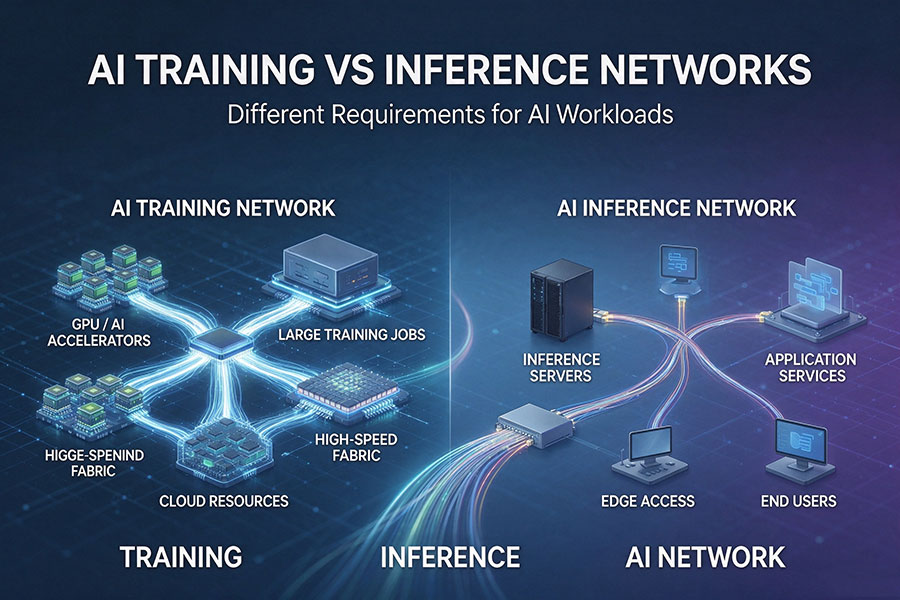
AI training and inference use the same broad computing infrastructure, but they place different demands on network connectivity. Training systems coordinate large numbers of accelerators to process datasets and update model parameters. Inference systems use trained models to respond to application requests, often under strict response-time and availability targets.
These differences affect how data moves, where network capacity is required, how congestion is managed and which optical interfaces are appropriate. Training networks commonly prioritize sustained throughput and synchronized GPU-to-GPU communication. Inference networks must balance request latency, response throughput, concurrency and service availability. Large-scale distributed inference can also generate substantial east-west traffic, so the distinction is not simply between bandwidth-intensive training and low-bandwidth inference.
1. Different Workloads Create Different Network Requirements
Training is the process of adjusting model parameters through repeated computation over training data. Large training jobs are often distributed across multiple GPUs and servers to increase processing capacity. These devices exchange intermediate results, gradients, parameter updates and other data during the training process.
Inference uses an already-trained model to generate predictions or responses. A request may arrive from a user, application, enterprise system or connected device. The inference service processes the input and returns an output, sometimes streaming the result progressively.
The primary difference is the communication objective. Training networks coordinate a distributed computation, while inference networks deliver a service to requests. Both can require high bandwidth and low latency, but the relative importance of each metric changes with the workload.
2. AI Training Networks: High-Bandwidth GPU Communication
Distributed AI training generates intensive east-west traffic between accelerators. The network must move data among GPUs quickly enough to prevent communication from becoming a bottleneck in the training process.
2.1 Collective communication
Data-parallel training divides a workload across multiple GPUs. Each GPU processes a portion of the data and calculates updates, which must be coordinated with other participants. Collective communication operations are used to exchange and combine these results.
AllReduce: Combines values from multiple participants and distributes the resulting values back to them.
AllGather: Collects distributed data from participants so each can access the combined result.
ReduceScatter: Reduces distributed data and sends different portions of the result to individual participants.
All-to-All: Exchanges data among multiple participants, particularly relevant to some model-parallel and mixture-of-experts workloads.
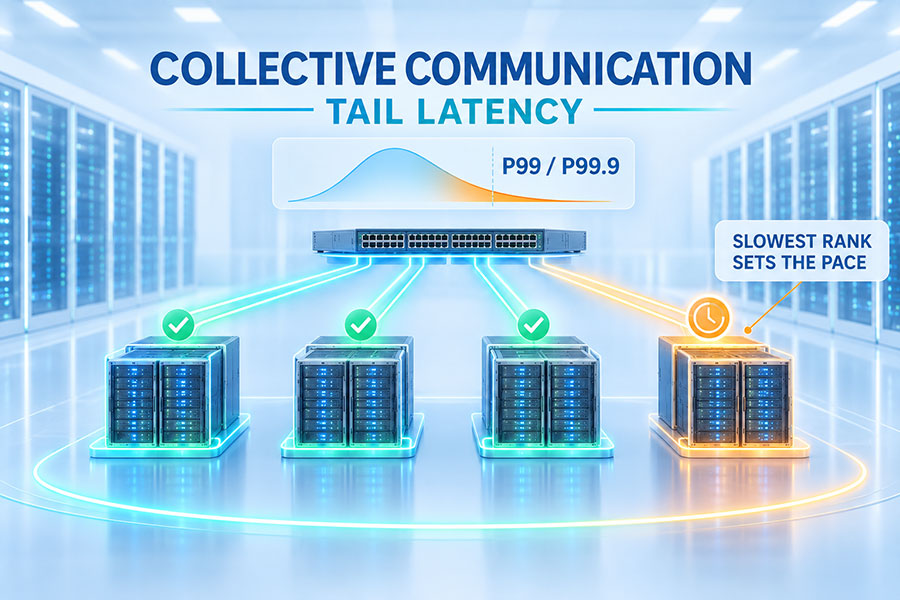
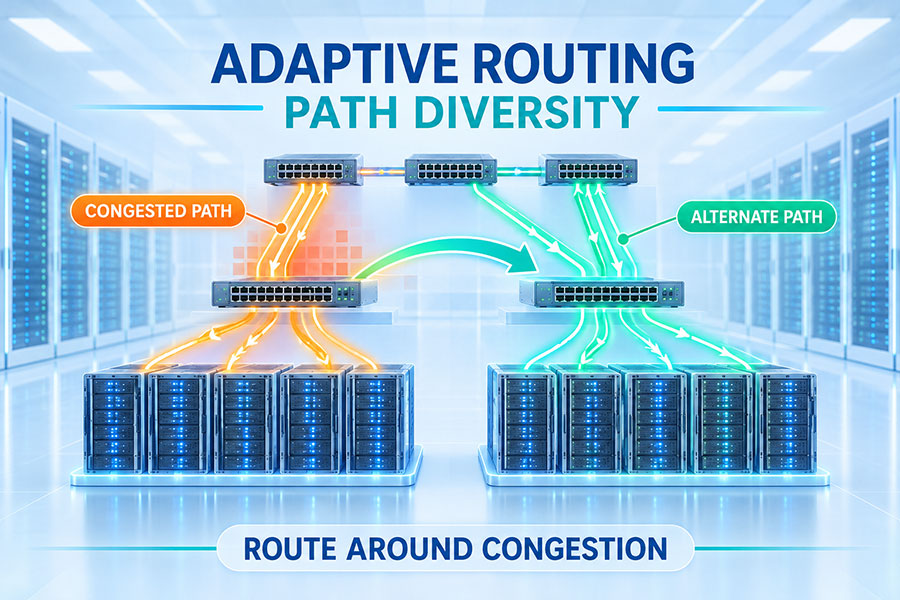
These operations can create synchronized traffic bursts. Many GPUs may begin transmitting around the same time, placing considerable demand on shared switch links and network paths. If one path becomes congested, the affected communication phase can delay the wider training operation.
2.2 Bandwidth and throughput priorities
Training networks need sufficient aggregate bandwidth to support communication across the full cluster. The required capacity depends on model size, parallelization strategy, accelerator count, communication frequency and the amount of data exchanged per operation.
Large clusters commonly use high-speed NICs, high-radix switches and carefully designed leaf-spine or Clos fabrics. InfiniBand and Ethernet-based RoCE are both used in AI and HPC environments. They have different protocol and operational characteristics, and their suitability depends on the system design.
2.3 Low latency and predictable communication
Although training is often described as bandwidth-intensive, latency remains important. Distributed operations may require many participants to complete communication before the next computation stage proceeds. A delayed flow or congested path can therefore affect the progress of an entire group.
Training networks need to control queueing, packet loss and congestion while maintaining high throughput. Average bandwidth alone is insufficient to characterize performance; tail latency and the consistency of communication completion times also matter.
3. AI Inference Networks: Request Latency and Service Throughput
Inference networks connect users and applications to model-serving infrastructure. Their traffic commonly consists of requests sent to inference endpoints and responses returned to clients. In production environments, thousands or millions of requests may arrive with different input sizes, processing requirements and response-time expectations.
3.1 Request-response traffic
Unlike a large training job, inference traffic is often driven by external demand. Requests may arrive continuously, in bursts or according to predictable daily usage patterns. The network must deliver requests to available inference resources and return results without creating excessive delay.
Many deployments use load balancers, API gateways and service-routing layers to distribute requests across inference servers. These components help manage concurrency and availability, but their performance also depends on network capacity and the location of available compute resources.
3.2 Latency and response-time consistency
For interactive inference, users often care about how quickly a system begins responding and how consistently it completes requests. In generative AI services, two useful measurements are:
Time to First Token (TTFT): The time from submitting a request until the first generated token is returned.
Inter-Token Latency (ITL): The time interval between successive generated tokens during streaming output.
End-to-end response time also includes request routing, queueing, model execution, memory access, token generation and response delivery. Network latency is one component of this process, not the only determinant.
3.3 Concurrency and throughput
Inference platforms must handle multiple requests at the same time. A service may need to maintain acceptable response times while processing requests with different prompt lengths, output lengths and computational complexity.
Throughput is often measured in requests per second or generated tokens per second. However, high aggregate throughput does not necessarily mean every user receives a fast response. Queueing and resource contention can increase tail latency when demand approaches available capacity.
4. Training and Inference Network Requirements
The two workload types share many technologies, but their priorities differ. The following table summarizes typical network design considerations rather than fixed requirements for every deployment.
| Network dimension | AI training | AI inference |
|---|---|---|
| Primary objective | Efficient distributed model computation | Fast and reliable model serving |
| Typical traffic | Large GPU-to-GPU exchanges, synchronization and storage transfers | Requests, responses, model data and internal serving traffic |
| Traffic direction | Often dominated by east-west cluster communication | Often includes substantial north-south user traffic and east-west internal traffic |
| Bandwidth priority | High aggregate throughput across accelerator nodes | Enough capacity for request volume, response delivery and distributed serving |
| Latency priority | Predictable communication completion and low collective-operation delay | Low request latency, good TTFT and consistent response delivery |
| Traffic behavior | Coordinated and potentially bursty communication phases | Variable request arrivals, concurrent sessions and streaming responses |
| Network scale | Often organized around large GPU clusters | Can span data centers, regional sites and edge locations |
| Congestion concerns | Collective traffic, incast and uneven link utilization | Request bursts, queueing, load imbalance and shared service bottlenecks |
| Availability focus | Job completion, fabric stability and fault recovery | Service uptime, request continuity and geographic resilience |
| Power considerations | High-density accelerator and network fabrics | Serving efficiency, utilization, traffic distribution and cooling |
5. East-West and North-South Traffic in Both Environments
East-west and north-south describe traffic direction within a network architecture. They are useful concepts for understanding AI network design, but neither direction belongs exclusively to training or inference.
5.1 East-west traffic in training clusters
Training clusters depend heavily on communication between GPUs and servers. The east-west fabric carries collective operations, parameter exchanges and other distributed-computing traffic. It needs sufficient bandwidth and predictable performance as the number of participating accelerators increases.
5.2 North-south traffic in inference services
Inference services receive requests from external users, applications or enterprise systems. These requests generally enter through customer-facing or service-facing network paths, while generated responses travel back toward the requesting clients.
When inference infrastructure is distributed across regions or edge locations, network design must also account for service discovery, routing, geographic placement and data movement between sites.
5.3 Distributed inference also needs east-west capacity
Large inference models do not always run on a single GPU or server. Tensor parallelism, pipeline parallelism and mixture-of-experts architectures can distribute inference computation across multiple accelerators or nodes.
These designs create internal communication requirements. For example, mixture-of-experts models may route tokens between different expert groups, producing All-to-All traffic. Consequently, a large inference cluster can require a high-performance east-west fabric similar in some respects to a training network.
6. Network Architecture for AI Training
Training network architecture is designed around accelerator connectivity, collective communication and the need to scale across many compute nodes. A common approach uses a leaf-spine or Clos topology with multiple high-speed paths between network endpoints.
6.1 GPU compute fabric
The GPU compute fabric carries high-volume communication between accelerator nodes. In larger deployments, it may use dedicated switches and NICs to separate GPU traffic from customer access, management and other infrastructure flows.
6.2 Rail-optimized network design
Rail-optimized architectures organize accelerator network interfaces into corresponding network planes. This can help align communication paths and distribute traffic across the fabric. The exact design depends on the server configuration, NIC count, switch port availability and collective communication software.
6.3 Storage and checkpoint connectivity
Training systems also move large datasets from storage to compute nodes and periodically save checkpoints. These transfers can compete with accelerator communication if they share network paths without adequate capacity planning.
Storage connectivity should therefore be sized according to dataset access patterns, checkpoint frequency, storage throughput and the number of training nodes. A high-performance GPU fabric cannot compensate for a storage system that delivers data too slowly.
7. Network Architecture for AI Inference
Inference architecture is shaped by the location of users, the distribution of model-serving resources and the response-time requirements of applications. Unlike a single large training job, inference services may need to serve requests from different regions and maintain availability during traffic fluctuations.
7.1 Front-end and back-end network separation
The front-end network handles client access, API requests, service routing and response delivery. The back-end network connects inference servers, accelerators, storage and supporting services.
Separating these traffic types can help maintain predictable performance and simplify security and operational policies. Smaller deployments may use a converged physical network with logical separation, while larger systems may benefit from dedicated network fabrics.
7.2 Load balancing and service placement
Inference requests can be routed according to server availability, model placement, accelerator utilization and geographic location. Load balancing needs to account for more than connection counts because requests can vary significantly in processing cost.
For example, a long prompt or a request that generates a large response may consume more resources than a short request. Routing decisions that account for model and server load can help reduce queueing and improve service consistency.
7.3 Distributed and edge inference
Inference does not always take place in one central data center. Some workloads benefit from placing compute closer to users, enterprise locations or data sources. This can reduce the distance requests travel and avoid transferring large raw datasets to a remote facility.
Distributed deployments introduce additional requirements for WAN connectivity, data center interconnect, routing, security and service continuity. The network must connect inference sites while maintaining suitable latency and capacity for the application.
8. RDMA, Ethernet and InfiniBand Considerations
RDMA is important in high-performance AI networking because it enables supported systems to transfer data between memory regions with reduced CPU involvement. It is commonly used for distributed training and can also support distributed inference architectures that require frequent accelerator-to-accelerator communication.
InfiniBand is a high-performance interconnect technology used in AI and HPC clusters. Ethernet-based RoCE provides RDMA capabilities over Ethernet networks. Both can support demanding workloads, but they differ in ecosystem, configuration, operational practices and deployment considerations.
Conventional Ethernet remains important for customer access, service communication, management and many inference deployments. A network may use Ethernet for front-end connectivity and a separate RDMA-capable fabric for accelerator communication.
9. Optical Connectivity for Training and Inference
Optical connectivity supports high-speed communication across racks, rows and data center facilities. The required interface depends on link distance, aggregate bandwidth, fiber infrastructure, power limits and equipment compatibility.
9.1 Optical transceivers in training networks
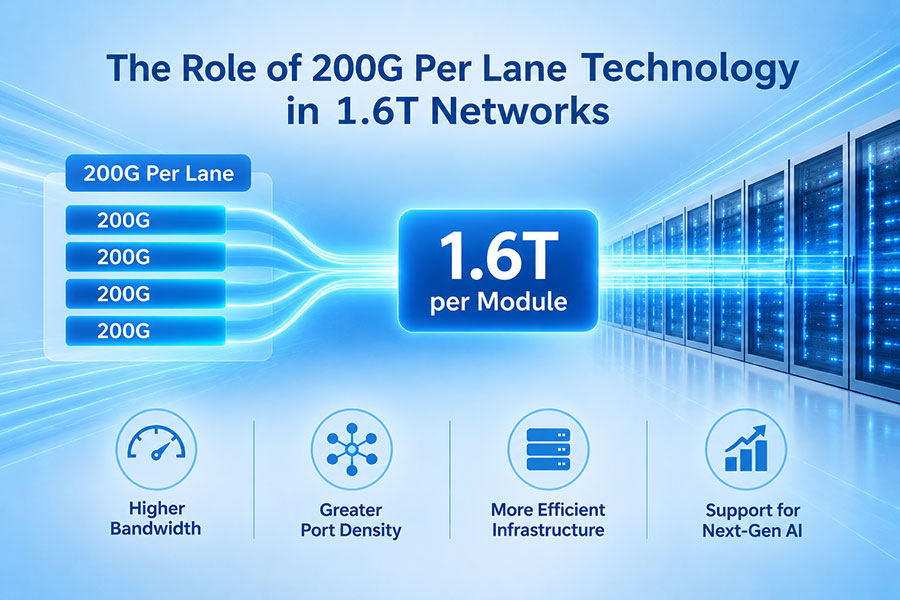
Training clusters can require large numbers of high-speed connections between GPU servers and switches. 400G and 800G optical transceivers are relevant to these environments, while emerging 1.6T interfaces offer a path toward higher port bandwidth as compatible platforms become available.
Parallel optics such as SR8 and DR8, along with wavelength-multiplexed options such as 2FR4, serve different reach and fiber requirements. They should be selected according to the actual switch and NIC interfaces rather than assuming that modules with the same aggregate data rate use the same cabling.
9.2 Optical transceivers in inference networks
Inference networks use optical connectivity for switch uplinks, data center interconnect, distributed serving clusters and connections to regional or edge facilities. The appropriate interface depends on the service topology and distance between network locations.
High-volume inference clusters may also require 400G or 800G links inside the back-end fabric. In these environments, optical bandwidth supports both external request delivery and internal accelerator communication.
9.3 DAC and AOC for shorter connections
DAC cables can provide practical short-distance connections between compatible devices, particularly within racks. AOC cables use optical fiber and integrated active components, making them useful for certain connections where copper reach, cable weight or routing constraints become less suitable.
Pluggable optical transceivers provide a different level of flexibility because the module and fiber assembly can be selected separately. The best option depends on reach, power, cable density, maintenance requirements and platform support.
For available optical connectivity options, see the optical transceiver product range.
10. Power Efficiency and Cooling Requirements
Training and inference networks both contribute to data center power consumption, but their system-level requirements can differ. Training facilities often operate dense accelerator clusters with extensive high-speed fabrics. Inference facilities may distribute compute across multiple locations and optimize for service demand, utilization and response-time targets.
Optical transceivers, switches, NICs and supporting equipment all contribute to network power. Higher interface speeds can increase the complexity of signal processing and thermal management, although actual power depends on the module architecture, reach and implementation.
Inference efficiency also depends on how well serving capacity matches demand. Underutilized accelerator resources can increase energy consumed per request, while excessive consolidation may create congestion and response-time problems during traffic peaks.
Training efficiency is influenced by how much time accelerators spend performing useful computation rather than waiting for communication or data. Network performance, storage throughput and workload scheduling therefore affect the energy efficiency of the overall training job.
11. Network Reliability and Performance Monitoring
Training and inference systems need reliable connectivity, but the operational consequences of network disruption differ.
A training job may lose time or require recovery when a network failure interrupts communication across a large group of accelerators. Inference services may experience failed requests, degraded response times or reduced serving capacity when links or sites become unavailable.
Monitoring should be aligned with the workload:
Training: Monitor collective-operation duration, link utilization, congestion events, packet errors, RDMA performance and checkpoint transfer time.
Inference: Monitor request latency, TTFT, inter-token latency, request throughput, queue depth, error rates and service availability.
Both environments: Monitor optical transmit and receive power, module temperature, link state, switch health and physical-layer errors.
Optical diagnostics can help identify link-level issues, but they cannot independently explain application performance. Network telemetry should be correlated with GPU utilization, server health, workload traces and service-level measurements.
12. Can Training and Inference Share the Same Network?
Training and inference do not always require physically separate networks. Smaller deployments may use a shared physical infrastructure with logical segmentation, traffic prioritization and resource controls. This can reduce equipment cost and simplify operations.
However, sharing infrastructure creates potential contention. A large training transfer or synchronized communication burst may affect inference requests if both workloads compete for the same switch ports, queues or uplinks.
For production environments with strict inference service-level objectives, isolation may be achieved through dedicated fabrics, separate network planes, traffic classes or carefully managed capacity reservations. The right approach depends on workload scale, performance targets and operational complexity.
| Deployment model | Advantages | Considerations |
|---|---|---|
| Shared physical network | Lower infrastructure cost and simpler physical deployment | Requires traffic isolation, capacity planning and congestion control |
| Logically separated network | Can isolate traffic classes while retaining shared physical infrastructure | Performance depends on the effectiveness of QoS, routing and resource controls |
| Dedicated network fabrics | Greater control over bandwidth, traffic patterns and operational boundaries | Higher equipment, cabling and management requirements |
13. How AI Workload Evolution Is Changing Network Design
The boundary between training and inference is becoming less rigid as AI systems adopt more complex deployment models. Fine-tuning, retrieval-augmented generation, mixture-of-experts inference and multi-stage agent workflows introduce different combinations of storage access, internal communication and external traffic.
Large inference systems can require extensive accelerator-to-accelerator communication. Meanwhile, training may involve data ingestion across multiple facilities, checkpoint replication and distributed storage. Network architecture must therefore reflect actual workload behavior rather than rely only on whether a system is labeled as a training or inference cluster.
As AI services expand across central data centers, regional facilities and edge locations, optical connectivity and data center interconnect become increasingly important. High-speed Ethernet, RDMA fabrics, coherent optics and structured fiber infrastructure each address different parts of the connectivity requirement.
14. Practical Network Design Considerations
Before selecting switches, NICs, optical transceivers or fiber assemblies, network planners should identify the workload's communication pattern and performance objectives.
For training: Estimate GPU-to-GPU communication demand, collective-operation behavior, cluster size and storage bandwidth requirements.
For inference: Estimate request volume, concurrency, response sizes, latency targets and geographic distribution.
For distributed inference: Evaluate internal accelerator communication, model partitioning, KV-cache movement and inter-site traffic.
For shared infrastructure: Define traffic isolation, QoS policies, capacity reservations and congestion controls.
For optical connectivity: Verify data rate, reach, fiber type, connector, lane mapping, FEC requirements and host compatibility.
For operations: Establish telemetry and performance baselines that connect network metrics with application behavior.
Testing should use representative workloads. A network that performs well in a simple throughput test may behave differently under synchronized AllReduce traffic or a high-concurrency inference workload with variable response sizes.
15. Conclusion
AI training and inference networks share many technologies, but their priorities are shaped by different communication patterns. Training networks focus on high-throughput accelerator communication, synchronization efficiency and predictable fabric performance. Inference networks focus on request latency, response throughput, concurrency, availability and service placement.
These differences influence topology, traffic separation, congestion management, optical interface selection and power planning. However, distributed inference can also require high-bandwidth east-west connectivity, while training systems need reliable storage and external data paths. Network design should therefore be based on workload characteristics rather than a simplified training-versus-inference distinction.
As AI infrastructure expands toward 800G and emerging 1.6T connectivity, the ability to match optical bandwidth, network architecture and application requirements will remain central to efficient data center operation.
For optical connectivity requirements and high-speed transceiver solutions, view the optical transceiver product range or Contact C-LIGHT.
 >

 >
 >
 >
 >
 >
 >
 >