TEL:+86 132 6656 7067





Multi-Source Agreements (MSAs) play a central role in optical networking by establishing common technical specifications that allow products from different manufacturers to work within the same network ecosystem. They help standardize optical transceiver form factors, electrical interfaces, mechanical dimensions, thermal requirements, and management functions.
Without MSAs, optical module manufacturers could develop products with different physical designs and interface requirements, making equipment integration more difficult and limiting customer choice. MSAs provide a shared foundation for interoperability, competition, and faster product development across the optical communications industry.
1. What Is a Multi-Source Agreement (MSA)?
A Multi-Source Agreement is an industry specification developed and adopted by multiple companies to establish common technical requirements for a particular product or interface. In optical networking, MSAs are widely used to define pluggable transceiver form factors and their interfaces with host equipment.
The term "multi-source" reflects the objective: multiple manufacturers can develop products based on the same specification rather than relying on a proprietary design controlled by a single supplier.
For example, an optical module manufacturer can design a QSFP-DD transceiver according to the QSFP-DD MSA, while a switch manufacturer can develop a compatible host cage and electrical interface. Both companies work from a common technical reference, reducing the need for custom hardware designs.
Unlike formal standards published by organizations such as IEEE or ITU-T, an MSA is generally an industry agreement among participating companies. However, widely adopted MSAs can become de facto industry specifications.
2. What Does an Optical Transceiver MSA Define?
The exact scope depends on the MSA. Form-factor MSAs generally focus on the physical module and its interaction with host equipment. Some specialized optical MSAs also define optical interface characteristics. Common areas include the following.
2.1 Mechanical Dimensions and Form Factor
Mechanical specifications define the module's size, shape, latching mechanism, connector position, and other physical characteristics. They also establish requirements for the host cage and mating connector.
These details allow a module designed by one manufacturer to fit into a compatible port designed by another. Common examples include SFP, SFP+, QSFP28, QSFP-DD, and OSFP.
2.2 Electrical Interface and Pinout
The electrical interface defines how the transceiver connects to the host system. Specifications may cover high-speed data lanes, low-speed control signals, pin assignments, power connections, and signal requirements.
For high-speed modules, the number of electrical lanes and their supported signaling rates are important design considerations. For example, QSFP-DD and OSFP architectures support eight high-speed electrical lanes in widely used configurations, while newer generations extend the supported lane rates to meet higher aggregate bandwidth requirements.
2.3 Power and Thermal Requirements
High-speed optical modules generate heat through their electrical and optical components. MSA specifications can define power-related requirements, thermal limits, and cooling considerations that help host manufacturers design suitable cages, airflow paths, and heat dissipation structures.
This becomes increasingly important as data rates increase from 400G to 800G and 1.6T. Module power consumption, heat-sink design, airflow, and system cooling must be considered together.
2.4 Management and Monitoring Interfaces
Modern pluggable transceivers provide digital management functions that allow network equipment to identify and monitor installed modules.
Depending on the applicable specification, management functions may include module identification, temperature monitoring, supply voltage, transmit and receive optical power, alarms, warnings, and control functions.
Many modern high-speed transceiver specifications use the Common Management Interface Specification (CMIS) as their management framework. CMIS is a separate specification, although it is referenced by form-factor specifications such as QSFP-DD and OSFP.
2.5 Optical Interface Requirements
Not every form-factor MSA defines the complete optical transmission interface. Optical characteristics such as wavelength, modulation, transmission distance, optical power, receiver sensitivity, and fiber requirements are often specified by standards or application-specific agreements.
Some optical MSAs do define particular optical interfaces. Therefore, engineers should check the scope of each specification instead of assuming that every MSA covers the same technical areas.
3. Why Are MSAs Important in Optical Networking?
3.1 Enable Multi-Vendor Interoperability
One of the most important roles of MSAs is reducing hardware incompatibility between manufacturers. When transceivers and host ports follow the same applicable specifications, they have a common physical and electrical foundation.
This allows network operators to evaluate optical modules from different suppliers instead of depending entirely on one equipment or transceiver vendor. It also makes it easier to introduce alternative suppliers into an established network.
3.2 Reduce Vendor Lock-In
Without common interfaces, equipment manufacturers could use proprietary module designs that restrict customers to a limited number of compatible suppliers.
MSAs encourage a broader supply ecosystem. Data center operators, telecom providers, and enterprise network teams can consider multiple manufacturers when selecting optical transceivers, provided that the products meet the required technical and equipment-specific compatibility conditions.
3.3 Lower Development and Integration Costs
Common specifications reduce the need for every manufacturer to develop a unique mechanical or electrical interface. Module suppliers can focus more resources on optical performance, power efficiency, DSP design, and manufacturing quality.
Equipment manufacturers also benefit from using established interface designs instead of creating a proprietary host interface for every new module generation.
3.4 Accelerate New Technology Adoption
As network bandwidth increases, the industry needs new module architectures that can support higher lane rates, greater port density, and more demanding thermal requirements.
MSA development provides a shared engineering framework for companies working on new form factors. It helps module manufacturers, switch vendors, connector suppliers, and test-equipment developers coordinate their designs.
3.5 Support Supply Chain Flexibility
Large data centers and telecommunications networks may deploy thousands of optical transceivers. Depending on a single source can create procurement risks when demand increases or supply becomes constrained.
MSA-based product ecosystems allow operators to qualify alternative suppliers and improve sourcing flexibility. This is especially valuable for large-scale 100G, 400G, 800G, and emerging 1.6T deployments.
4. Common Optical Transceiver MSAs and Form Factors
Different MSAs address different generations of optical connectivity. Some are designed for compact, lower-speed applications, while newer specifications support high-density interfaces for modern data centers.
| MSA / Form Factor | Typical Applications | Key Characteristics |
|---|---|---|
| SFP / SFP+ | 1G and 10G networking | Compact, hot-pluggable interfaces |
| SFP28 | 25G Ethernet | Single-lane 25G-class module architecture |
| QSFP28 | 100G Ethernet | Four-lane high-density interface |
| QSFP-DD | 400G and 800G networking | Double-density electrical interface with eight high-speed lanes |
| OSFP | 400G, 800G and 1.6T applications | Eight-lane architecture with thermal design options |
| OSFP-XD | Next-generation high-density connectivity | Extended-density architecture with 16 electrical lanes |
These form factors are not interchangeable simply because they support similar data rates. Their mechanical dimensions, electrical interfaces, cooling requirements, and host compatibility can differ significantly.
4.1 QSFP-DD MSA
The QSFP-DD MSA defines the hardware architecture for Quad Small Form-factor Pluggable Double Density modules. It introduces an additional row of electrical contacts compared with the original QSFP interface, enabling eight electrical lanes in the host connection.
QSFP-DD has become an important form factor for 400G and 800G optical networking. The QSFP-DD MSA also defines hardware and management-related requirements, with CMIS used for the applicable module management interface.
For an example of this form factor in commercial optical networking, see the C-LIGHT 800G QSFP-DD optical transceiver. Its product specifications identify IEEE 802.3, CMIS, and QSFP-DD800 MSA hardware requirements as separate parts of the module's technical compliance.
4.2 OSFP MSA
The OSFP MSA defines the Octal Small Form Factor Pluggable architecture. Its specification covers the module's mechanical design, host cage, mating connector, electrical pinout, power and thermal requirements, and management interface.
OSFP supports high-density optical connectivity and has been adopted for 400G, 800G, and 1.6T networking applications. Different OSFP thermal designs, including integrated heat-sink and reduced-height heat-sink configurations, address different system cooling requirements.
The C-LIGHT 1.6T OSFP-RHS optical transceiver is an example of a high-speed product using the OSFP package. Its architecture uses eight 200G PAM4 channels, with thermal design intended for high-density data center environments.
4.3 SFP and QSFP Specifications
Earlier SFP and QSFP specifications established the foundation for compact, hot-pluggable optical modules. These form factors remain widely used in Ethernet, Fibre Channel, and telecommunications equipment.
As transmission speeds increased, enhanced versions such as SFP+, SFP28, QSFP28, and QSFP-DD were introduced to support higher electrical lane rates and aggregate bandwidth.
5. MSA vs. IEEE, ITU-T, OIF, and CMIS
MSAs are part of a broader standards ecosystem. Different organizations and specifications address different layers of optical networking, and understanding their responsibilities helps avoid compatibility assumptions.
| Specification / Organization | Main Responsibility | Typical Scope |
|---|---|---|
| MSA | Common product interfaces | Form factor, mechanical design, electrical interface, thermal and related requirements |
| IEEE 802.3 | Ethernet standards | Ethernet MAC and PHY specifications, including optical Ethernet interfaces |
| ITU-T | Telecommunication standards | Optical transport, wavelength division multiplexing, and network architectures |
| OIF | Optical and electrical implementation agreements | Coherent optics, electrical interfaces, and interoperability frameworks |
| CMIS | Module management | Module identification, monitoring, control, and management behavior |
| SNIA SFF | Form-factor and interface specifications | Connectors, cages, electrical interfaces, and pluggable module requirements |
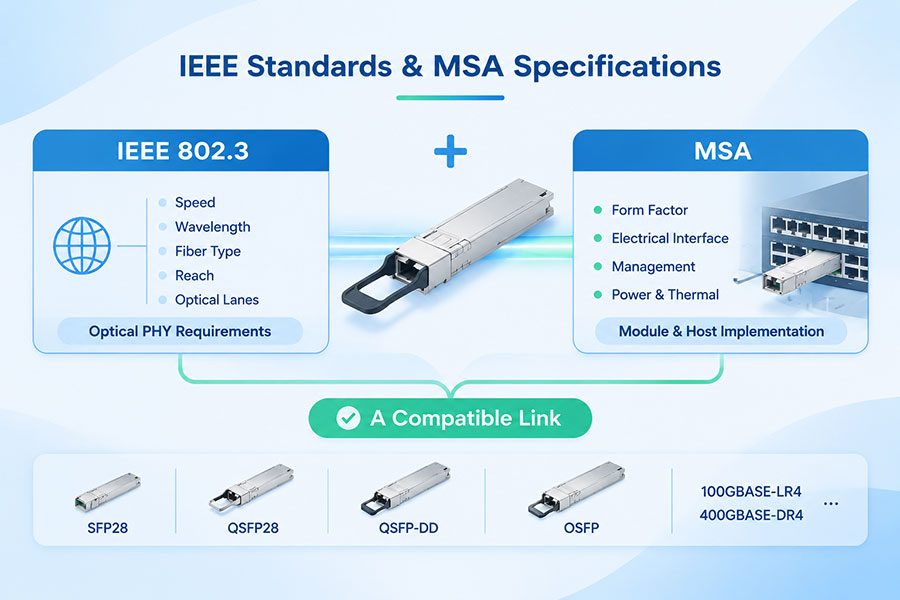
These specifications complement one another rather than replacing one another. An optical transceiver may need to comply with a form-factor MSA, an Ethernet PHY standard, and a management specification to operate correctly in a particular application.
6. Does MSA Compliance Guarantee Optical Transceiver Compatibility?
No. MSA compliance is important, but it does not automatically guarantee that an optical transceiver will operate correctly in every switch, router, server, or network interface card.
Compatibility depends on several technical and system-level factors.
6.1 Form-Factor Compatibility
The module must match the host port's physical design. A QSFP-DD module and an OSFP module, for example, have different mechanical interfaces and cannot be treated as interchangeable.
6.2 Electrical Interface Compatibility
The host and module must support compatible electrical lane configurations, signaling rates, and signal-integrity requirements. A physical fit does not prove that the electrical connection will operate correctly.
6.3 Optical Interface Compatibility
The optical transmission specification must match the intended link. Engineers should verify wavelength, fiber type, connector, lane mapping, transmission distance, modulation format, and optical power budget.
6.4 Management and Firmware Compatibility
Host equipment must correctly recognize and communicate with the transceiver. Differences in management-interface implementation, firmware behavior, module identification, or vendor-specific restrictions can affect operation even when the hardware follows a common MSA.
6.5 Thermal and Power Compatibility
The host platform must provide adequate power and cooling for the module. High-speed optical transceivers can have demanding thermal requirements, so the supported power class and airflow conditions should be checked against the equipment manufacturer's specifications.
7. How to Verify MSA Compliance When Selecting Optical Transceivers
Network engineers and procurement teams should evaluate more than the module's form-factor label. The following checks help establish whether a product is suitable for a specific deployment.
Confirm the form factor: Check whether the module uses the required SFP, QSFP28, QSFP-DD, OSFP, or other interface.
Review the applicable MSA: Identify the specification revision and verify the mechanical, electrical, and thermal requirements.
Check the Ethernet or transport standard: Confirm the applicable IEEE, ITU-T, or other protocol specification for the intended application.
Verify optical parameters: Check data rate, wavelength, fiber type, connector, transmission distance, and optical budget.
Check management support: Confirm CMIS or another applicable management interface and its supported revision.
Confirm host compatibility: Verify switch, router, NIC, and firmware support, including any vendor-specific restrictions.
Review test results: Request relevant interoperability, electrical, optical, and environmental test information.
For large deployments, qualification testing in the actual host platform is recommended. This helps identify issues that cannot be determined from the MSA label alone.
8. The Growing Importance of MSAs in 400G, 800G, and 1.6T Networks
As data center networks move toward higher speeds, optical transceiver design becomes more complex. Higher electrical lane rates, advanced PAM4 signaling, increased module power, and denser front-panel layouts create additional challenges for module and switch manufacturers.
MSAs provide common hardware requirements that help the ecosystem coordinate these developments. They are particularly relevant in the following areas:
400G networking: QSFP-DD and OSFP provide established high-density pluggable architectures.
800G networking: QSFP-DD800 and OSFP support eight-lane architectures using higher-speed electrical interfaces.
1.6T networking: OSFP1600 and emerging extended-density architectures address higher bandwidth and more demanding thermal requirements.
AI data centers: Common interfaces help module, switch, and system manufacturers develop compatible high-bandwidth interconnect solutions.
For example, a 1.6T module based on an eight-channel 200G PAM4 architecture requires coordinated electrical, mechanical, management, and thermal design. The relevant MSA provides the hardware framework, while the applicable Ethernet PHY specification defines the transmission requirements.
9. The Role of MSAs in C-LIGHT Optical Transceiver Solutions
For optical transceiver manufacturers, MSA specifications provide an important design reference for developing products intended for multi-vendor networking environments.
C-LIGHT's high-speed optical transceiver portfolio includes products based on established pluggable form factors. For example, its 800G QSFP-DD product information identifies three distinct specification areas:
IEEE 802.3: Ethernet communication and PHY requirements applicable to the product variant.
CMIS Rev. 5.0: The module management interface specification.
QSFP-DD800 MSA HW: The hardware and packaging specification for the QSFP-DD800 form factor.
These specifications address different aspects of the module and should be evaluated together when determining suitability for a network platform.
For higher-bandwidth applications, the C-LIGHT 1.6T OSFP-RHS portfolio uses an OSFP-based package and an eight-channel 200G PAM4 architecture. Its product design illustrates why form-factor, electrical, optical, management, and thermal requirements must be considered together in next-generation data center networks.
See the C-LIGHT optical transceiver portfolio for additional form factors and transmission-speed options.
10. Frequently Asked Questions About Multi-Source Agreements
Q1: What does MSA stand for in optical networking?
MSA stands for Multi-Source Agreement. It is an industry agreement that defines shared technical requirements so multiple manufacturers can develop compatible optical transceivers and related hardware.
Q2: Why are MSAs important for optical transceivers?
MSAs establish common interfaces and design requirements, reducing integration complexity and allowing network operators to source compatible modules from multiple manufacturers.
Q3: Are MSAs official international standards?
Generally, no. MSAs are industry agreements developed by participating companies rather than formal standards issued by organizations such as IEEE or ITU-T. Widely adopted MSAs can nevertheless become de facto industry specifications.
Q4: What is the difference between MSA and IEEE 802.3?
An MSA commonly defines a module's physical and host-side interface, while IEEE 802.3 defines Ethernet requirements, including MAC and PHY specifications. Both may be relevant to the same optical transceiver.
Q5: Does an MSA-compliant transceiver work with every network switch?
No. The module must also match the host's electrical and optical interfaces, management implementation, power and cooling capabilities, and compatibility requirements. Equipment-specific qualification may still be necessary.
Q6: What are some common optical transceiver MSAs?
Common form-factor specifications include SFP, SFP+, QSFP28, QSFP-DD, and OSFP. Each addresses a different module architecture and application range.
Q7: What is the relationship between MSA and CMIS?
CMIS defines common management functions for pluggable modules, including identification, monitoring, and control. Form-factor MSAs such as QSFP-DD and OSFP reference the applicable management interface requirements.
Q8: Do MSAs define optical wavelengths and transmission distances?
It depends on the specification. Form-factor MSAs mainly address packaging and host interfaces, while optical wavelengths and reach are often defined by IEEE, ITU-T, or application-specific optical specifications. Some optical MSAs also define optical interface requirements.
Q9: How do MSAs benefit data center operators?
They improve sourcing flexibility, reduce dependence on proprietary interfaces, and provide a common design reference for deploying optical modules across compatible network platforms.
Q10: Will MSAs remain important as optical networking moves to 1.6T and beyond?
Yes. Higher data rates introduce more demanding electrical, mechanical, power, and thermal requirements. Shared specifications remain important for coordinating development and supporting multi-vendor product ecosystems.
11. Conclusion
Multi-Source Agreements are a key part of the optical networking ecosystem. By defining shared product interfaces and design requirements, they help manufacturers develop compatible transceivers and host equipment while giving network operators greater flexibility in supplier selection.
However, MSA compliance is only one part of interoperability. IEEE and ITU-T standards, optical interface specifications, CMIS management requirements, host firmware, and platform-level qualification also matter. Understanding how these specifications work together is essential when selecting optical transceivers for modern 400G, 800G, and 1.6T networks.
 >

 >
 >
 >
 >
 >
 >
 >