TEL:+86 132 6656 7067





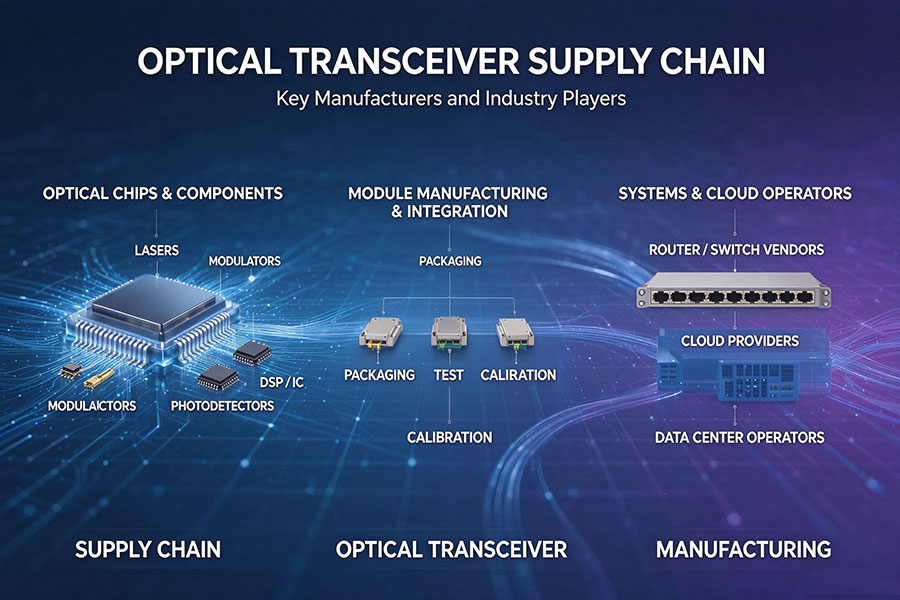
Optical transceivers are the result of a multi-layer supply chain that connects semiconductor fabrication, photonic components, precision packaging, electronic design and high-volume module manufacturing. A finished 400G or 800G transceiver may carry a single manufacturer's brand, but its production can depend on specialized suppliers across several countries and technology segments. As AI data centers accelerate demand for higher-speed optical connectivity, the relationships between chip designers, laser manufacturers, component suppliers, module integrators and contract manufacturers are becoming increasingly important to the industry's competitiveness.
1. How the Optical Transceiver Supply Chain Is Structured
The optical transceiver supply chain can be divided into several connected layers. Upstream suppliers provide semiconductor materials, wafers and optical components. Specialized manufacturers produce lasers, photodetectors, DSPs, drivers and other electronic or photonic devices. Module manufacturers integrate these components into complete transceivers, while contract manufacturers may support assembly and production at scale.
At the downstream end, networking equipment vendors, data center operators, telecom carriers and system integrators deploy the finished products in switches, routers, servers and optical transport systems.
| Supply Chain Layer | Main Products or Services | Representative Industry Participants |
|---|---|---|
| Semiconductor materials and wafers | InP, GaAs, silicon wafers and specialty substrates | AXT, specialized wafer and semiconductor material suppliers |
| Optical chips and photonic devices | Laser diodes, photodetectors, modulators and photonic integrated circuits | Coherent, Lumentum, Mitsubishi Electric, Broadcom |
| Electronic chips | DSPs, TIAs, laser drivers, retimers and control ICs | Broadcom, Marvell, MACOM, Semtech, Credo |
| Passive optical components | Connectors, isolators, filters, lenses, fiber arrays and optical interfaces | SENKO, Amphenol, Molex, TE Connectivity and specialist component suppliers |
| Optical module manufacturing | 400G, 800G, 1.6T, coherent and industrial transceivers | Coherent, InnoLight, Eoptolink, Accelink, Source Photonics |
| Contract manufacturing | Module assembly, photonic packaging, testing and production services | Fabrinet and other manufacturing service providers |
| Networking equipment and deployment | Switches, routers, servers, optical transport and data center systems | Cisco, Arista Networks, NVIDIA, Nokia and hyperscale operators |
This structure is not a rigid division of responsibilities. Some companies operate across several layers. Coherent, for example, has capabilities spanning optical components and finished transceivers, while Broadcom participates in high-speed semiconductor and optical connectivity technologies. The actual sourcing model varies by product family and customer program.
2. Semiconductor Materials and Wafer Suppliers
The upstream supply chain begins with the materials and wafers used to manufacture optical and electronic devices. Different semiconductor materials are selected according to their electrical and photonic properties.
Indium Phosphide (InP)
InP is an important material for high-performance optical devices, particularly lasers and certain photodetectors and photonic integrated circuits. It supports efficient light generation and operation at wavelengths used in fiber-optic communications. As optical data rates increase, InP-based devices remain relevant to applications requiring high-speed modulation and reliable optical output.
Gallium Arsenide (GaAs)
GaAs is widely associated with VCSEL technology, which is used in short-reach multimode optical links. VCSEL-based products are important in data center environments where short-distance connections and parallel optical transmission are required.
Silicon and Specialty Substrates
Silicon is the foundation of silicon photonics platforms. It supports the integration of optical waveguides and other photonic structures with semiconductor manufacturing processes. Specialty substrates and packaging materials are also required for high-frequency electronic devices and advanced optical assemblies.
AXT is an example of a company involved in compound semiconductor substrate materials. However, wafer suppliers and finished-device manufacturers are different parts of the chain: supplying a substrate does not mean that a company manufactures the final laser or transceiver.
3. Laser and Photonic Component Manufacturers
Laser sources and photonic devices are among the most important components in an optical transceiver. Their performance affects transmission distance, optical power, modulation capability, wavelength stability and overall link reliability.
| Company | Industry Role | Relevant Technology Areas |
|---|---|---|
| Coherent | Optical component and module manufacturer | InP lasers, VCSELs, photodetectors, silicon photonics and transceivers |
| Lumentum | Optical component and laser supplier | EML lasers, CW lasers, VCSELs and photonic components |
| Mitsubishi Electric | Optical semiconductor and component supplier | EML lasers, photodiodes and optical devices |
| Broadcom | Semiconductor and optical connectivity supplier | High-speed optical components and silicon photonics-related technologies |
| Sumitomo Electric | Optical and electronic component manufacturer | Optical devices, lasers, photodiodes and fiber-related technologies |
Different laser technologies serve different link requirements. EML devices combine a laser source with an electro-absorption modulator and are used in high-speed single-mode applications. DFB lasers are used in various single-mode optical designs, while VCSELs are common in short-reach multimode applications. Continuous-wave lasers can also provide optical sources for silicon photonics architectures that use external modulation.
At 800G and 1.6T, the requirements for optical power, modulation bandwidth, thermal stability and manufacturing consistency become more demanding. The availability and production yield of suitable laser chips can therefore influence the output of complete transceiver product lines.
4. DSP and High-Speed Semiconductor Suppliers
Optical modules need electronic circuits to convert, condition and process high-speed signals. In many pluggable transceivers, the DSP is a central component that supports signal conditioning, equalization, clock recovery and other functions required by the optical architecture.
Other important electronic components include transimpedance amplifiers (TIAs), laser drivers, retimers, control ICs and power-management devices.
| Company | Primary Supply Chain Position | Relevant Technology |
|---|---|---|
| Broadcom | High-speed semiconductor supplier | PAM4 DSPs, networking silicon and optical connectivity technologies |
| Marvell | High-speed and optical semiconductor supplier | Optical DSPs, coherent DSPs and connectivity processors |
| MACOM | Analog and optical semiconductor supplier | TIAs, laser drivers, amplifiers and related high-speed components |
| Credo | High-speed connectivity semiconductor supplier | Retimers, DSP-related technologies and active electrical connectivity |
| Semtech | Signal integrity and connectivity semiconductor supplier | Signal conditioning and high-speed optical/electrical components |
DSP selection affects module power consumption, signal performance and compatibility with the host platform. As electrical lane rates increase, the semiconductor design must manage tighter signal-integrity margins and more demanding processing requirements.
Not all optical modules use the same DSP architecture. Some linear pluggable optics designs reduce or eliminate conventional DSP retiming inside the module, shifting more responsibility to the host electrical interface. Coherent transceivers also use specialized digital signal processing that differs from the processing architecture of many direct-detect datacom modules.
5. Passive Optical Components and Connectivity Suppliers
Optical transceivers require more than lasers and electronic chips. Passive components guide, couple, filter and connect optical signals. Their precision and reliability influence insertion loss, optical alignment, return loss and long-term operating stability.
Important component categories include:
Optical connectors: LC, MPO/MTP and other interfaces used to connect modules to fiber infrastructure.
Fiber arrays: Align multiple optical fibers with photonic devices or optical engines.
Optical filters and multiplexers: Separate or combine wavelengths in WDM-based transmission systems.
Isolators and lenses: Support optical direction control, coupling and beam alignment.
Precision mechanical components: Provide module housings, alignment structures and thermal interfaces.
Companies such as SENKO, Amphenol, Molex and TE Connectivity participate in connector, interconnect or related component markets. Corning is a major supplier of optical fiber and cable infrastructure. Their products support the broader optical connectivity ecosystem, although not every supplier is directly involved in assembling transceiver modules.
For high-density 800G and 1.6T systems, connector insertion loss, fiber alignment, mechanical tolerances and repeatable assembly become especially important. Small variations in optical coupling can affect manufacturing yield and link performance.
6. Major Optical Transceiver Manufacturers
Optical transceiver manufacturers integrate electronic chips, photonic devices, passive components and mechanical structures into finished modules. They are responsible for product architecture, component selection, optical and electrical design, firmware integration, testing and customer qualification.
| Manufacturer | Market Position | Product and Technology Areas |
|---|---|---|
| Coherent | Vertically integrated photonics and transceiver supplier | Datacom transceivers, coherent optics, lasers and photonic components |
| InnoLight Technology | High-speed data center transceiver manufacturer | 400G, 800G and next-generation optical modules |
| Eoptolink Technology | Optical module manufacturer | Datacom transceivers across multiple speed generations |
| Accelink Technologies | Optical communication component and module supplier | Optical transceivers and telecom/datacom optical devices |
| Source Photonics | Optical transceiver manufacturer | Datacom and telecom optical modules |
| Sumitomo Electric | Optical device and module manufacturer | Optical transceivers, lasers and communication components |
| Fujitsu Optical Components | Optical component and transceiver supplier | High-speed optical devices and transmission modules |
| Applied Optoelectronics (AOI) | Optical component and transceiver manufacturer | Datacenter and broadband optical products |
| Hisense Broadband | Optical communication product manufacturer | Datacom and telecom optical modules |
| O-Net Technologies | Optical component and module supplier | Optical devices, components and transceiver products |
These companies differ in scale, product mix, manufacturing model and target customers. Some have substantial internal component capabilities, while others rely more heavily on external suppliers for lasers, DSPs or photonic devices.
Market leadership also varies by product category. A company with a strong position in telecom coherent modules may not have the same position in short-reach multimode products or high-volume AI data center transceivers. Manufacturer comparisons should therefore consider the specific speed, reach, form factor and application.
7. Contract Manufacturing and Optical Module Assembly
Optical transceiver manufacturing involves precision processes that combine electronic and photonic components in a compact enclosure. These processes include chip attachment, wire bonding or other electrical interconnection, optical alignment, fiber coupling, housing assembly and final testing.
Some optical companies operate their own manufacturing facilities, while others use external manufacturing partners for selected production stages. Contract manufacturing can provide additional capacity, specialized assembly expertise and geographic flexibility.
Fabrinet is a prominent example of a manufacturing service provider involved in optical communications and photonics assembly. Its role differs from that of a branded transceiver vendor: a contract manufacturer produces equipment or assemblies for customers rather than necessarily selling the finished product under its own brand.
Typical manufacturing activities include:
Precision placement and attachment of optical and electronic components.
Laser and photodetector alignment with optical paths.
Fiber-array and connector assembly.
Thermal interface and mechanical housing integration.
Electrical, optical and environmental testing.
Production traceability and quality-control procedures.
At higher data rates, manufacturing repeatability becomes increasingly important. Optical alignment tolerances, component variation and thermal behavior can influence production yield. Automated test equipment and process controls are therefore central to scaling high-speed module production.
8. Network Equipment Vendors and End Customers
Downstream demand is generated by the companies that build, operate and expand communication networks. Their product requirements influence optical module specifications, interoperability testing and supplier qualification.
Networking Equipment Vendors
Cisco, Arista Networks, NVIDIA and Nokia are examples of companies providing networking equipment and platforms that use optical connectivity. Their switch, router and transport-system designs determine supported form factors, data rates, host electrical interfaces and module operating requirements. Cisco's Acacia business also contributes coherent optical technology to the networking ecosystem.
Hyperscale Cloud and Data Center Operators
Large cloud providers and data center operators purchase optical modules for server connectivity, leaf-spine networks, AI clusters and data center interconnect. Their procurement decisions can influence product roadmaps, qualification requirements and production volumes.
Telecom Carriers and Transport Network Operators
Telecom operators use optical transceivers in metro, regional and long-haul networks. Their requirements often emphasize transmission distance, coherent performance, optical line-system compatibility, reliability and network monitoring.
The downstream market is not a single homogeneous customer group. AI data centers, enterprise networks and telecom transport systems use different optical technologies and have distinct purchasing criteria.
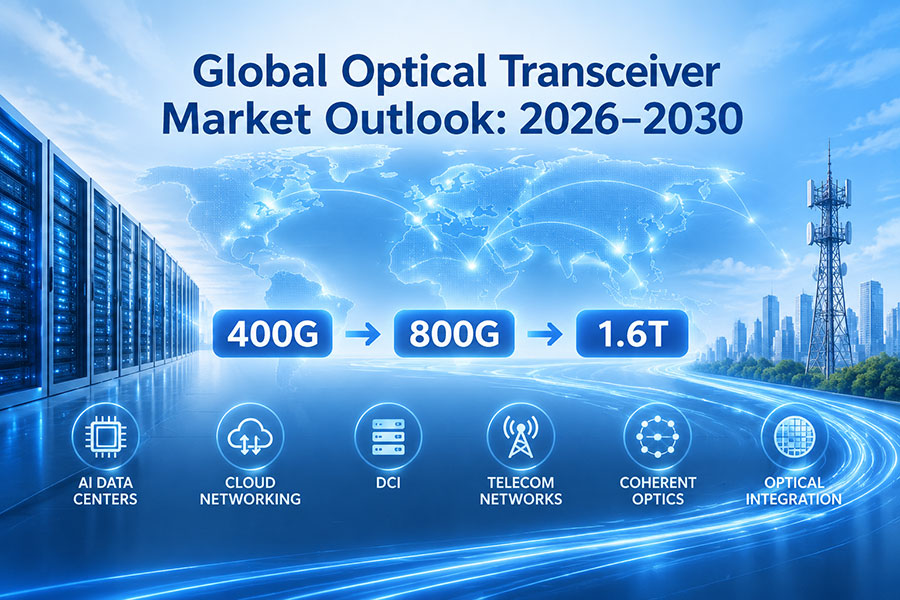
9. How the Supply Chain Changes from 400G to 800G and 1.6T
Higher data rates increase pressure on nearly every part of the optical transceiver supply chain. A 400G module already requires advanced electrical and optical integration, but 800G and 1.6T designs introduce more demanding lane speeds, component bandwidth and thermal constraints.
| Technology Area | 400G Generation | 800G Generation | 1.6T Development |
|---|---|---|---|
| Electrical interface | 50G-class and 100G-class lane implementations | Commonly 100G-class lanes | Increasing use of 200G-class lanes |
| Optical components | Established laser and photodetector technologies | Higher bandwidth and tighter performance requirements | More demanding component bandwidth and integration |
| DSP and electronics | High-speed PAM4 processing | More demanding signal processing and power optimization | Advanced 200G-per-lane electrical and optical design |
| Packaging | Pluggable module integration | Higher port density and thermal constraints | Greater focus on advanced photonic integration and packaging |
| Manufacturing | Established high-volume production for major designs | Capacity expansion and qualification of new designs | Yield, component availability and process maturity remain important |
The move to 800G and 1.6T does not mean that all suppliers must replace their existing technologies at the same time. Some companies specialize in lasers, others in DSPs or optical packaging, and module manufacturers combine these technologies into complete products. The transition therefore creates opportunities across multiple supply chain layers.
10. Supply Chain Risks and Manufacturing Constraints
Optical transceiver production depends on a combination of specialized components and manufacturing processes. A disruption in one critical component category can affect the availability of complete modules, even when other parts of the supply chain have sufficient capacity.
Specialized Component Availability
High-performance lasers, photodetectors and DSPs require specialized semiconductor processes. The number of qualified suppliers for certain component types may be limited, particularly when new speed generations are introduced.
Manufacturing Yield
Optical alignment and photonic packaging require precision. Small variations in coupling efficiency, electrical performance or thermal behavior can reduce production yield. Scaling a new design from engineering samples to volume manufacturing is therefore a significant challenge.
Qualification and Compatibility
Modules must pass testing in the intended host platforms. Different switch vendors may impose specific requirements for firmware, module identification, diagnostics and operating behavior. Qualification delays can affect product launches and customer deployment schedules.
Geographic and Logistics Concentration
Semiconductor fabrication, optical component production, module assembly and final equipment integration may take place in different regions. This creates exposure to logistics disruptions, trade restrictions, regional manufacturing concentration and changes in sourcing requirements.
Demand Fluctuations
AI infrastructure investment can create rapid changes in demand for selected optical products. Suppliers must balance capacity expansion with the risk of over-investment if customer deployment schedules or technology preferences change.
11. Vertical Integration and Strategic Supplier Relationships
Vertical integration is an important competitive factor in the optical transceiver industry. A vertically integrated company controls several stages of the supply chain, such as semiconductor devices, photonic components, module design and final assembly.
This structure can improve coordination between component design and module performance. It may also provide better visibility into component availability and manufacturing schedules. However, vertical integration requires substantial investment in fabrication facilities, engineering capabilities and production equipment.
Other manufacturers use a more specialized sourcing model. They purchase lasers, DSPs and passive components from external suppliers, then focus their resources on module architecture, integration, testing and customer support. This approach can provide flexibility and reduce the need to own every manufacturing process.
Neither model is automatically superior. The appropriate structure depends on product complexity, manufacturing volume, component availability, intellectual property and customer requirements. In practice, the industry includes vertically integrated suppliers, specialized component manufacturers and module companies that combine internal and external capabilities.
12. What Buyers Should Evaluate When Selecting a Transceiver Supplier
Choosing an optical transceiver supplier involves more than comparing product prices or published data rates. Buyers should assess the manufacturer's technical capabilities, manufacturing consistency, component sourcing and ability to support the intended equipment platform.
| Evaluation Area | Questions to Consider |
|---|---|
| Product portfolio | Does the supplier support the required speeds, reaches, wavelengths and form factors? |
| Component sourcing | Are critical lasers, DSPs and other components supported by qualified sourcing arrangements? |
| Manufacturing capability | Can the supplier maintain consistent production quality and meet expected volume requirements? |
| Compatibility | Has the module been tested in the intended switch, router or server platform? |
| Optical performance | Are transmit power, receiver sensitivity, wavelength and BER performance within specification? |
| Quality assurance | Are production testing, traceability and reliability procedures clearly established? |
| Technical support | Can the supplier assist with qualification, troubleshooting and product lifecycle requirements? |
| Supply continuity | Are lead times, production capacity and product change notifications managed effectively? |
For high-speed deployments, compatibility testing should include the exact host model, software version and port configuration. Optical specifications alone cannot guarantee that a module will operate correctly in every networking platform.
Buyers evaluating optical module options can review optical transceiver solutions and confirm the required interface, transmission distance and equipment compatibility before deployment.
13. Industry Outlook: A More Integrated Optical Ecosystem
The optical transceiver supply chain is evolving as AI data centers and high-capacity networks increase demand for 800G and emerging 1.6T products. Market research from MarketsandMarkets identifies a broad competitive field that includes module manufacturers, component suppliers and networking companies. Its company coverage includes Coherent, Lumentum, InnoLight, Eoptolink, Accelink, Sumitomo Electric, Broadcom and Marvell, among others.
Several developments are likely to influence the industry's structure:
Greater photonic integration: Silicon photonics and advanced optical packaging are creating new relationships between chip designers, component suppliers and module manufacturers.
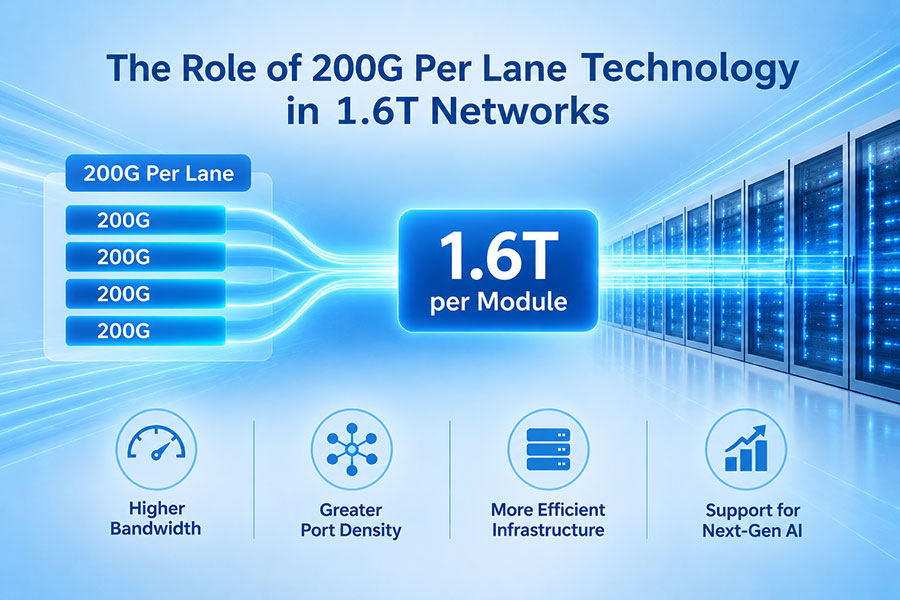
Higher-speed component requirements: 200G-class electrical and optical lanes increase the importance of advanced lasers, DSPs and photodetectors.
More manufacturing specialization: Contract manufacturers and photonic packaging providers can support companies seeking additional production capacity.
Closer customer collaboration: Module suppliers are working more closely with switch and system vendors to qualify products against specific platforms.
Supply-chain diversification: Manufacturers are evaluating sourcing flexibility and production locations to reduce exposure to individual suppliers or regions.
Co-packaged optics and optical I/O may also change the traditional boundary between transceiver manufacturers and semiconductor companies. As optical engines move closer to switching or computing ASICs, component design, packaging and system architecture become more closely connected.
These developments do not mean that pluggable transceivers will disappear in the near term. Pluggable modules retain advantages in serviceability, replacement flexibility and established deployment practices. Different optical integration models are likely to coexist according to system requirements.
14. Conclusion
The optical transceiver industry is supported by a global supply chain that extends from semiconductor materials and photonic chips to DSPs, passive components, module assembly and network deployment. Companies such as Coherent, Lumentum, Broadcom, Marvell, InnoLight, Eoptolink, Accelink and Fabrinet occupy different positions within this ecosystem, while connector, fiber and equipment suppliers provide the infrastructure needed to complete the system.
As the market moves from 400G toward 800G and 1.6T, competitive strength will depend on more than module design. Access to qualified components, manufacturing yield, advanced packaging, host compatibility and reliable production capacity will all influence supplier performance. Understanding the relationships between these industry participants provides a clearer view of how optical connectivity products are developed, manufactured and delivered to the global market.
For optical connectivity requirements, product information or technical discussions, Contact C-LIGHT.
 >

 >
 >
 >
 >
 >
 >
 >