TEL:+86 132 6656 7067





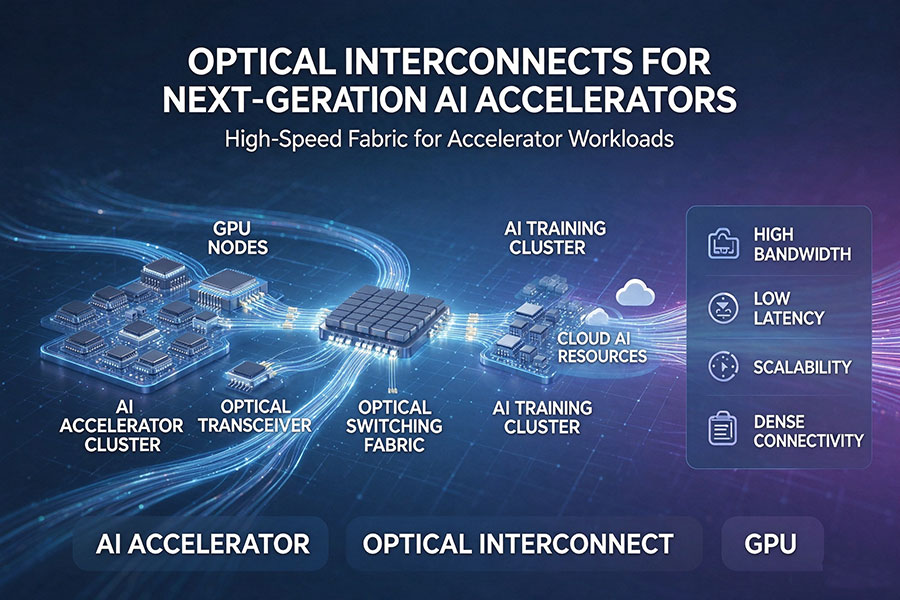
Next-generation AI accelerators are increasing the amount of data that must move between GPUs, memory systems, network switches and distributed compute nodes. As accelerator performance grows, electrical interconnects face increasing pressure from signal loss, power consumption, channel reach and physical connector density. Optical connectivity is therefore becoming an increasingly important part of AI infrastructure, extending beyond conventional switch-to-switch links toward closer integration with compute silicon.
The requirements are not limited to higher transmission rates. AI accelerator interconnects must also deliver predictable latency, low energy consumption per bit, high port density, reliable operation and interoperability across different system architectures. These requirements vary significantly between scale-up, scale-out and scale-across networks.
1. Why Next-Generation AI Accelerators Need Advanced Optical Interconnects
AI accelerator performance depends on more than the arithmetic capacity of individual processors. Large models distribute computation across multiple GPUs, and the resulting system must continuously exchange data among compute devices, memory resources and network endpoints.
Several workload characteristics increase interconnect demand:
Distributed training: GPUs exchange gradients, parameters and intermediate results through collective communication operations.
Model parallelism: Large models may be partitioned across multiple accelerators, requiring frequent communication between partitions.
Mixture-of-experts architectures: Token routing can generate substantial traffic between different groups of accelerator devices.
Distributed inference: Model execution, KV-cache movement and parallel processing can require high-bandwidth communication between servers.
Memory-intensive workloads: Data movement between compute and memory resources can become a limiting factor as processing throughput increases.
When communication capacity does not scale with compute performance, accelerators may spend more time waiting for data or synchronization. Increasing network bandwidth is therefore important, but the interconnect must also preserve signal quality, reduce energy consumption and support practical system integration.
2. Three Interconnect Domains: Scale-Up, Scale-Out and Scale-Across
Optical interconnect requirements depend strongly on where the connection sits in the AI infrastructure. The three main connectivity domains have different distances, traffic patterns and physical constraints.
2.1 Scale-up: Accelerator-to-accelerator connectivity
Scale-up networks connect accelerators within a tightly coupled compute domain, such as a server or multi-rack accelerator system. They support communication among GPUs and other high-performance compute resources.
Traditional scale-up architectures often use high-speed electrical links and dedicated switching fabrics. Copper remains attractive for short connections because it can provide low latency and avoid optical conversion. However, increasing signaling rates and connection density make electrical channel loss, reach and routing more difficult to manage.
Optical scale-up is attracting attention as accelerator systems extend beyond the practical reach or density of conventional electrical connections. Optical I/O, near-package optics and co-packaged optics are among the approaches being developed for this transition.
2.2 Scale-out: Server-to-server and rack-to-rack connectivity
Scale-out networks connect accelerator servers and racks through high-capacity Ethernet or InfiniBand fabrics. They commonly use leaf-spine or Clos topologies to provide multiple paths across a large cluster.
Optical transceivers are important for switch-to-switch and rack-to-rack connections, particularly where link distances, bandwidth density or cable management make optical fiber suitable. 400G and 800G interfaces are established parts of this environment, while 1.6T interfaces are emerging for higher-capacity platforms.
2.3 Scale-across: Data center and campus connectivity
Scale-across networks connect separate data centers, campuses or geographically distributed compute facilities. These links may span hundreds of meters to many kilometers, depending on the deployment.
Single-mode fiber, coherent optical technology and DWDM systems can support high-capacity connections over these distances. The design must account for optical reach, fiber loss, wavelength planning, amplification, dispersion and operational resilience.
| Connectivity domain | Typical endpoints | Primary requirements | Common technologies |
|---|---|---|---|
| Scale-up | GPU-to-GPU, accelerator-to-switch | Very high bandwidth density, low latency, short-reach signal integrity and low power | High-speed electrical links, optical I/O, NPO and CPO |
| Scale-out | Server-to-switch, rack-to-rack | High aggregate bandwidth, scalable topology and manageable cabling | 400G/800G optics, emerging 1.6T optics, DAC and AOC |
| Scale-across | Data center-to-data center, campus links | Longer reach, high capacity, optical performance and resilience | Single-mode optics, coherent transceivers and DWDM |
3. Bandwidth Density and Per-Lane Data Rates
One of the most important requirements for next-generation AI interconnects is higher bandwidth density. As accelerator and switch ASIC capacities increase, the physical interfaces connecting them must carry more data without requiring an impractical number of ports, cables or connectors.
Aggregate interface bandwidth is determined by the number of lanes and the signaling rate of each lane. Increasing either factor can raise total capacity, but both approaches have physical and implementation constraints.
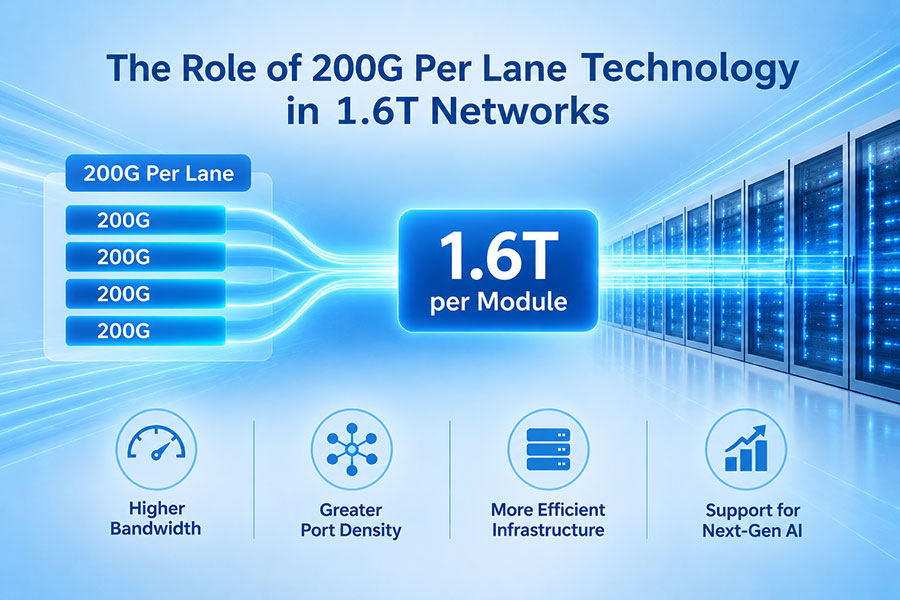
For example, an 800G optical interface may use eight electrical lanes operating around 100G-class signaling, while emerging 1.6T implementations move toward eight 200G-class electrical lanes. Actual lane mapping, modulation and host electrical specifications depend on the module and platform architecture.
Moving toward 200G-per-lane signaling places greater demands on electrical channel design, transmitter and receiver performance, packaging and optical conversion. The industry is also working on 448G-class electrical interface frameworks for future systems, although these developments should not be confused with a universal production requirement for current AI accelerators.
4. Low Power Consumption and Energy per Bit
Power efficiency is a major consideration for large AI installations. A data center may contain thousands of high-speed network connections, so even modest differences in power consumption per interface can become significant at system scale.
Optical interconnect power is influenced by several components:
Electrical signal conditioning: Drivers, equalizers, retimers and DSPs consume power while preparing signals for transmission.
Optical transmitters: Laser sources and modulation components require electrical power to generate and control optical signals.
Optical receivers: Photodetectors, TIAs and downstream signal-processing circuits contribute to receiver power.
Thermal management: Higher component power creates additional cooling requirements, particularly in densely populated switch systems.
Host-side electronics: ASIC SerDes and associated electrical channels also contribute to the total energy required for each transmitted bit.
A useful metric is energy per bit, commonly expressed in picojoules per bit (pJ/bit). However, comparisons must use consistent measurement boundaries. Module-only power does not represent the total energy of a complete link, which also includes host SerDes, retimers, optical engines and other supporting electronics.
For next-generation AI systems, the objective is not simply to reduce optical module power. It is to minimize the energy required to move useful data across the complete compute and network architecture.
5. Signal Integrity at Higher Electrical Speeds
Although optical fiber provides low-loss transmission over suitable distances, optical modules still depend on high-speed electrical interfaces between host ASICs and optical components. These electrical channels become more difficult to design as signaling rates increase.
Important signal-integrity challenges include:
Insertion loss: Electrical signal amplitude decreases as signals travel through PCB traces, connectors and cables.
Return loss: Impedance discontinuities cause part of the signal energy to reflect toward the transmitter.
Crosstalk: Nearby electrical channels can interfere with one another, affecting signal quality.
Jitter: Timing variations can reduce the receiver's ability to distinguish symbols reliably.
Equalization complexity: Higher-speed links may require more sophisticated signal compensation and careful channel characterization.
These constraints influence the choice between conventional retimed modules, linear-drive optics, near-package optics and co-packaged optics. Each architecture distributes signal-processing responsibilities differently between the host ASIC and optical interface.
6. Optical I/O: Moving Optical Conversion Closer to Compute
Conventional pluggable optics are positioned at the front panel of a switch or network device. Electrical signals travel from the ASIC across the host board to the module, where they are converted into optical signals.
As bandwidth increases, the electrical distance between the ASIC and front-panel module can become a significant design constraint. Optical I/O approaches move the electrical-to-optical conversion closer to the compute or switching silicon, reducing the length of demanding high-speed electrical channels.
This is particularly relevant to future accelerator systems that require very high bandwidth between compute devices and network fabrics. The goal is to improve bandwidth density and energy efficiency while reducing the limitations associated with long electrical connections.
7. Pluggable Optics, LPO, NPO and CPO Architectures
Several optical architectures are being developed to address the increasing bandwidth and power requirements of AI systems. They differ in where optical conversion occurs, how much signal processing remains inside the module and how components are serviced.
7.1 Conventional pluggable optical transceivers
Pluggable modules place the optical transmitter and receiver in a replaceable module that connects to the host through an electrical interface. This architecture provides flexibility in module selection, optical reach and maintenance.
It remains useful for switch-to-switch and server-to-switch connections. Its main design challenge at higher speeds is the electrical channel between the ASIC and front-panel module, along with the power and cooling required by increasingly capable modules.
7.2 Linear Pluggable Optics
Linear Pluggable Optics (LPO) reduces or removes conventional DSP retiming within the optical module in suitable architectures. This can lower module power and latency, but it also places greater responsibility on the host SerDes and electrical channel.
LPO is therefore sensitive to host signal quality, channel characteristics and interoperability. It is not a universal replacement for retimed pluggable optics, especially where longer or more challenging electrical channels require additional signal conditioning.
7.3 Near-Packaged Optics
Near-Packaged Optics (NPO) places optical engines close to the host ASIC while keeping them outside the ASIC package. This shortens high-speed electrical connections and can provide greater optical bandwidth density than conventional front-panel arrangements.
NPO designs introduce new requirements for mechanical integration, optical connector placement, thermal interfaces, power delivery and maintenance access. The details depend on the implementation and the system-level packaging design.
7.4 Co-Packaged Optics
Co-Packaged Optics (CPO) integrates optical engines close to or within the same package assembly as the switching or compute ASIC. The architecture aims to reduce high-speed electrical channel length and support dense optical connectivity.
CPO can offer advantages in bandwidth density and energy efficiency, but it also changes how optical components are packaged, powered, cooled and serviced. External laser sources are one approach to separating laser generation from the hottest parts of the package.
| Architecture | Optical engine location | Potential advantages | Key considerations |
|---|---|---|---|
| Pluggable optics | Front-panel module | Replaceability, flexibility and established deployment practices | Host electrical channel, module power and front-panel density |
| LPO | Front-panel module with linear signal path | Potentially lower module power and latency | Host signal integrity and interoperability |
| NPO | Near the ASIC, outside its package | Shorter electrical paths and higher bandwidth density | Packaging, thermal integration and serviceability |
| CPO | Integrated with the ASIC package assembly | Very short electrical paths and dense optical I/O | Laser architecture, thermal management, reliability and maintenance |
8. Silicon Photonics and Optical Engine Integration
Silicon photonics is an important technology for building compact optical engines. It uses silicon-based photonic structures to integrate optical functions such as waveguides, modulators and other components into a photonic circuit.
For AI accelerator systems, silicon photonics can support high-density optical interfaces and integration with advanced electronic packaging. It is relevant to pluggable modules as well as emerging NPO and CPO architectures.
However, silicon photonics is not a complete interconnect architecture by itself. A practical optical engine also requires a suitable light source, coupling structures, photodetectors, electrical drivers, receiver circuits, packaging and thermal management.
Laser integration is particularly important. Some designs integrate light sources with the photonic platform, while others use external continuous-wave laser sources. The choice depends on thermal conditions, reliability, optical power requirements and manufacturing considerations.
9. Optical Reach, Fiber Type and Connector Requirements
AI accelerator systems use optical connections across different distances. A suitable optical interface must match the physical reach, fiber infrastructure, connector configuration and link budget.
| Optical interface category | Typical fiber environment | Example application | Design considerations |
|---|---|---|---|
| Short-reach parallel optics | Multimode fiber | Short connections within data center environments | Fiber grade, parallel lane mapping and connector configuration |
| Single-mode parallel optics | Single-mode fiber | High-bandwidth server and switch connections | Optical lane count, reach, insertion loss and fiber polarity |
| Wavelength-multiplexed optics | Single-mode fiber | Duplex-fiber links with multiple optical channels | Wavelength plan, optical budget and receiver specifications |
| Coherent optics | Single-mode fiber | Longer-reach data center interconnect and transport | OSNR, dispersion, modulation, FEC and line-system compatibility |
Connector selection is equally important. MPO/MTP interfaces are used by many parallel-optics implementations, while duplex LC connectors are common in several wavelength-multiplexed interfaces. Exact connector type and fiber mapping must be checked against the transceiver specification.
High-density optical systems also require careful management of polarity, insertion loss, connector cleanliness, bend radius and cable routing. These details directly affect link reliability and maintenance efficiency.
10. Latency and Reliability Requirements
Optical interconnects must support predictable communication behavior, particularly in tightly coupled accelerator systems. Although fiber propagation and optical conversion contribute to link delay, the total latency also includes host SerDes processing, DSP or retiming, switching, queuing and protocol behavior.
For this reason, optical link selection should consider the complete communication path rather than the optical medium alone.
Reliability requirements also become more important as the number of connections increases. A large accelerator installation may contain many optical links, and failures or intermittent errors can affect workload completion and system availability.
Relevant design and operational measures include:
Stable transmitter output and receiver sensitivity within specified operating conditions.
Appropriate optical power budget and link margin.
Low bit error rate and suitable FEC configuration.
Thermal stability across the intended operating environment.
Connector cleanliness and controlled fiber handling.
Module diagnostics, link monitoring and fault isolation.
Interoperability testing across host platforms and optical interfaces.
11. Thermal Management and High-Density Packaging
AI accelerator systems already operate under demanding thermal conditions. Optical engines placed near high-power ASICs must function within the thermal limits of their components while maintaining stable optical performance.
Thermal design affects laser characteristics, photonic components, electronic drivers and receiver circuits. Temperature variation can influence wavelength behavior, output power, receiver performance and overall reliability.
Pluggable optics, NPO and CPO have different thermal arrangements. Front-panel modules can be serviced independently but require adequate airflow around densely populated ports. NPO and CPO shorten electrical paths but place optical components closer to heat-generating compute or switching silicon.
External laser sources can help separate light generation from high-temperature regions, but they introduce additional optical connections and system-level management requirements. Liquid cooling and other advanced cooling methods may be relevant to certain high-density platforms, depending on their mechanical and thermal design.
12. Interoperability and Standards Development
Next-generation optical interconnects require coordination across ASIC vendors, module manufacturers, connector suppliers, photonic component providers and system integrators. Without consistent electrical, optical and management interfaces, multi-vendor integration becomes more difficult.
The Optical Internetworking Forum (OIF) is developing specifications covering high-speed electrical interfaces, energy-efficient optical interfaces, optical packaging and management. Its work includes 224G and 448G electrical interface projects, linear optical interfaces, compute optics and near-package optical modules.
Common management interfaces are also important. They support module identification, configuration, monitoring, diagnostics and interoperability across different host systems. As optical architectures become more diverse, consistent management behavior will be essential for large-scale deployment.
Standards development does not mean that every new interface is already commercially deployed. Engineering teams should distinguish published implementation agreements, active projects, interoperability demonstrations and production-ready products.
13. Practical Optical Interconnect Selection for AI Systems
Selecting an optical interconnect requires matching the interface to the accelerator platform, switch architecture and physical deployment. A high aggregate data rate is only one part of the decision.
| Selection factor | Questions to evaluate |
|---|---|
| Bandwidth | What aggregate data rate and per-lane signaling does the host support? |
| Reach | Is the connection within a rack, between racks or across separate facilities? |
| Fiber type | Does the link require multimode or single-mode fiber? |
| Connector | Does the interface use MPO/MTP, LC or another specified connector? |
| Power | What is the module or optical-engine power, and how does it affect the system budget? |
| Thermal conditions | Can the host provide suitable airflow or cooling at the intended installation point? |
| Signal integrity | Does the host electrical channel meet the module or optical-engine requirements? |
| Compatibility | Are the switch, NIC, firmware, lane mapping and management interfaces supported? |
| Reliability | Are link margin, FEC behavior, diagnostics and fault recovery suitable for the application? |
| Maintenance | Can the optical interface be accessed, replaced and tested without excessive system disruption? |
For current deployments, pluggable optics remain a practical option where flexibility and serviceability are priorities. LPO, NPO and CPO should be evaluated according to the host architecture and system-level requirements rather than selected solely on theoretical power or bandwidth advantages.
14. The Development Direction of Optical Interconnects
The optical interconnect roadmap is moving toward higher per-lane data rates, greater bandwidth density and closer integration with compute and switching silicon. The transition involves both improvements to conventional pluggable modules and new packaging approaches.
Several development areas are particularly relevant:
800G and 1.6T optical interfaces: Increasing port bandwidth for high-capacity scale-out networks.
200G-per-lane signaling: Supporting higher aggregate interface rates while increasing electrical and optical design requirements.
448G electrical interface development: Addressing future chip-to-module, chip-to-chip and other high-speed electrical channels.
Optical scale-up: Extending optical connectivity closer to accelerator devices as electrical reach and density become more challenging.
Silicon photonics: Supporting compact optical engines and advanced photonic integration.
External laser sources: Providing light for architectures that separate laser generation from optical engines near hot ASIC packages.
Advanced packaging: Developing NPO and CPO designs with suitable thermal, mechanical and serviceability characteristics.
These technologies are progressing at different stages. Their adoption will depend on manufacturing maturity, cost, reliability, interoperability and the performance requirements of specific accelerator platforms.
15. Conclusion
Next-generation AI accelerators require optical interconnects that deliver more than higher transmission speeds. Bandwidth density, energy per bit, signal integrity, latency, optical reach, thermal performance and interoperability all influence the efficiency of large AI systems.
Scale-out networks already rely heavily on high-speed optical connectivity, while scale-up architectures are creating new opportunities for optical I/O, NPO and CPO. Silicon photonics, 1.6T interfaces and higher per-lane signaling are important parts of this development, but practical deployment depends on complete system integration.
The most suitable optical interconnect is determined by the connection domain, host electrical interface, distance, power budget and operational requirements. As AI accelerator architectures continue to evolve, optical connectivity will become an increasingly important foundation for scalable, energy-efficient computing infrastructure.
For high-speed optical connectivity requirements, view the optical transceiver product range or Contact C-LIGHT.
 >

 >
 >
 >
 >
 >
 >
 >