TEL:+86 132 6656 7067





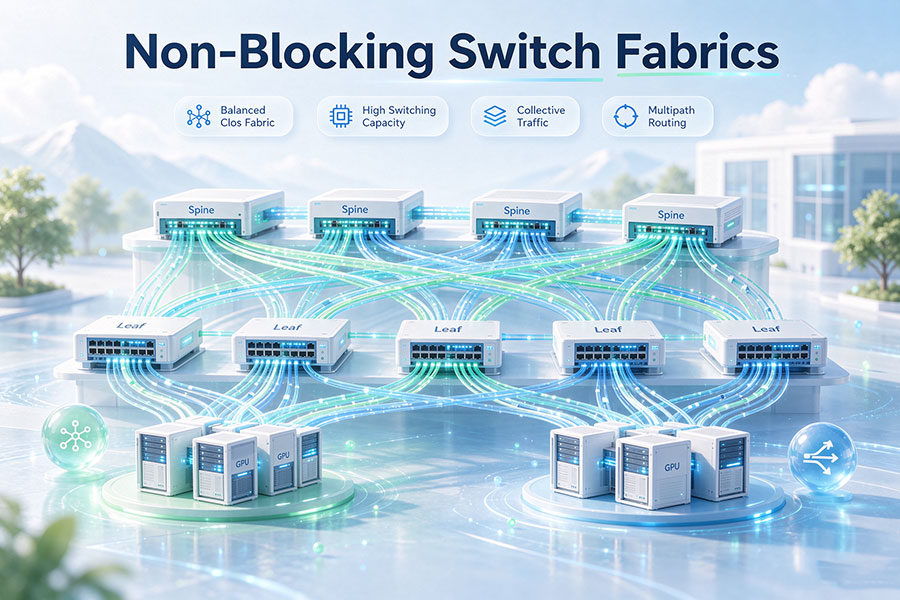
Collective communication places demanding and highly synchronized traffic patterns on GPU data center networks. When hundreds or thousands of GPUs exchange data through AllReduce, AllGather, ReduceScatter and All-to-All operations, the switching fabric must carry traffic across multiple servers and network paths without introducing persistent capacity bottlenecks. A non-blocking switch fabric is designed to provide sufficient internal and inter-switch bandwidth for supported traffic patterns, helping distributed workloads use available network capacity more efficiently.
1. Why Non-Blocking Switch Fabrics Matter for GPU Networks
Distributed GPU training relies on frequent communication between accelerators located in different servers. GPUs exchange gradients, parameters, activations and intermediate results, often in parallel across many network interfaces.
In a large cluster, the network must handle multiple communication flows at the same time. Even when every server has a high-speed NIC, insufficient switch capacity or oversubscribed uplinks can prevent the cluster from using the full aggregate bandwidth of its endpoints.
A non-blocking switch fabric addresses this challenge by providing enough switching and interconnection capacity to support the intended simultaneous traffic demand. It reduces the likelihood that traffic from one group of servers will compete for insufficient shared network resources.
This is particularly relevant to AI training clusters, where collective operations can create synchronized bursts of traffic across large portions of the network.
2. What Is a Non-Blocking Switch Fabric?
A non-blocking switch fabric is a switching system designed to support the required simultaneous input-to-output traffic without internal fabric capacity becoming the limiting factor, under the defined traffic model and port configuration.
In practical data center designs, this generally means that the aggregate bandwidth available through the switch fabric and its network connections is sufficient for the intended traffic demand.
Non-blocking behavior involves more than the number of ports. It depends on several factors:
Port bandwidth: The configured line rate of each active interface.
Switching capacity: The aggregate internal capacity available to move traffic between ports.
Inter-switch bandwidth: The capacity of links connecting leaf, spine and other switching stages.
Path availability: The number and capacity of usable paths between endpoint groups.
Traffic distribution: Whether simultaneous flows can use the available paths without persistent concentration on a limited resource.
A switch can have sufficient internal switching capacity but still participate in an oversubscribed network if its uplinks are undersized. Conversely, a well-provisioned multi-switch fabric can provide non-blocking behavior across a much larger endpoint population.
3. Internal Switching Capacity and Fabric Bandwidth
Switching capacity describes the aggregate rate at which a switch can process traffic through its switching architecture. Vendors may report this capacity using different conventions, so the measurement basis should be checked before comparing products.
For a simplified switch with N full-duplex ports operating at line rate R, the aggregate one-direction port capacity is:
One-direction aggregate capacity:
\(B=N\times R\)
Full-duplex aggregate capacity:
\(B_{\text{FD}}=2\times N\times R\)
For example, a switch with 64 ports operating at 400 Gb/s has 25.6 Tb/s of aggregate one-direction port capacity. Under a full-duplex accounting convention, the total transmit-plus-receive figure is 51.2 Tb/s.
This distinction matters because some published switching-capacity figures count both directions, while others use a different convention. A valid non-blocking assessment must compare switching capacity and port bandwidth using consistent accounting.
Packet processing capability also matters. A switch may have adequate bandwidth in bits per second but encounter limitations when processing large numbers of minimum-sized packets. Packet forwarding performance and fabric bandwidth should therefore be evaluated separately.
4. Blocking and Non-Blocking Architectures
A blocking fabric cannot support every intended simultaneous input-to-output traffic pattern at full requested bandwidth. Some flows must wait for shared resources or compete for limited internal or external capacity.
A non-blocking fabric is designed to avoid such capacity limitations for the traffic patterns covered by its design assumptions. It does not mean that packets can never experience queueing or that congestion is impossible.
| Characteristic | Blocking or oversubscribed fabric | Non-blocking fabric |
|---|---|---|
| Aggregate capacity | Some traffic patterns exceed available shared capacity | Capacity is provisioned for the intended simultaneous demand |
| Uplink design | Endpoint bandwidth may exceed uplink bandwidth | Inter-stage bandwidth is sized to support the target traffic model |
| Concurrent transfers | Competing flows may share constrained resources | More concurrent flows can operate at their intended rates |
| Congestion behavior | Higher risk of sustained queue buildup under demanding traffic | Lower risk of capacity-driven congestion under the design assumptions |
| Cost and resources | Can require fewer uplinks and switches | Usually requires more switching and interconnection capacity |
The distinction is about available capacity, not an absolute guarantee of zero delay. Even a fully provisioned fabric can experience temporary congestion when traffic is unevenly distributed or multiple flows target the same destination.
5. Clos and Leaf-Spine Architectures for Non-Blocking Fabrics
Clos networks are commonly used to build scalable non-blocking data center fabrics. Instead of relying on a single large switch, a Clos-style design connects multiple leaf and spine switches through a structured multi-stage topology.
In a two-tier leaf-spine architecture:
GPU servers connect to leaf switches.
Each leaf connects to multiple spine switches.
Spine switches provide paths between different leaf groups.
Multiple equal-cost paths can be available between endpoints connected to different leaves.
For a balanced design, the aggregate uplink capacity of each leaf can be provisioned to match its aggregate server-facing bandwidth. The spine layer must also have enough ports and switching capacity to support the complete leaf population.
Larger GPU fabrics may require additional switching stages when the number of leaf switches exceeds the practical port capacity of the spine layer.
Clos topology provides a scalable structure, but the topology itself does not automatically make a network non-blocking. Link rates, port allocation, switch capacity and routing behavior must all be considered.
6. Oversubscription and Its Effect on Available Bandwidth
Oversubscription occurs when the aggregate bandwidth of downstream ports exceeds the aggregate bandwidth of the uplinks connecting them to the next switching stage.
Oversubscription ratio:
\(\text{Ratio}=\frac{\text{Aggregate downlink bandwidth}}{\text{Aggregate uplink bandwidth}}\)
A 1:1 ratio means that downlink and uplink bandwidth are equal. A 2:1 ratio means that the aggregate downlink capacity is twice the available uplink capacity.
| Ratio | Downlink capacity | Uplink capacity | Potential effect |
|---|---|---|---|
| 1:1 | 400 Tb/s | 400 Tb/s | Equal aggregate capacity at both layers |
| 2:1 | 400 Tb/s | 200 Tb/s | Cross-switch traffic shares a smaller uplink capacity |
| 3:1 | 600 Tb/s | 200 Tb/s | Greater potential contention under simultaneous transfers |
| 4:1 | 800 Tb/s | 200 Tb/s | High oversubscription relative to endpoint bandwidth |
These are simplified aggregate examples. Actual application throughput depends on traffic locality, routing, flow distribution and the number of endpoints communicating across the oversubscribed boundary.
For GPU clusters, the impact can be significant because collective operations often generate simultaneous traffic across many servers. A network that performs well under low utilization may experience substantial performance degradation when all GPUs participate in large communication operations.
7. Bisection Bandwidth and Non-Blocking Fabric Design
Bisection bandwidth measures the aggregate capacity across a balanced division of a network. It helps determine how much traffic can move between two approximately equal groups of endpoints.
For a selected network cut, the one-direction bisection capacity can be expressed as:
\(B_{\text{bis}}=\sum_{e\in C}C_e\)
Where C represents the links crossing the cut and \(C_e\) is the usable one-direction capacity of each link.
A full-bisection design aims to provide enough capacity across the relevant balanced cuts to support the intended simultaneous traffic demand. In a symmetric Clos fabric, this commonly requires sufficient leaf-to-spine and spine switching capacity.
However, bisection bandwidth is an aggregate metric. It does not guarantee that every individual flow can achieve line rate, nor does it describe all possible congestion conditions. Traffic distribution and routing still determine how effectively the capacity is used.
8. How Non-Blocking Fabrics Improve AllReduce
AllReduce combines data from multiple GPUs and distributes the reduced result to all participating devices. It is widely used for synchronizing gradients during distributed data-parallel training.
Ring AllReduce divides data into chunks and exchanges them across a sequence of participating ranks. The operation commonly consists of reduce-scatter and all-gather phases. Each GPU contributes data, receives data from another participant and forwards the processed result through subsequent steps.
When communication crosses multiple servers, network bandwidth becomes a key performance factor. A blocking or oversubscribed fabric can limit the rate at which data moves between leaf groups, increasing the time required to complete collective operations.
A non-blocking fabric can provide more aggregate capacity for simultaneous transfers, helping the collective algorithm approach the bandwidth available at the participating endpoints.
Its benefits are most visible when:
Many GPU ranks communicate across different servers.
Collective messages are large enough to become bandwidth-sensitive.
Traffic is distributed across multiple network paths.
The NICs, switches and endpoints can sustain the configured line rates.
For small messages, synchronization and per-operation latency may dominate. In those cases, increasing fabric bandwidth alone may produce limited improvement.
9. Impact on AllGather and ReduceScatter
AllGather collects data distributed across multiple participants and makes the combined data available to each participant. ReduceScatter performs a reduction and distributes different portions of the result to participating devices.
These operations are frequently used in model-parallel and distributed training workflows. Their traffic patterns can involve multiple simultaneous transfers between GPU servers.
A non-blocking fabric helps provide sufficient inter-server capacity for these exchanges, particularly when data is distributed across a large number of ranks.
However, the final performance depends on the collective algorithm and topology mapping. A communication library may use different rings, trees or other algorithms according to message size, GPU topology and available network resources.
10. Impact on All-to-All Communication
All-to-All communication can be particularly demanding for large GPU fabrics. Each participant sends different data segments to multiple other participants, creating a broad set of simultaneous flows.
This pattern is common in Mixture of Experts (MoE) models, where tokens may be routed to different expert networks located on separate GPUs or servers.
Because many endpoints communicate at the same time, All-to-All can expose bottlenecks that are not obvious in simple point-to-point tests.
A non-blocking fabric provides greater aggregate capacity for these exchanges, but the actual result still depends on traffic distribution. If many flows converge on a small number of destination ports or share the same uplinks, localized congestion can occur even when the overall fabric is adequately provisioned.
Designers should therefore evaluate both aggregate capacity and hotspot behavior. A high bisection bandwidth figure alone does not guarantee balanced traffic across every switch port.
11. Ring, Tree and Other Collective Algorithms
Collective communication software can use different algorithms to perform the same logical operation. The algorithm selected affects how much data moves through the network, how many communication steps are required and how traffic is distributed.
| Algorithm family | Typical characteristics | Network considerations |
|---|---|---|
| Ring | Transfers data through a sequence of participants; often effective for large messages | Requires sufficient bandwidth along the selected paths and balanced link utilization |
| Tree | Uses hierarchical communication between participants | Can reduce communication depth, but upper tree levels may concentrate traffic |
| Topology-aware algorithms | Build communication paths around available GPU and network connectivity | Depend on accurate topology discovery and suitable path selection |
| In-network collective offload | Uses supported network hardware to perform selected collective processing | Requires compatible endpoints, switches and software support |
NVIDIA NCCL supports topology-aware collective operations and uses algorithm selection to optimize communication across available interconnects. Its documented algorithms and features vary by software version and hardware platform.
A non-blocking fabric provides a strong bandwidth foundation, but collective software must still select efficient communication paths to use that capacity effectively.
12. Why a Non-Blocking Fabric Does Not Eliminate Congestion
Non-blocking describes the capacity of the switching system under defined conditions. It does not mean that every possible traffic pattern is guaranteed to operate without queueing or contention.
Congestion can still occur for several reasons:
Destination hotspots: Many sources send traffic to the same destination or limited set of output ports.
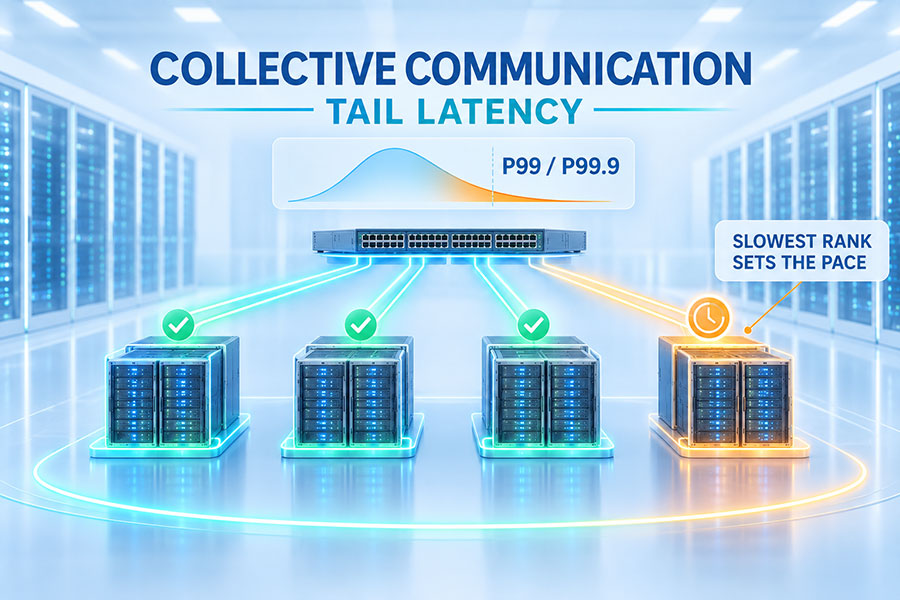
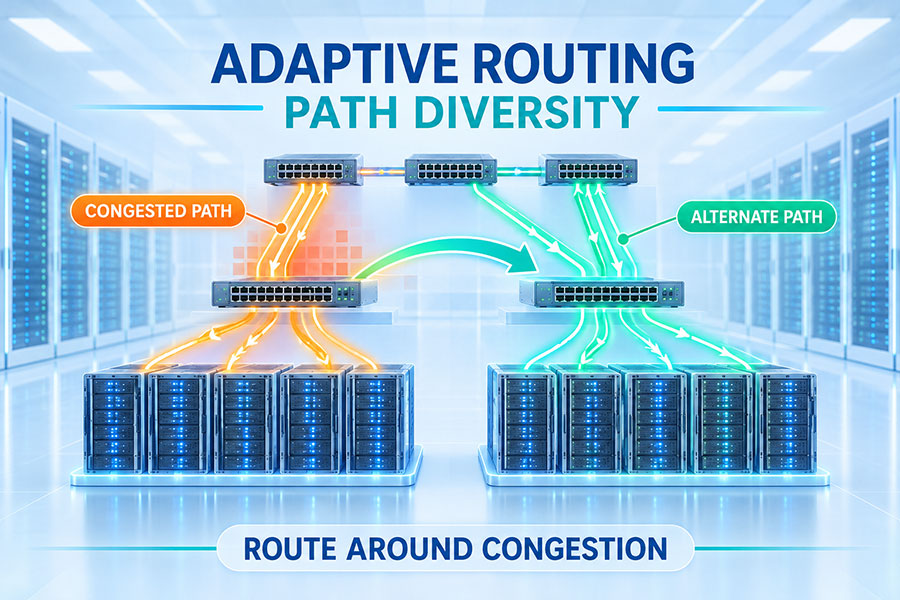
Uneven flow distribution: Hash-based path selection may place multiple large flows on the same route.
Microbursts: Short periods of concentrated traffic can temporarily exceed output capacity.
Traffic imbalance: Different communication phases may produce uneven load across network paths.
Endpoint limitations: NIC, PCIe or GPU transfer capacity may become the bottleneck.
Shared resources: Storage, management or other application traffic may compete with GPU communication.
For this reason, non-blocking capacity planning should be combined with routing design, congestion management and traffic monitoring.
13. InfiniBand and RoCE Non-Blocking Fabrics
Non-blocking GPU fabrics can be built using InfiniBand or Ethernet with RoCE. Both approaches can support high-performance distributed communication, but their congestion-management and operational models differ.
| Design area | InfiniBand | RoCE over Ethernet |
|---|---|---|
| Switching infrastructure | InfiniBand switches and compatible adapters | Ethernet switches and compatible RDMA NICs |
| Transport | InfiniBand transport architecture | RDMA over Converged Ethernet |
| Path selection | Fabric routing and adaptive routing where supported | Ethernet routing, ECMP and other supported multipath mechanisms |
| Congestion management | InfiniBand-specific congestion-management mechanisms | Commonly ECN-based signaling and transport response; PFC may be used where required |
| Validation focus | Fabric configuration, routing, link health and adapter compatibility | ECN, QoS, queue management, loss behavior and end-to-end consistency |
For RoCE, PFC should not be treated as a replacement for sufficient switching capacity or congestion control. Poorly designed pause behavior can introduce head-of-line blocking and deadlock risks.
For either technology, the network should be validated under realistic collective traffic rather than relying exclusively on isolated port-throughput measurements.
14. Rail-Optimized Networks and Non-Blocking Fabrics
Rail optimization and non-blocking switching address complementary design requirements. Rail optimization organizes corresponding NIC connections across servers, while non-blocking fabric design focuses on providing sufficient switching and interconnection capacity.
In a rail-optimized GPU cluster, each corresponding NIC position may connect to a specific leaf-switch group. Multiple rails then operate through the larger Clos fabric.
This arrangement can improve traffic organization and reduce unnecessary cross-rail transfers when the communication software follows the intended topology.
However, a rail-aligned design is not automatically non-blocking. Each rail must have adequate uplink capacity, and the combined network must provide sufficient bandwidth across the required communication paths.
Likewise, a non-blocking fabric does not automatically provide rail-aware communication. The GPU-to-NIC mapping, switch configuration and collective software must be aligned with the physical design.
15. Network Capacity Planning for GPU Clusters
Capacity planning should start with the number of GPU servers, network ports per server and configured interface rates. The switching fabric must then be sized to support the required aggregate traffic.
For a simplified leaf switch, the oversubscription ratio can be calculated as:
\(\text{Oversubscription}=\frac{N_d\times R_d}{N_u\times R_u}\)
Where \(N_d\) and \(R_d\) represent the number and rate of downlinks, while \(N_u\) and \(R_u\) represent the number and rate of uplinks.
For example, a leaf with 32 server-facing 400 Gb/s ports has 12.8 Tb/s of one-direction downlink capacity. If it has 32 uplinks at the same rate, the aggregate uplink capacity is also 12.8 Tb/s, producing a 1:1 ratio.
This calculation is only one part of the design. Engineers must also verify spine port capacity, internal switching bandwidth, network-plane separation, routing behavior and the capacity available after a link or switch failure.
16. Optical Connectivity and High-Speed Switch Fabrics
High-speed optical connectivity is an important part of large GPU fabrics, particularly for connections between racks, leaf switches and spine switches.
As link rates increase, the physical interconnect must support the required bandwidth, reach and signal quality. Common options include:
DAC: Passive direct attach copper for supported short-reach connections.
AEC: Active electrical cables for selected high-speed copper connections that require signal conditioning.
AOC: Active optical cables that integrate optical transmission into a cable assembly.
Optical transceivers: Pluggable modules used with fiber infrastructure for switch-to-switch and other high-speed links.
In a non-blocking design, the aggregate bandwidth of these physical links must match the planned switching capacity. Installing high-speed optical modules does not create a non-blocking fabric if there are too few uplinks or if the switching architecture has insufficient capacity.
Link reliability is equally important. Optical power levels, fiber condition, connector cleanliness, module compatibility and FEC statistics should be monitored to prevent individual links from reducing the usable capacity of the fabric.
17. Measuring Collective Communication Performance
Fabric validation should include both network-level measurements and application-level collective benchmarks.
| Measurement | What it evaluates | Why it matters |
|---|---|---|
| Point-to-point bandwidth | Throughput between two endpoints | Checks individual path capacity |
| AllReduce bandwidth and latency | Distributed reduction performance | Reflects a common training communication workload |
| AllGather and ReduceScatter | Data distribution and reduction phases | Tests additional collective traffic patterns |
| All-to-All throughput | Many-to-many communication | Can expose congestion and traffic imbalance |
| Switch port utilization | Per-port traffic levels | Identifies heavily loaded links and uneven distribution |
| Queue and ECN statistics | Congestion behavior | Shows whether traffic is accumulating at shared resources |
| FEC and link error counters | Physical link quality | Helps identify errors that reduce effective link reliability |
Testing should cover different message sizes and GPU counts. Small messages can be dominated by synchronization and latency, while large messages are more sensitive to available bandwidth.
Results should also be compared across different server groups and network paths. A cluster-wide average can hide a poorly performing leaf, uplink or individual rail.
18. Common Misconceptions About Non-Blocking Switch Fabrics
Non-blocking means zero congestion
A non-blocking design provides sufficient switching capacity for its defined traffic assumptions. Destination hotspots, microbursts and uneven routing can still create temporary congestion.
High switching capacity guarantees high collective performance
Collective performance also depends on GPU-to-NIC connectivity, PCIe bandwidth, NIC throughput, routing and communication algorithms.
A 1:1 uplink ratio guarantees every flow can run at line rate
A 1:1 ratio is a useful capacity-planning target, but localized contention and traffic concentration can still limit individual flows.
All collective algorithms benefit equally from more bandwidth
Large-message operations may be bandwidth-sensitive, while small-message operations can be limited by latency and synchronization overhead.
Switch port count alone determines fabric capacity
Port speeds, internal switching capacity, uplink configuration, packet processing and path distribution must also be evaluated.
19. Conclusion
Non-blocking switch fabrics provide an important foundation for high-performance GPU networks. By supplying sufficient internal switching capacity and inter-switch bandwidth, they reduce the risk that network infrastructure becomes a persistent bottleneck during distributed collective communication.
Their impact is particularly relevant to AllReduce, AllGather, ReduceScatter and All-to-All operations, where multiple GPUs exchange data across servers in coordinated patterns. A well-provisioned Clos or leaf-spine architecture can provide the aggregate capacity needed to support these workloads more efficiently.
However, non-blocking design is not a guarantee of zero congestion or maximum application performance. Oversubscription, routing, traffic distribution, endpoint capabilities, congestion control and physical link quality all influence the final result.
For large AI clusters, the most effective approach combines balanced switch capacity, topology-aware communication, suitable high-speed interconnects and workload-level validation. This creates a network fabric that can scale with GPU resources while maintaining predictable communication performance.
Evaluate optical transceiver and interconnect options for high-bandwidth leaf-spine and multi-stage switching architectures.
Contact C-LIGHT >

 >
 >
 >
 >
 >
 >
 >