TEL:+86 132 6656 7067





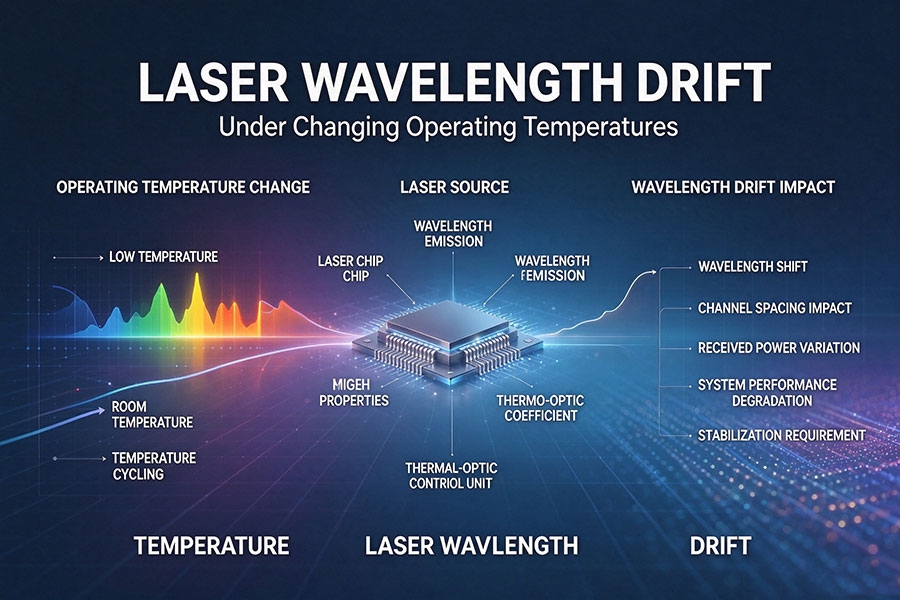
Laser wavelength stability is a critical parameter in optical communication systems, particularly when transmitters operate across changing ambient temperatures, equipment loads and environmental conditions. A semiconductor laser's emission wavelength is influenced by the temperature of its active region, refractive index, semiconductor bandgap and optical cavity characteristics. As operating temperature changes, the emitted wavelength can shift away from its nominal value, potentially affecting wavelength alignment, optical filtering and channel performance.
1. Why Laser Wavelength Changes With Temperature
A semiconductor laser generates light through stimulated emission in an active semiconductor region. Its emission wavelength depends on the energy difference between electronic states and the optical resonance conditions of the laser cavity.
When the laser temperature increases, several physical properties change simultaneously:
The semiconductor bandgap generally decreases, changing the energy associated with optical transitions.
The refractive index of semiconductor materials changes with temperature.
The optical path length of the laser cavity changes through thermal expansion and refractive-index variation.
The gain spectrum and carrier distribution within the active region can shift.
The temperature-dependent characteristics of the laser's wavelength-selective structure can alter the selected lasing mode.
These effects influence the wavelength at which the laser achieves its operating condition. For many semiconductor laser structures, increasing chip temperature causes the emission wavelength to shift toward longer wavelengths, commonly called a red shift.
The exact response depends on the laser architecture, material composition, cavity design, operating current and temperature-control system. It is therefore important to use device-specific specifications rather than assuming that every laser has the same temperature coefficient.
2. The Relationship Between Temperature and Wavelength
Laser wavelength drift is commonly described using a temperature coefficient, which expresses the wavelength change relative to a change in laser temperature.
Where:
αλ: Wavelength temperature coefficient, commonly expressed in nm/°C or pm/°C.
Δλ: Change in emission wavelength.
ΔT: Change in the relevant laser temperature.
For a sufficiently small temperature interval, a first-order approximation is:
For example, if a particular laser has a measured wavelength coefficient of 0.08 nm/°C, a 5°C temperature increase would correspond to an approximate 0.4 nm red shift under the same operating conditions.
This is an illustrative calculation, not a universal semiconductor laser specification. Actual wavelength-versus-temperature behavior may be nonlinear, particularly over a wide temperature range or near a change in laser operating mode.
Published measurements demonstrate the variation between devices and test conditions. One DFB laser stabilization study reported approximately 0.1 nm/°C over its tested temperature interval, while an EXFO application note describes much smaller residual wavelength sensitivity in temperature-controlled DFB equipment. These values represent different operating and control conditions rather than contradictory universal specifications.
3. How the Semiconductor Bandgap Affects Emission Wavelength
The semiconductor bandgap is one of the fundamental factors governing the emission wavelength of a laser diode. It represents the energy difference between the conduction band and valence band in the semiconductor material.
As temperature rises, lattice vibrations increase and the semiconductor bandgap generally becomes smaller. This changes the energy of the optical transition associated with light generation.
The relationship between photon energy and wavelength is:
Where E is photon energy, h is Planck's constant, c is the speed of light and λ is wavelength.
A reduction in the relevant transition energy generally corresponds to a longer optical wavelength. However, the actual lasing wavelength is also influenced by the cavity resonance and gain spectrum, so the bandgap change alone does not fully describe the behavior of a practical laser.
In semiconductor lasers, material composition, quantum-well design and active-region structure determine how strongly temperature affects the gain spectrum and emission characteristics.
4. Refractive Index and Optical Cavity Temperature Effects
The optical cavity determines the wavelengths that can be supported by the laser. Its resonance condition depends on the effective refractive index and optical path length.
For a simplified cavity, the resonance condition can be expressed as:
Where m is the longitudinal mode order, n is the effective refractive index and L is the cavity length.
Temperature changes can affect both n and L. The refractive-index change is generally associated with the thermo-optic effect, while physical expansion changes the cavity dimensions.
For a small temperature variation, the approximate relative wavelength change can be expressed as:
This simplified relationship illustrates why cavity-based laser structures are temperature-sensitive. In actual devices, the effective index, optical mode distribution, material properties and cavity design all contribute to the final response.
5. Temperature Characteristics of Different Laser Types
Different semiconductor laser architectures use different wavelength-selection mechanisms. Their temperature sensitivity and stabilization requirements therefore vary.
| Laser type | Wavelength-selection mechanism | Temperature-related behavior | Typical application considerations |
|---|---|---|---|
| Fabry-Pérot (FP) | Multiple longitudinal cavity modes | Mode positions and gain characteristics change with temperature; mode distribution may also vary. | Suitable where broad spectral characteristics and wavelength tolerance are acceptable. |
| DFB | Integrated distributed Bragg grating | Bragg wavelength and semiconductor gain spectrum shift with temperature. | Widely used where narrow spectral width and controlled wavelength are required. |
| DBR | Separate Bragg reflector section | Reflector and gain-section characteristics can respond differently to temperature. | Can support wavelength tuning and stabilization through separately controlled sections. |
| VCSEL | Vertical optical cavity with distributed Bragg reflectors | Cavity resonance and gain peak both vary with temperature. | Commonly used for short-reach optical links, sensing and data communication. |
| External-cavity laser | External wavelength-selective optical cavity | External cavity dimensions and refractive index influence wavelength stability. | Requires control of cavity and optical alignment conditions. |
DFB lasers are particularly important in telecommunications because their grating structure provides single-mode wavelength selection. However, the Bragg wavelength is not temperature-independent. Temperature stabilization or wavelength compensation may still be required, especially for narrow-grid DWDM applications.
6. DFB Laser Wavelength Drift and Bragg Grating Effects
A distributed feedback laser uses a periodic refractive-index structure to provide wavelength-selective optical feedback. The grating establishes a preferred lasing wavelength through the Bragg condition.
Where λB is the Bragg wavelength, neff is the effective refractive index and Λ is the grating period.
As temperature changes, both the effective refractive index and physical grating period can change. Consequently, the Bragg wavelength shifts.
The laser's gain spectrum also changes with temperature. Stable single-mode operation therefore depends on the relationship between the grating reflection peak and the gain characteristics of the active region.
When temperature changes substantially, the separation between the gain peak and Bragg wavelength can affect output efficiency and spectral performance. A DFB laser's narrow linewidth does not mean its central wavelength is immune to thermal drift.
For WDM transmitters, this distinction is important: spectral purity and wavelength accuracy are separate characteristics. A laser can maintain a relatively narrow spectrum while its central wavelength moves away from the assigned channel.
7. Laser Drive Current and Temperature-Related Wavelength Changes
Drive current can influence laser wavelength through both electrical and thermal mechanisms. Increasing current changes carrier density in the active region and can also increase heat generation.
Several effects may occur:
Junction heating: Electrical power dissipated inside the laser increases its active-region temperature.
Carrier-induced refractive-index change: Changes in carrier concentration influence the effective refractive index.
Gain-spectrum variation: Carrier density affects the gain characteristics and operating wavelength.
Thermal response: Heat accumulation changes the laser's wavelength over time, depending on the thermal structure.
As a result, wavelength can vary with drive current even when the external temperature remains constant. The immediate carrier-related response and slower thermal response may have different directions and time constants.
For accurate characterization, temperature and drive current should be controlled independently wherever possible. Otherwise, a measured wavelength shift may combine multiple effects and be incorrectly attributed to temperature alone.
8. Ambient Temperature Versus Laser Junction Temperature
One of the most important distinctions in optical transceiver thermal design is the difference between ambient temperature, module temperature, case temperature and laser junction temperature.
| Temperature parameter | Meaning | Relevance to wavelength drift |
|---|---|---|
| Ambient temperature | Temperature of the surrounding air or environment. | Influences the module's overall thermal conditions. |
| Module temperature | Temperature measured at a designated point within the optical module. | Provides information about the module's internal thermal state. |
| Case temperature | Temperature measured at the specified module case location. | Used for product operating-temperature qualification. |
| Laser junction temperature | Temperature of the laser's active semiconductor region. | Directly influences laser emission and cavity characteristics. |
The junction temperature can differ significantly from ambient temperature because of heat generated by the laser, driver circuitry and neighboring components.
Thermal resistance between the laser die and its package, heat spreader and surrounding environment determines how efficiently heat is removed. Airflow, module power consumption, cage design and port density can also affect the thermal conditions.
Therefore, a module operating in a 50°C environment does not necessarily have a laser junction temperature of 50°C. The actual junction temperature depends on the thermal design and operating load.
9. How Temperature Changes Affect Optical Transceiver Performance
Wavelength drift can influence several aspects of optical transceiver operation. Its impact depends on the laser type, optical architecture, wavelength tolerance and receiver design.
Wavelength alignment
In WDM systems, each transmitter is assigned a nominal wavelength or frequency. If the emitted wavelength shifts away from the intended channel, alignment with the multiplexer, demultiplexer or receiver filter can deteriorate.
Optical filtering and insertion loss
Wavelength-selective filters have finite passbands. When a laser's emission spectrum moves toward the edge of a filter passband, transmitted optical power may decrease.
Adjacent-channel interference
In tightly spaced WDM systems, excessive wavelength deviation can reduce the spectral separation between neighboring channels and increase the risk of unwanted interference, depending on filter characteristics and system design.
Output power and efficiency
Temperature can affect threshold current, slope efficiency and the gain characteristics of the laser. These changes may influence output power even when wavelength alignment remains acceptable.
Receiver performance
For systems using wavelength-selective receiver components, a shift in the incoming signal can affect filter transmission and received optical power. The resulting impact on sensitivity and error performance depends on the complete receiver architecture.
10. Wavelength Drift in CWDM and DWDM Systems
Wavelength stability requirements depend strongly on the channel spacing and optical filtering architecture of the transmission system.
CWDM uses relatively wide wavelength spacing. The ITU-T G.694.2 wavelength grid uses 20 nm channel spacing, allowing optical systems to accommodate comparatively broad wavelength variations. This makes uncooled laser architectures practical in many CWDM applications.
DWDM uses much narrower frequency spacing. ITU-T G.694.1 defines fixed grids with channel spacings including 100 GHz, 50 GHz, 25 GHz and 12.5 GHz, as well as flexible-grid arrangements. These tighter spectral allocations place greater demands on transmitter frequency accuracy and stability.
| Characteristic | CWDM | DWDM |
|---|---|---|
| Channel spacing | Commonly 20 nm under the ITU-T CWDM grid. | Frequency-based grid with much narrower spacing. |
| Wavelength tolerance | Generally more accommodating of temperature-related wavelength variation. | Requires tighter control according to the selected channel and interface specification. |
| Laser temperature control | Uncooled designs are common in suitable applications. | Temperature control or other wavelength-stabilization methods are commonly required. |
| Filter requirements | Relatively broad channel passbands. | Narrower and more precise wavelength-selective filtering. |
| Design priority | Cost-effective operation with adequate channel separation. | Accurate frequency placement and long-term spectral stability. |
These are general architectural tendencies rather than universal product rules. The actual wavelength tolerance must be taken from the relevant optical interface specification and component datasheet.
11. Thermal Electric Coolers and Laser Temperature Stabilization
Thermoelectric coolers (TECs) are widely used in temperature-controlled optical transmitters. A TEC transfers heat between its two surfaces when electrical current is applied, allowing the laser package temperature to be regulated.
A typical temperature-control arrangement includes:
Thermistor: Measures temperature near the laser package or another specified location.
TEC: Adjusts the thermal condition of the laser assembly.
Temperature controller: Compares measured temperature with the target setpoint and adjusts TEC drive.
Laser driver: Supplies the operating current required by the laser.
Thermal package: Provides the mechanical and thermal path between the laser, TEC and surrounding structure.
The temperature controller typically uses feedback to maintain a selected temperature. The laser's wavelength can consequently remain more stable even when ambient conditions vary.
However, maintaining a stable thermistor reading does not automatically guarantee perfectly constant wavelength. The relationship between sensor temperature and actual laser junction temperature depends on sensor placement, thermal resistance, drive-current changes and the thermal response of the package.
TEC-based stabilization also introduces additional power consumption, component cost and thermal-management requirements. It is most useful when the wavelength stability requirement justifies these trade-offs.
12. Uncooled Lasers and Temperature Compensation
Not every optical transceiver requires a TEC. Uncooled laser designs are widely used in applications where the wavelength tolerance and optical filtering architecture can accommodate the expected temperature variation.
Several approaches can support stable operation without continuous active cooling:
Wide channel spacing: Uses sufficient spectral separation to accommodate the expected wavelength range.
Temperature-tolerant laser design: Selects semiconductor structures and cavity characteristics appropriate for the required operating range.
Passive thermal design: Uses package materials and heat paths to reduce temperature variation at the laser.
Current compensation: Adjusts laser drive conditions where the device's characterized behavior supports this approach.
Wavelength feedback: Uses monitoring signals to detect and compensate for deviations when supported by the architecture.
Uncooled does not mean temperature-independent. It means that the device is designed to operate without an active temperature-control element under its specified conditions.
The CWDM grid is an important example of an architecture that can accommodate uncooled sources through relatively wide wavelength spacing. DWDM transmitters generally require more precise frequency management.
13. Wavelength Drift and Optical Power Variation
Temperature affects both the spectral characteristics and power-generation efficiency of a semiconductor laser. These effects are related, but they should be evaluated separately.
As temperature increases, the threshold current of many semiconductor lasers rises. The slope efficiency may also decrease, depending on the device design and operating range. At a fixed drive current, the available output power can therefore change.
Automatic power control (APC) can regulate average optical output power by adjusting laser drive conditions. However, APC is not necessarily a wavelength-locking mechanism.
Similarly, automatic temperature control and automatic power control address different parameters:
Automatic temperature control: Regulates the thermal condition of the laser assembly.
Automatic power control: Maintains a target optical output level.
Wavelength stabilization: Maintains or corrects the emission wavelength relative to a target.
A transmitter may require more than one of these functions. Power regulation alone cannot guarantee that the emitted wavelength remains aligned with a WDM channel.
14. Measuring Laser Wavelength Drift Under Temperature Changes
Wavelength characterization should evaluate the relationship between actual emission wavelength and the relevant operating conditions. A temperature-controlled test environment helps separate thermal effects from unrelated changes.
Common measurement equipment includes:
Optical spectrum analyzer (OSA): Measures the optical spectrum and identifies the central emission wavelength and spectral characteristics.
Wavelength meter: Provides precise wavelength or optical-frequency measurements.
Temperature chamber: Provides controlled environmental conditions for evaluating thermal behavior.
Temperature sensor: Records the specified package, case or nearby device temperature.
Optical power meter: Monitors output-power variation during the test.
Important measurement considerations include:
Record the laser's nominal wavelength and specified operating conditions.
Distinguish the ambient, case and monitored internal temperatures.
Maintain consistent laser drive conditions when isolating temperature effects.
Allow the assembly to reach thermal equilibrium before recording measurements.
Measure wavelength at multiple temperature points within the specified operating range.
Record output power and spectral characteristics alongside wavelength.
Evaluate both the temperature coefficient and any nonlinear or hysteretic behavior.
For high-precision WDM applications, the measurement instrument's wavelength accuracy and resolution must be suitable for the required tolerance. A basic optical power measurement cannot establish whether the laser remains correctly aligned to its assigned channel.
15. Long-Term Wavelength Stability and Aging
Wavelength drift is not caused by temperature alone. Semiconductor laser characteristics can also change over time due to aging, package stress and changes in operating conditions.
Potential long-term influences include:
Changes in semiconductor material characteristics.
Gradual changes in threshold current and slope efficiency.
Package and mounting stress variation.
Changes in thermal contact between the laser and its heat-management structure.
Drift in temperature-sensor calibration or control circuitry.
Changes in laser operating current as the control system compensates for aging.
A stable temperature reading therefore does not prove that a laser's wavelength remains unchanged throughout its service life. Long-term performance evaluation should consider wavelength, output power, operating current and control-system behavior together.
16. Engineering Considerations for Temperature-Stable Optical Transceivers
Laser wavelength stability should be considered during optical transceiver selection and system qualification rather than treated as an isolated laser specification.
| Design consideration | What to evaluate | Engineering objective |
|---|---|---|
| Laser architecture | FP, DFB, DBR, VCSEL or other source type. | Match spectral characteristics to the optical application. |
| Wavelength tolerance | Nominal wavelength, allowable deviation and temperature coefficient. | Maintain compatibility with the assigned channel. |
| Operating temperature | Specified case-temperature range and internal thermal conditions. | Ensure stable operation across the intended environment. |
| Temperature control | TEC, thermistor, controller and thermal package. | Reduce temperature-induced wavelength variation. |
| Optical filtering | Filter passband, channel spacing and insertion-loss response. | Maintain sufficient wavelength alignment margin. |
| Drive-current control | Current stability, APC behavior and thermal effects. | Limit operating-point changes that influence wavelength and power. |
| Monitoring | Wavelength measurement, temperature telemetry and optical power. | Identify deviations and verify operating stability. |
| System qualification | Temperature cycling, thermal stabilization and long-term drift. | Verify performance under realistic operating conditions. |
For high-density optical systems, the thermal environment around neighboring transceivers also matters. High port density, restricted airflow and elevated switch temperatures can increase the thermal load on individual modules. The module's specified case-temperature range and the laser's wavelength tolerance should therefore be evaluated together.
17. Conclusion
Laser wavelength drift under changing operating temperatures results from the combined influence of semiconductor bandgap variation, refractive-index changes, cavity expansion and temperature-dependent gain characteristics. The resulting emission shift can affect wavelength alignment, optical filtering and transmission stability, particularly in DWDM systems with narrow channel spacing.
DFB lasers provide controlled single-mode emission through distributed feedback, but their Bragg wavelength remains temperature-sensitive. TEC-based stabilization, thermistor feedback, suitable laser architecture and wavelength monitoring can reduce the impact of changing operating conditions. Uncooled designs remain practical where the optical system provides sufficient wavelength tolerance.
For reliable optical connectivity, wavelength stability must be evaluated alongside output power, operating temperature, drive current, filter characteristics and long-term device behavior. A well-designed thermal and wavelength-control strategy helps maintain consistent optical performance across changing environmental conditions.
Review the operating conditions, optical interface specifications and compatibility requirements for your network. Contact C-LIGHT
 >

 >
 >
 >
 >
 >
 >
 >