TEL:+86 132 6656 7067





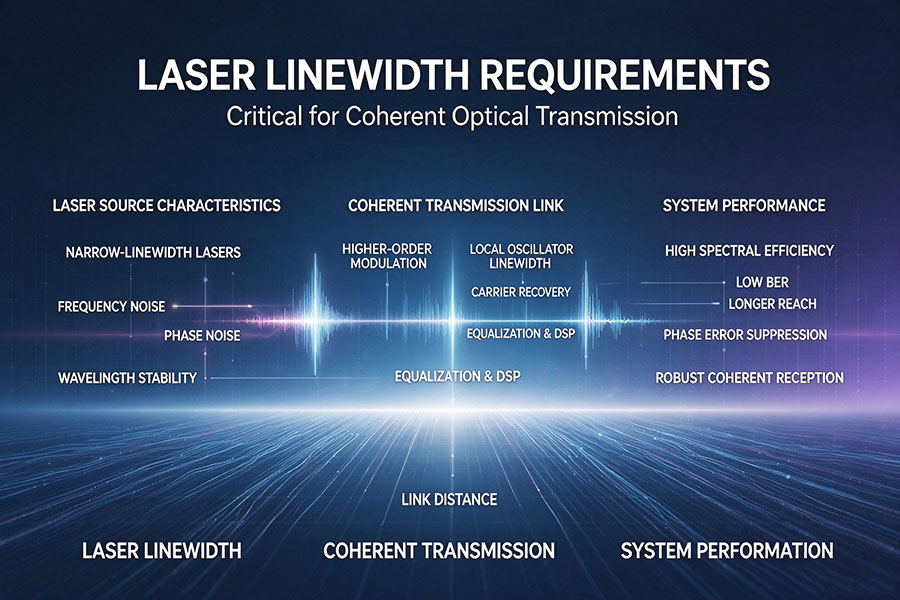
Laser linewidth is a critical parameter in coherent optical transmission because it determines how quickly the optical carrier phase fluctuates over time. In a coherent receiver, the incoming signal is mixed with a local oscillator (LO), and the receiver must estimate and track the relative phase between the two optical fields. Excessive phase noise makes carrier recovery more difficult and can increase bit error rate (BER), reduce OSNR tolerance and cause cycle slips.
1. Why Laser Linewidth Matters in Coherent Optical Transmission
A coherent optical transmitter encodes information into the amplitude and phase of an optical carrier. At the receiver, a local oscillator provides a reference optical field that is mixed with the incoming signal. The resulting electrical signals contain information about the received optical field, including its phase.
Both the transmitter laser and the receiver LO have finite phase stability. Spontaneous emission and other physical noise mechanisms cause their optical phases to fluctuate over time. The relative phase between the two lasers therefore changes during transmission and reception.
The coherent receiver must estimate these changes to recover the transmitted symbols correctly. If phase fluctuations become too large or too rapid for the carrier recovery algorithm to track, the received constellation becomes distorted.
Excessive laser phase noise can lead to:
Increased symbol decision errors.
Higher pre-FEC BER.
Reduced OSNR tolerance.
Increased cycle-slip probability.
More demanding carrier phase recovery.
Reduced transmission margin, particularly with higher-order modulation.
Laser linewidth is consequently an important specification for coherent optical transceivers, especially at high symbol rates and in systems using dense QAM constellations.
2. What Is Laser Linewidth?
Laser linewidth describes the spectral width of the emitted optical signal. It is commonly specified in hertz, kilohertz or megahertz and is often expressed as the full width at half maximum (FWHM) of the optical spectrum.
For an idealized laser dominated by white frequency noise, the optical spectrum has a Lorentzian shape. Its FWHM linewidth is related to the rate of phase diffusion caused by spontaneous emission and other frequency-noise contributions.
A narrower linewidth generally indicates slower phase diffusion under the same measurement model. However, linewidth alone does not describe every aspect of laser frequency stability.
Real semiconductor lasers can exhibit additional noise components, including:
White frequency noise: Produces rapid random phase fluctuations and contributes to the fundamental Lorentzian linewidth.
Flicker frequency noise: Creates close-to-carrier frequency fluctuations that can affect phase tracking and frequency stability.
Low-frequency drift: Changes the average optical frequency over longer periods due to temperature, current and environmental variations.
Technical noise: Can arise from power supplies, mechanical disturbances, thermal effects and control electronics.
These noise components can influence coherent transmission differently. Two lasers with similar nominal linewidths may therefore produce different system performance if their frequency-noise spectra differ significantly.
3. How Laser Phase Noise Affects a Coherent Signal
The phase of an optical carrier can be represented as a time-dependent quantity. In a simplified coherent transmission model, the received signal includes the phase contributions of both the transmitter laser and the receiver local oscillator.
The relative phase can be expressed as:
Where:
φTx(t): Phase fluctuation of the transmitter laser.
φLO(t): Phase fluctuation of the receiver local oscillator.
φrelative(t): Relative phase error observed by the coherent receiver.
For independent lasers dominated by white frequency noise, their linewidth contributions add approximately. The combined linewidth is therefore:
This relationship assumes independent Lorentzian phase-noise processes. Correlated noise, non-Lorentzian frequency noise and additional technical disturbances require a more detailed model.
As the relative phase changes, the received constellation points rotate around the origin. The DSP must estimate this rotation and compensate for it before making reliable symbol decisions.
4. The Relationship Between Linewidth and Symbol Rate
Laser phase noise accumulates over time. The amount of phase uncertainty experienced during one symbol interval is therefore an important factor in coherent receiver performance.
For independent lasers with Lorentzian linewidths and a simplified white-frequency-noise model, the phase-noise variance accumulated over one symbol interval is:
Where:
σφ2: Phase-noise variance in radians squared.
ΔνTx: Transmitter laser linewidth in hertz.
ΔνLO: Local oscillator linewidth in hertz.
Ts: Symbol duration in seconds.
Since symbol duration is the reciprocal of symbol rate, the expression can also be written as:
Where Rs is the symbol rate in baud.
This relationship highlights two important points:
Increasing the combined laser linewidth increases phase-noise variance.
Increasing the symbol rate reduces the phase noise accumulated during each symbol interval, assuming the same linewidth model.
However, higher symbol rates also introduce more demanding electrical bandwidth, sampling, equalization and implementation requirements. A higher baud rate does not eliminate the need for suitable laser phase stability.
5. Laser Linewidth Requirements for Different Modulation Formats
Different coherent modulation formats have different sensitivities to phase noise. The distance between constellation points, decision boundaries and carrier recovery algorithm all influence how much phase uncertainty can be tolerated.
QPSK uses four constellation points and generally offers greater phase-noise tolerance than higher-order QAM formats. In 16QAM and 64QAM, constellation points are more densely arranged, so residual phase errors can cause symbols to cross decision boundaries more easily.
| Modulation format | Bits per symbol per polarization | General phase-noise tolerance | Design consideration |
|---|---|---|---|
| DP-QPSK | 2 | Relatively high | Suitable for robust coherent transmission where reach and noise tolerance are priorities. |
| DP-8QAM | 3 | Intermediate | Requires more careful phase estimation than QPSK. |
| DP-16QAM | 4 | More demanding | Requires lower residual phase error and effective carrier recovery. |
| DP-32QAM | 5 | Highly demanding | Greater sensitivity to phase noise and implementation penalties. |
| DP-64QAM | 6 | Very demanding | Requires stringent phase-noise control and advanced DSP. |
This is a qualitative engineering guide, not a universal linewidth specification. Actual tolerances depend on symbol rate, FEC threshold, OSNR, phase recovery algorithm, frequency-noise spectrum and the permitted implementation penalty.
6. QPSK and Laser Linewidth Tolerance
QPSK is widely used in coherent optical transmission because it combines relatively high spectral efficiency with good tolerance to noise and phase fluctuations.
Each QPSK symbol represents two bits per polarization. In dual-polarization QPSK, two independent polarization channels provide four uncoded bits per symbol interval.
Because the QPSK constellation has four widely separated phase states, its decision process can tolerate more phase uncertainty than higher-order QAM under comparable operating conditions.
However, QPSK does not eliminate the need for linewidth control. Excessive phase noise can still cause constellation rotation, phase estimation errors and cycle slips.
QPSK linewidth requirements should be determined using the combined transmitter and LO phase noise, the symbol rate and the receiver's actual carrier recovery performance.
7. 16QAM and 64QAM Require Greater Phase Stability
Higher-order QAM formats increase the number of bits carried by each symbol. This improves spectral efficiency but makes the receiver more sensitive to residual amplitude and phase errors.
In 16QAM, the constellation contains 16 points arranged across different amplitude and phase positions. In 64QAM, the number increases to 64, producing a denser constellation.
As the spacing between neighboring decision regions becomes smaller, phase fluctuations can more easily move a received symbol into an incorrect decision region.
Higher-order QAM systems therefore often require:
Lower combined laser linewidth or more favorable frequency-noise characteristics.
More accurate carrier phase estimation.
Improved frequency-offset estimation.
Careful control of OSNR and nonlinear transmission penalties.
Appropriate DSP algorithms and phase-tracking parameters.
Stable transmitter and local oscillator operating conditions.
Research on 64–96 GBd coherent systems has shown that higher-order modulation can be particularly sensitive to flicker noise and laser linewidth. The effective phase-noise behavior may also change with transmission distance because of interactions between dispersion compensation and phase noise.
8. Transmitter Laser and Local Oscillator Linewidth
A coherent optical system uses at least two relevant optical frequency sources: the transmitter laser and the receiver local oscillator. Both contribute to the relative phase noise observed by the receiver.
The transmitter laser establishes the optical carrier used to encode the information. Its phase noise is already present in the signal before it enters the fiber.
The local oscillator generates the reference field used by the coherent receiver. Its phase noise affects the receiver's ability to estimate the phase of the incoming signal.
| Parameter | Transmitter laser | Receiver local oscillator |
|---|---|---|
| Primary function | Generates the optical carrier for data transmission. | Provides a reference optical field for coherent detection. |
| Phase-noise contribution | Introduces phase fluctuations into the transmitted signal. | Introduces reference-phase fluctuations during detection. |
| Important specifications | Linewidth, frequency stability, output power and wavelength accuracy. | Linewidth, frequency stability, tuning range and phase-noise spectrum. |
| System-level impact | Influences the transmitted signal's phase quality. | Influences carrier recovery and the relative phase observed at the receiver. |
For two independent Lorentzian lasers, the combined linewidth is approximately their sum. For example, a transmitter laser with a 50 kHz linewidth and an LO with a 50 kHz linewidth produce a nominal combined linewidth of 100 kHz under this model.
Using a narrower-linewidth laser at either end can reduce the total phase-noise contribution. However, the benefit must be assessed against other noise sources and the receiver's ability to track phase changes.
9. Laser Linewidth and OSNR Requirements
Optical signal-to-noise ratio (OSNR) describes the optical signal power relative to the noise power within a defined reference bandwidth. It is a major performance metric in amplified coherent optical systems.
OSNR and laser linewidth are different parameters, but both influence the quality of the received constellation.
ASE noise from optical amplifiers increases the uncertainty of the received signal amplitude and phase. Laser phase noise introduces additional uncertainty in the carrier phase.
When these impairments occur together, the receiver must distinguish the transmitted symbols despite both noise and phase fluctuations.
Excessive laser phase noise can therefore increase the OSNR required to achieve a target BER. This is commonly described as a phase-noise-induced OSNR penalty.
The actual penalty depends on modulation format, symbol rate, carrier recovery algorithm, FEC and the frequency-noise behavior of both lasers. A linewidth figure alone cannot determine the required OSNR.
10. Carrier Frequency Offset and Laser Linewidth
Carrier frequency offset (CFO) and laser linewidth are related to optical frequency behavior, but they describe different effects.
Frequency offset is the difference between the transmitter carrier frequency and the receiver LO frequency. It can cause a systematic rotation of the received constellation over time.
Linewidth describes the spectral broadening associated with phase and frequency fluctuations around the carrier.
A coherent receiver typically needs to estimate and compensate for both effects:
Frequency offset estimation: Determines the average frequency difference between the received signal and the local oscillator.
Carrier phase recovery: Tracks time-varying phase fluctuations after frequency correction.
Cycle-slip monitoring: Detects phase-tracking failures that can cause abrupt constellation errors.
A laser can have a narrow linewidth but still operate with a significant frequency offset relative to the LO. Conversely, two lasers can have a small average frequency offset while exhibiting substantial phase noise.
Frequency accuracy, frequency tuning range and linewidth should therefore be specified and evaluated separately.
11. The Role of DSP in Managing Laser Phase Noise
Digital signal processing is essential to modern coherent optical receivers. After optical-to-electrical conversion and analog-to-digital sampling, DSP reconstructs the transmitted signal and compensates for important transmission impairments.
Carrier recovery is one of its most important functions. It estimates the phase and frequency relationship between the received signal and the local oscillator.
Common carrier recovery approaches include:
Feed-forward phase estimation: Estimates phase over a group of received symbols without relying exclusively on previous decisions.
Decision-directed phase tracking: Uses detected symbols to refine the estimated carrier phase.
Blind phase search: Tests candidate phase rotations and selects the estimate that produces the best symbol decisions over a processing window.
Kalman filtering and tracking: Uses a model of phase evolution to estimate carrier behavior over time.
Each approach has different trade-offs involving complexity, tracking speed, noise tolerance and implementation latency.
DSP can compensate for a significant amount of laser phase noise, but it cannot remove every limitation. Rapid phase fluctuations, insufficient sampling, poor OSNR and cycle slips can still degrade system performance.
12. Symbol Rate and the Linewidth-to-Baud Ratio
Linewidth is often evaluated relative to symbol rate rather than as an isolated number. The normalized parameter Δν/Rs provides a convenient way to compare laser phase noise across systems operating at different baud rates.
A smaller ratio generally indicates less white-frequency-noise-induced phase variation per symbol under the simplified Lorentzian model.
Consider two systems with the same combined linewidth:
| Parameter | System A | System B |
|---|---|---|
| Combined linewidth | 100 kHz | 100 kHz |
| Symbol rate | 32 GBd | 64 GBd |
| Normalized linewidth | 3.125 × 10⁻⁶ | 1.5625 × 10⁻⁶ |
| Phase noise accumulated per symbol | Higher | Lower |
System B has a higher symbol rate, so the same phase-noise process accumulates over a shorter symbol interval. This is one reason linewidth requirements are often expressed in relation to baud rate.
However, normalized linewidth is not a complete system-performance metric. It does not capture close-in frequency noise, laser drift, nonlinear phase noise or the specific behavior of the DSP algorithm.
13. Worked Example: Combined Linewidth and Phase-Noise Variance
Consider a coherent optical link with the following illustrative laser specifications:
Transmitter laser linewidth: 50 kHz.
Receiver LO linewidth: 50 kHz.
Symbol rate: 64 GBd.
The combined linewidth is:
The symbol duration is:
Using the white-frequency-noise model, the phase-noise variance accumulated over one symbol interval is:
≈ 9.82 × 10⁻⁶ rad2
The corresponding RMS phase variation is approximately:
This calculation illustrates the relationship between combined linewidth and symbol duration. It is not a complete prediction of coherent receiver performance or a guaranteed acceptable phase-error limit. Practical evaluation must include frequency-noise spectra, DSP phase-estimation windows, OSNR, modulation format and transmission impairments.
14. Linewidth Measurement Methods
Accurate linewidth measurement is important when qualifying lasers for coherent optical transceivers. Narrow-linewidth lasers may have spectral widths far below the resolution of conventional optical spectrum analyzers.
Several measurement approaches are used:
Delayed Self-Heterodyne Measurement
In a delayed self-heterodyne arrangement, the laser output is divided into two optical paths. One path introduces a sufficiently long delay, while the other introduces a frequency shift. The two optical signals are recombined and detected to produce an electrical beat spectrum.
For a laser dominated by Lorentzian white frequency noise, the measured beat linewidth is related to the original optical linewidth. The relationship depends on the delay and measurement configuration.
Heterodyne Measurement with a Reference Laser
The laser under test is mixed with a reference laser whose linewidth is sufficiently narrow and independently characterized. The resulting beat signal provides information about the combined frequency-noise characteristics.
The reference laser contribution must be considered when estimating the linewidth of the device under test.
Frequency-Noise Spectrum Analysis
Frequency-noise analysis measures frequency fluctuations as a function of offset frequency. It can reveal white frequency noise, flicker components and low-frequency drift that a single FWHM number may not adequately describe.
This approach is particularly useful when evaluating semiconductor lasers for advanced coherent transmission.
15. Why Conventional Optical Spectrum Analyzers May Be Insufficient
Conventional optical spectrum analyzers are useful for measuring wavelength, optical power distribution and broader spectral characteristics. However, their resolution may be insufficient for accurately characterizing lasers with linewidths in the kilohertz range.
For example, a laser with a linewidth of tens of kilohertz may appear as an unresolved spectral peak on an instrument whose resolution bandwidth is several megahertz.
In such cases, the measured spectral width may be determined mainly by the instrument rather than the laser itself.
More suitable characterization methods include delayed self-heterodyne measurements, optical heterodyne measurements and frequency-noise spectrum analysis.
When comparing laser specifications, engineers should distinguish between:
Instrument resolution bandwidth.
Measured optical spectrum width.
Intrinsic or fundamental linewidth.
Effective linewidth over a specified observation interval.
Frequency stability over longer time periods.
16. Effective Linewidth and Real Semiconductor Lasers
The conventional Lorentzian linewidth model assumes a particular frequency-noise behavior. Real semiconductor lasers can contain carrier-induced frequency noise, flicker noise and other non-white components.
Under these conditions, a single nominal linewidth may not fully describe the phase noise that affects a coherent receiver.
Effective linewidth is a useful concept for evaluating the impact of a more complex frequency-noise spectrum on coherent transmission. It aims to represent the phase-noise behavior relevant to a particular observation interval or system performance criterion.
Effective linewidth should not be treated as a universal replacement for every linewidth specification. Its definition and calculation depend on the adopted measurement and analysis method.
For advanced coherent links, engineers may need to examine:
Frequency-noise power spectral density.
White and flicker frequency-noise contributions.
Phase-noise variance over relevant time intervals.
Frequency drift and long-term stability.
Carrier recovery algorithm and tracking bandwidth.
17. Linewidth Requirements for High-Speed Coherent Transceivers
High-speed coherent transceivers use increasingly high symbol rates and advanced modulation formats. Their laser requirements must be evaluated at the complete system level.
For example, 400G coherent interfaces may use DP-QPSK or DP-16QAM depending on the application and optical implementation. Higher-capacity coherent interfaces can use higher-order QAM or other optimized modulation schemes to increase spectral efficiency.
As baud rates increase, the laser and receiver must support faster signal processing and accurate phase estimation. A high symbol rate can reduce the phase-noise variance accumulated per symbol under the white-frequency-noise model, but higher-order modulation may impose stricter phase-error tolerance.
Important design parameters include:
Transmitter and LO linewidth.
Frequency-noise spectrum and long-term frequency stability.
Symbol rate and modulation format.
DSP carrier recovery capability.
OSNR and FEC operating margin.
Cycle-slip performance and phase-tracking stability.
Temperature and operating-current behavior.
Consequently, there is no single linewidth value that applies to every 400G, 800G or higher-capacity coherent transceiver. The applicable specification and measured system performance must determine the required limit.
18. Laser Selection and System-Level Verification
Selecting a laser for coherent transmission requires more than checking its nominal linewidth. The transmitter and LO should be evaluated using consistent measurement definitions and operating conditions.
A practical verification process should consider:
Linewidth: Confirm the specified FWHM or other defined linewidth metric.
Frequency-noise spectrum: Identify white, flicker and low-frequency noise contributions.
Frequency stability: Evaluate drift across temperature, operating current and observation time.
Combined linewidth: Account for both transmitter and LO contributions.
Modulation compatibility: Check the laser's suitability for the selected coherent modulation format and symbol rate.
Receiver DSP: Verify carrier recovery and frequency-offset estimation performance.
System BER: Measure pre-FEC and post-FEC performance under defined OSNR conditions.
Cycle slips: Monitor phase-tracking failures during extended operation.
Back-to-back testing can help isolate transmitter and receiver phase-noise behavior before fiber transmission. Subsequent tests over the intended fiber and optical line system reveal additional effects from dispersion, amplification and nonlinear propagation.
19. Conclusion
Laser linewidth directly influences phase stability in coherent optical transmission. The transmitter laser and receiver local oscillator both contribute to the relative phase noise that the coherent receiver must track. Their combined linewidth, symbol rate and frequency-noise characteristics determine an important part of the phase-noise operating margin.
QPSK generally offers greater phase-noise tolerance than higher-order QAM formats, while 16QAM and 64QAM require more careful control of residual phase errors. Advanced DSP can compensate for substantial phase fluctuations, but it cannot eliminate every limitation associated with laser noise and carrier recovery.
For high-speed coherent transceivers, laser qualification should consider linewidth, frequency-noise spectrum, frequency stability, modulation format, symbol rate and receiver DSP together. This system-level approach provides a more reliable basis for achieving the required BER, OSNR margin and transmission performance.
Evaluate coherent transceiver performance, laser specifications and optical link requirements for your application. Contact C-LIGHT
 >

 >
 >
 >
 >
 >
 >
 >