TEL:+86 132 6656 7067





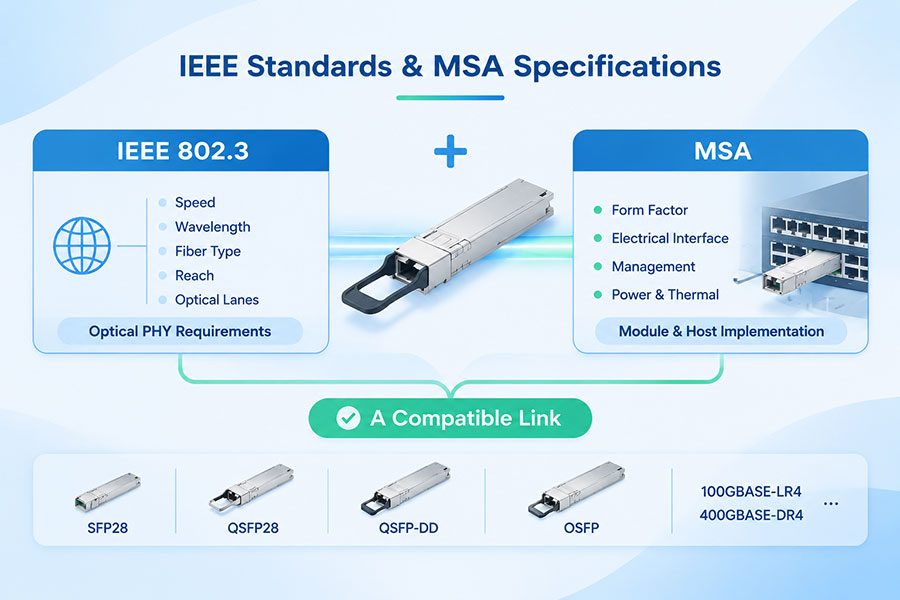
IEEE standards and optical transceiver MSAs (Multi-Source Agreements) work together to make optical networking equipment interoperable, but they serve different purposes.
IEEE standards primarily define Ethernet transmission requirements, including data rates, physical-layer behavior, signaling and optical link characteristics. MSAs define common implementation details for optical modules, such as form factor, mechanical dimensions, electrical interfaces, pin assignments and management requirements.
In practical terms, IEEE helps establish what a network link must do, while an MSA helps establish how compatible optical modules are designed and connected to host equipment.
Neither replaces the other. A transceiver may follow an IEEE Ethernet PHY specification but still need to comply with the relevant MSA to fit and operate correctly in a particular switch platform.
1. What Are IEEE Standards in Optical Networking?
The Institute of Electrical and Electronics Engineers (IEEE) develops technical standards for networking, electrical engineering and other technologies. In optical networking, the IEEE 802.3 working group is particularly important because it defines Ethernet specifications across copper and optical physical media.
IEEE 802.3 standards establish the technical requirements that allow Ethernet equipment from different manufacturers to communicate using compatible physical-layer interfaces.
1.1 Ethernet Data Rates and Physical Layers
IEEE 802.3 defines Ethernet operation at different data rates, including 10G, 25G, 40G, 100G, 200G, 400G, 800G and newer high-speed generations through applicable amendments and specifications.
For optical transceivers, these specifications may define:
Supported Ethernet data rates and physical-layer types.
Optical wavelengths and channel arrangements.
Transmission distances and fiber requirements.
Transmitter and receiver performance limits.
Optical power, sensitivity and link budget requirements.
Encoding, modulation and signaling characteristics.
Link-level performance and error requirements.
1.2 IEEE 802.3 Optical PHY Specifications
An optical PHY defines how Ethernet data is transmitted and received over an optical medium. Different PHY specifications address different transmission distances, fiber types and optical architectures.
For example, 400GBASE-DR4 and 400GBASE-FR4 both support 400GbE, but use different optical channel arrangements and reach characteristics.
| IEEE PHY Example | Application | Optical Characteristics |
|---|---|---|
| 100GBASE-DR | 100GbE short-reach single-mode links | Parallel optical transmission over SMF |
| 400GBASE-DR4 | 400GbE short-reach data center links | Four optical lanes over single-mode fiber |
| 400GBASE-FR4 | 400GbE data center links up to 2km | Four LAN-WDM wavelengths over duplex SMF |
| 800GBASE-DR8 | 800GbE short-reach data center links | Eight optical lanes over single-mode fiber |
The specific PHY requirements determine whether a transmitter and receiver can establish a compliant Ethernet optical link. They do not, by themselves, define every mechanical and electrical detail of the pluggable module.
2. What Is an Optical Transceiver MSA?
A Multi-Source Agreement is an industry agreement among participating manufacturers and technology companies to establish common specifications for a product interface or technology.
In optical networking, MSAs are especially important for pluggable transceivers. They provide shared design requirements so that modules from different suppliers can be developed for compatible host equipment.
Unlike IEEE standards, MSAs are generally industry-developed specifications rather than formal IEEE standards. Their scope depends on the particular agreement.
2.1 Mechanical Form Factor
MSAs define the physical dimensions and mechanical structure of optical modules. This includes module outlines, cage dimensions, connector arrangements, latching mechanisms and insertion requirements.
These specifications help ensure that a module designed for a particular form factor can physically fit into a compatible host port.
2.2 Electrical Interface and Pin Assignment
An MSA may define the electrical connections between an optical module and its host equipment, including:
High-speed transmit and receive electrical lanes.
Power supply contacts.
Ground connections.
Low-speed control signals.
Module reset and status signals.
Electrical connector and PCB requirements.
These details are important because a module can support the correct Ethernet data rate but still be incompatible with a host if its electrical interface does not match the host design.
2.3 Thermal and Power Requirements
Higher-speed optical modules generate heat from their DSP, laser drivers, optical components and other electronic circuits.
Form-factor specifications therefore address power delivery and thermal requirements, including heatsink structures, airflow considerations and operating limits.
2.4 Management Interface
Optical modules also need a standardized way to communicate operational information to the host switch. Depending on the module family, this may include temperature, supply voltage, transmit optical power, receive optical power, alarms and configuration settings.
Common Management Interface Specification (CMIS) provides a management framework used by several modern pluggable module families. It is a separate specification that works alongside the relevant hardware MSA.
3. IEEE Standards vs. Optical Transceiver MSAs
IEEE standards and MSAs address different layers of optical module design. IEEE focuses on Ethernet communication requirements, while MSAs focus on the physical implementation and host-module interface.
| Comparison | IEEE Standards | Optical Transceiver MSAs |
|---|---|---|
| Main Purpose | Define interoperable Ethernet communication | Define common module and host interfaces |
| Organization | IEEE Standards Association and working groups | Industry participants and MSA organizations |
| Primary Scope | Ethernet MAC and PHY specifications | Mechanical, electrical, thermal and related module requirements |
| Optical Performance | Defines PHY-specific transmission requirements | May define optical connector and lane-interface arrangements; optical signaling limits may be referenced from other specifications |
| Mechanical Dimensions | Generally not the main focus | Defines module, cage and connector dimensions |
| Electrical Pinout | Defines PHY-level interface behavior, not a universal pluggable pinout | Defines host-module electrical connections and pin assignments |
| Management | Defines relevant Ethernet management functions | Often references a separate specification such as CMIS |
| Interoperability Focus | Ethernet link interoperability | Module-to-host and multi-vendor hardware interoperability |
For example, IEEE may define the optical transmission requirements for 400GBASE-DR4, while QSFP-DD MSA defines the module's mechanical and electrical interface. A compatible implementation must satisfy both sets of requirements where applicable.
4. How IEEE and MSA Specifications Work Together
Optical transceiver development involves several related specifications. A module manufacturer cannot rely on a single document to cover every aspect of product design and interoperability.
A simplified specification structure looks like this:
Ethernet standard: Defines the Ethernet data rate and applicable physical-layer requirements.
Optical PHY specification: Defines the optical transmission characteristics for the selected reach and fiber type.
Hardware MSA: Defines the module form factor, electrical interface, mechanical dimensions and thermal requirements.
Management specification: Defines module identification, configuration, monitoring and control behavior.
Product implementation: Combines these requirements into a specific optical transceiver design.
These documents complement one another. The exact combination depends on the product family and application.
4.1 Example: 400G QSFP-DD Optical Transceiver
A 400G QSFP-DD optical transceiver may need to comply with several specifications:
IEEE 802.3: Defines the applicable 400GbE physical-layer requirements, such as 400GBASE-DR4 or 400GBASE-FR4.
QSFP-DD MSA: Defines the module and host hardware interface, including dimensions, electrical contacts and thermal requirements.
CMIS: Defines the management interface and associated module behavior.
Applicable connector specifications: Define the optical connector interface used by the module.
A 400G QSFP-DD module therefore needs more than a 400GbE label. Its optical PHY, hardware implementation and management behavior must match the intended host system.
4.2 Example: 800G QSFP-DD Optical Transceiver
For an 800G QSFP-DD module, the same principle applies. The IEEE 800GbE PHY specification defines the transmission requirements, while QSFP-DD800 MSA hardware specifications define the relevant module interface.
For example, an 800GBASE-DR8 module and an 800GBASE-2FR4 module may share the same general module form factor but use different optical channel arrangements, connectors and fiber configurations.
The form factor alone does not establish that two modules have the same optical performance or application compatibility.
5. Major Optical Transceiver MSAs and Their Applications
Different MSA families have been developed to support different module sizes, lane counts, bandwidth levels and host-system requirements.
5.1 SFP and SFP+ MSA
SFP (Small Form-factor Pluggable) is a widely used compact transceiver form factor. SFP+ extends the family for higher-speed applications, particularly 10GbE.
These form factors have been used across Ethernet, Fibre Channel and other networking applications. Their related specifications address mechanical dimensions, electrical interfaces and management functions.
5.2 QSFP and QSFP28
QSFP provides four high-speed electrical lanes and supports multiple generations of optical connectivity. QSFP28 became widely used for 100G Ethernet, commonly using four 25G-class electrical lanes.
The QSFP family is important in data center switches, routers and high-density network equipment.
5.3 QSFP-DD MSA
QSFP-DD (Quad Small Form-factor Pluggable Double Density) adds a second row of electrical contacts to increase the number of high-speed electrical lanes.
The architecture supports multiple bandwidth generations, including 400G, 800G and 1.6T implementations, depending on the hardware revision and host platform.
The QSFP-DD MSA defines important hardware details such as module dimensions, connector interfaces, electrical contacts and thermal requirements. Optical signaling specifications are defined by the applicable industry PHY standards or other relevant specifications.
5.4 OSFP MSA
OSFP (Octal Small Form-factor Pluggable) is a high-density pluggable module family designed for demanding data center and high-performance networking applications.
The OSFP MSA defines mechanical form factors, host cages, electrical interfaces, pin assignments and thermal requirements. Its later revisions include support for 1.6T module implementations.
OSFP and QSFP-DD are different form factors. Even when both support the same aggregate bandwidth, their mechanical interfaces and host requirements are not automatically interchangeable.
5.5 CFP and CFP2
CFP and CFP2 are earlier high-speed pluggable module families used in telecommunications, carrier networking and data center applications.
They supported generations of 100G optical connectivity and helped establish the transition toward higher-capacity optical modules.
| MSA Family | Typical Application | Key Design Focus |
|---|---|---|
| SFP / SFP+ | 1G and 10G networking | Compact single-lane module interfaces |
| QSFP / QSFP28 | 40G and 100G networking | Four-lane pluggable architecture |
| QSFP-DD | 400G, 800G and 1.6T systems | Double-density electrical interface |
| OSFP | 400G, 800G and 1.6T systems | High-speed electrical interface and thermal design |
| CFP / CFP2 | 100G optical networking | High-capacity telecommunications interfaces |
Supported data rates are determined by the relevant MSA revision, PHY specification and host implementation. A form-factor name alone does not guarantee support for every listed speed.
6. The Role of OIF, SFF and CMIS in the Specification Ecosystem
IEEE and MSAs are not the only organizations or specifications involved in optical transceiver interoperability. Other industry groups address electrical interfaces, module management and optical networking implementation requirements.
6.1 OIF Implementation Agreements
The Optical Internetworking Forum (OIF) develops Implementation Agreements (IAs) to promote interoperability between optical networking components and systems.
OIF specifications address areas such as coherent optical interfaces, electrical interfaces, optical components and network interconnection requirements.
For example, OIF 400ZR defines a coherent optical interface for specific data center interconnect applications. This is different from an IEEE 400GBASE Ethernet PHY specification and from a QSFP-DD or OSFP hardware MSA.
6.2 SNIA SFF Specifications
The SFF Technical Working Group, operating under SNIA, develops specifications covering storage and networking interfaces, including pluggable modules, connectors, electrical interfaces and management-related technologies.
Some SFF specifications complement MSA documents by defining specific hardware or management details.
6.3 Common Management Interface Specification (CMIS)
CMIS defines a common management framework for compatible optical modules. It allows host equipment to identify modules, configure supported functions and monitor operational information.
Depending on the module and CMIS revision, management functions may include:
Module identification and supported capabilities.
Transmit and receive channel information.
Optical power monitoring.
Temperature and voltage monitoring.
Alarm and warning reporting.
Configuration and control functions.
CMIS is not an Ethernet optical PHY specification. It complements the relevant hardware MSA and transmission standard.
7. Does MSA Compliance Guarantee IEEE Compliance?
No. MSA compliance and IEEE compliance are separate requirements.
A module may meet the mechanical and electrical requirements of a QSFP-DD or OSFP MSA but use an optical design that does not comply with the intended IEEE Ethernet PHY.
Likewise, a module may implement a compliant Ethernet optical PHY but fail to meet the mechanical or electrical requirements of the host's pluggable form factor.
For example:
A module can have the correct QSFP-DD dimensions but use an unsupported optical interface.
A module can meet the optical performance requirements of a particular Ethernet PHY but have an incompatible host pin assignment.
A module can fit into a port but exceed the host's supported power or thermal limits.
A module can use a compatible hardware interface but implement a different management revision or unsupported feature set.
Therefore, checking only the module's data rate or form factor is insufficient when evaluating interoperability.
8. How to Check IEEE and MSA Compliance When Selecting Optical Transceivers
Network operators, equipment manufacturers and optical module buyers should verify several specifications before selecting a transceiver.
8.1 Verify the Ethernet PHY
Identify the exact Ethernet PHY supported by the switch or network device. Examples include 400GBASE-DR4, 400GBASE-FR4, 800GBASE-DR8 and other applicable optical interfaces.
Confirm that the module's transmission distance, fiber type, wavelength and optical connector match the intended link.
8.2 Check the Hardware MSA Revision
Confirm the module's form factor and the relevant MSA hardware revision. Do not assume that every generation within a form-factor family has identical electrical, mechanical or thermal requirements.
8.3 Confirm CMIS Compatibility
Check the supported CMIS revision and the management features implemented by both the module and host switch.
A shared CMIS version does not guarantee complete compatibility because vendor-specific host requirements and optional features may still differ.
8.4 Verify Host Electrical and Thermal Support
Confirm that the host port supports the required electrical lane rate, power class, module type and cooling arrangement.
This is particularly important for 800G and 1.6T modules, where high-speed electrical interfaces and thermal requirements become more demanding.
8.5 Perform Interoperability Testing
Before large-scale deployment, test the optical module with the intended switch platform, firmware and fiber infrastructure.
Useful validation items include link establishment, error performance, optical power levels, temperature behavior, alarms, module recognition and sustained traffic operation.
9. How These Specifications Apply to C-LIGHT Optical Transceivers
C-LIGHT optical transceiver products are developed for different Ethernet speeds, form factors and optical transmission distances. The applicable standards depend on the specific product configuration rather than the product's aggregate data rate alone.
9.1 400G QSFP-DD Optical Transceivers
The C-LIGHT 400G QSFP-DD optical transceiver series includes different optical configurations, including DR4, FR4, LR4 and other variants.
Its product specifications reference applicable IEEE Ethernet standards, QSFP-DD hardware requirements, CMIS and, for coherent variants, relevant OIF or OpenZR+ specifications.
When selecting a specific model, the exact PHY, optical reach, connector and host compatibility should be checked against its datasheet.
9.2 800G QSFP-DD Optical Transceivers
The C-LIGHT 800G QSFP-DD optical transceiver series references applicable IEEE 802.3 specifications, QSFP-DD800 MSA hardware requirements and CMIS Rev. 5.0.
Different variants support different optical arrangements and distances. For example, 800G DR8, 2×FR4 and coherent configurations have different transmission characteristics and should be evaluated separately.
9.3 1.6T OSFP-RHS Optical Transceivers
The C-LIGHT 1.6T OSFP-RHS optical transceiver uses an eight-channel 200G PAM4 architecture and an OSFP-RHS hardware design.
Its specification combines the relevant 1.6T Ethernet requirements with OSFP hardware and management specifications. The available configurations include DR8 for up to 500m and 2×FR4 for up to 2km, depending on the selected part number.
These examples illustrate why an optical module's specification should identify the transmission standard, hardware MSA and management interface separately.
10. Frequently Asked Questions About IEEE Standards and Optical Transceiver MSAs
Q1: What is the main difference between IEEE standards and optical transceiver MSAs?
IEEE standards define Ethernet communication and physical-layer requirements, while MSAs define common module hardware interfaces, including form factor, electrical connections and thermal requirements.
Q2: Is an MSA an official IEEE standard?
No. An MSA is generally an industry agreement developed by participating companies. It complements formal standards but is not itself an IEEE standard.
Q3: Does IEEE 802.3 define QSFP-DD and OSFP dimensions?
No. QSFP-DD and OSFP mechanical dimensions and hardware interfaces are defined by their respective MSA specifications.
Q4: Can an optical transceiver comply with an MSA but not IEEE?
Yes. A module may meet the hardware requirements of an MSA without implementing a particular IEEE Ethernet PHY. The two types of compliance must be evaluated separately.
Q5: What is the relationship between MSA and CMIS?
The MSA defines the relevant module hardware interface, while CMIS defines management and control behavior. Many modern pluggable modules use both specifications.
Q6: What is the role of OIF in optical transceiver standards?
OIF develops Implementation Agreements for interoperable optical and electrical interfaces, including coherent optical technologies and high-speed electrical connections.
Q7: Are QSFP-DD and OSFP interchangeable?
No. They are different form factors with different mechanical and host interfaces. A switch must support the specific module family.
Q8: Does the same 800G data rate mean two optical modules are compatible?
No. They may use different PHYs, optical lane arrangements, connectors, MSA revisions, power classes or management implementations.
Q9: Why should buyers check both IEEE and MSA compliance?
IEEE compliance helps verify optical link performance, while MSA compliance helps verify module and host hardware compatibility. Both are important for reliable deployment.
Q10: What should be included in an optical transceiver datasheet?
A useful datasheet should identify the form factor, supported PHY, transmission distance, fiber type, wavelength, connector, electrical interface, power requirements and applicable management specifications.
11. Conclusion
IEEE standards and optical transceiver MSAs form two complementary parts of the optical networking specification ecosystem.
IEEE defines how Ethernet data is transmitted across the physical layer, including data rates, optical signaling and link performance. MSAs define how optical modules connect to host systems through standardized mechanical, electrical and thermal interfaces. CMIS and other related specifications add the management functions needed for module monitoring and control.
For optical transceiver manufacturers and network operators, understanding these distinctions is essential. A module's data rate and form factor alone do not guarantee interoperability. Its Ethernet PHY, hardware MSA, management interface and host-system requirements must all be considered together.
As networking advances from 400G and 800G toward 1.6T and beyond, coordination between standards organizations and industry MSA groups will remain central to building interoperable, scalable optical networks.
 >

 >
 >
 >
 >
 >
 >
 >