TEL:+86 132 6656 7067





Future data center networks must connect increasingly large groups of processors, storage systems and accelerator racks without allowing electrical switching capacity, power consumption or cabling complexity to grow uncontrollably. Optical switching offers another way to build these connections. Instead of converting every incoming optical signal into an electrical signal for packet processing and then converting it back into light, an optical switch can redirect light between physical ports or optical paths. This capability enables reconfigurable network topologies, high-capacity circuit connections and more flexible allocation of bandwidth across AI and cloud infrastructure.
1. Why Data Center Networks Are Moving Toward Optical Switching
Conventional data center networks rely primarily on electronic packet switches connected through optical transceivers and fiber links. Ethernet or InfiniBand switches inspect packet information, make forwarding decisions and transfer traffic through their switching fabrics. This approach provides flexible packet-level connectivity and supports dynamic traffic patterns across large server environments.
However, as AI clusters and hyperscale facilities expand, the electrical switching fabric must handle increasingly demanding traffic volumes. Large accelerator groups can generate concentrated communication patterns during distributed training, synchronization and data exchange. Supporting these workloads may require additional switching stages, higher-radix devices and extensive optical interconnections.
Several architectural pressures are encouraging the adoption of optical switching:
Bandwidth growth: More accelerator nodes and higher-speed network interfaces increase aggregate traffic between racks and computing groups.
Power consumption: Electronic packet switching requires processing and electrical switching resources that consume power as network capacity increases.
Network topology: Fixed electrical fabrics may not always provide the most efficient connectivity for workloads with changing communication patterns.
Fiber utilization: High-density optical links create opportunities to reconfigure physical connections instead of permanently assigning every link to one traffic relationship.
Infrastructure scalability: Large networks need flexible ways to add capacity, isolate traffic domains and adapt connections as computing resources change.
Optical switching addresses these challenges by introducing reconfigurable connectivity at the physical or optical layer. It does not necessarily replace electronic packet switching. In many practical architectures, the two technologies perform complementary functions.
2. How Optical Switching Works
An optical switch directs an incoming optical signal from one input port to a selected output port. Depending on the technology, switching can be performed through mechanical movement, changes in optical properties or integrated photonic components. The signal can remain in the optical domain while passing through the switching element.
In an optical circuit switching (OCS) architecture, the controller establishes a dedicated optical path between two endpoints or network devices. Once the path is configured, data travels through the connection without requiring the optical switch to inspect and forward individual packets.
A simplified OCS connection process includes:
Traffic identification: The network controller identifies endpoints that need additional bandwidth or a direct optical connection.
Resource calculation: The control system checks available switch ports, fiber paths and connection constraints.
Path configuration: The optical switch establishes the required input-to-output connection.
Link validation: The endpoints verify optical power, signal quality and communication readiness.
Data transmission: Traffic flows through the established optical circuit.
Reconfiguration or release: The connection is retained, modified or released according to network demand.
3. Optical Circuit Switching and Electronic Packet Switching
Electronic packet switching and optical circuit switching solve different networking problems. An electronic switch examines packet headers and forwards individual packets according to routing and forwarding information. An OCS device establishes an optical connection between selected ports and maintains that connection until it is reconfigured or released.
| Technical factor | Electronic packet switching | Optical circuit switching |
|---|---|---|
| Forwarding method | Processes packet headers and forwards packets individually | Establishes optical paths between selected ports |
| Data processing | Uses electronic switching logic and packet-processing functions | Redirects optical signals without packet-level processing inside the optical fabric |
| Bandwidth allocation | Shares link capacity among packet flows | Allocates a physical optical connection for the configured circuit |
| Latency characteristics | Includes switching, buffering and queuing effects | Can avoid intermediate packet-buffering and forwarding stages within the optical path |
| Traffic flexibility | Supports dynamic packet forwarding across many destinations | Connectivity changes when the optical circuit is reconfigured |
| Contention handling | Can use packet buffers and scheduling mechanisms | Requires topology planning, resource coordination or other contention-management methods |
| Typical role | General-purpose network connectivity | High-capacity direct connections and reconfigurable network topology |
OCS is particularly useful when traffic between selected computing groups is large enough and stable enough to justify a dedicated connection. Electronic packet switching remains important for bursty, unpredictable and fine-grained traffic that requires flexible destination selection.
This distinction explains why optical switching is often deployed as an additional network layer rather than as a universal replacement for Ethernet or InfiniBand switching.
4. Main Optical Switching Technologies
Optical switches can be built using different physical and photonic mechanisms. Each technology has different characteristics in terms of port count, insertion loss, switching time, scalability, reliability and integration complexity.
| Technology | Operating principle | Typical characteristics | Design considerations |
|---|---|---|---|
| MEMS optical switching | Micromirrors physically redirect optical beams between input and output fibers | Can support high port counts and relatively low-loss optical paths | Mechanical movement introduces reconfiguration time and precision requirements |
| Liquid crystal on silicon (LCoS) | Uses electrically controlled liquid-crystal elements to manipulate optical phase and routing | Useful in wavelength-selective switching and flexible optical transport systems | Optical alignment, polarization behavior and switching response require consideration |
| Mach-Zehnder interferometer (MZI) | Controls interference between optical paths to select an output | Suitable for integrated photonic switching fabrics | Thermal stability, control complexity and accumulated insertion loss matter |
| Microring resonators | Uses resonant optical coupling to select or redirect specific wavelengths | Compact and compatible with photonic integration | Wavelength and temperature sensitivity require careful control |
| Semiconductor optical amplifier (SOA) | Uses electrically controlled optical gain to enable switching and signal gating | Can support fast switching in suitable architectures | Noise, gain variation, nonlinear effects and polarization sensitivity must be managed |
| Arrayed waveguide grating (AWG) | Uses wavelength-dependent interference to route different wavelengths to different ports | Provides passive wavelength routing without mechanical switching | Channel spacing, wavelength stability and fixed routing behavior affect flexibility |
These technologies are not interchangeable. MEMS devices are commonly associated with high-port-count circuit switching, while integrated MZI and microring structures are relevant to compact photonic switching. AWGs provide wavelength-dependent routing and are often used as part of a larger optical architecture rather than as arbitrary port-to-port switches.
5. How Optical Switching Supports AI Training Networks
Distributed AI training involves repeated communication among accelerators. Operations such as AllReduce, AllGather, ReduceScatter and All-to-All move data between GPUs or other compute devices. The communication pattern depends on the training algorithm, parallelization strategy, cluster topology and placement of computing resources.
In large clusters, certain groups of accelerators may exchange substantial volumes of data during particular training phases. A fixed network topology may provide sufficient capacity for average traffic but become inefficient when communication demand shifts between groups.
Optical circuit switching can provide additional direct connectivity between selected network blocks. A controller can reconfigure optical paths to reflect workload placement or changing traffic demand, potentially reducing the need for some intermediate switching resources.
Potential applications include:
Dynamic accelerator connectivity: Establishes direct optical paths between selected compute groups when their communication demand is high.
Traffic-aware topology changes: Adjusts physical connectivity to better match the communication pattern of a training workload.
Cluster expansion: Provides a reconfigurable optical layer for connecting additional computing blocks.
Workload isolation: Establishes separate physical paths for selected traffic domains where the architecture and control policies support it.
Resilience: Reconfigures connections around certain link or device failures when alternate optical paths are available.
The benefit depends on the workload and reconfiguration overhead. OCS is most attractive when traffic relationships persist long enough to justify the time and control operations required to establish a circuit.
6. Optical Switching and AI Network Topologies
Traditional data center fabrics often use leaf-spine or Clos architectures. These designs provide multiple paths through electronic switches and can scale by adding network devices and links. Optical switching introduces another option: the physical topology can be adjusted by changing which ports are connected through the optical layer.
Google's Jupiter network is a notable example of optical circuit switching used to create reconfigurable data center topologies. Its architecture uses optical switches to connect network blocks through dynamically configured fiber paths. This allows logical connectivity to evolve without requiring every physical link to be permanently assigned to a fixed switch pair.
Several topology approaches can incorporate optical switching:
| Topology approach | Role of optical switching | Potential benefit |
|---|---|---|
| Leaf-spine with OCS augmentation | Adds reconfigurable optical connections between selected network blocks | Provides additional capacity for traffic hotspots |
| Optical circuit mesh | Connects aggregation blocks through configurable optical paths | Supports flexible physical connectivity and alternative traffic paths |
| Hybrid electrical-optical fabric | Combines packet switching with optical circuit switching | Balances packet-level flexibility and high-capacity optical connections |
| Reconfigurable AI cluster fabric | Changes optical connections according to accelerator placement and workload requirements | Can align network resources more closely with distributed training patterns |
Optical switching does not eliminate the need for a well-designed network topology. Engineers must still evaluate path diversity, oversubscription, bisection bandwidth, failure domains and the behavior of traffic that cannot use a dedicated optical circuit.
7. Optical Switching Can Reduce Intermediate Electrical Processing
In an all-optical path, signals can pass through optical switching elements without repeated optical-electrical-optical (O-E-O) conversion at every intermediate switching stage. This can reduce the need for some electrical packet-processing hardware and associated power consumption.
For large data center networks, the potential savings are related to the number of switching stages removed or simplified, the optical path length and the traffic volume carried by the circuit. Optical switching can also reduce the amount of electrical switching capacity required for selected high-volume connections.
However, the complete system still consumes power. Optical transmitters, receivers, endpoint switches, laser sources, control electronics and cooling systems remain part of the network. Some architectures also require additional transceivers or optical components to support the OCS layer.
Power efficiency should therefore be assessed across the complete network rather than inferred from the optical switch's standalone power consumption. The relevant comparison includes the electrical switches and transceivers that an optical architecture replaces, as well as the additional equipment needed to operate it.
8. Switching Speed Determines Which Workloads Can Benefit
Optical switching technologies operate at different timescales. Some MEMS-based circuit switches require milliseconds or longer to reconfigure, making them suitable for connections that remain active over relatively long periods. Faster integrated photonic approaches have demonstrated much shorter switching times in research environments.
Switching time alone, however, does not determine how quickly a network can use a new connection. The complete reconfiguration process may also involve controller decisions, device configuration, endpoint coordination, link training, clock and data recovery, and traffic scheduling.
| Switching timescale | Potential use | Important considerations |
|---|---|---|
| Millisecond-scale | Long-lived optical circuits and scheduled traffic aggregation | Traffic demand must persist long enough to justify reconfiguration |
| Microsecond-scale | More dynamic circuit allocation and selected short-duration connections | Control-plane response and endpoint synchronization become important |
| Nanosecond-scale | Research into highly dynamic optical switching and packet-level operations | Requires very fast control, receiver recovery and contention handling |
Research has demonstrated nanosecond optical switching and control systems, but this should not be confused with the behavior of every commercially deployed OCS platform. Many practical data center systems still use slower circuit reconfiguration and rely on traffic scheduling to make efficient use of established connections.
For AI clusters, a scheduled optical circuit may be more practical than attempting to switch the optical path for every individual packet. The network controller can configure connectivity around known communication phases while electronic switches continue handling ordinary packet traffic.
9. Optical Switching Has Important Engineering Limitations
Although optical switching offers attractive bandwidth and power characteristics, it introduces constraints that must be considered before deployment.
Limited optical buffering: Optical circuit switches generally do not provide the same packet-buffering capabilities as electronic switches. Contending traffic must be handled through scheduling, path planning or electronic buffering elsewhere in the network.
Reconfiguration overhead: Establishing a new optical path takes time. Frequent changes can reduce effective network utilization if the traffic pattern changes faster than the switch can respond.
Port contention: Multiple traffic demands may request the same output port or optical resource. The controller needs a method to resolve conflicting connection requests.
Optical loss: Connectors, fiber routing and switching components introduce insertion loss that must remain within the link budget.
Signal quality: Optical power, wavelength compatibility, dispersion and receiver sensitivity still affect end-to-end link performance.
Control complexity: Dynamic topology management requires coordination among the optical switch, endpoint devices, network controller and monitoring systems.
Fault recovery: A physical connection change must be coordinated with routing and traffic management to avoid unexpected packet loss or prolonged interruption.
These limitations explain why hybrid architectures are often more practical than attempting to move every network function into the optical domain.
10. The Role of SDN and Network Automation
Optical switching becomes more useful when its physical connectivity can be coordinated with the logical network. Software-defined networking (SDN) provides a framework for managing this relationship. A controller can collect network information, identify traffic demands, calculate suitable optical paths and instruct optical switches to establish or release connections.
For an AI data center, the control system may use information about accelerator placement, training phases, link utilization and network congestion. It can then determine whether a direct optical connection would improve the available bandwidth for a particular group of endpoints.
A practical control architecture may include:
Telemetry collection: Gathers link utilization, optical power, port status and network performance information.
Traffic analysis: Identifies sustained high-volume communication relationships and potential network bottlenecks.
Path computation: Determines feasible optical connections based on available ports, fiber paths and topology constraints.
Configuration management: Programs the optical switch and coordinates endpoint network settings.
Verification: Confirms that the new path is operational before traffic is moved.
Automated recovery: Recalculates paths when a link, optical switch or endpoint becomes unavailable.
The Open Compute Project's Optical Circuit Switching initiative addresses this broader ecosystem, including hardware and software specifications, SDN integration, telemetry and interoperability. Standardized control interfaces can help reduce dependence on isolated vendor-specific implementations.
11. Optical Switching and the Evolution of Data Center Interconnect
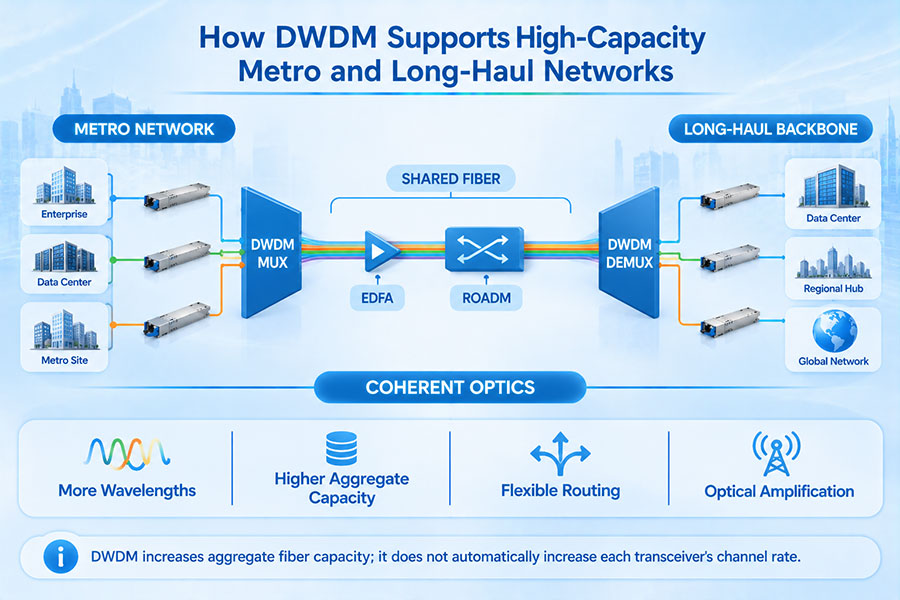
Optical switching also supports connectivity between separate data center facilities. Data center interconnect (DCI) systems use fiber infrastructure to link geographically distributed computing environments. WDM and DWDM increase the number of optical channels that can share available fiber, while optical switching and reconfigurable optical add-drop multiplexers can change how wavelengths are routed through the network.
Within a campus or hyperscale environment, optical circuit switches can connect computing blocks, aggregation systems or separate network domains. Across metro and regional networks, wavelength-selective switching can provide flexible optical paths between data center locations.
These functions operate at different levels:
| Network domain | Optical switching application | Primary objective |
|---|---|---|
| Within a rack or computing block | Short-reach optical interconnects and emerging photonic switching architectures | High-density connectivity between computing resources |
| Between racks and clusters | OCS-based reconfigurable network connections | Dynamic allocation of bandwidth across computing groups |
| Between data center buildings | Optical circuit switching and wavelength routing | High-capacity campus connectivity |
| Between geographically separated facilities | ROADM-based optical transport and DCI systems | Flexible wavelength routing and resilient long-distance connectivity |
End-to-end network design must account for the differences between intra-data-center optical circuits and carrier-style wavelength routing. The switching hardware, reach requirements, control systems and protection mechanisms may be very different.
12. Optical Switching, CPO and Silicon Photonics Serve Different Functions
Optical switching is often discussed alongside co-packaged optics (CPO), silicon photonics and high-speed optical transceivers. These technologies are related through their use of photonic components, but they address different parts of the network architecture.
| Technology | Main function | Position in the network |
|---|---|---|
| Optical circuit switching | Redirects optical signals to establish configurable physical connections | Network connectivity and topology layer |
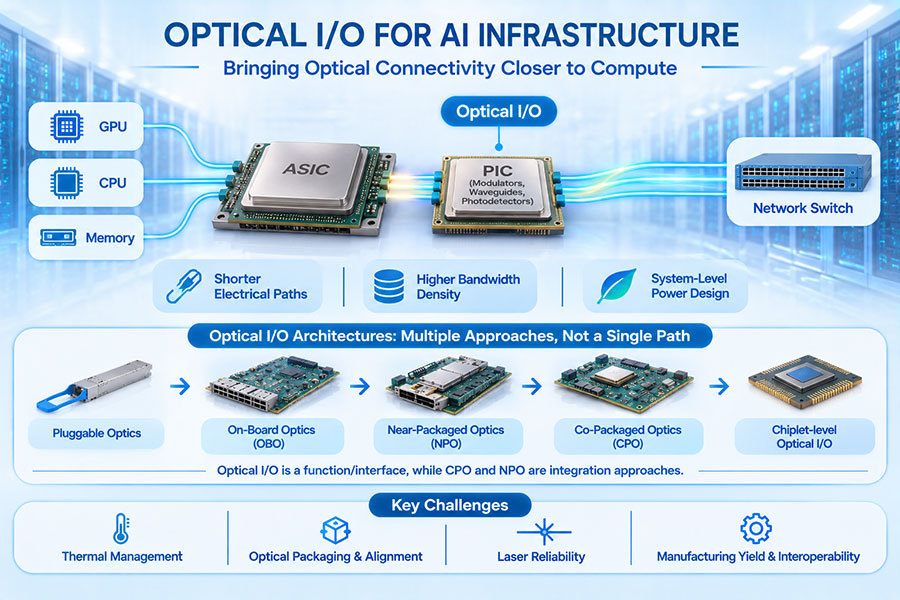
| Co-packaged optics | Places optical engines close to a switch ASIC to reduce electrical I/O distance | Switch package and optical I/O architecture |
| Silicon photonics | Integrates optical functions such as waveguides, modulators and photodetectors on photonic chips | Photonic component and integration platform |
| Pluggable optical transceivers | Convert electrical host signals to optical signals and back | Equipment ports and fiber links |
| DWDM and ROADM | Multiplex and route optical wavelength channels | Optical transport and DCI infrastructure |
Silicon photonics can be used to build optical switching components, and CPO can integrate optical engines near switching ASICs. Neither technology is synonymous with OCS. A network may use CPO-based packet switches and a separate optical circuit switching layer, or deploy conventional pluggable transceivers with an OCS fabric.
13. What Future Data Center Networks May Look Like
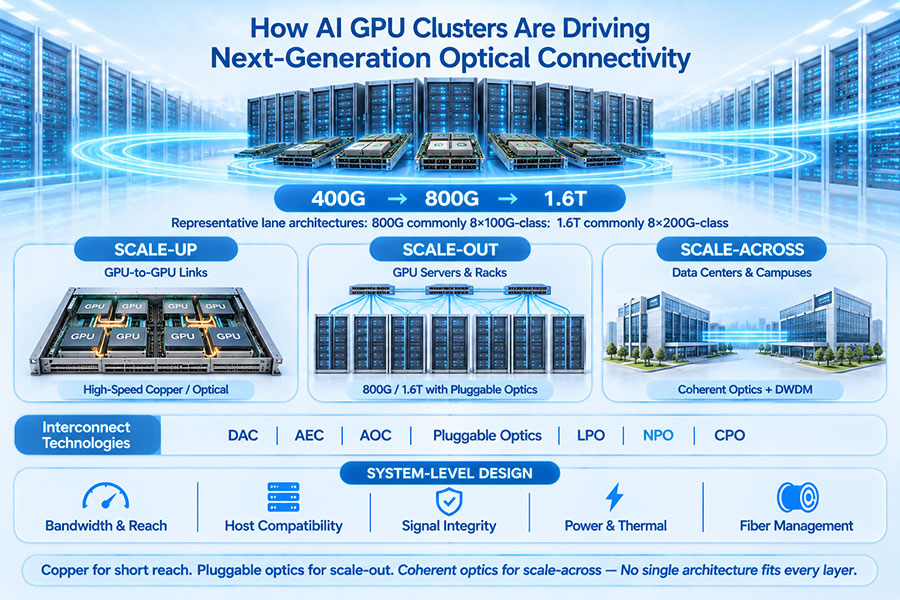
Future data center networks are likely to combine electronic packet switching, optical circuit switching, high-speed pluggable optics, co-packaged optics and increasingly automated network control. Each technology will serve a different function according to the required bandwidth, traffic pattern, switching timescale and physical distance.
For AI infrastructure, one possible architecture uses electronic switches for general packet forwarding and an optical circuit layer to establish additional high-capacity connections between selected accelerator groups. For hyperscale facilities, optical switching can also support reconfigurable connections between aggregation blocks and reduce dependence on fixed electrical network topologies.
Several developments will influence wider adoption:
Higher-port-count optical switches: Improve the number of endpoints that can be connected through a reconfigurable optical fabric.
Faster photonic switching: Opens opportunities for more dynamic optical connectivity, provided control and receiver technologies can keep pace.
Open hardware and software interfaces: Improve interoperability between optical switches, controllers and network operating systems.
Workload-aware orchestration: Connects physical network configuration with AI scheduling and application communication requirements.
Integrated monitoring: Combines optical diagnostics and network telemetry to improve fault detection and resource allocation.
Optical switching will not make electronic networking unnecessary. Its long-term value comes from placing optical connectivity where dedicated bandwidth, flexible physical topology and reduced intermediate electrical processing provide measurable advantages.
14. Optical Switching Is Becoming an Important Part of Network Architecture
As AI and cloud infrastructure continue to scale, network design must account for more than the capacity of individual Ethernet or InfiniBand ports. The physical topology, traffic distribution, power budget, fiber infrastructure and ability to reconfigure connections all influence overall performance.
Optical circuit switching provides a way to establish high-capacity optical paths between selected network endpoints. Combined with electronic packet switching and intelligent network control, it can support workload-aware connectivity, more flexible topologies and efficient use of optical resources.
Its adoption will depend on practical factors such as switching speed, port density, optical loss, contention management, interoperability and maintenance requirements. Rather than replacing conventional switching across every application, optical switching is likely to become an increasingly important complementary layer in large-scale data center networks.
C-LIGHT provides optical connectivity solutions for data center and telecommunications infrastructure. Visit the optical transceiver portfolio for high-speed optical link requirements, or Contact C-LIGHT to discuss network connectivity applications.
 >

 >
 >
 >
 >
 >
 >
 >