TEL:+86 132 6656 7067





Hyperscale data centers are changing optical module demand through their scale, network architecture, and continuous expansion of computing capacity. Large cloud platforms now connect vast numbers of servers, storage systems, accelerators, and switches across facilities containing thousands of network ports. As traffic volumes increase, optical connectivity must deliver higher bandwidth, greater port density, predictable performance, and improved energy efficiency. These requirements are changing not only the number of optical modules purchased, but also the speed grades, form factors, transmission technologies, and manufacturing capabilities suppliers need to support.
1. Hyperscale Expansion Is Increasing the Number of Optical Connections
Hyperscale data centers differ from conventional enterprise facilities in their scale of deployment and network design. They operate large pools of computing and storage resources, often distributed across multiple buildings or campuses. Their network infrastructure must support continuous communication between servers, switches, storage platforms, and increasingly large accelerator clusters.
Every expansion of computing capacity creates additional connectivity requirements. New server racks need connections to leaf switches, leaf switches connect to spine layers, and separate facilities may require dedicated data center interconnect links. As the number of devices and network ports increases, the total installed base of optical modules can grow even when individual links retain the same data rate.
AI workloads add another source of demand. Distributed model training involves frequent data exchange between accelerators, while inference services require communication between computing, storage, and network resources. These traffic patterns increase the importance of high-capacity links and predictable network performance.
Consequently, optical module demand is influenced by two separate factors: the number of physical connections being deployed and the bandwidth required by each connection. Hyperscale operators are increasing both as their infrastructure expands and network generations advance.
2. Network Scale Is Changing the Distribution of Optical Module Speeds
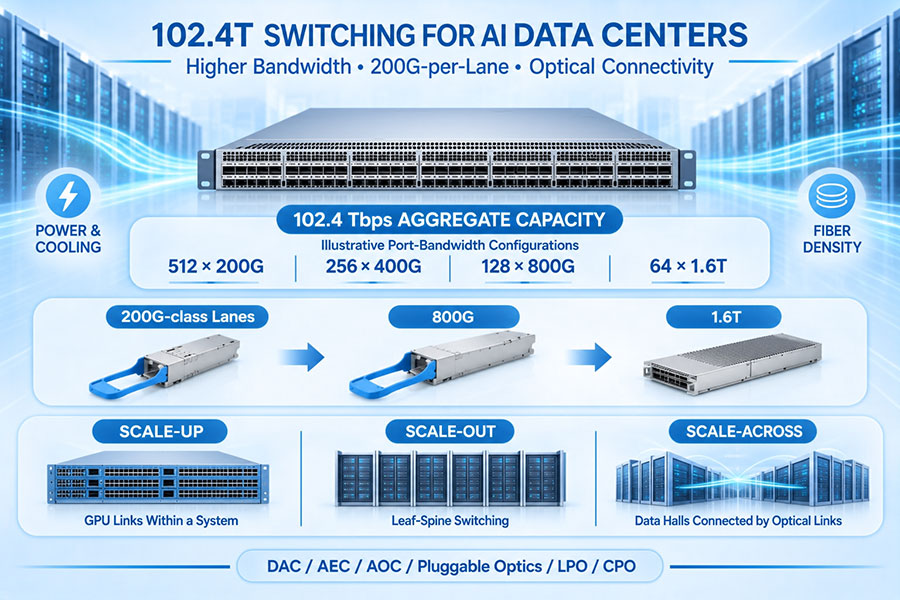
Optical module procurement is moving toward a broader mix of high-speed products. Earlier data center deployments relied heavily on 10G, 25G, 40G, and 100G interfaces. Later network upgrades introduced 200G and 400G, while 800G has become an important generation for large-scale AI and cloud networking. The next transition toward 1.6T is adding another layer to the product roadmap.
| Data Rate | Typical Deployment Role | Demand Characteristics |
|---|---|---|
| 100G | Existing data center links, access networks, and selected switch connections | Continues to support installed infrastructure and cost-sensitive applications |
| 200G | Intermediate-speed connections and selected network platforms | Application depends on equipment generation and port architecture |
| 400G | High-capacity switch links and established data center fabrics | Remains relevant in ongoing deployments and network upgrades |
| 800G | High-density AI clusters and next-generation switching systems | Strong demand from large-scale computing and bandwidth expansion |
| 1.6T | Newer high-capacity switching platforms and future network generations | Increasing qualification and production activity as platforms mature |
The migration is not a simple replacement process. Hyperscale operators may deploy several speed generations simultaneously because different network layers have different bandwidth requirements, equipment lifecycles, and upgrade schedules. A 400G module can remain appropriate for one network segment even when 800G or 1.6T is being introduced elsewhere.
For suppliers, this creates a need to maintain a portfolio that supports current deployments while preparing for higher-speed interfaces. Product availability, qualification status, and manufacturing consistency become important alongside nominal data rate.
3. Scale-Out Networking Is a Major Driver of Optical Module Consumption
Scale-out networking connects a growing number of servers and accelerator systems through a switching fabric. In large AI clusters, this architecture supports communication among distributed compute resources and allows operators to expand capacity by adding servers and network equipment.
Optical modules are widely used for switch-to-switch and rack-to-rack connections, particularly where bandwidth and distance exceed practical copper-link limits. High-radix switches also create substantial demand for optical ports. A network deployment involving many switches can require large quantities of transceivers, fiber assemblies, and associated connectivity components.
Several factors influence the optical module mix in scale-out networks:
Switch capacity: Higher aggregate switching bandwidth creates demand for faster optical interfaces and more capable uplinks.
Port density: The number of usable front-panel ports affects the quantity and physical arrangement of modules.
Connection distance: Links between equipment in the same rack may use copper or active cables, while longer rack-to-rack connections often require optical solutions.
Network topology: Leaf-spine designs and larger multi-tier fabrics create different port and link requirements.
Traffic patterns: Distributed AI workloads increase the importance of network capacity and congestion management.
The resulting demand is not determined by switch bandwidth alone. The number of switches, network oversubscription, redundancy design, fiber topology, and the ratio of server-facing to fabric-facing ports all affect the final module requirement.
4. AI Clusters Are Expanding Demand Beyond Conventional Cloud Networking
Hyperscale data centers increasingly accommodate specialized AI infrastructure alongside general-purpose cloud services. GPU and accelerator clusters have different networking requirements from many traditional enterprise workloads. Training systems may connect large numbers of accelerators through high-performance fabrics, while inference infrastructure must support efficient communication between model-serving resources and other services.
This creates demand for optical connectivity at several network layers:
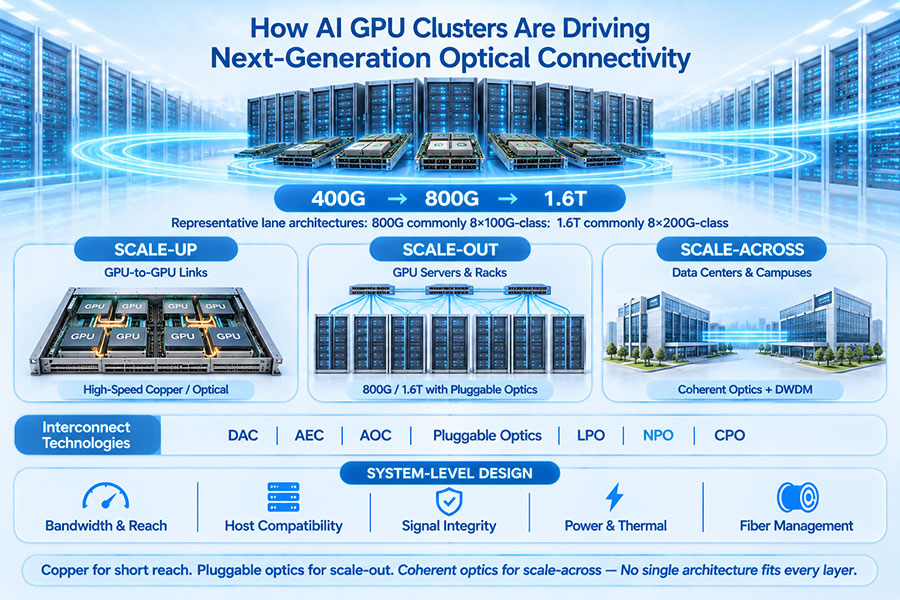
| Network Layer | Connection Scope | Optical Demand Factors |
|---|---|---|
| Scale-up | Accelerators and processors within tightly coupled systems | Bandwidth density, electrical reach, packaging, and emerging optical I/O |
| Scale-out | Servers, racks, and network switches | 800G and 1.6T interfaces, port density, and fiber connectivity |
| Storage networking | Compute nodes and high-performance storage systems | Throughput, latency, link reliability, and network topology |
| Data center interconnect | Separate buildings, campuses, and facilities | WDM, coherent optics, transmission distance, and aggregate capacity |
Not every AI connection requires a pluggable optical module. Short electrical connections and active copper cables remain useful in appropriate applications. However, as the number of connections and required bandwidth increase, optical technology becomes more important for extending reach and supporting high-capacity network fabrics.
5. Higher Port Speeds Are Increasing the Importance of Power Efficiency
At hyperscale, even a small difference in power consumption per port can become significant when multiplied across thousands of optical interfaces. Higher-speed modules also introduce additional thermal challenges because faster electrical signaling, optical conversion, and signal processing must operate within compact packages.
Traditional DSP-based transceivers provide retiming and signal-conditioning functions that support demanding host and optical channels. However, these functions consume power and generate heat. As switch port density increases, the combined thermal load from optical modules becomes an important factor in equipment design.
Several technology directions are addressing these constraints:
DSP optimization: More efficient processing and circuit design can reduce energy consumption while maintaining signal quality.
LPO: Linear pluggable optics reduces or removes conventional module DSP retiming, potentially lowering module power and latency. It requires careful host-channel engineering.
Silicon photonics: Photonic integration can combine optical functions into compact devices and support higher integration density.
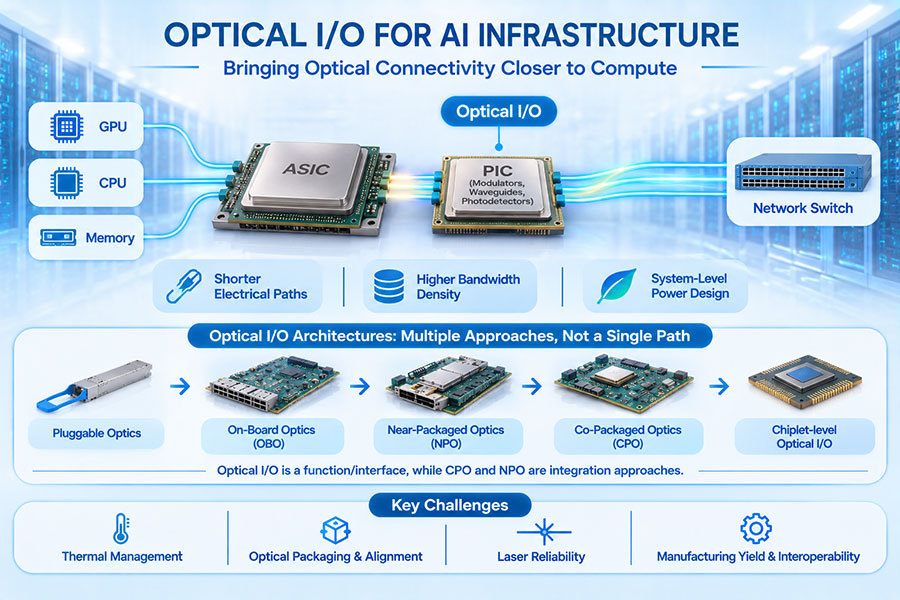
NPO and CPO: Moving optical engines closer to the host ASIC can shorten electrical paths and support higher bandwidth density.
Thermal engineering: Improved module packaging, heat transfer, airflow, and chassis cooling help maintain stable operating conditions.
These technologies address different parts of the system. Their suitability depends on the host platform, service model, optical reach, electrical channel, and operational requirements. Pluggable optics remains valuable where field replacement and modular upgrades are important.
6. Form Factors and Optical Interfaces Must Match Network Design
Higher-speed optical modules are available in several form factors, including QSFP-DD and OSFP. Their mechanical dimensions, electrical interfaces, thermal characteristics, and host requirements influence which products can be deployed in a particular switch platform.
OSFP is widely associated with high-density 400G and 800G applications, while QSFP-DD supports a broad range of high-speed optical and electrical interconnect products. Newer 1.6T platforms introduce further requirements for electrical lane rates, module power, cooling, and host-side signal integrity.
Optical interfaces also vary according to reach and fiber architecture. Parallel-fiber modules commonly use MPO/MTP connectivity, while duplex single-mode solutions often use LC connectors. Wavelength-division products can transmit multiple optical channels over a duplex fiber pair, reducing the number of fibers required for a given application.
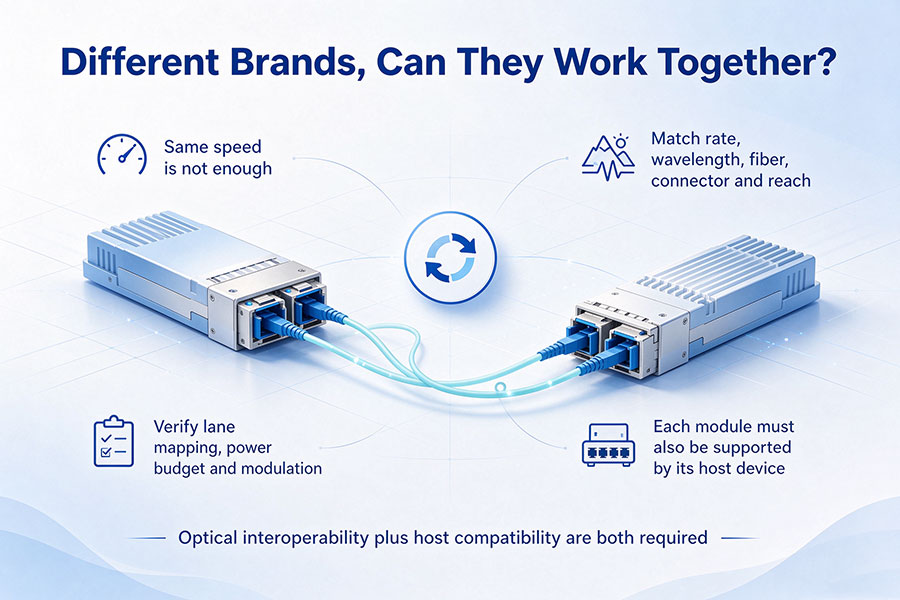
Module selection therefore involves more than matching the data rate. Operators must verify:
Host form factor, electrical lane configuration, and supported module power.
Optical application, wavelength, transmission distance, and fiber type.
Connector type, fiber polarity, and lane mapping.
Transmitter output power, receiver sensitivity, and link budget.
Module management interface, firmware behavior, and host compatibility.
Operating temperature, airflow direction, and thermal limits.
Physical fit does not guarantee operational compatibility. A module must be qualified against the actual switch model, hardware revision, software release, and intended port configuration.
7. Data Center Interconnect Is Expanding the Market for Coherent Optics
As hyperscale operators distribute computing capacity across multiple buildings and campuses, connections between facilities become increasingly important. Data center interconnect (DCI) supports traffic exchange between separate sites and can help operators distribute workloads, storage, and network services across a larger geographic area.
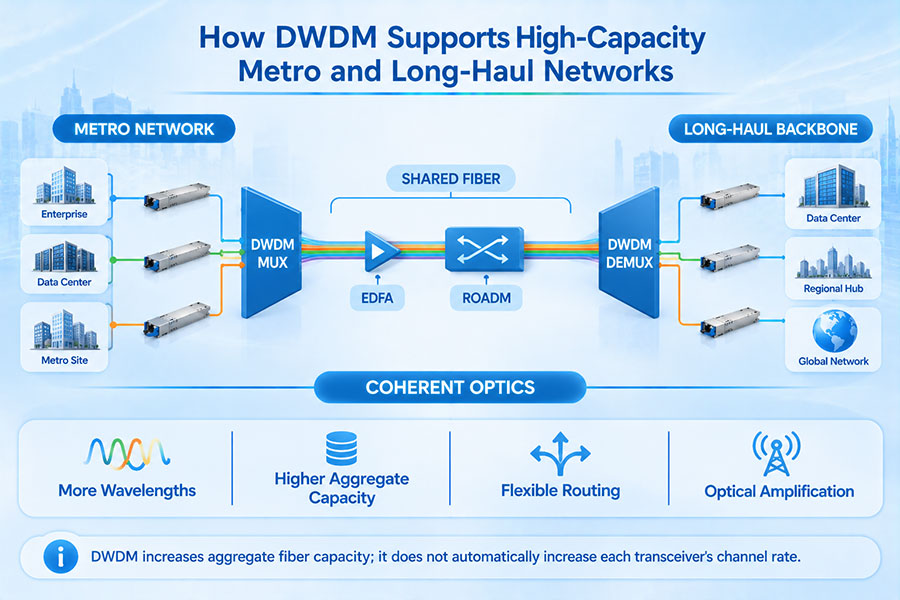
For shorter links, direct-detect optical modules may provide a suitable combination of capacity and cost. Longer connections can require wavelength-division multiplexing or coherent optical technology. Coherent modules encode information using multiple properties of the optical signal and apply digital signal processing to compensate for transmission impairments.
Coherent pluggable formats such as 400ZR, 800ZR, and evolving higher-capacity solutions address different network requirements. Actual reach depends on the optical system, fiber characteristics, modulation format, baud rate, FEC, amplification, and required performance margin.
DCI demand therefore expands the optical module market beyond conventional short-reach server and switch connections. It also increases the importance of system-level optical engineering, including OSNR, dispersion, amplifier configuration, channel power, and fiber route quality.
8. Hyperscale Procurement Is Changing Optical Supply-Chain Requirements
Large cloud operators purchase optical modules at volumes that can influence component sourcing, manufacturing capacity, product roadmaps, and supplier qualification processes. Their requirements often extend beyond individual module specifications to include delivery consistency, reliability, lifecycle support, and the ability to scale production.
High-speed optical modules depend on a specialized supply chain involving laser chips, photodetectors, DSPs, photonic integrated circuits, passive components, precision packaging, and test equipment. Shortages in any critical component can affect the production schedule of the finished module.
| Supply-Chain Segment | Role in Optical Modules | Hyperscale Requirement |
|---|---|---|
| Laser chips | Generate optical signals | Stable performance, wavelength control, and dependable supply |
| DSP and driver ICs | Electrical signal processing and laser control | High-speed operation, power efficiency, and platform qualification |
| Photonic integrated circuits | Integrate optical functions | High integration density, yield, and repeatable performance |
| Passive optical components | Filter, split, combine, and route optical signals | Low insertion loss, isolation, and manufacturing consistency |
| Module packaging | Provide mechanical, optical, and thermal integration | Precision alignment, reliability, and scalable production |
| Testing equipment | Verify optical and electrical performance | Accurate measurements, automation, and production traceability |
TrendForce reported in April 2026 that the global AI-focused optical transceiver market was projected to grow from approximately US$16.5 billion in 2025 to US$26 billion in 2026. Its research also identified constrained supplies of EML and continuous-wave laser components, along with precision optical alignment, as important capacity challenges. These figures represent market forecasts, not audited final market results.
For suppliers, the ability to secure components and maintain stable production is becoming as important as developing new module specifications. Qualification with major customers can also take substantial time, making early engineering collaboration and consistent quality control important commercial advantages.
9. Optical Testing and Interoperability Are Critical at Hyperscale
Large data centers may deploy thousands of optical links across different equipment generations and network layers. A small recurring compatibility or performance issue can therefore affect a substantial number of ports. Testing must cover the complete connection rather than relying only on a module's nominal data-rate specification.
Optical module validation commonly includes transmitter power, wavelength, receiver sensitivity, overload, extinction ratio, optical modulation amplitude, and signal-quality measurements appropriate to the interface. PAM4 applications may require eye analysis and TDECQ measurements, while BER testing helps assess link performance under defined conditions.
Production and deployment testing should also consider:
Host interoperability: Confirm module recognition, initialization, management functions, and link establishment on the target equipment.
Fiber-channel quality: Verify insertion loss, return loss, connector cleanliness, polarity, and cable routing.
Thermal behavior: Check operating temperature, power consumption, and stability under representative airflow conditions.
FEC configuration: Confirm that both ends use compatible forward error correction settings and evaluate pre-FEC and post-FEC performance where applicable.
Long-duration operation: Evaluate sustained traffic and error performance under realistic deployment conditions.
At hyperscale, consistent qualification procedures and traceable production data help reduce deployment risk. The objective is not simply to verify that a module works in a laboratory setup, but to establish that it performs reliably within the intended network environment.
10. What the Demand Shift Means for Optical Module Suppliers
Hyperscale expansion is changing the competitive requirements of the optical module industry. Suppliers must manage multiple speed generations, increasingly demanding host platforms, tighter power budgets, and more complex customer qualification processes.
Several priorities are becoming particularly important:
Support multiple speed generations: Maintain product availability for existing 100G, 200G, and 400G networks while developing 800G and 1.6T capabilities.
Improve manufacturing scalability: Strengthen optical alignment, automated testing, yield control, and component traceability.
Develop application-specific solutions: Address differences between short-reach server links, switch interconnects, and longer-distance DCI applications.
Strengthen compatibility validation: Test against relevant switch platforms and firmware configurations instead of relying only on mechanical and electrical specifications.
Monitor photonic integration: Track silicon photonics, LPO, NPO, and CPO developments as their commercial applications mature.
Build supply-chain resilience: Manage component availability, alternative sourcing, and long-term production planning.
Customers are also evaluating suppliers on their ability to provide dependable technical support, consistent product quality, and predictable delivery. These factors can have a direct effect on deployment schedules when a data center project involves large numbers of interconnected systems.
11. Conclusion
Hyperscale data centers are changing optical module demand through simultaneous growth in network scale, connection density, and transmission speed. AI infrastructure is accelerating the adoption of 800G and 1.6T interfaces, while conventional cloud expansion continues to sustain demand for established optical generations. DCI, coherent optics, and advanced photonic integration are adding further dimensions to the market.
The opportunity extends across transceivers, laser components, DSPs, silicon photonics, fiber assemblies, passive optical devices, and testing systems. However, higher demand also brings challenges involving component availability, thermal management, production yield, and interoperability. Suppliers that combine scalable manufacturing with reliable performance and application-level engineering support will be better positioned as hyperscale networks continue to evolve.
Supporting high-density optical connectivity for data center networks?
Review optical transceiver solutions for different data rates, transmission distances, and deployment environments, or Contact C-LIGHT to discuss your connectivity requirements.
 >

 >
 >
 >
 >
 >
 >
 >