TEL:+86 132 6656 7067





Artificial intelligence is changing the traffic profile between data centers. Large-scale model training, distributed GPU clusters, high-volume dataset movement, and geographically distributed inference services are increasing the amount of data that must move between facilities. As computing resources become more distributed, the network connecting those resources is no longer simply a backup path between independent sites. Data Center Interconnect (DCI) is becoming a critical part of the overall AI infrastructure.
Traditional DCI designs were often optimized for predictable enterprise applications, cloud replication, storage synchronization, and disaster recovery. AI workloads introduce different demands: sustained high-throughput transfers, changing traffic patterns, tighter coordination between distributed computing resources, and greater sensitivity to congestion or packet loss. Operators are responding through higher-capacity coherent optics, denser DWDM systems, more flexible optical routing, improved network telemetry, and stronger resilience mechanisms.
1. Why AI Workloads Are Increasing DCI Traffic
AI infrastructure generates traffic at several stages of the computing lifecycle. Model training requires datasets to be distributed to compute clusters, while distributed training can exchange intermediate results and synchronization information between groups of accelerators. Inference deployments may retrieve model parameters, reference data, and application content from multiple locations. Model checkpoints, storage replication, and dataset updates add further traffic between facilities.
The resulting demand is not limited to a steady increase in average bandwidth. Some applications generate sustained high-volume flows, while others produce bursts associated with training synchronization, data ingestion, or model deployment. Network design must account for both aggregate throughput and the timing and distribution of traffic.
| AI workload | Inter-site traffic pattern | DCI requirement |
|---|---|---|
| Distributed model training | Large transfers and recurring synchronization between compute sites | High sustained capacity, predictable latency, and congestion control |
| Dataset ingestion and replication | Large sequential transfers, often with changing demand | High-throughput paths and scalable storage connectivity |
| Model checkpointing | Periodic transfers of large model states | Bandwidth headroom and reliable transfer completion |
| Distributed inference | Variable traffic between application services, models, and data sources | Flexible capacity, low latency, and service-aware routing |
| Multi-site cloud operations | Continuous movement of application, storage, and management data | Resilient connectivity and efficient bandwidth utilization |
Not every AI deployment requires the same DCI architecture. A system that distributes independent inference requests across regions has different network characteristics from a tightly coupled training workload that exchanges data frequently between sites. Traffic engineering should therefore begin with workload placement, communication patterns, and application requirements rather than assuming that all AI traffic needs identical treatment.
2. From Conventional DCI to AI-Oriented Connectivity
Conventional DCI commonly connects two data centers through dedicated optical links or carrier transport services. The architecture may support storage replication, application access, backup, and disaster recovery, with capacity planned around expected traffic growth and service-level requirements.
AI infrastructure introduces a broader range of connectivity patterns. Large computing facilities may operate as distributed clusters, with traffic moving between multiple data centers rather than following a simple point-to-point pattern. Some deployments need dedicated high-capacity connections between two major sites; others require a mesh or hub-and-spoke arrangement connecting several compute and storage locations.
Scale-across networking
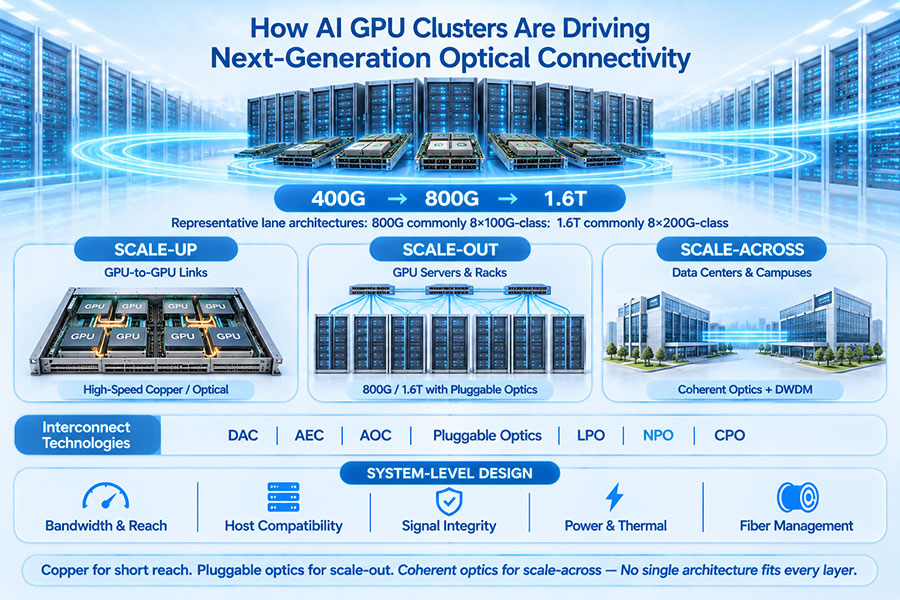
Scale-across describes the extension of computing resources across geographically separate facilities. It allows organizations to connect distributed GPU clusters, storage systems, and AI services. DCI provides the optical transport foundation for this connectivity, while routers, switches, and transport systems handle packet forwarding, traffic engineering, and service separation.
The practical design challenge is deciding which workloads should communicate across sites and which should remain within a local facility. Moving tightly coupled training traffic over long distances can introduce additional propagation delay and operational complexity. Where possible, compute placement should minimize unnecessary inter-site exchanges, while DCI capacity should be engineered for the traffic that genuinely needs to cross facility boundaries.
3. Higher-Capacity Coherent Optics Are Expanding DCI Bandwidth
Increasing traffic demand is pushing DCI interfaces toward higher per-wavelength rates. Coherent optical technology is particularly important for metro and regional links because it combines advanced modulation, digital signal processing, and forward error correction to transmit high-capacity signals over single-mode fiber.
Instead of converting every high-speed client signal into a separate long-distance optical channel through a dedicated transport platform, coherent pluggable modules can place optical transmission functionality directly in compatible routers or switches. This approach can simplify network architecture and reduce the number of equipment layers, although actual savings depend on reach, power, cooling, optical line-system requirements, and operational design.
| Optical generation | DCI role | Engineering considerations |
|---|---|---|
| 400G coherent | Established high-capacity option for metro and regional interconnects | Reach, optical amplification, channel plan, host compatibility, and line-system design |
| 800G coherent | Higher capacity per wavelength for bandwidth-intensive DCI routes | Power consumption, fiber impairments, OSNR, amplifier performance, and module interoperability |
| 1.6T coherent | Emerging higher-capacity option for next-generation DCI | Newer host platforms, thermal design, optical reach, and ecosystem maturity |
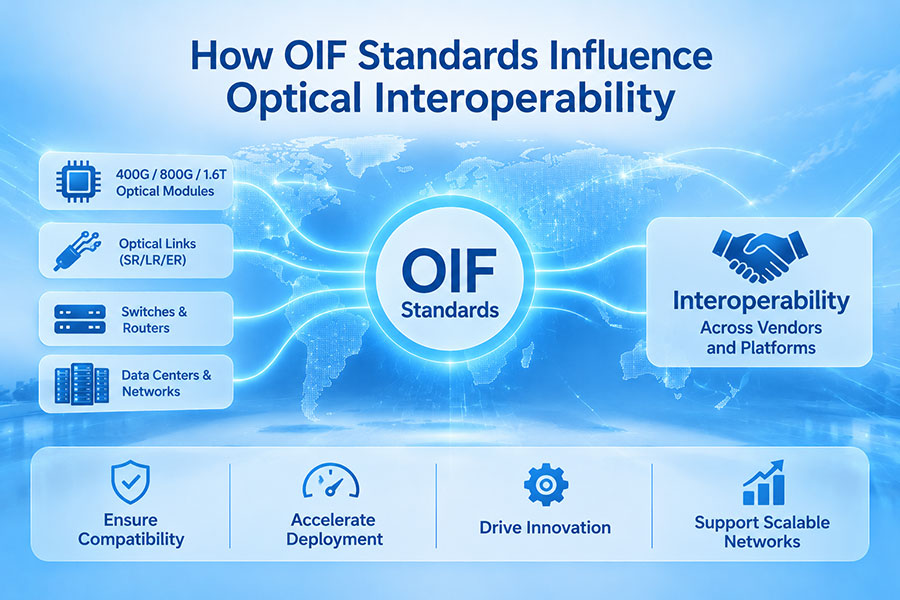
OIF's 800ZR Implementation Agreement defines an 800G coherent line interface for amplified, single-span DWDM links in the approximate 80–120 km range. In September 2026, OIF published its 1600ZR Implementation Agreement, defining a single-wavelength 1.6T coherent interface for amplified point-to-point DWDM links up to 120 km. These specifications provide important interoperability foundations, but they do not mean that every 800G or 1.6T module supports the same distance or works in every router and optical line system.
For shorter reaches, direct-detection optical interfaces may remain appropriate where their reach and optical budgets meet the application requirements. Coherent technology becomes more attractive as capacity, distance, and wavelength efficiency requirements increase. The correct choice depends on the complete link rather than data rate alone.
4. DWDM and Optical Line Systems Help Scale Existing Fiber
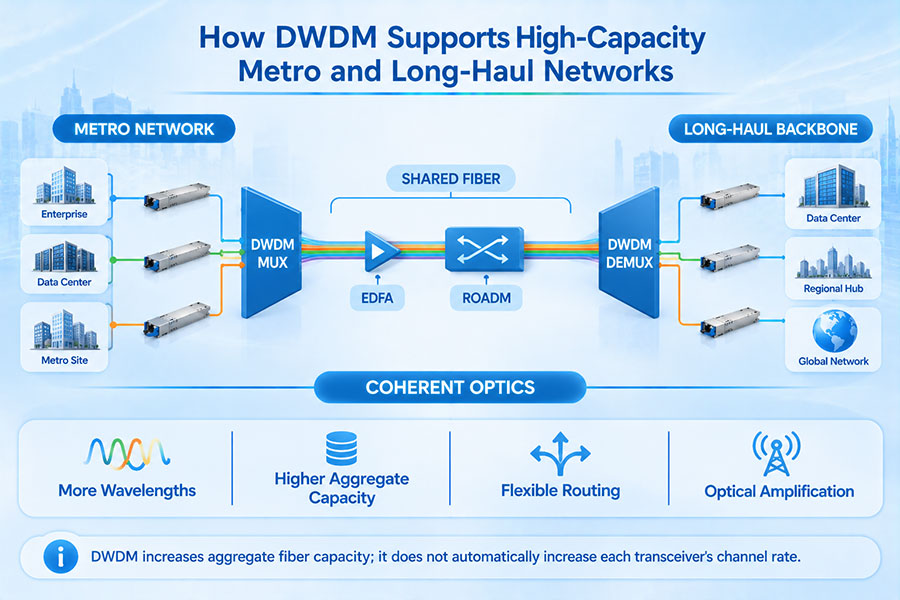
Adding fiber capacity is not always as simple as installing another cable. Physical routes may be constrained by rights of way, construction costs, conduit availability, or existing infrastructure. Dense Wavelength Division Multiplexing (DWDM) allows multiple optical channels to share a fiber pair, increasing aggregate capacity without requiring a separate fiber pair for every connection.
In a DWDM DCI system, each wavelength carries an independent optical channel. Multiplexers combine channels for transmission, while demultiplexers separate them at the receiving end. Optical amplifiers can compensate for fiber attenuation, and dispersion or other impairments must be managed according to the transmission design.
How optical line systems support growth
Wavelength multiplexing: Multiple channels share the same fiber infrastructure, increasing the capacity available from deployed routes.
Optical amplification: EDFA-based systems can extend transmission reach without requiring optical-electrical-optical regeneration at every intermediate point.
ROADM functionality: Reconfigurable optical add-drop multiplexers allow wavelengths to be added, dropped, or routed through network nodes with greater flexibility.
Open line systems: In suitable architectures, transponders or coherent pluggables from different equipment platforms can operate over a common optical line system, subject to interoperability and qualification requirements.
Capacity expansion: Additional wavelengths, higher-rate channels, or new fiber pairs can be introduced as traffic demand and optical budgets require.
Higher per-wavelength rates do not automatically translate into proportional increases in usable fiber capacity. Channel spacing, available spectrum, optical signal-to-noise ratio, amplifier bandwidth, filter characteristics, fiber quality, and nonlinear effects all influence the practical capacity of a DWDM route.
5. Low Latency and Traffic Stability Matter Alongside Bandwidth
AI traffic can be sensitive to network behavior beyond raw throughput. Distributed training workloads may coordinate operations across multiple computing groups. If one part of a distributed job experiences congestion or delayed data delivery, other resources may remain underutilized while waiting for communication to complete.
DCI design must therefore consider propagation delay, switching and routing delay, queueing, packet loss, and delay variation. Optical fiber provides a predictable physical transmission medium, but it cannot eliminate the propagation delay associated with distance. The approximate propagation delay in fiber is around 5 microseconds per kilometer in one direction, before accounting for equipment and routing overhead.
Managing congestion and packet loss
High-capacity optical links provide the underlying bandwidth, but packet-level performance depends on the routers, switches, buffers, and traffic-control mechanisms at each endpoint. Network operators may use traffic classification, quality-of-service policies, congestion management, and carefully engineered routing to reduce contention between workload types.
Where AI clusters use RDMA-based communication, transport behavior becomes especially important. RDMA over Converged Ethernet deployments may require loss-management and congestion-control mechanisms configured consistently across the network. A high-speed optical link alone does not guarantee lossless application behavior; the complete Ethernet fabric and its operational settings must be considered.
6. Resilience Is Essential for Distributed AI Infrastructure
As AI applications depend on multiple data centers, a failure on one inter-site route can affect more than ordinary application availability. It may interrupt dataset access, delay synchronization, disrupt distributed jobs, or reduce the resources available to an inference service.
DCI resilience is commonly built through physical route diversity, redundant optical equipment, protection switching, and alternate network paths. The level of protection should reflect the business and workload requirements of the connected sites.
| Resilience mechanism | Function | Design consideration |
|---|---|---|
| Physical route diversity | Reduces exposure to a single cable route or shared civil infrastructure | Verify that nominally separate paths do not share vulnerable ducts, bridges, or access points |
| Optical protection | Provides an alternate optical path when a primary path fails | Evaluate switching behavior, spare capacity, and optical compatibility |
| Router and switch redundancy | Maintains network connectivity after equipment or interface failures | Check control-plane convergence, forwarding behavior, and failure domains |
| Service-level monitoring | Detects degradation before it becomes a major service interruption | Monitor optical power, errors, latency, packet loss, and capacity utilization |
Protection mechanisms should be tested under realistic failure conditions. A physically diverse route is not sufficient if both paths depend on the same power system, building entrance, or intermediate network node. Similarly, fast optical switching does not automatically guarantee uninterrupted application sessions. End-to-end recovery behavior must be validated across optical, packet, and application layers.
7. Dynamic Optical Routing and Automated Bandwidth Management
AI traffic can change as training jobs start and stop, datasets move between locations, or inference services shift according to demand. A fixed allocation of bandwidth may leave some optical capacity underused while another route becomes congested.
ROADM-based networks and software-defined transport control can make wavelength resources more flexible. Depending on the platform, operators can provision optical paths, adjust connectivity, and coordinate capacity across multiple network segments. Telemetry from routers, optical transponders, and line systems can provide information for capacity planning and fault detection.
More advanced network automation can use workload information to support traffic engineering. For example, a network controller may coordinate planned large-scale transfers with available route capacity, or identify when an additional wavelength is needed. Such capabilities require reliable topology data, policy controls, interoperability, and safeguards against unstable or conflicting automated decisions.
Dynamic optical provisioning is not a replacement for packet-layer engineering. Optical circuits provide high-capacity paths, while IP and Ethernet layers continue to handle routing, forwarding, service separation, and congestion management. Effective DCI operation requires coordination between these layers.
8. Power Efficiency and Total Cost per Bit
AI data centers consume substantial power, and the network connecting them adds to the overall infrastructure energy requirement. As optical capacity increases, operators need to evaluate not only the energy consumed by each module but also the total power used to deliver traffic across the complete route.
Coherent pluggables can reduce equipment-layer complexity in suitable deployments by integrating optical transmission into compatible routers or switches. However, higher-rate modules may have significant power and cooling requirements. A solution that reduces the number of network devices may still require careful thermal planning at the host platform.
Useful efficiency measures include power per transmitted bit, usable capacity per fiber pair, equipment utilization, optical amplification requirements, and the number of electrical regeneration stages. The lowest module power is not necessarily the lowest total network power if the design requires additional regeneration, spare equipment, or inefficient wavelength allocation.
9. Engineering Considerations When Upgrading DCI for AI
DCI upgrades should be based on measured traffic demand, route characteristics, application requirements, and the expected growth of connected facilities. Selecting an 800G or 1.6T interface before evaluating the optical path can lead to avoidable compatibility or reach problems.
Traffic assessment: Measure average and peak throughput, burst behavior, traffic direction, and the communication patterns of distributed workloads.
Distance and fiber qualification: Verify route length, fiber type, attenuation, connector loss, splice loss, and available optical margin.
Optical performance: Evaluate OSNR, dispersion, nonlinear penalties, amplifier configuration, channel spacing, and filter compatibility.
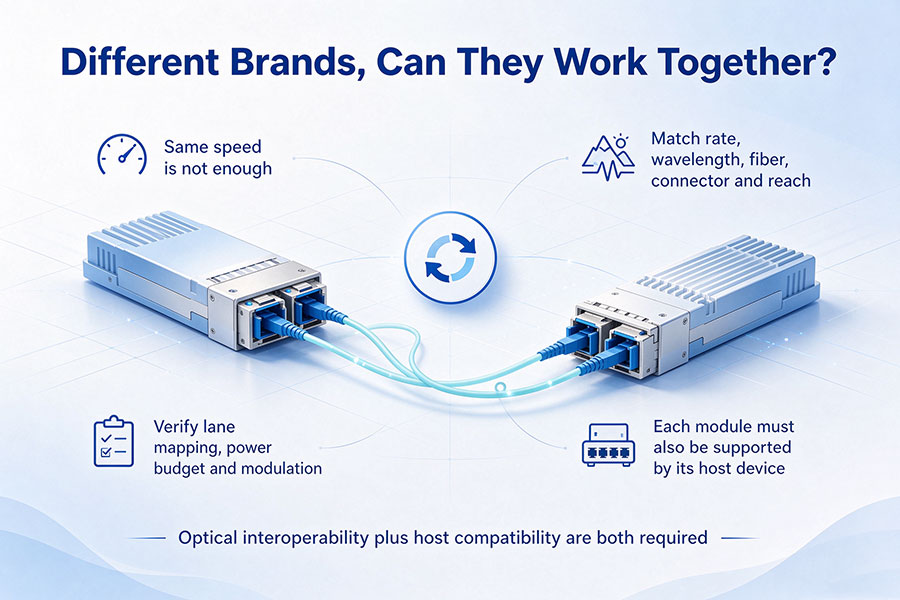
Interface interoperability: Confirm host port support, module specifications, firmware requirements, FEC behavior, management functions, and line-system compatibility.
Capacity planning: Estimate wavelength utilization, fiber-pair requirements, protection overhead, and the expansion path for additional channels.
Latency and packet behavior: Validate round-trip delay, congestion control, packet loss, and the requirements of RDMA or other workload transport protocols.
Resilience: Review physical route diversity, equipment redundancy, protection switching, and recovery behavior across network layers.
Operations: Establish monitoring thresholds, fault isolation procedures, capacity alerts, and a controlled process for adding or modifying optical paths.
Testing should cover the complete link under representative operating conditions. Optical power measurements alone do not establish that a high-speed DCI connection is ready for production. Error performance, FEC statistics, link stability, traffic behavior, and recovery after failures should also be evaluated.
10. The Next Stage of DCI in AI Data Center Networks
DCI is evolving from a relatively static inter-site transport function into a more scalable and programmable part of distributed AI infrastructure. Higher-rate coherent interfaces, DWDM expansion, ROADM-based optical routing, and network automation are helping operators increase capacity while making better use of existing fiber assets.
The emergence of 800G and 1.6T coherent interfaces reflects the industry's effort to increase capacity per wavelength. At the same time, optical bandwidth alone cannot solve every challenge. Fiber availability, route diversity, latency, packet-level congestion, power consumption, and application placement remain important factors in the overall architecture.
The most effective AI-oriented DCI design combines high-capacity optical transmission with flexible bandwidth management, reliable packet transport, and end-to-end operational visibility. As AI computing becomes more distributed, the ability to scale inter-site connectivity efficiently will be as important as increasing the processing capacity inside individual data centers.
Reliable DCI deployment depends on matching optical interfaces, transmission distance, fiber infrastructure, and host equipment requirements. For optical connectivity solutions and technical support, Contact C-LIGHT.
 >

 >
 >
 >
 >
 >
 >
 >