TEL:+86 132 6656 7067





Artificial intelligence is changing the economics and engineering priorities of data center networks. As GPU clusters grow in size, the volume of data exchanged between accelerators, servers, and storage systems increases sharply. Network bandwidth, latency, power consumption, and connection density are becoming critical factors in overall computing performance. This shift is placing optical communication technologies at the center of data center infrastructure investment and accelerating changes across the optical component supply chain.
1. AI Computing Is Creating a New Source of Optical Connectivity Demand
Traditional enterprise data centers were designed around a mix of application servers, storage platforms, and relatively distributed workloads. AI infrastructure has a different traffic profile. Large-scale training requires frequent communication among GPUs, while inference systems must move model parameters, intermediate data, and user requests across compute and storage resources.
These workloads create substantial east-west traffic inside data centers. As accelerator clusters expand across multiple racks, network capacity must scale alongside compute capacity. A single high-performance accelerator is not sufficient to deliver efficient cluster performance if communication between devices becomes a bottleneck.
Optical links are increasingly important where electrical connections face limitations in reach, bandwidth density, signal integrity, or power consumption. They support high-capacity connections between switches, racks, and data center facilities, allowing operators to build larger networks without relying exclusively on short-reach copper interconnects.
Market research published by TrendForce in April 2026 projected that the AI-focused optical transceiver market would increase from approximately US$16.5 billion in 2025 to US$26 billion in 2026. This is a forecast rather than a confirmed market result, but it illustrates the scale of demand expected from AI infrastructure deployment.
2. 800G and 1.6T Are Changing the Optical Transceiver Product Mix
One of the most visible effects of AI infrastructure investment is the migration toward higher-speed optical interfaces. As switch capacity and accelerator-network bandwidth increase, 400G, 800G, and 1.6T products occupy increasingly important positions in data center network roadmaps.
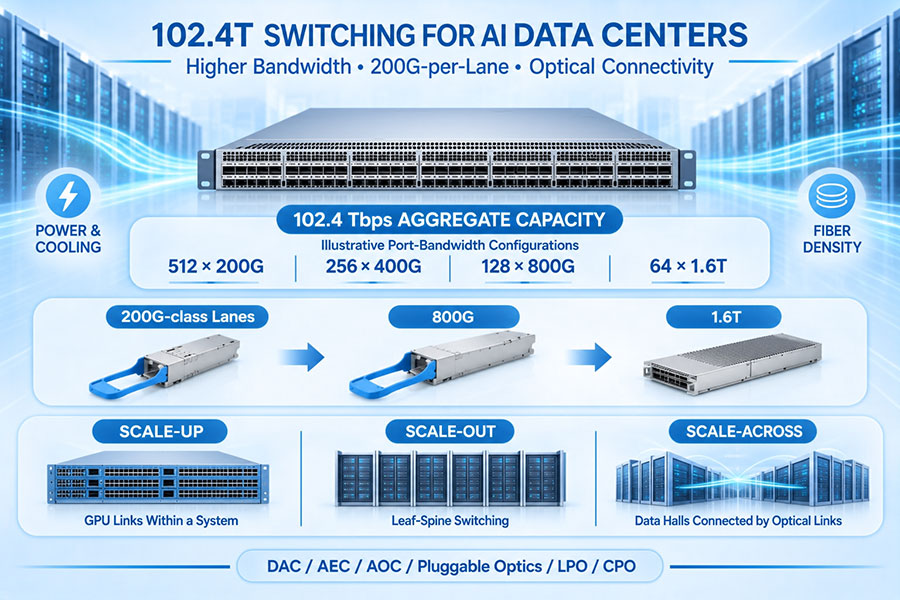
800G transceivers are used in high-bandwidth switch interconnections and AI cluster networks. Their adoption is supported by established pluggable form factors and a growing ecosystem of optical engines, DSPs, lasers, and fiber connectivity products. At the same time, 1.6T technology is advancing to address the next stage of aggregate switch bandwidth and port-density requirements.
| Generation | Typical industry role | Key engineering priorities |
|---|---|---|
| 400G | Established high-speed data center interconnects and switch uplinks | Optical reach, lane configuration, power efficiency, and deployment cost |
| 800G | High-density AI clusters and next-generation data center switching | Signal integrity, thermal management, DSP performance, and port density |
| 1.6T | Higher-capacity switching platforms and expanding AI network architectures | 200G-per-lane technology, optical integration, power per bit, and manufacturing yield |
| 3.2T and beyond | Emerging bandwidth roadmaps for future network platforms | Advanced photonic integration, packaging, thermal design, and system-level validation |
These generations will not replace one another immediately. Data centers have different equipment refresh cycles, network topologies, reach requirements, and cost constraints. 400G and 800G products can remain important in existing deployments even as new platforms introduce 1.6T interfaces.
For optical manufacturers, the transition requires more than increasing data rates. Higher-speed products demand careful control of transmitter performance, receiver sensitivity, lane-to-lane consistency, power consumption, and thermal behavior. Production testing must also address increasingly demanding signal-quality and interoperability requirements.
3. AI Network Architecture Is Expanding Optical Links Across Multiple Layers
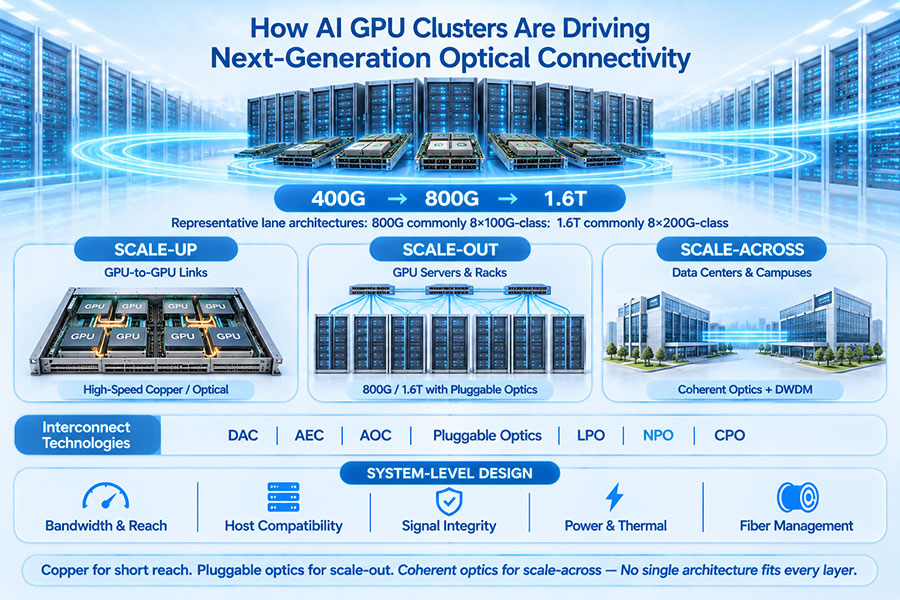
AI infrastructure does not rely on a single network connection type. Different layers have different distance, latency, bandwidth, and power requirements. Optical communication is gaining ground in several parts of the architecture, although copper remains relevant where electrical reach and density are still practical.
Scale-up networks
Scale-up connectivity links processors and accelerators within tightly coupled systems. Short electrical connections remain widely used inside servers and racks, while optical technologies are being investigated and deployed in selected architectures as bandwidth density and physical distance increase. The balance depends on system design, packaging, and the required connection reach.
Scale-out networks
Scale-out networks connect servers and racks through high-speed Ethernet or InfiniBand switching fabrics. This layer is a major application for 400G and 800G optical transceivers, with 1.6T interfaces entering newer platform roadmaps. High port counts and large numbers of parallel connections make module power, fiber routing, and serviceability important design considerations.
Data center interconnect
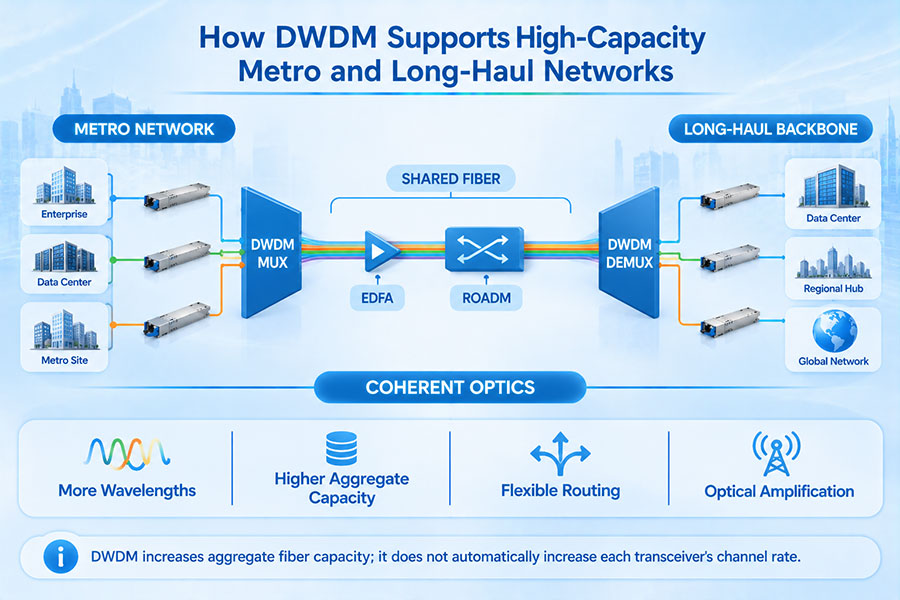
As AI capacity spreads across buildings or campuses, optical transport connects separate data center facilities. Depending on distance and network architecture, deployments may use direct-detect optical links, wavelength-division multiplexing, or coherent optical systems. Longer-reach connections introduce additional requirements involving dispersion, optical signal-to-noise ratio, amplification, and link engineering.
| Network layer | Connection scope | Relevant optical technologies | Main design considerations |
|---|---|---|---|
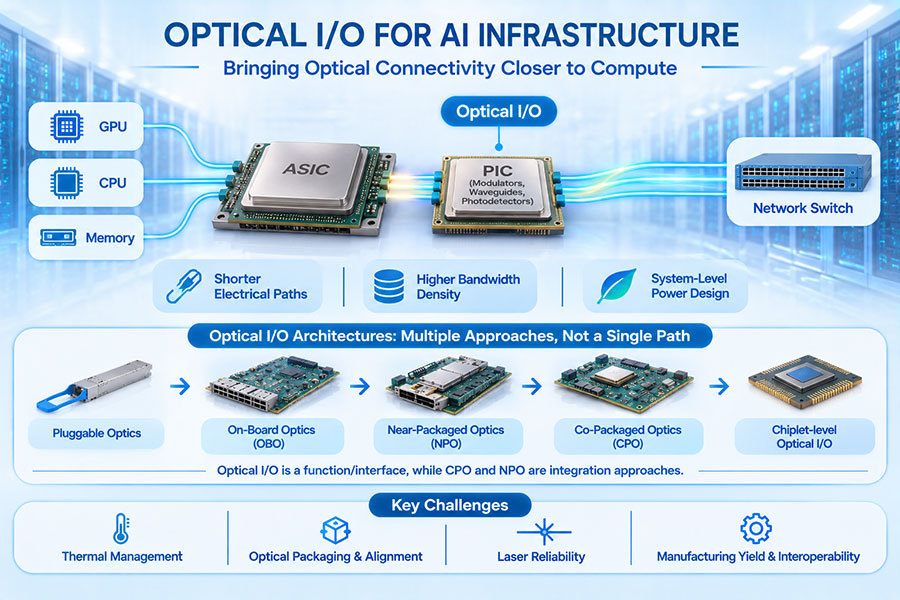
| Scale-up | Accelerator and processor interconnection | Emerging optical I/O, near-packaged and co-packaged approaches | Latency, bandwidth density, packaging, and power |
| Scale-out | Server-to-switch and rack-to-rack | 400G/800G/1.6T pluggable optics, AOCs, and related interconnects | Port density, reach, interoperability, and thermal performance |
| Data center interconnect | Building-to-building and site-to-site | WDM, coherent optics, and high-capacity optical transport | Distance, OSNR, fiber availability, and system capacity |
4. Power Efficiency and Thermal Management Are Reshaping Module Design
AI data centers consume substantial electrical power, and network equipment contributes to the total energy and cooling requirements. As optical port speeds rise, the power consumed by each transceiver becomes an important factor in switch design and operating cost.
Higher-speed modules must manage faster electrical signaling, optical conversion, signal conditioning, and heat dissipation within compact form factors. DSP-based modules provide important signal-processing functions, but their power consumption and thermal output can become significant at high port densities.
Manufacturers are therefore working on several approaches to improve energy efficiency:
More efficient DSPs: Improvements in process technology, circuit design, and signal-processing algorithms can reduce power consumption while supporting higher data rates.
Linear optical architectures: LPO and related approaches reduce or remove some conventional module DSP functions, shifting more responsibility to the host electrical interface and system-level signal design.
Silicon photonics: Photonic integration can combine multiple optical functions on a compact platform and support higher integration density.
Thermal optimization: Module packaging, heat spreading, airflow design, and chassis-level cooling all influence stable operation at high port density.
Lower module power does not automatically guarantee lower system power. The host switch, electrical channel, cooling architecture, and link performance must be evaluated together. An architecture that reduces power inside the module may require tighter electrical channel control or additional system-level engineering.
5. LPO, NPO, and CPO Are Expanding the Optical Integration Landscape
The traditional pluggable transceiver places optical conversion and much of the signal-conditioning function inside a removable module. As bandwidth increases, the electrical connection between the host ASIC and the optical module becomes more challenging. New optical integration architectures aim to shorten this electrical path and improve bandwidth density or energy efficiency.
| Architecture | Positioning | Potential advantages | Key challenges |
|---|---|---|---|
| Pluggable optics | Removable module installed at the equipment front panel | Serviceability, replaceability, and established deployment practices | Front-panel density, module power, and electrical reach |
| LPO | Linear optical module with reduced conventional DSP processing | Potential reduction in module power and latency | Host signal quality, channel design, and interoperability |
| NPO | Optical engine positioned near the host ASIC | Shorter electrical paths and improved integration density | Packaging, thermal management, and field serviceability |
| CPO | Optical engines integrated within the same package or package assembly as the ASIC | Very short electrical connections and high bandwidth density | Co-design, optical routing, laser supply, repair, and reliability |
These approaches should be viewed as different system architectures rather than interchangeable module specifications. LPO changes the signal-processing arrangement within a pluggable form factor, while NPO and CPO change where optical engines are positioned relative to the host ASIC.
Pluggable modules are expected to remain important because they offer a mature service model and can support multiple network designs. Near-packaged and co-packaged approaches may become more relevant in systems where electrical reach, front-panel density, or power per bit becomes difficult to manage. Their adoption will depend on manufacturing maturity, reliability data, ecosystem support, and operational requirements.
6. Silicon Photonics and Laser Technology Are Becoming Strategic Supply-Chain Factors
Higher optical bandwidth is increasing the importance of photonic integration and advanced laser technology. Conventional optical modules rely on several discrete optical and electronic components, while silicon photonics can integrate selected optical functions onto a photonic integrated circuit.
Silicon photonics supports compact optical engines and can be combined with different laser arrangements, modulators, detectors, and packaging technologies. It is not a complete replacement for all other photonic platforms. Indium phosphide remains important for laser sources and other active photonic devices, while different material systems offer different performance and manufacturing characteristics.
Key supply-chain components include:
EML and DFB lasers: Provide optical sources for different transmission architectures and reach requirements.
Continuous-wave lasers: Can serve as external optical sources in architectures such as silicon photonics and selected CPO designs.
Optical DSPs: Support high-speed electrical and optical signal processing in conventional retimed modules.
Photodetectors and TIAs: Convert received optical signals into electrical signals and provide the required receiver amplification.
Passive optical components: Filters, mux/demux devices, isolators, connectors, and fiber arrays support optical routing and signal management.
Advanced packaging: Optical alignment, thermal interfaces, and fiber attachment influence yield, reliability, and production scalability.
Market expansion is therefore not limited to transceiver assembly. Capacity and technical progress in lasers, DSPs, photonic integrated circuits, passive components, and precision packaging can all influence the pace at which high-speed optical products reach volume production.
7. Fiber Connectivity and Optical Testing Are Becoming More Important
Higher port speeds and larger AI clusters increase the number of optical connections that must be installed, managed, and maintained. Fiber infrastructure is consequently becoming a major part of data center planning rather than a secondary cabling consideration.
High-density MPO/MTP connectivity can support parallel-fiber applications, while duplex LC interfaces remain common in wavelength-division and duplex single-mode links. The appropriate connector and fiber arrangement depends on the transceiver optical interface, polarity requirements, lane mapping, and network topology.
At high port densities, cable routing and physical management can affect airflow, access, and maintenance. Operators must consider bend radius, connector cleanliness, insertion loss, return loss, polarity, labeling, and cable accessibility during installation and ongoing service.
Testing requirements also become more demanding as data rates rise. Optical power measurements alone cannot establish that a high-speed link will perform correctly. Depending on the application, validation may include:
Transmitter output power, wavelength, and spectral characteristics.
Receiver sensitivity and overload performance.
Eye diagrams, OMA, extinction ratio, and TDECQ for applicable PAM4 interfaces.
Bit error rate measurements, including pre-FEC and post-FEC performance where relevant.
Fiber insertion loss, return loss, polarity, and end-face inspection.
Host compatibility, module management, temperature behavior, and sustained traffic testing.
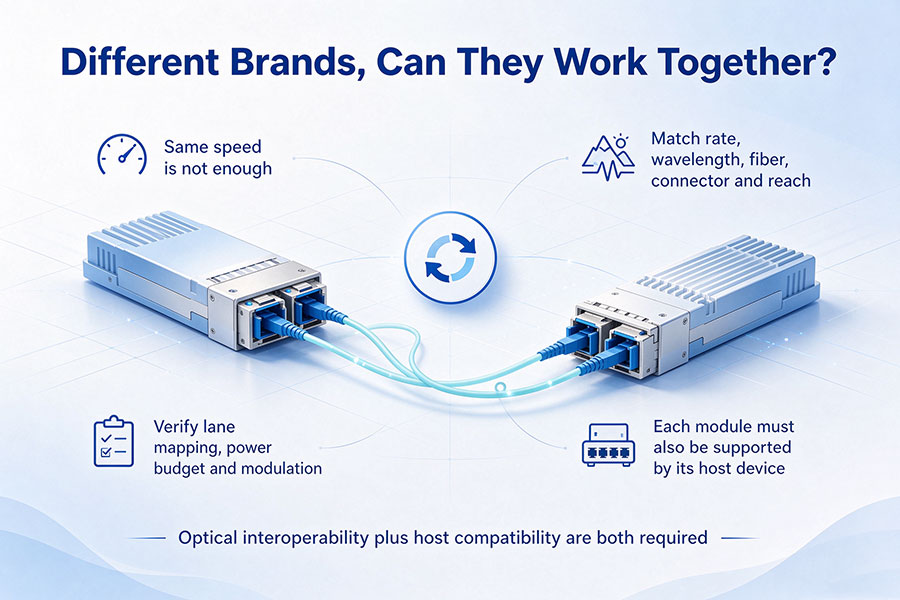
For AI networks, interoperability must be checked across the complete link. Matching nominal data rates does not guarantee compatibility if optical specifications, host interfaces, firmware, FEC settings, or lane configurations differ.
8. Market Growth Is Creating Both Opportunities and Supply-Chain Pressure
AI infrastructure investment is creating demand across multiple layers of the optical communication industry. Transceiver suppliers benefit from higher-speed deployments, while component manufacturers, fiber-connectivity providers, optical packaging specialists, and test-equipment companies participate in the broader upgrade cycle.
However, rising demand does not automatically translate into smooth production growth. High-performance lasers, DSPs, photonic components, and precision packaging processes can constrain output. Manufacturers must also manage qualification schedules, component lead times, yield improvement, and customer-specific requirements.
| Market segment | Demand driver | Important competitive factors |
|---|---|---|
| Optical transceivers | Migration to 800G and 1.6T data center links | Performance, power, compatibility, yield, and delivery capacity |
| Optical chips and lasers | Higher lane rates and new photonic architectures | Device performance, process maturity, reliability, and supply capacity |
| Passive components | More optical paths, wavelength management, and dense integration | Insertion loss, isolation, precision, and manufacturing consistency |
| Fiber assemblies and connectivity | Expansion of rack-scale and facility-scale optical networks | Connector quality, polarity control, density, and installation efficiency |
| Testing and validation | More demanding high-speed optical and electrical interfaces | Measurement accuracy, automation, repeatability, and traceability |
For suppliers, long-term competitiveness will depend on more than the ability to introduce a higher-speed product. Customer qualification, manufacturing consistency, component sourcing, technical support, and the ability to deliver at scale are equally important.
9. What Optical Communication Suppliers Need to Prepare For
The AI-driven market shift is changing product development and manufacturing priorities. Suppliers should prepare for overlapping product generations rather than assume that every customer will migrate to the newest speed at the same time.
Build a balanced product portfolio: Maintain support for established 100G, 400G, and 800G applications while developing capabilities for higher-speed platforms where customer demand is validated.
Strengthen host compatibility testing: Validate module behavior across relevant switch platforms, firmware versions, port configurations, and operating conditions.
Improve manufacturing repeatability: Focus on optical alignment, component consistency, thermal control, automated testing, and production traceability.
Develop supply-chain resilience: Monitor the availability of lasers, DSPs, photonic components, and passive optical devices, while qualifying appropriate alternatives.
Follow architecture changes: Track LPO, silicon photonics, NPO, and CPO developments without assuming that one architecture will replace all others.
Support complete connectivity solutions: Coordinate transceivers, fiber assemblies, connectors, and test procedures to reduce deployment and troubleshooting risks.
For customers, supplier evaluation should include optical performance, interoperability, reliability, delivery capability, and technical support. A product that meets a headline data-rate specification may still require additional system-level validation before deployment in a production AI network.
10. Conclusion
AI infrastructure is reshaping the optical communication market through a combination of rising connection volumes, higher interface speeds, changing network architectures, and greater pressure on power efficiency. The expansion of GPU clusters is accelerating demand for 800G and 1.6T connectivity, while silicon photonics, LPO, NPO, and CPO are broadening the technology options available to data center designers.
The resulting opportunity extends across the entire optical ecosystem, from lasers and DSPs to transceivers, passive components, fiber assemblies, and testing systems. At the same time, component availability, manufacturing yield, thermal performance, and interoperability remain practical constraints. Suppliers that combine reliable products with scalable manufacturing and strong engineering support will be better positioned to serve the changing requirements of AI data center networks.
Building optical connectivity for next-generation data center networks?
Explore optical transceiver and connectivity solutions for different network speeds and deployment requirements, or Contact C-LIGHT to discuss your application.
 >

 >
 >
 >
 >
 >
 >
 >