TEL:+86 132 6656 7067





The evolution of 5G-Advanced is placing new demands on the transport infrastructure connecting radio access networks, edge computing facilities, and mobile core networks. As operators introduce higher-capacity radio configurations, denser deployments, more demanding enterprise services, and increasingly distributed network functions, the optical transport layer must provide sufficient bandwidth, precise synchronization, predictable latency, and flexible resource allocation. These requirements are encouraging upgrades across fiber infrastructure, WDM systems, optical transport networks, and packet-based metro networks.
1. Why 5G-Advanced Creates New Transport Requirements
5G-Advanced, associated primarily with 3GPP Release 18 and subsequent development, builds on the 5G New Radio and 5G Core architecture. Its evolution includes enhancements to radio performance, mobility, positioning, energy efficiency, network intelligence, and support for new application scenarios.
These developments influence the transport network because the radio access network cannot operate independently of the infrastructure carrying traffic between base stations, distributed processing units, centralized network functions, and the mobile core.
Several factors contribute to the need for transport upgrades:
Higher radio capacity: Improved radio capabilities and wider use of advanced spectrum configurations can increase traffic demand at selected cell sites.
Denser network deployments: Additional radio sites and distributed coverage increase the number of connections that transport networks must support.
Distributed computing: Edge computing and flexible placement of network functions create additional traffic paths between access sites and regional facilities.
More demanding services: Enterprise connectivity, industrial applications, immersive media, and other services may require differentiated bandwidth and latency characteristics.
Network intelligence: More dynamic service management increases the importance of transport visibility, automation, and resource coordination.
These drivers do not affect every operator or deployment equally. Actual upgrade requirements depend on spectrum, radio configuration, site density, traffic growth, functional splits, and the capacity of the existing transport network.
2. Fronthaul, Midhaul, and Backhaul Require Different Optical Architectures
The 5G transport network is commonly divided into three functional domains. Each connects different parts of the radio and core network architecture and has its own bandwidth, latency, synchronization, and distance requirements.
| Transport domain | Connection | Primary requirements | Typical optical considerations |
|---|---|---|---|
| Fronthaul | Radio unit (RU) to distributed unit (DU), depending on functional split | High throughput, controlled latency, precise timing | Fiber access, WDM, dedicated optical links, and suitable PON architectures |
| Midhaul | Distributed unit (DU) to centralized unit (CU) | Scalable capacity, low latency, synchronization, service separation | Metro aggregation, Ethernet transport, OTN, and WDM |
| Backhaul | Radio access network toward the 5G Core | Aggregated capacity, resilience, routing flexibility, and QoS | Metro WDM, DWDM, OTN, and high-capacity packet transport |
The exact boundaries depend on the selected RAN functional split. A centralized RAN architecture may place more stringent bandwidth and latency requirements on fronthaul, while a distributed architecture can move more processing closer to the radio site and shift traffic requirements toward backhaul.
For this reason, optical transport planning should begin with the actual RAN architecture rather than assuming that every 5G-Advanced site needs the same optical interface.
3. Higher Traffic Capacity Is Driving Fiber and WDM Upgrades
As radio capacity and the number of connected sites increase, aggregation networks must carry traffic from more access locations. Existing fiber routes may have sufficient capacity in some areas, while heavily utilized metro links may require additional wavelengths, higher-speed interfaces, or new fiber infrastructure.
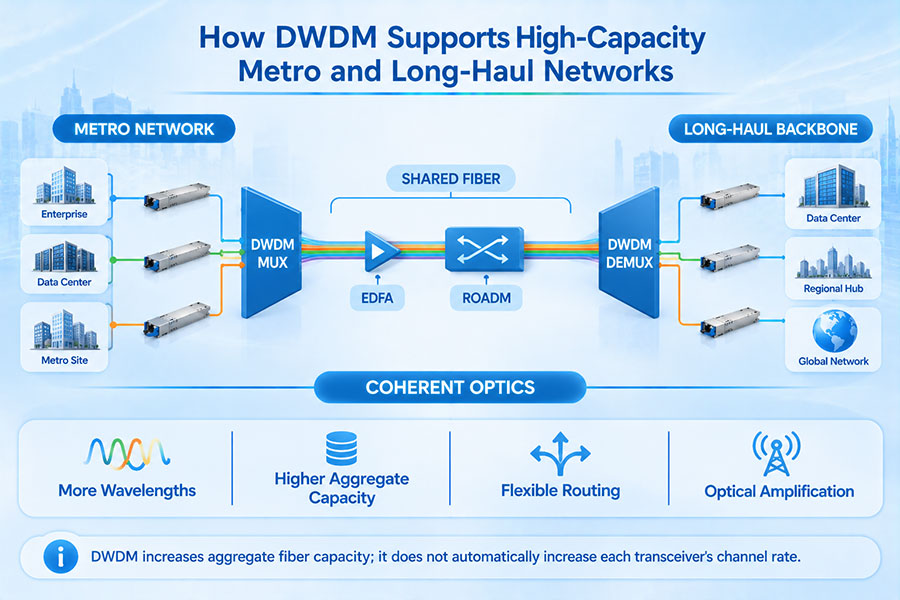
Wavelength-division multiplexing provides a way to increase transmission capacity by carrying multiple optical channels over a shared fiber pair. CWDM can support cost-effective wavelength aggregation in suitable access and metro scenarios, while DWDM offers a denser wavelength plan for higher-capacity transport networks.
Operators can use these technologies to expand capacity without necessarily deploying a separate fiber pair for every new service or connection. The appropriate solution depends on route distance, wavelength plan, channel spacing, optical loss, amplification requirements, and the capacity of existing equipment.
| Technology | Transport role | Typical deployment consideration |
|---|---|---|
| CWDM | Wavelength aggregation over fiber | Useful where channel count and optical budget suit access or metro requirements |
| DWDM | High-density wavelength multiplexing | Supports more channels and scalable capacity on constrained fiber routes |
| Optical amplification | Compensates for optical attenuation on suitable links | Requires careful power balancing, noise management, and link engineering |
| ROADM | Flexible wavelength routing between optical network nodes | Enables reconfigurable optical paths and more flexible metro or regional networks |
As transport demand increases, operators may combine higher-rate optical interfaces with additional WDM channels. This approach can improve fiber utilization while allowing capacity to be expanded in stages.
For relevant wavelength-based connectivity options, see the CWDM and DWDM optical transceiver range.
4. Higher-Speed Optical Interfaces Improve Transport Scalability
Optical interface speeds have continued to increase as transport equipment evolves. Higher-rate interfaces allow operators to aggregate more traffic onto individual links and reduce the number of lower-capacity connections needed for a given bandwidth target.
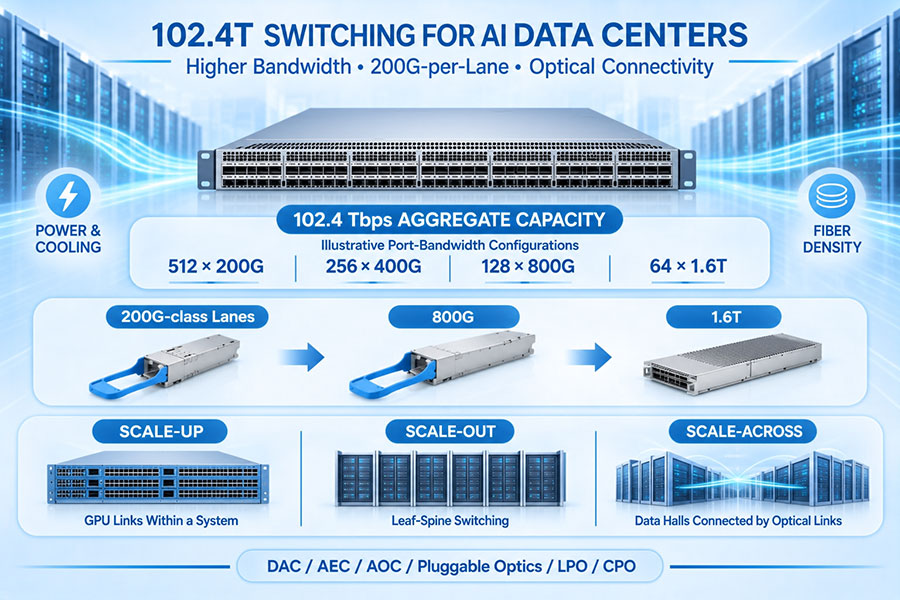
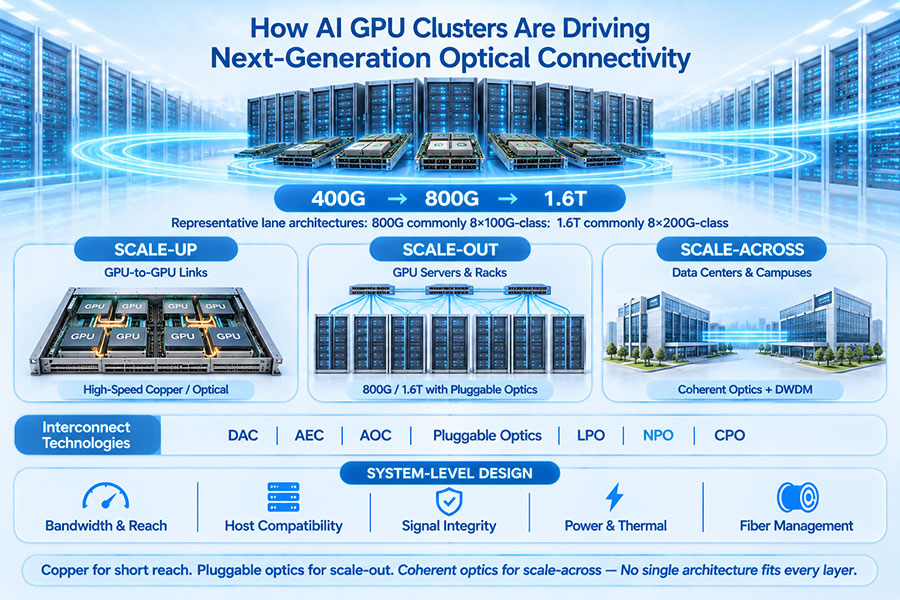
100G interfaces remain important in many mobile transport deployments. 200G and 400G interfaces can provide additional capacity in aggregation and metro networks, while 800G and 1.6T-class technologies are relevant to emerging high-capacity transport architectures and future network evolution.
| Optical interface generation | Potential transport role | Engineering considerations |
|---|---|---|
| 10G / 25G | Access aggregation and selected radio transport links | Existing equipment compatibility, reach, and fiber availability |
| 100G | High-capacity fronthaul, midhaul, and backhaul applications where supported | Optical budget, latency, interface mapping, and synchronization |
| 200G / 400G | Metro aggregation and higher-capacity transport links | Port capacity, wavelength planning, and equipment upgrade path |
| 800G / 1.6T | Emerging high-capacity transport and backbone applications | Platform maturity, power, coherent or client optics, and deployment economics |
These rates are examples of available or developing interface generations, not fixed requirements for particular 5G-Advanced network segments. A radio fronthaul link may have very different needs from a regional aggregation or backbone connection.
Operators should also distinguish client-side Ethernet interfaces from coherent optical line interfaces. A 400G Ethernet client connection, for example, may be transported over a wavelength system using a coherent line interface with its own modulation, baud rate, FEC, and reach characteristics.
5. OTN Provides Service Mapping and Transport Protection
Optical Transport Network technology remains relevant because it provides structured transport containers, multiplexing, performance monitoring, and protection mechanisms for client services. These functions can help operators carry different traffic types across a shared optical infrastructure while maintaining defined service boundaries.
In mobile transport networks, OTN can map Ethernet and other client signals into transport structures suited to the optical network. This allows operators to manage capacity at different granularities and maintain visibility into service performance.
Important OTN capabilities include:
Client signal mapping: Adapts Ethernet and other client signals to OTN transport structures.
Multiplexing: Combines multiple lower-rate services into higher-capacity transport signals.
Performance monitoring: Provides transport-layer information for fault detection and service assurance.
Forward error correction: Supports improved transmission performance on applicable optical interfaces.
Protection switching: Provides mechanisms to restore services when supported network paths or equipment fail.
Flexible bandwidth allocation: Supports different service capacities through OTN and related flexible transport mechanisms.
OTN is not a mandatory replacement for packet transport. Many operators use Ethernet and IP/MPLS-based architectures for service delivery, while OTN provides an additional transport layer where deterministic capacity, monitoring, and protection are valuable.
6. Precise Synchronization Is Essential for 5G Radio Performance
Mobile networks depend on accurate frequency, phase, and time synchronization. This becomes particularly important in deployments using time-division duplexing (TDD), coordinated radio operation, and applications requiring accurate timing across multiple sites.
Optical transport equipment must therefore do more than move user traffic. It may also distribute synchronization information through physical-layer frequency methods and packet-based timing protocols.
Common technologies include:
Synchronous Ethernet (SyncE): Distributes frequency synchronization through the physical Ethernet interface.
IEEE 1588 Precision Time Protocol (PTP): Distributes time and phase information through packet networks.
Telecom boundary clocks: Support timing distribution and regeneration across network segments.
Telecom time slave clocks: Recover and maintain timing at downstream network elements.
Transport path asymmetry, packet delay variation, clock quality, and network reconfiguration can all affect synchronization performance. Operators must therefore evaluate timing across the complete path, including aggregation switches, optical transport equipment, and intermediate network nodes.
7. Low-Latency Services Require More Predictable Transport
5G-Advanced supports the continued development of services that require more controlled network behavior. Examples include industrial connectivity, interactive applications, enterprise services, and applications involving distributed computing.
For these services, latency is not determined by fiber propagation alone. Switching, queuing, packet processing, route length, congestion, and traffic scheduling also contribute to end-to-end delay.
Optical transport upgrades can help by providing higher-capacity links, reducing congestion risk, and enabling more direct network paths. However, the optical layer must work with packet scheduling and service engineering to deliver predictable performance.
Useful design measures include:
Capacity planning: Maintain sufficient headroom on heavily utilized aggregation links.
Traffic engineering: Select appropriate paths for services with defined latency and availability requirements.
QoS policies: Apply consistent traffic classification, scheduling, and prioritization across network domains.
Route optimization: Avoid unnecessary transport detours between radio sites, edge facilities, and core network functions.
Performance monitoring: Track latency, packet loss, jitter, and utilization across the service path.
Low-latency performance must be engineered end to end. Optical transport capacity is one part of that requirement, not a standalone guarantee of application response time.
8. Network Slicing Increases the Need for Flexible Optical Transport
Network slicing allows operators to create logically separated service environments over shared physical infrastructure. Different slices may have different requirements for bandwidth, latency, availability, and traffic isolation.
This creates additional demands on transport networks. The infrastructure must allocate resources according to service requirements while maintaining visibility and operational control across multiple network layers.
Optical transport can contribute through several mechanisms:
OTN containers: Provide structured bandwidth allocation and separation for supported client services.
WDM channels: Allow selected services to use separate optical wavelengths where dedicated paths are required.
Packet-based QoS: Differentiates traffic according to service classes and forwarding policies.
SDN control: Supports centralized provisioning and coordination of transport resources.
Network monitoring: Helps operators verify service performance and detect faults across shared infrastructure.
Logical slicing does not necessarily require a separate physical fiber or wavelength for every service. The isolation method depends on the required security, performance, and operational model.
9. Fiber Access and Metro Networks Need More Flexible Capacity
Radio site densification can increase the number of locations that need reliable fiber connectivity. In areas where dedicated fiber construction is expensive or difficult, operators may consider shared optical access infrastructure and passive optical network solutions for suitable transport applications.
PON technology can provide point-to-multipoint connectivity through passive optical splitters. Its suitability for mobile transport depends on bandwidth allocation, latency behavior, synchronization support, protection requirements, and the specific fronthaul or backhaul architecture.
For mobile transport, ITU-T has documented approaches to using PON for 5G fronthaul and small-cell backhaul or midhaul. These architectures require careful attention to dynamic bandwidth allocation and timing performance rather than assuming that any broadband PON deployment is automatically suitable for radio transport.
At the metro level, operators may combine PON access, Ethernet aggregation, OTN, and WDM systems to create a layered transport architecture. This allows different access technologies and service types to share a coordinated infrastructure.
10. Network Automation and Optical Layer Visibility
As transport networks become more distributed and service requirements become more varied, manual configuration and isolated equipment monitoring can make operations increasingly difficult. Operators need better visibility into optical performance, traffic utilization, synchronization status, and service-level behavior.
Modern optical transport management can integrate telemetry, topology information, fault correlation, and automated provisioning. SDN-based control can coordinate resources across packet and optical layers, allowing network operators to respond more efficiently to capacity changes and service demands.
Important operational functions include:
Optical performance monitoring: Tracks transmit and receive power, temperature, alarms, and other available module diagnostics.
Wavelength and capacity management: Records channel utilization and available optical resources.
Fault localization: Helps identify whether performance problems originate in fiber infrastructure, optical equipment, or packet transport.
Synchronization monitoring: Tracks clock quality and timing distribution across the network.
Automated provisioning: Coordinates service setup and capacity changes across supported network layers.
Optical module diagnostics such as DDM/DOM can provide useful information about transceiver operating conditions. These measurements should be combined with equipment-level telemetry and end-to-end service monitoring to support reliable network operations.
11. Planning Optical Transport Upgrades for 5G-Advanced
Operators should avoid treating 5G-Advanced transport evolution as a simple replacement of older optical modules with faster models. A successful upgrade requires a review of the complete transport path, including radio interfaces, aggregation equipment, optical line systems, synchronization, and network management.
| Planning area | Key questions | Possible upgrade direction |
|---|---|---|
| Traffic capacity | Where are utilization and forecast demand approaching available capacity? | Higher-rate interfaces, additional WDM channels, or new fiber routes |
| Fronthaul architecture | What functional split and latency budget does the RAN require? | Dedicated fiber, WDM, or qualified PON-based transport |
| Midhaul and backhaul | How much aggregation capacity is needed between sites and core facilities? | Ethernet, OTN, DWDM, and metro transport expansion |
| Synchronization | Can the network maintain the required frequency and phase accuracy? | SyncE, PTP, boundary clocks, and timing-aware transport design |
| Reliability | Are protection paths and restoration mechanisms sufficient? | Optical protection, route diversity, and monitoring improvements |
| Operations | Can operators identify faults and manage capacity across network layers? | Telemetry integration, SDN control, and automated provisioning |
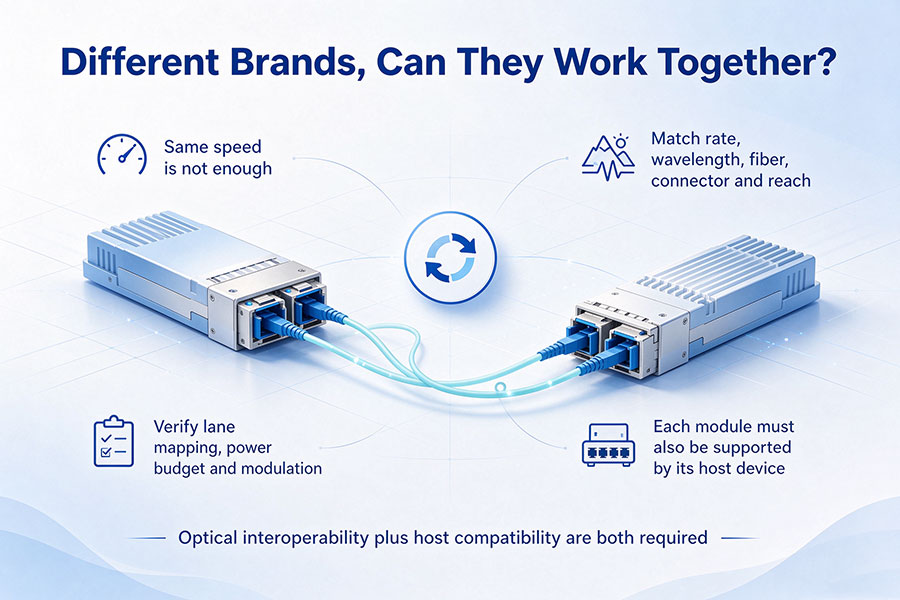
For optical transceiver selection, compatibility should be checked against the actual transport equipment, interface rate, wavelength, reach, connector, optical budget, and environmental requirements. A higher data-rate module is not automatically a suitable replacement for an existing interface.
12. Conclusion
5G-Advanced is increasing the importance of optical transport infrastructure by extending the demands placed on mobile network capacity, synchronization, latency, and service flexibility. The resulting evolution involves more than faster transceivers. Operators need coordinated improvements across fiber access, WDM, OTN, packet transport, timing distribution, and network management.
The most effective upgrade strategy is based on the requirements of each transport segment. Fronthaul needs careful attention to bandwidth, latency, and synchronization; midhaul and backhaul require scalable aggregation, resilience, and service-aware capacity management. By combining suitable optical interfaces with flexible transport architecture, operators can prepare their networks for continued 5G-Advanced development and future mobile traffic growth.
For optical connectivity requirements and product-related technical discussions, view the optical transceiver product range or Contact C-LIGHT.
 >

 >
 >
 >
 >
 >
 >
 >