TEL:+86 132 6656 7067





AI data centers are entering a new phase of network development. Larger accelerator clusters, higher aggregate bandwidth, and increasingly distributed AI workloads are placing greater demands on the connections between GPUs, switches, storage systems, and data center facilities.
Optical connectivity is becoming more important across this infrastructure. The next stage will not simply involve replacing 400G modules with 800G or 1.6T products. It will involve changes in optical integration, electrical interface design, fiber management, switching architectures, and the way networks are engineered at scale.
1. Why AI Data Centers Need a New Generation of Optical Connectivity
AI training and inference depend on large volumes of data moving between computing resources. As clusters expand, network capacity must grow without allowing power consumption, signal loss, cabling complexity, and system cost to increase at the same rate.
Traditional network designs remain important, but higher signaling rates are making the electrical connection between a switch ASIC and its optical interface more challenging. Longer electrical paths can require more signal conditioning and create additional power and design constraints.
Optical connectivity addresses several of these challenges by carrying data over fiber between network devices and across longer distances than practical high-speed electrical connections. Its role is also expanding as optical engines move closer to switching and computing silicon.
Higher Bandwidth Density
AI clusters require more aggregate network capacity as accelerator counts and inter-node communication increase. Higher-speed interfaces help increase capacity per port and per rack.
Power and Thermal Constraints
Networking power contributes to data center energy and cooling requirements. Future architectures must consider the power consumed by electrical interfaces, DSPs, optical engines, and cooling systems together.
Greater Network Scale
Large deployments require consistent connectivity across racks, rows, buildings, and data center campuses. Fiber provides the reach and cabling flexibility needed for these environments.
Operational Reliability
Higher port density increases the importance of fiber routing, connector cleanliness, link monitoring, serviceability, and consistent component qualification.
2. The Transition from 800G to 1.6T and Beyond
800G has become an important interface generation for high-bandwidth AI and cloud networks. The next step is 1.6T, which increases the capacity available through a single network interface and supports continued growth in switch bandwidth.
Higher data rates are not achieved through a single optical component change. They depend on coordinated advances in electrical signaling, modulation, DSP technology, laser performance, photodetectors, packaging, and thermal design.
| Technology Generation | Network Role | Engineering Considerations |
|---|---|---|
| 400G | Established high-speed connectivity for data center and AI network deployments | Port density, reach, lane mapping, and interoperability |
| 800G | Higher-capacity links for large AI clusters and high-radix switches | Power per port, thermal management, fiber count, and host compatibility |
| 1.6T | Next-generation high-bandwidth connectivity for increasingly dense network systems | Higher lane rates, signal integrity, advanced packaging, and cooling |
| Beyond 1.6T | Future network interfaces as switch and accelerator bandwidth continue to scale | New electrical interfaces, photonic integration, manufacturing, and standardization |
For network planners, the important question is not only which speed comes next. It is whether the switch platform, host electrical interface, optical reach, fiber plant, and thermal environment can support the selected module generation.
C-LIGHT's 1.6T OSFP-RHS optical transceiver family is relevant to this transition. The product family includes high-speed single-mode optical configurations such as 2×DR4 and 2×FR4. Actual deployment suitability depends on the specific host platform, supported interface, reach requirement, and thermal design.
3. Pluggable Optics Will Remain an Important Part of AI Networks
Pluggable optical transceivers are likely to remain central to AI data center connectivity during the transition to more integrated optical architectures. Their removable form factor supports module replacement, maintenance, upgrades, and multi-vendor sourcing.
They are especially useful for scale-out networks connecting switches across racks and rows, as well as for links where front-panel access and field replacement are important operational requirements.
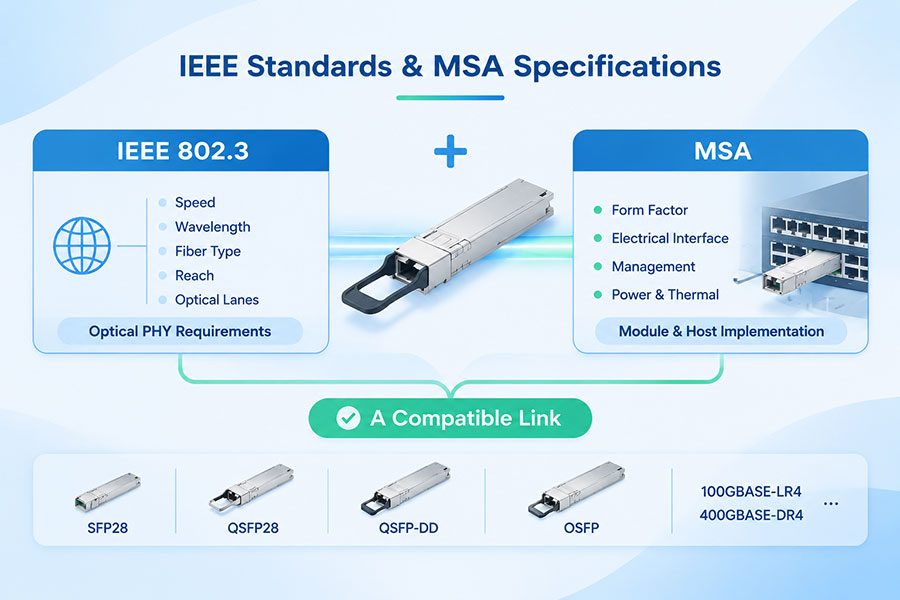
Different form factors and optical reaches serve different deployment needs. SR, DR, FR, and LR families, for example, are selected according to fiber type, distance, link budget, and platform support rather than data rate alone.
Browse the C-LIGHT optical transceiver portfolio for optical connectivity options across different data rates and network applications.
4. CPO and NPO Will Move Optics Closer to Switching Silicon
One of the most important changes in optical connectivity is the movement of optical engines closer to the switch ASIC. As electrical signaling rates increase, the distance between the ASIC and optical conversion point becomes a significant system-design consideration.
Co-Packaged Optics (CPO)
CPO integrates optical engines within the same package or closely integrated package assembly as the switching ASIC. Shorter electrical paths can reduce signal-conditioning requirements and help improve bandwidth density and system-level power efficiency.
However, CPO also changes how systems are manufactured, tested, cooled, and maintained. Optical engine replacement, fiber attachment, laser arrangements, package yield, and failure isolation all require careful engineering.
Near-Packaged Optics (NPO)
NPO places optical engines close to the ASIC but keeps them outside the ASIC package. This approach aims to shorten high-speed electrical paths while retaining more modularity than tightly integrated CPO implementations.
For some system designs, NPO can provide a practical balance between electrical performance, optical integration, serviceability, and component sourcing. Its adoption will depend on standardized interfaces and the availability of qualified system platforms.
Linear Pluggable Optics (LPO)
LPO reduces or removes DSP-based signal processing within the optical module, depending on the implementation. It can reduce module power and latency in suitable systems, but it places greater responsibility on the host electrical interface and system-level signal integrity.
| Architecture | Optical Engine Location | Potential Advantages | Key Considerations |
|---|---|---|---|
| Traditional Pluggable | Front-panel removable module | Serviceability, flexibility, and established deployment practices | Electrical reach to the front panel, module power, and port density |
| LPO | Front-panel module with a simplified signal-processing chain | Potential power and latency reduction | Host signal quality and interoperability |
| NPO | Near the ASIC, outside its package | Shorter electrical paths with potential modularity benefits | Mechanical, thermal, optical, and electrical interface standards |
| CPO | Integrated with the ASIC package | High bandwidth density and reduced electrical path length | Manufacturing yield, serviceability, thermal design, and fiber attachment |
These architectures should be viewed as different engineering options rather than a simple replacement sequence. Pluggables, LPO, NPO, and CPO may coexist because they address different reach, density, cost, and maintenance requirements.
5. Silicon Photonics and Laser Integration Will Shape Optical Engine Design
Silicon photonics is an important technology direction for increasing the integration of optical functions. It uses silicon-based photonic circuits to implement functions such as optical modulation, routing, and coupling, often alongside electronic control and signal-processing components.
Its potential value comes from integration and manufacturing scalability. As optical engine counts increase, the ability to combine multiple photonic functions into compact assemblies becomes increasingly important.
Laser integration remains a separate but closely related design challenge. Some architectures use external continuous-wave laser sources, while others use different laser integration arrangements. The choice affects thermal management, optical coupling, reliability, and service procedures.
Silicon photonics is not a complete solution by itself. System performance also depends on packaging, fiber attachment, optical loss, laser stability, photodetector performance, manufacturing yield, and the electronic interface.
6. Optical Circuit Switching May Support Larger AI Fabrics
As AI clusters grow, operators are evaluating ways to allocate network capacity more efficiently across large groups of computing resources. Optical circuit switching (OCS) is one approach that can establish configurable optical paths between network endpoints or groups of endpoints.
Unlike an Ethernet packet switch, an OCS system establishes optical circuits rather than forwarding individual packets based on packet headers. It can complement electronic packet switching by providing configurable high-capacity paths for selected traffic patterns.
OCS may be useful where traffic demand is predictable enough to benefit from circuit reconfiguration. Its practical deployment requires attention to reconfiguration time, optical loss, topology control, path planning, and fault recovery.
7. Fiber Infrastructure Must Scale Alongside Optical Port Speeds
Increasing transceiver speed does not remove the need for a well-designed fiber plant. In high-density AI data centers, fiber infrastructure must support large numbers of parallel optical lanes, reliable patching, manageable cable routes, and efficient maintenance.
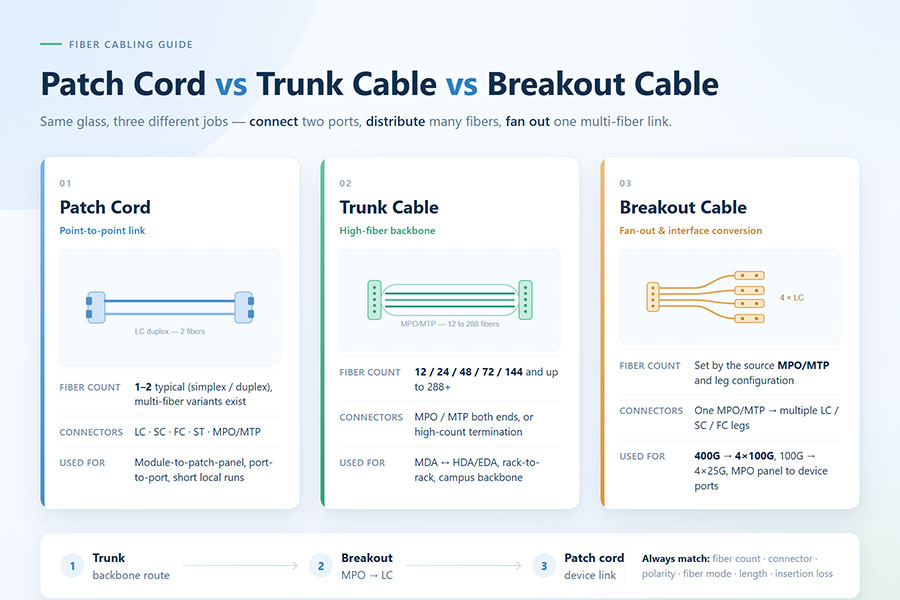
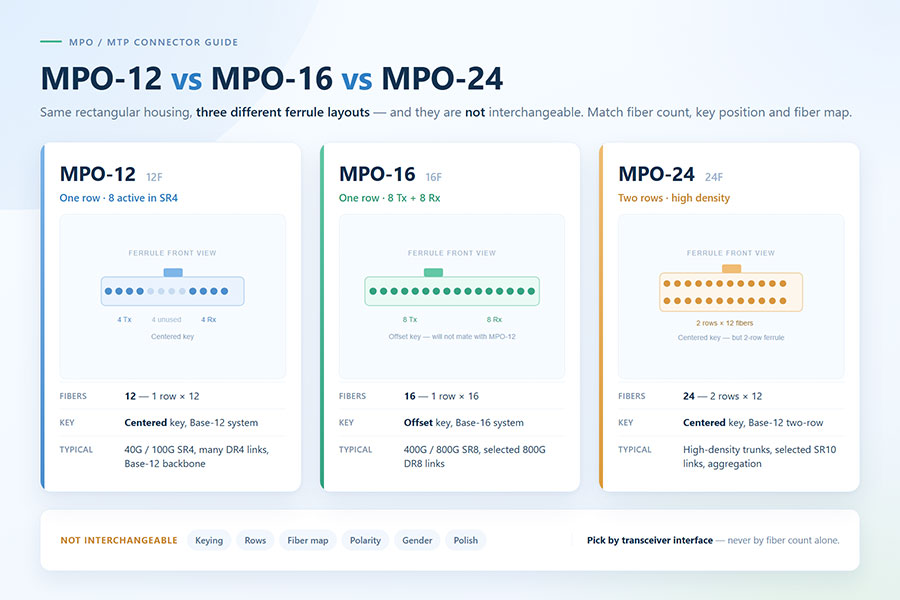
Parallel optics can require multiple fiber strands for each link. MPO and MTP connectivity helps organize multi-fiber connections and supports structured cabling between transceivers, patch panels, and distribution areas.
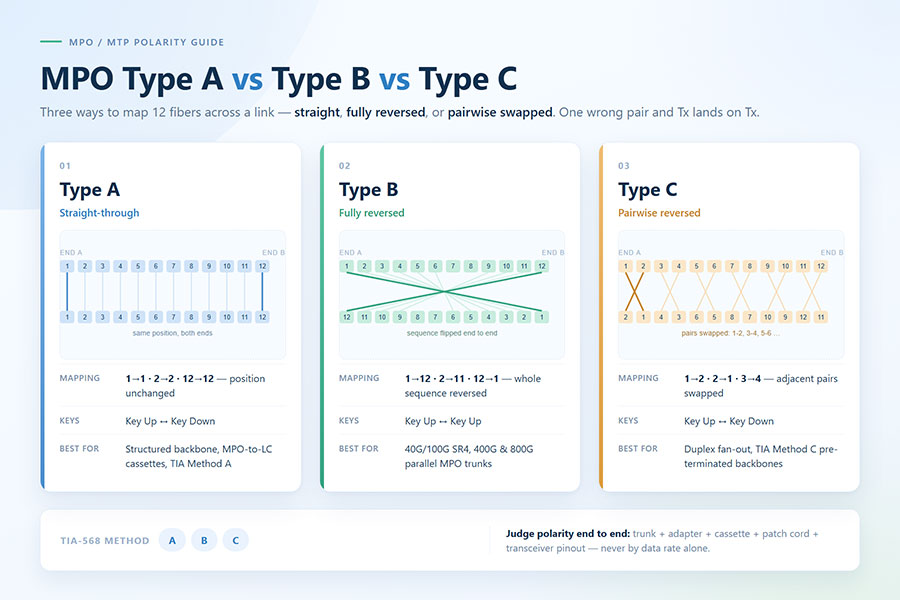
As port density increases, cable management becomes a system-level concern. Bend radius, polarity, connector cleanliness, insertion loss, labeling, and accessibility all affect deployment quality and troubleshooting efficiency.
C-LIGHT provides MPO-MPO fiber patch cables and MTP-MTP fiber patch cables for multi-fiber connectivity applications. Fiber type, connector configuration, polarity, fiber count, and insertion-loss requirements should be matched to the optical interface and cabling design.
8. Data Center Interconnect Will Extend AI Connectivity Beyond Individual Facilities
AI infrastructure is not always contained within a single data center building. Large operators may distribute computing resources across multiple facilities or campuses to address power availability, capacity planning, resilience, and geographic requirements.
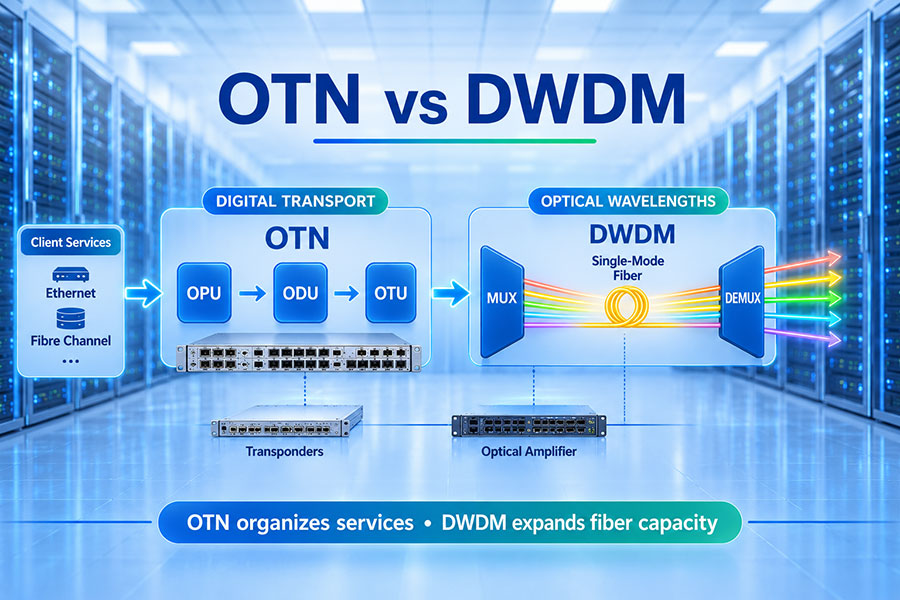
These environments require data center interconnect (DCI) solutions that provide high-capacity connectivity over campus, metro, or longer regional distances. Coherent optical technology and DWDM systems can support high-capacity transmission over single-mode fiber.
In September 2026, the Optical Internetworking Forum published its 1600ZR coherent interface agreement. The specification defines an interoperable 1.6T coherent line interface for amplified point-to-point DWDM links up to 120 km. This is an important development for higher-capacity DCI, although actual reach depends on the optical line system and deployment conditions.
For multi-site AI infrastructure, network design must consider more than line rate. Fiber route diversity, amplification, optical signal-to-noise ratio, latency, protection, and operational monitoring all influence service performance.
9. Power Efficiency, Cooling, and Reliability Will Influence Architecture Choices
Future optical connectivity must deliver more bandwidth without creating disproportionate increases in system power and cooling demand. The relevant measurement is not simply the power consumption of an individual transceiver, but the total energy required to deliver usable network capacity across the complete system.
That system includes the switch ASIC, SerDes interfaces, DSPs, optical engines, lasers, cooling equipment, and supporting infrastructure. Moving optics closer to the ASIC may reduce some electrical-interface overhead, but the overall result depends on the implementation.
Reliability and maintenance are equally important. A tightly integrated optical engine may improve density, but it can introduce different replacement and fault-isolation requirements compared with a removable front-panel module.
Power: Evaluate energy consumption across the complete link and switching system.
Thermal design: Confirm module, engine, ASIC, and chassis cooling requirements.
Serviceability: Plan for module replacement, fiber access, and fault isolation.
Interoperability: Validate optical, electrical, mechanical, and management interfaces.
Reliability: Assess component lifetime, connector performance, and system-level failure behavior.
10. What Network Designers Should Prepare for Next
The future of AI optical connectivity will involve several technologies developing at different speeds. Network operators should avoid designing around a single technology forecast. Instead, they should build infrastructure that can accommodate increasing bandwidth while preserving operational flexibility.
Plan for multiple speed generations. Ensure that fiber pathways, patching areas, and network equipment can accommodate future 800G and 1.6T deployments where appropriate.
Validate the complete link. Check host compatibility, lane mapping, optical reach, power budget, thermal limits, and management support before deployment.
Keep fiber infrastructure organized. Use suitable MPO/MTP assemblies, clear polarity management, labeling, and documented cable routes.
Evaluate emerging integration models carefully. Compare pluggables, LPO, NPO, and CPO against real system requirements for power, density, reliability, and maintenance.
Design for operational flexibility. Consider multi-vendor interoperability, spare-part availability, monitoring, and upgrade procedures as part of the architecture.
11. Conclusion: Optical Connectivity Will Become More Integrated and More Strategic
The future of optical connectivity in AI data centers will be shaped by the combined development of higher-speed transceivers, silicon photonics, NPO, CPO, optical circuit switching, and high-density fiber infrastructure.
800G and 1.6T optics will support growing scale-out and data center interconnect requirements, while more integrated optical architectures will address selected bandwidth-density and electrical-interface constraints. At the same time, pluggable optics will remain valuable wherever flexibility, serviceability, and established deployment models matter.
There will not be one universal optical architecture for every AI network. The appropriate solution will depend on traffic patterns, link distance, power limits, equipment design, reliability requirements, and total deployment cost. A well-planned optical infrastructure will combine technologies according to their practical strengths and provide a foundation for future AI cluster expansion.
Optical Connectivity for Next-Generation Data Centers
C-LIGHT provides optical transceivers, high-speed interconnect cables, and fiber connectivity products for data center and AI network applications. For product information, compatibility requirements, or project discussions, please Contact C-LIGHT.
 >

 >
 >
 >
 >
 >
 >
 >