TEL:+86 132 6656 7067





The rapid expansion of AI computing, hyperscale cloud infrastructure and high-performance networking is increasing the demand for higher-capacity optical connectivity. As 800G optical transceivers become an important part of modern data center networks, 1.6T optical transceivers are emerging as the next major bandwidth generation.
However, the future of 1.6T is not simply about doubling the data rate of an 800G module. It involves a broader evolution in optical technology, including 200G-per-lane signaling, advanced laser and photonic integration, coherent transmission, improved digital signal processing and more sophisticated thermal management.
These developments will influence how optical modules connect AI GPU clusters, high-capacity switches and geographically distributed data centers. They will also establish an important foundation for future 3.2T optical connectivity.
1. Why Is the Industry Moving Toward 1.6T Optical Transceivers?
AI workloads generate substantial communication traffic between GPUs, servers and network switches. Distributed training, model synchronization and large-scale inference all depend on high-bandwidth connections with predictable performance.
As GPU clusters expand, conventional 400G and 800G links may require increasingly large numbers of physical connections to provide the necessary aggregate bandwidth. This creates challenges in switch port density, cabling, power consumption and rack-level infrastructure.
1.6T optical transceivers address part of this challenge by doubling the nominal bandwidth available from a single 800G module.
1.1 Higher Bandwidth per Optical Port
A 1.6T optical transceiver provides up to 1.6Tbps of aggregate transmission capacity. Compared with 800G, it can deliver twice the nominal bandwidth through a single optical interface.
For network designers, this can reduce the number of physical links required to achieve a specific aggregate bandwidth target, provided that the switch platform and connected devices support the higher data rate.
1.2 Growing AI Cluster Requirements
AI infrastructure increasingly relies on high-speed communication between large groups of accelerators. Network bandwidth must scale alongside compute capacity to avoid creating communication bottlenecks.
1.6T links can support higher-capacity connections between switches and network domains. They are particularly relevant to future AI scale-out architectures where the number of connected servers and accelerators continues to increase.
1.3 Higher Switch Capacity and Port Density
Switch manufacturers are developing platforms with increasingly high aggregate switching bandwidth. Supporting higher data rates per optical port allows these systems to provide more bandwidth without increasing the number of front-panel connections at the same rate.
This is one reason why 1.6T OSFP modules are receiving attention in next-generation Ethernet switching systems.
2. 200G per Lane Is the Foundation of 1.6T Optics
The most important technical development behind 1.6T optical transceivers is the move from 100G-per-lane to 200G-per-lane signaling.
Conventional 800G modules commonly use eight electrical lanes operating at approximately 100Gbps each. A 1.6T module doubles the lane rate while retaining an eight-lane architecture.
The basic bandwidth calculation is:
8 × 200Gbps = 1,600Gbps = 1.6Tbps
2.1 PAM4 Modulation
PAM4 (Pulse Amplitude Modulation with four levels) is an important modulation technology used in high-speed optical transmission. It represents two bits per symbol by using four distinct signal levels.
Compared with NRZ, PAM4 can carry twice as many bits per symbol. This makes it possible to increase data rates without requiring the symbol rate to increase by the same factor.
At 200G per lane, however, the transmitter, receiver and electrical interface must operate at much higher bandwidths. Maintaining signal quality becomes increasingly difficult as insertion loss, crosstalk and noise affect the transmission channel.
2.2 DSP and Forward Error Correction
Digital Signal Processing (DSP) plays an important role in managing signal impairments in high-speed optical modules. It can support equalization, signal recovery and other functions required for reliable transmission.
Forward Error Correction (FEC) adds redundant information that allows the receiver to detect and correct certain transmission errors. At higher lane rates, DSP and FEC performance become important factors in determining link reliability, power consumption and latency.
2.3 Higher-Speed Electrical Interfaces
The transition to 200G-per-lane optics also requires compatible switch ASICs, host connectors and PCB electrical channels.
Even if an optical module supports 1.6T transmission, the complete system must support the corresponding electrical interface. Host compatibility, signal integrity and module management therefore remain essential considerations during deployment.
3. Silicon Photonics and EML: Two Important Technology Directions
The future of 1.6T optical transceivers will depend heavily on improvements in optical integration and transmitter technology. Two important approaches are EML-based optics and silicon photonics.
3.1 EML Technology
EML stands for Electro-Absorption Modulated Laser. It integrates a laser source and an electro-absorption modulator into a single semiconductor device.
EML technology has been used in high-speed optical communication because of its ability to provide high-speed modulation and suitable optical performance for different transmission distances.
For 1.6T applications, higher-bandwidth EML devices are being developed to support 200G-per-lane transmission. Their performance, manufacturing yield, power consumption and cost will influence their suitability across different optical reach categories.
3.2 Silicon Photonics
Silicon photonics uses silicon-based integrated optical circuits to combine multiple optical functions on a photonic chip.
Instead of relying entirely on discrete optical components, silicon photonics can integrate waveguides, modulators, couplers and other optical structures into a compact platform.
Its potential advantages include:
Higher integration of optical components.
Support for multiple optical channels on a photonic circuit.
Potential improvements in manufacturing scalability.
Opportunities for more compact optical engine designs.
Compatibility with advanced packaging and optical integration approaches.
Silicon photonics still requires suitable laser sources, coupling solutions, packaging and thermal control. Its performance and economics depend on the specific implementation rather than the technology name alone.
3.3 EML vs. Silicon Photonics in 1.6T Modules
| Feature | EML | Silicon Photonics |
|---|---|---|
| Technology | Electro-absorption modulated laser | Integrated silicon photonic circuits |
| Modulation | Integrated laser and modulator | Typically uses external laser sources with integrated photonic modulation |
| Integration | Integrated laser-modulator device | Multiple optical functions on a photonic chip |
| Key Strength | High-speed optical transmission | Optical integration and scalability |
| Engineering Challenges | High-speed device performance and manufacturing | Laser coupling, packaging, thermal control and integration |
| 1.6T Development | Higher-bandwidth transmitter technology | Multi-channel photonic integration |
These technologies should not be viewed as mutually exclusive solutions. Their suitability depends on optical reach, power targets, manufacturing economics and module architecture.
4. The Role of Coherent Optics in 1.6T Connectivity
Not all 1.6T optical transceivers are designed for the same application. Short-reach data center links and longer-distance data center interconnects have different transmission requirements.
For short-reach connections, intensity-modulation direct-detection (IM-DD) technologies such as DR8 and FR4 are important. For longer distances, coherent optical technology provides another path to 1.6T transmission.
4.1 1.6T IM-DD Optical Transceivers
IM-DD systems transmit information by varying optical intensity and detecting the received optical power. They are widely used in data center optical modules because of their relatively straightforward architecture and suitability for short and medium reaches.
Examples of 1.6T optical configurations include:
1.6T DR8: Eight optical channels designed for short-reach single-mode fiber links.
1.6T 2×FR4: Two 800G optical interfaces combined within a 1.6T module architecture for longer data center reach.
The exact optical lane arrangement, wavelength plan and connector configuration depend on the implementation.
4.2 1.6T Coherent Optics
Coherent optical technology uses the amplitude, phase and polarization properties of light to transmit information. It is particularly valuable for longer-distance links where optical amplification, dispersion management and spectral efficiency are important.
In September 2026, the Optical Internetworking Forum (OIF) published its 1600ZR Coherent Interface Implementation Agreement. It defines an interoperable 1.6T coherent line interface for amplified, point-to-point DWDM links up to 120km.
This development extends the role of 1.6T optics beyond short-reach AI data center links and into high-capacity data center interconnect (DCI) applications.
4.3 IM-DD vs. Coherent 1.6T Optics
| Feature | 1.6T IM-DD | 1.6T Coherent |
|---|---|---|
| Transmission Method | Optical intensity modulation and direct detection | Coherent detection using optical field information |
| Primary Applications | Data center and AI cluster links | Longer-reach DCI and DWDM networks |
| Typical Reach Focus | Short and medium reach | Longer reach, including amplified links |
| Optical Technology | Direct-detection optical components | Coherent transmitter and receiver architecture |
| Key Considerations | Lane rate, link budget, fiber and power | DSP, modulation, OSNR and optical amplification |
Although both approaches support a 1.6T data rate, they solve different networking problems. A 1.6T DR8 module and a 1.6T coherent 1600ZR module should not be treated as interchangeable products.
5. OSFP1600 and the Evolution of Optical Module Packaging
OSFP is one of the major form factors used in high-speed data center optical connectivity. As module bandwidth increases, its mechanical design, electrical interface and cooling structure must evolve to accommodate more demanding components.
5.1 OSFP1600
OSFP1600 is designed to support 1.6Tbps aggregate bandwidth through eight 200G electrical lanes.
The form factor provides space for high-speed electrical connections, optical components, DSP and thermal management structures. This makes it an important platform for 1.6T optical transceiver development.
5.2 OSFP-RHS Thermal Design
RHS stands for Reduced Height Sink. An OSFP-RHS module uses a reduced-height heatsink structure designed for compatible host thermal arrangements.
As module power increases, thermal design becomes more important. Some high-density systems use cold plates or other advanced cooling arrangements to remove heat from optical modules and surrounding components.
OSFP-RHS should not automatically be interpreted as a liquid-cooled module. Actual cooling compatibility depends on the module and host platform design.
5.3 OSFP-XD and Future 3.2T Connectivity
Beyond 1.6T, OSFP-XD introduces a higher-density electrical interface with 16 lanes. This architecture provides a path toward 3.2T modules using 16 × 200G signaling.
It represents a different development direction from standard eight-lane OSFP1600. The two form factors have different mechanical and electrical interfaces and require compatible host platforms.
As 1.6T adoption expands, OSFP-XD and other high-density optical architectures will become relevant to future switching systems.
6. Power Consumption and Thermal Management Will Shape 1.6T Adoption
Increasing bandwidth per module does not automatically reduce total network power consumption. Higher-speed electrical interfaces, DSP, optical transmitters and receivers can all increase module power requirements.
For large AI data centers, even small power differences per optical module can become significant when multiplied across thousands of network connections.
6.1 More Efficient DSP
DSP is essential in many high-speed optical modules, but its power consumption becomes increasingly important at 200G per lane and beyond.
Future designs will focus on improving equalization, signal processing efficiency and integration while maintaining the required transmission performance.
6.2 Advanced Thermal Structures
Higher module power requires improved heat transfer. Heatsink optimization, airflow management and host-level cooling design will all influence 1.6T module performance.
For high-density switching systems, liquid cooling may become increasingly relevant where air cooling cannot efficiently handle the total thermal load.
6.3 Total System Power Efficiency
Optical module power should be evaluated alongside switch ASIC power, electrical channel losses, cooling overhead and the number of links required by the network architecture.
A module with lower power consumption does not necessarily produce a more efficient network if it requires additional ports or more complex optical connections. System-level evaluation is therefore more meaningful than comparing module power alone.
7. How 1.6T Optical Transceivers Will Change AI Data Center Networks
1.6T optical connectivity is closely associated with the growing scale and complexity of AI infrastructure. Its influence will extend across several network layers.
7.1 AI Scale-Out Networks
Scale-out networks connect GPU servers and racks through Ethernet or InfiniBand switching fabrics. As clusters grow, higher-capacity optical links can help increase bandwidth between network layers.
1.6T transceivers can provide higher-capacity connections between switches, supporting network architectures with greater aggregate throughput.
7.2 High-Density Switch Connectivity
Higher bandwidth per port can reduce the number of physical interfaces required for a given switching capacity. This can simplify certain cabling arrangements and support more compact network designs.
However, the benefits depend on switch port architecture, breakout options, fiber connectivity and the bandwidth requirements of connected devices.
7.3 Data Center Interconnect
AI infrastructure is not always confined to a single building or data center. Large-scale deployments may connect multiple facilities through high-capacity optical links.
Coherent 1.6T technology provides a path toward transporting higher client bandwidth over DWDM infrastructure, while short-reach 1.6T modules serve connections within data center environments.
8. What Comes After 1.6T? The Road to 3.2T
Although 1.6T is an important milestone, optical interconnect development will continue toward 3.2T and higher capacities.
One potential path is to increase the number of 200G lanes from eight to sixteen:
16 × 200Gbps = 3.2Tbps
Another longer-term direction is to increase the signaling rate per lane beyond 200G. This creates more demanding requirements for electrical interfaces, optical components and signal processing.
Several technologies will influence this evolution:
OSFP-XD: A higher-density pluggable architecture with 16 electrical lanes.
CPO: Co-Packaged Optics places optical engines close to the switch ASIC to reduce electrical interconnect distance.
NPO: Near-Packaged Optics positions optical engines near high-speed processing components.
LPO: Linear Pluggable Optics reduces certain DSP functions within the module to target lower power and latency.
XPO: eXtra-dense Pluggable Optics introduces a separate high-density pluggable architecture designed for very high aggregate bandwidth and liquid cooling.
These approaches are not direct substitutes in every application. They represent different ways to address bandwidth density, electrical reach, power consumption and serviceability.
9. What Challenges Could Slow Down 1.6T Adoption?
Despite its advantages, 1.6T optical technology faces several practical challenges. The speed of adoption will depend on the maturity of the entire networking ecosystem.
9.1 200G-per-Lane Component Maturity
Producing reliable 200G-per-lane optical components requires advanced lasers, modulators, photodetectors and high-speed electrical interfaces. Manufacturing consistency and qualification are important for large-scale deployment.
9.2 Compatibility Across Network Equipment
1.6T modules require compatible switch ASICs, host electrical interfaces, connectors and management systems. Network operators must verify compatibility at the complete system level.
9.3 Fiber Infrastructure
Higher data rates may require different fiber arrangements, connector configurations or optical link budgets. Existing fiber infrastructure must be evaluated before upgrading to a new optical generation.
9.4 Supply Chain and Cost
New optical components and packaging technologies can initially have higher manufacturing costs. Laser availability, photonic integration capacity and module qualification can influence product pricing and deployment schedules.
9.5 Standards and Interoperability
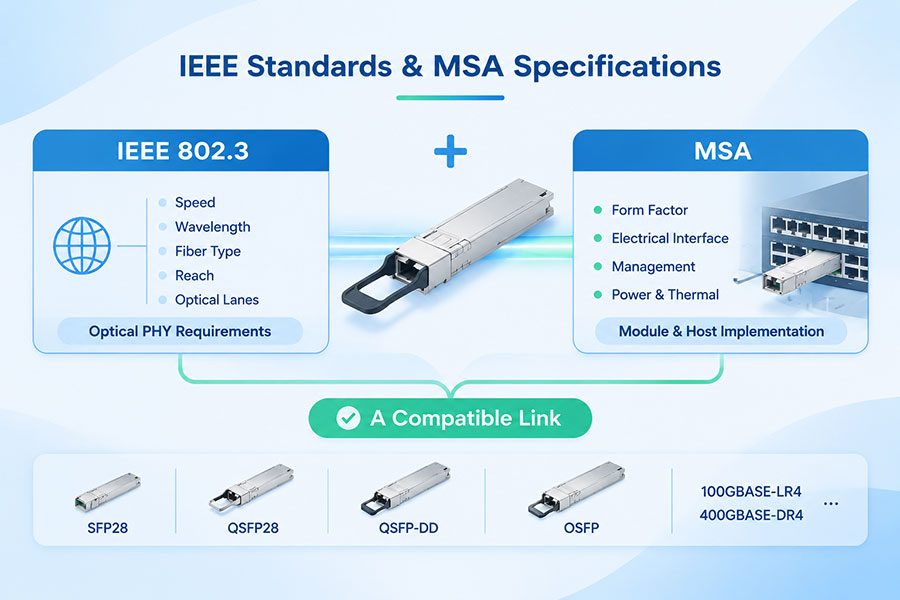
Industry standards and multi-source agreements help establish common interfaces. However, a standards document does not automatically guarantee compatibility between every product. Electrical, optical, mechanical and management requirements must all be validated.
10. C-LIGHT 1.6T Optical Transceiver Solutions
As data center networks move toward higher bandwidth, selecting optical modules with the correct form factor, optical reach and thermal design becomes increasingly important.
C-LIGHT's 1.6T OSFP-RHS optical transceiver portfolio is designed for next-generation Ethernet connectivity in AI data centers, GPU clusters and hyperscale cloud infrastructure.
10.1 1.6T OSFP-RHS 8 × 200G Architecture
The C-LIGHT 1.6T OSFP-RHS platform uses eight 200G PAM4 lanes to provide an aggregate bandwidth of 1.6Tbps. Its reduced-height heatsink design is intended for high-density systems with demanding thermal requirements.
10.2 1.6T DR8 for 500m Connections
The C-LIGHT 1.6T OSFP-RHS DR8 configuration supports up to 500m transmission over single-mode fiber. It is designed for high-capacity optical links within data center networks.
10.3 1.6T 2×FR4 for 2km Connections
For longer data center connections, C-LIGHT also offers a 1.6T 2×FR4 configuration supporting up to 2km over single-mode fiber. This option uses a dual LC/APC interface and is designed for longer-reach connectivity requirements.
The exact optical interface, host compatibility, power specification and management requirements should be confirmed against the selected part number and product datasheet.
10.4 Preparing for Future Network Upgrades
When planning a migration from 800G to 1.6T, network operators should evaluate the following factors:
Switch ASIC and 1.6T electrical interface support.
Required optical reach and fiber infrastructure.
OSFP1600 host compatibility.
Module power and thermal design.
Optical connector and cabling configuration.
Interoperability and qualification requirements.
For additional high-speed connectivity options, visit the C-LIGHT optical transceiver product range.
11. Frequently Asked Questions About the Future of 1.6T Optical Transceivers
Q1: Why are 1.6T optical transceivers important for AI data centers?
They provide twice the aggregate bandwidth of 800G modules, helping AI data centers increase network capacity while reducing the number of physical links required for a given bandwidth target.
Q2: What technology enables 1.6T optical transmission?
1.6T modules commonly use eight 200G lanes with PAM4 signaling, supported by high-speed electrical interfaces, optical components, DSP and FEC.
Q3: What is the difference between 800G and 1.6T optical transceivers?
800G modules commonly use eight 100G lanes, while 1.6T modules use eight 200G lanes. The latter doubles the aggregate bandwidth per module.
Q4: Will silicon photonics replace EML in 1.6T modules?
Not necessarily. Silicon photonics and EML offer different integration and performance characteristics. Both may serve different 1.6T applications depending on reach, power, cost and manufacturing requirements.
Q5: What is the difference between 1.6T DR8 and 1.6T 2×FR4?
DR8 uses eight optical channels for short-reach single-mode transmission. 2×FR4 combines two 800G FR4 optical interfaces within a 1.6T module architecture for longer reach.
Q6: What is 1600ZR?
1600ZR is a 1.6T coherent optical interface defined by the OIF for amplified DWDM links up to 120km. It targets high-capacity data center interconnect applications.
Q7: Will 1.6T optical transceivers use liquid cooling?
Some high-density platforms may use cold plates or liquid cooling, while other modules rely on heatsinks and airflow. Cooling requirements depend on module power and host-system design.
Q8: What comes after 1.6T optical transceivers?
3.2T optical connectivity is an important next development. OSFP-XD, CPO, NPO and other advanced optical architectures may support future bandwidth scaling.
Q9: Are 1.6T optical transceivers compatible with 800G OSFP ports?
Physical similarity does not guarantee compatibility. The host switch, electrical interface, cage, power delivery and management implementation must explicitly support the selected 1.6T module.
Q10: What should buyers consider when selecting a 1.6T optical module?
Important factors include optical reach, fiber type, connector, wavelength, host compatibility, power consumption, cooling requirements and the applicable Ethernet or coherent interface specification.
12. Conclusion
The future of 1.6T optical transceivers will be shaped by higher lane rates, improved optical integration and increasingly sophisticated thermal management. The transition to 200G-per-lane signaling is a major step, enabling higher bandwidth without continuously increasing the number of electrical lanes.
EML and silicon photonics will continue to influence short-reach optical module development, while coherent 1600ZR technology extends 1.6T connectivity into longer-distance DWDM applications.
Beyond 1.6T, OSFP-XD, CPO, NPO and other high-density optical architectures will help address the growing requirements of AI infrastructure and hyperscale networks.
Rather than being a temporary speed upgrade, 1.6T represents an important transition in optical interconnect technology. Its adoption will depend on the maturity of optical components, switch platforms, cooling infrastructure and interoperable network interfaces.
 >

 >
 >
 >
 >
 >
 >
 >