TEL:+86 132 6656 7067





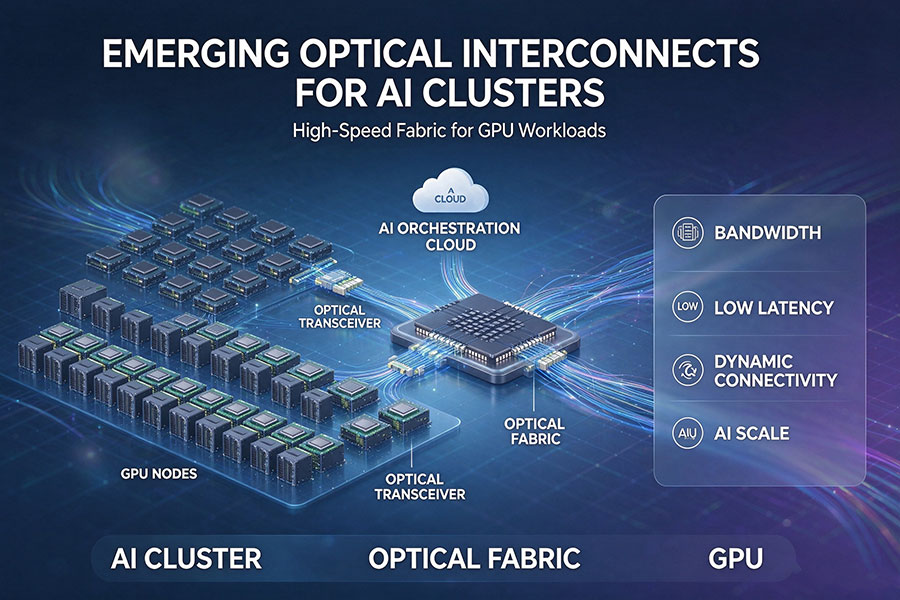
AI clusters are placing new demands on network architectures, from high-bandwidth communication between accelerators to large-scale traffic exchange across racks and data centers. Traditional electrical interconnects remain important, but their reach, power consumption and bandwidth density become increasingly difficult to manage as signaling rates and port capacities rise. Optical technologies are therefore moving beyond conventional front-panel transceivers into a broader range of network architectures, including linear pluggable optics, near-packaged optics, co-packaged optics, optical circuit switching and optical compute interconnects. These approaches address different parts of the AI infrastructure and are likely to coexist rather than converge immediately on a single design.
1. Why AI Clusters Need New Optical Interconnect Architectures
Large AI workloads generate continuous communication between accelerators, memory systems, network interfaces and distributed compute nodes. Distributed training can involve AllReduce, AllGather, ReduceScatter and All-to-All operations, each creating different traffic patterns and synchronization requirements. As the number of accelerators increases, the network must deliver sufficient bandwidth while controlling congestion, latency, power consumption and operational complexity.
Conventional data center networks use a combination of electrical switching, copper links and pluggable optical transceivers. This architecture remains effective for many deployments, but several constraints are becoming more prominent:
Electrical channel loss: Higher signaling rates make PCB traces, connectors and other electrical interconnects more difficult to manage.
Power consumption: High-speed SerDes, retimers and optical-module DSPs contribute to the power required for each network connection.
Front-panel density: Increasing port bandwidth can reduce the number of physical ports that fit within a given switch faceplate and thermal envelope.
Thermal management: Dense optical and electrical components create concentrated heat loads around switch ASICs and front-panel cages.
Network scalability: Large accelerator clusters need more flexible ways to allocate bandwidth and establish connections between compute groups.
Emerging optical architectures respond to these constraints at different integration levels. Some reduce power within a removable transceiver, while others move optical conversion closer to the switching ASIC or use optical switching to reconfigure network paths.
2. Three Interconnect Domains in AI Infrastructure
Optical architecture selection becomes clearer when AI networking is divided into scale-up, scale-out and scale-across domains. Each domain has different distance, bandwidth, latency and topology requirements.
| Network domain | Primary connectivity | Typical technologies | Main design priorities |
|---|---|---|---|
| Scale-up | Accelerator-to-accelerator communication within a tightly coupled system or rack group | High-speed electrical links, emerging optical I/O, NPO and CPO | Very high bandwidth density, low power and low latency |
| Scale-out | Connections among servers, racks, leaf switches and spine switches | Ethernet, InfiniBand, DAC, AEC, AOC, pluggable optics, LPO and CPO | Aggregate bandwidth, topology, congestion control and reach |
| Scale-across | Connectivity between data center buildings, campuses and geographically distributed facilities | Coherent optics, DWDM, OTN, optical transport and DCI systems | Longer reach, capacity, resilience and optical spectrum efficiency |
Scale-up networks traditionally rely heavily on high-speed electrical connections because accelerators within a tightly coupled system require dense, low-latency communication. Optical scale-up is receiving increasing attention as electrical channel limits become more difficult to overcome, especially when connectivity must extend beyond a single package or rack.
Scale-out networks already make extensive use of optical transceivers for rack-to-rack and switch-to-switch connections. Their evolution is increasingly influenced by 800G and 1.6T interfaces, higher-radix switching systems, optical switching and more integrated photonic solutions.
Scale-across networks have different requirements. They must connect geographically separated computing facilities and often depend on coherent transmission, wavelength-division multiplexing and optical transport systems. These technologies complement the short-reach optical interfaces used inside data centers.
3. Front-Panel Pluggable Optics: The Established Foundation
Conventional pluggable optical transceivers remain a major part of AI data center connectivity. They convert host electrical signals into optical signals for transmission over fiber and convert incoming optical signals back into electrical data at the receiving end.
Removable modules offer several operational advantages:
Modules can be replaced without changing the entire switch or server platform.
Different optical reaches and fiber configurations can be selected for different network links.
Network operators can maintain spare modules and replace failed components independently.
Standardized form factors and management interfaces support multi-vendor equipment ecosystems where interoperability requirements are met.
As port speeds advance from 400G to 800G and 1.6T, however, the electrical connection between the host ASIC and the front-panel module becomes increasingly demanding. The host PCB channel, module connector and internal electrical path all contribute to signal loss and power requirements.
Pluggable optics are therefore not disappearing. Instead, their internal architectures and host interfaces are evolving. Linear designs, higher-density mechanical formats and improved photonic integration are extending the capabilities of removable modules.
4. Linear Pluggable Optics and Reduced-Power Transceiver Designs
Linear pluggable optics (LPO) reduce or remove conventional DSP-based retiming within the optical module. Rather than relying on a full retiming DSP to recover and regenerate the electrical signal, an LPO design uses a more direct electrical path and places greater responsibility on the host SerDes and system-level signal processing.
The main motivation is power reduction. Removing or simplifying module-side signal processing can lower power consumption and reduce the amount of heat generated by each transceiver. This is attractive in AI switches where many high-speed optical ports operate simultaneously.
However, the approach creates tighter dependencies between the host ASIC and optical module. Electrical channel quality, transmitter linearity, receiver performance, equalization and signal margin must be carefully coordinated.
Key engineering considerations
Host SerDes capability: The host must provide the electrical signal quality and equalization required by the linear optical interface.
Channel characteristics: PCB length, connector loss, crosstalk and reflections can affect link performance.
Optical performance: Transmitter and receiver linearity must remain within the requirements of the selected optical interface.
Interoperability: Modules and host platforms require system-level validation rather than relying on mechanical compatibility alone.
LPO is most attractive where host and module designs can be developed and qualified together. It is not automatically suitable for every switch platform, and a lower module power figure does not guarantee lower total system power if additional host-side processing or tighter design constraints are introduced.
5. Near-Packaged Optics: Moving Optical Engines Closer to the ASIC
Near-packaged optics (NPO) places optical engines close to the host switching ASIC, typically on the same board or in a nearby socketed assembly. This shortens the high-speed electrical path compared with a front-panel pluggable module.
The architecture addresses one of the main limitations of conventional pluggable optics: the electrical channel between the ASIC package and the optical module. Shorter channels can reduce insertion loss and make higher lane rates easier to support, while allowing optical engines to be distributed around the switching package.
Unlike fully co-packaged designs, NPO generally retains a degree of physical separation between the optical engine and the ASIC package. This can offer more flexibility in assembly and serviceability, depending on the socket and mechanical implementation.
Advantages and limitations
| Aspect | Potential advantage | Remaining challenge |
|---|---|---|
| Electrical channel | Shorter connection between ASIC and optical engine | Residual board and socket losses remain |
| Bandwidth density | Optical engines can be placed closer to the switching package | Board area and engine placement still constrain density |
| Serviceability | Socketed implementations may allow engine replacement | Replacement depends on socket design and system access |
| Thermal design | Engine placement can be coordinated with host cooling | ASIC and optical engine heat loads must be managed together |
| Interoperability | Open interface initiatives can encourage multi-vendor development | Different sockets and engine implementations are not automatically interchangeable |
NPO is an intermediate integration approach. It reduces the electrical distance without requiring every optical engine to be integrated directly into the ASIC package. This makes it relevant to systems seeking higher bandwidth density while retaining some separation between the compute or switching package and optical components.
6. Co-Packaged Optics: Integrating Photonics with Switching ASICs
Co-packaged optics (CPO) brings optical engines much closer to the switching ASIC by integrating them within the same package assembly or closely coupled package structure. The objective is to reduce the length of high-speed electrical connections between the ASIC and optical conversion components.
In a conventional pluggable architecture, high-speed electrical signals travel from the ASIC across the host PCB and through a module connector before reaching the optical engine. CPO substantially shortens this electrical path, potentially reducing channel loss and the power required to drive high-speed electrical signals.
Optical engines around a switching ASIC can provide multiple high-bandwidth optical interfaces. The resulting architecture may improve bandwidth density and energy efficiency, particularly in high-radix switches designed for large AI fabrics.
Important CPO design elements
Switch ASIC: Performs packet forwarding and provides high-speed electrical interfaces to the optical engines.
Optical engines: Convert electrical data into optical signals and recover incoming optical data.
Photonic integrated circuits: Implement functions such as waveguiding, modulation and wavelength multiplexing.
Laser sources: Supply the optical power required by the photonic transmitters, either through integrated or external arrangements.
Fiber coupling: Connects the optical engines to external fiber infrastructure through carefully designed optical interfaces.
Thermal structures: Manage heat generated by the switching ASIC, electrical circuits and optical components.
CPO also introduces significant manufacturing and operational challenges. Optical engines must be assembled and tested with high precision, package yield becomes important, and replacing an optical engine may be more difficult than replacing a front-panel module. External laser sources can provide a separate serviceable component in some designs, but they add optical connections and system-level considerations.
CPO is therefore not simply a smaller transceiver. It is a system architecture that changes packaging, cooling, testing, maintenance and network deployment.
7. XPO and Higher-Density Optical Engine Architectures
eXtra-dense pluggable optics (XPO) represents another approach to increasing optical bandwidth density. Rather than placing optical engines directly within the ASIC package, XPO-style designs use a denser optical module architecture and alternative high-speed electrical connections to the host system.
Some XPO proposals use cable-based electrical connections, such as copper fly-over connections, to reduce the limitations of conventional PCB routing. This can provide a different balance between module density, electrical reach and serviceability.
The architecture is intended to support high aggregate bandwidth in a compact system, but it also introduces new mechanical, thermal and cable-management requirements. A high-density module arrangement must account for insertion and removal access, cooling interfaces, cable routing and manufacturing consistency.
XPO should be understood as an emerging architecture rather than a universally standardized replacement for OSFP or other established pluggable form factors. Its long-term role will depend on ecosystem adoption, interoperability work and demonstrated system-level advantages.
8. Optical Circuit Switching in AI Network Fabrics
Optical circuit switching (OCS) takes a different approach from transceiver integration. Instead of focusing primarily on how optical signals enter and leave a host device, OCS changes how optical paths are established within the network.
An optical circuit switch creates a dedicated optical path between selected input and output ports. In MEMS-based systems, small mirrors redirect light through the switching fabric. The optical path can be reconfigured by a control system according to network requirements.
Unlike an electronic packet switch, a conventional OCS does not inspect packet headers or perform packet-by-packet forwarding. It establishes optical connections that remain in place for a period of time. This makes OCS suitable for traffic patterns where sustained high-capacity connections can be planned or dynamically allocated.
How OCS supports AI clusters
Connects selected groups of network switches through configurable optical paths.
Provides additional path options when traffic patterns change.
Can reduce the number of intermediate electronic switching stages for selected connections.
Supports topology reconfiguration through centralized network control.
Can complement conventional packet switches in hybrid network architectures.
Google's Jupiter network evolution provides a practical example of MEMS-based optical circuit switching combined with software-defined networking. The architecture uses optical switching and centralized traffic engineering to support a reconfigurable data center fabric. Its results demonstrate the potential of optical circuit switching in a production network, but they should not be treated as guaranteed performance figures for every OCS deployment.
OCS also has limitations. Reconfiguration takes time, optical paths require resource allocation, and the system does not provide ordinary packet buffering within the optical switching fabric. Electronic packet switches therefore remain important for flexible packet forwarding, congestion management and traffic aggregation.
9. Optical Compute Interconnects for Scale-Up Networks
Optical compute interconnect (OCI) architectures are emerging to extend high-bandwidth optical connectivity closer to accelerators and compute packages. Their purpose is to address the increasing difficulty of distributing high-speed electrical signals across larger and more densely connected AI systems.
Traditional scale-up connections often use high-speed electrical technologies within tightly coupled accelerator systems. As the number of connected accelerators and the physical distance between them increase, electrical channel loss, power consumption and cable complexity become more challenging.
Optical compute interconnects seek to provide high-bandwidth communication over optical links while supporting different physical integration options. Depending on the architecture, an optical interface may be implemented through a pluggable module, an on-board engine or a co-packaged optical engine.
The Optical Compute Interconnect MSA is an example of industry activity directed toward defining common interfaces for this emerging area. A common interface can help separate the optical interconnect ecosystem from individual accelerator implementations, although broad interoperability still depends on detailed electrical, optical, mechanical and management specifications.
OCI does not mean that all accelerator-to-accelerator communication will immediately become optical. Electrical links remain attractive for short distances and established platforms. Optical scale-up is an emerging development path whose adoption depends on bandwidth requirements, power efficiency, latency, packaging and system economics.
10. Silicon Photonics and the Evolution of Optical Engines
Silicon photonics provides a foundation for integrating multiple optical functions onto compact photonic integrated circuits. Waveguides, modulators, wavelength multiplexers and other optical components can be fabricated using semiconductor manufacturing techniques, supporting higher levels of integration.
For AI cluster interconnects, silicon photonics is relevant to pluggable modules, NPO, CPO and optical compute interfaces. It can help reduce component count and support dense optical engine designs, but it does not remove the need for suitable light sources, optical coupling and high-performance receiver components.
Silicon is an indirect-bandgap material and is not generally an efficient source of laser light. As a result, many silicon-photonic designs use external or hybrid-integrated lasers. Indium phosphide remains important for laser generation and optical gain, while silicon photonics provides a platform for integrating other optical functions.
Key photonic components
| Component | Function | Architectural significance |
|---|---|---|
| Laser source | Generates optical carrier light | Determines wavelength, output power and source reliability |
| Modulator | Encodes electrical data onto an optical carrier | Influences bandwidth, drive voltage and signal quality |
| Waveguide | Routes light within the photonic circuit | Supports compact integration of optical functions |
| Multiplexer and demultiplexer | Combines or separates optical wavelengths | Enables wavelength-multiplexed transmission |
| Photodetector | Converts received optical power into electrical current | Influences receiver sensitivity and bandwidth |
| Optical coupling interface | Connects the photonic circuit to external fiber | Affects insertion loss, assembly yield and reliability |
InP and silicon photonics are complementary technologies rather than direct substitutes. Hybrid and heterogeneous integration approaches can combine their respective strengths, depending on the optical engine design and manufacturing process.
11. External Laser Sources and Thermal Separation
External laser sources are an important consideration in some NPO and CPO architectures. Instead of placing every laser source directly beside the switching ASIC, a separate laser module can supply continuous-wave optical power to one or more photonic engines.
This arrangement can provide flexibility in laser placement and maintenance. It may also help separate temperature-sensitive laser components from the heat generated by a high-power switching ASIC. The optical engine then uses the supplied light to perform modulation and transmission.
External laser designs introduce additional requirements:
Optical distribution from the laser source to the photonic engines.
Connector reliability and insertion-loss control.
Laser output stability and wavelength management.
Redundancy and fault isolation for shared optical sources.
Monitoring of source power and optical path condition.
Thermal coordination between the laser module and host system.
Different light-source technologies are being evaluated for future optical engines, including continuous-wave distributed-feedback lasers, quantum-dot laser concepts, VCSEL arrays and other emerging approaches. Their suitability depends on wavelength requirements, modulation architecture, output power, noise, thermal stability and manufacturing maturity. No single source technology is optimal for every optical interconnect.
12. Comparing Emerging Optical Interconnect Architectures
These architectures solve different parts of the connectivity problem. A useful evaluation must consider the location of optical conversion, electrical channel length, module replacement strategy, thermal requirements and the type of traffic being connected.
| Architecture | Optical engine location | Main objective | Primary trade-off |
|---|---|---|---|
| Conventional pluggable | Front-panel module | Flexible, replaceable optical connectivity | Longer host electrical channel and front-panel density limits |
| LPO | Front-panel module | Reduce module power by simplifying retiming | Greater dependence on host signal quality |
| NPO | Near the ASIC on the host board | Shorten electrical channels while retaining some separation | Board density, socket and interoperability challenges |
| XPO | High-density module assembly | Increase optical bandwidth density and improve electrical connection design | New mechanical, cable and thermal requirements |
| CPO | Within or directly adjacent to the ASIC package | Minimize electrical distance and increase bandwidth density | Packaging yield, repairability and thermal complexity |
| OCS | Optical switching fabric | Reconfigure network-level optical paths | Connection setup time and limited packet-level flexibility |
| OCI | Pluggable, on-board or co-packaged, depending on implementation | Extend optical connectivity toward compute systems | Interface standardization and system integration |
OCS and OCI are not direct alternatives to LPO, NPO or CPO. OCS changes network connectivity, while OCI defines an optical interconnect approach for compute systems. They can be combined with different optical engine placements in a broader network design.
13. Network Topology and Software Control
Optical hardware alone does not determine AI cluster performance. The network topology, routing behavior and control software must be designed around the communication patterns of the workloads.
Leaf-spine and Clos-based architectures remain widely used for scale-out networks because they provide structured connectivity and multiple paths between endpoints. However, their performance depends on uplink capacity, oversubscription, routing and congestion control. Adding optical links does not automatically remove congestion or guarantee non-blocking communication.
Optical circuit switching introduces another dimension: the network can change selected physical paths according to traffic demand. A controller may use telemetry, traffic forecasts and topology information to determine when optical circuits should be established or released.
Two broad control approaches are relevant:
Traffic-aware reconfiguration: Uses observed or predicted traffic demand to allocate optical connections where they are most useful.
Scheduled or traffic-oblivious reconfiguration: Uses predefined or periodic switching schedules to provide predictable connection patterns with less dependence on real-time traffic measurement.
Hybrid approaches can combine the flexibility of traffic-aware control with the predictability of scheduled optical connectivity. In either case, the control plane must coordinate optical path allocation with electronic routing, workload placement and failure recovery.
14. Standards and Interoperability Development
Emerging optical architectures require coordinated development across electrical interfaces, optical specifications, mechanical packaging, management systems and network control. Without common interfaces, components from different suppliers may not operate together even when they serve similar architectural purposes.
Several industry organizations are contributing to this work:
OIF: Develops implementation agreements covering electrical and optical interfaces, energy-efficient interfaces, external laser sources and co-packaged optical modules.
IEEE 802.3: Develops Ethernet physical-layer specifications, including higher-speed electrical and optical interfaces relevant to next-generation data center networks.
Optical Compute Interconnect MSA: Works toward a common optical compute interconnect interface that can support different physical implementation approaches.
Open Compute Project: Provides an industry collaboration environment for open hardware and system-level infrastructure development.
OIF's work on external laser sources and co-packaged modules demonstrates that optical integration is becoming a system-level engineering topic. Its 2026 activities also include work related to NPO, high-speed electrical channels and other interfaces needed for AI infrastructure.
However, an implementation agreement, MSA, technical proposal and formal IEEE standard are not the same thing. Their maturity and interoperability scope should be evaluated separately. Products based on early specifications may still require vendor-specific qualification and system testing.
15. Engineering Challenges Before Large-Scale Deployment
Although emerging architectures offer potential improvements in bandwidth density and energy efficiency, deployment requires more than demonstrating a high-speed optical link in a laboratory. The complete system must operate reliably under realistic traffic, temperature and maintenance conditions.
Signal integrity and link performance
Electrical interfaces must maintain adequate signal margin across the ASIC package, substrate, PCB, connectors and optical engine. Optical paths require controlled insertion loss, receiver sensitivity, transmitter performance and error rates. FEC configuration and end-to-end link qualification are essential parts of the design.
Thermal management
High-power switching ASICs and nearby optical engines can create concentrated thermal loads. Airflow, cold plates, heat sinks, package materials and laser placement all influence operating stability. Thermal design must account for both normal operation and high-load conditions.
Manufacturing and reliability
Advanced photonic packaging requires precise alignment and reliable optical coupling. Assembly yield, fiber attachment, material compatibility and long-term stability can affect production cost and field reliability.
Serviceability and repair
Front-panel pluggables are relatively straightforward to replace. NPO and CPO may require more specialized service procedures, particularly when optical engines are socketed or integrated into the package. External laser sources can improve component separation but add their own connectors and maintenance requirements.
System economics
Reduced energy per bit is only one part of the total cost calculation. Network operators must also consider switch cost, optical-engine yield, cooling infrastructure, fiber installation, spare inventory, software integration and operational training.
16. The Future Direction of Optical Interconnects in AI Clusters
The development of AI optical interconnects is likely to proceed through several overlapping stages rather than a single industry-wide transition. Higher-speed pluggable modules will continue to serve established network architectures, while LPO and other linear approaches target lower-power front-panel connectivity. NPO and XPO explore denser optical-engine placement, and CPO moves photonics closer to the switching ASIC.
At the network level, OCS can provide configurable optical paths for selected traffic patterns, while software-defined control helps coordinate topology changes. At the compute level, optical compute interconnects aim to extend high-bandwidth communication beyond the limits of conventional electrical connections.
Several technology developments will influence how quickly these approaches mature:
Higher electrical lane rates and improved SerDes technology.
More efficient silicon-photonic modulators and photodetectors.
Reliable external laser sources and improved optical coupling.
Advanced packaging processes and higher-yield photonic assembly.
Better thermal integration for dense optical and switching components.
Common interfaces for optical engines, compute interconnects and management.
Network software capable of coordinating optical topology with AI workload behavior.
The long-term architecture will depend on the distance between connected devices, required bandwidth, power budget, service model and total system cost. A tightly coupled accelerator system may favor optical I/O or co-packaged solutions, while a conventional rack-to-rack link may continue to use a replaceable optical transceiver. Large-scale network fabrics may combine packet switching and optical circuit switching to balance flexibility and capacity.
17. Conclusion
Emerging optical interconnect architectures are expanding the role of photonics throughout AI infrastructure. LPO reduces module-side processing, NPO and XPO move optical connectivity toward denser system layouts, and CPO integrates optical engines more closely with switching ASICs. OCS adds network-level path reconfiguration, while optical compute interconnects target the growing bandwidth requirements of accelerator systems.
These approaches address different engineering constraints and should not be treated as interchangeable technologies. Their practical adoption depends on electrical and optical performance, thermal design, packaging maturity, interoperability, serviceability and network software.
As AI clusters grow in scale and complexity, the most effective network designs will combine optical and electrical technologies according to the requirements of each connectivity domain. The evolution of optical interconnects is therefore not just a transition to faster transceivers; it is a broader redesign of how computing systems exchange data.
Building high-bandwidth optical connectivity for data center networks? Selecting suitable optical transceivers requires matching interface speed, transmission distance, fiber type, connector, host compatibility and operating conditions. Visit C-LIGHT optical transceivers for product information, or Contact C-LIGHT for technical and application support.
 >

 >
 >
 >
 >
 >
 >
 >