TEL:+86 132 6656 7067





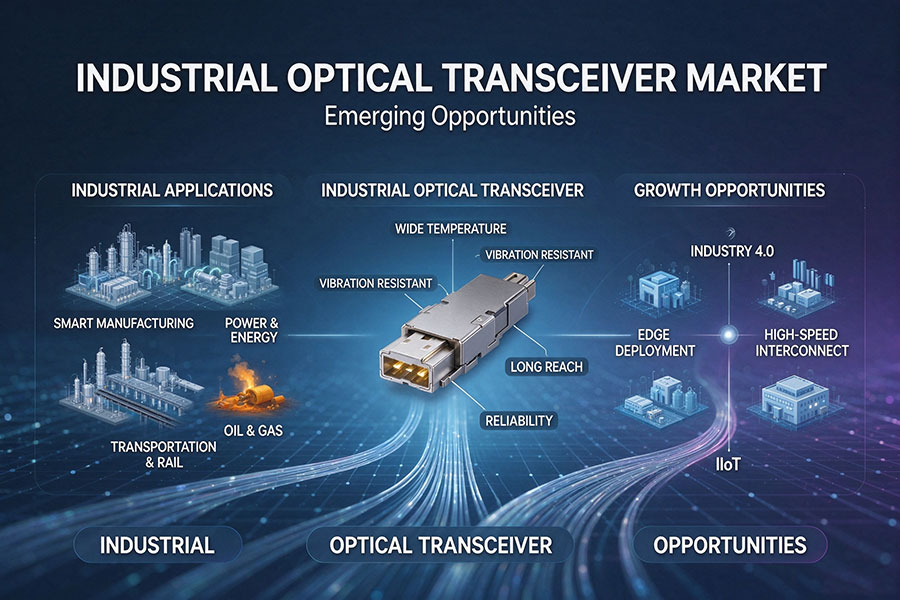
Industrial networks are undergoing a gradual but significant transformation. Manufacturing facilities, power utilities, transportation systems, oil and gas infrastructure, and distributed industrial sites are connecting more sensors, controllers, machines and edge-computing platforms. As these systems exchange larger volumes of operational data, reliable fiber-optic communication is becoming an increasingly important part of industrial infrastructure.
Industrial optical transceivers support this transition by providing optical connectivity between industrial switches, routers, controllers, remote equipment and supervisory systems. Compared with many commercial networking environments, industrial deployments often face wider temperature variations, electrical noise, vibration, dust, humidity and limited maintenance access. These conditions create a distinct market for optical modules designed around long-term operating stability rather than data rate alone.
The opportunity is expanding across several application areas. Smart factories need dependable links between production equipment and control networks. Utilities require communication infrastructure for substations, renewable energy facilities and distributed monitoring. Transportation systems depend on fiber networks connecting stations, signaling equipment and control centers. Industrial edge computing adds another layer of demand as operational data is increasingly processed close to machines and facilities.
1. The Industrial Optical Transceiver Market Is Expanding Beyond Traditional Networking
Industrial optical transceivers were historically associated with specialized communication systems and equipment operating in demanding environments. Their role is now broadening as industrial Ethernet, digital control systems and connected infrastructure become more widely deployed.
Traditional industrial communication networks often relied on fieldbus technologies, serial connections and proprietary interfaces. These technologies continue to serve many established applications, but Ethernet-based architectures are increasingly used to connect control systems, supervisory networks, industrial computers and enterprise infrastructure.
Fiber provides several advantages in these environments. It supports communication over distances that may be difficult for copper Ethernet, offers immunity to electromagnetic interference in the optical transmission path, and enables electrical isolation between connected locations. These characteristics are particularly relevant in facilities containing motors, variable-frequency drives, power electronics, high-voltage equipment and geographically distributed assets.
A September 2026 market report published by 360iResearch estimated the global industrial optical transceiver market at approximately USD 11.93 billion in 2025 and USD 12.96 billion in 2026. The report projected the market to reach USD 22.65 billion by 2032, representing a forecast CAGR of 9.58%. These figures should be interpreted as one research firm's market estimate because definitions of industrial optical transceivers, product coverage and revenue categories can vary between reports.
The market opportunity is therefore linked to the modernization of industrial communication infrastructure. As more facilities adopt Ethernet-based control and monitoring, optical interfaces become relevant across a wider range of equipment and network layers.
2. Smart Manufacturing Creates New Demand for Industrial Fiber Connectivity
Smart manufacturing is one of the most important long-term demand drivers for industrial optical transceivers. Modern production facilities increasingly combine programmable logic controllers, industrial PCs, machine vision systems, robotic equipment, sensors, manufacturing execution systems and centralized monitoring platforms.
These systems generate different types of traffic. Control messages may require predictable communication behavior, while machine vision and inspection systems can generate substantial data volumes. Production monitoring, quality analytics and equipment diagnostics add further communication requirements.
Machine vision and automated inspection
Automated inspection systems use cameras and image-processing platforms to identify defects, measure dimensions and verify production quality. Multiple cameras distributed across a production line may transmit image data to industrial computers or edge servers. Fiber links can connect remote inspection stations to aggregation switches where cable distance, electromagnetic interference or bandwidth requirements make optical connectivity suitable.
The appropriate transceiver depends on camera interface architecture, switch port speed, transmission distance and the facility's fiber infrastructure. Not every camera requires a high-speed optical module, but aggregation links serving multiple inspection systems may require greater capacity as production lines become more automated.
Industrial robotics and production equipment
Robotic cells, automated guided vehicles, programmable controllers and production monitoring systems require communication between equipment distributed across factory floors. Optical links are useful for connecting separate production areas, control rooms and industrial network cabinets.
In these applications, network design must consider more than nominal throughput. Latency variation, network redundancy, deterministic communication requirements and recovery behavior can be important. The transceiver provides the physical optical interface, but the overall network architecture and industrial Ethernet protocol determine how communication is managed.
Industrial edge computing
Edge computing moves selected data processing closer to production equipment instead of sending every data stream to a remote cloud platform. Edge servers may aggregate information from machine controllers, sensors, cameras and monitoring systems before forwarding selected data to central applications.
This creates additional optical connectivity requirements between production networks, local data rooms and enterprise infrastructure. Industrial optical transceivers can support these links, particularly where facilities have long cable routes or electrically noisy environments.
| Manufacturing application | Connectivity requirement | Potential optical module role |
|---|---|---|
| Machine vision | High-volume image transfer and stable aggregation links | Connect cameras, inspection systems and edge switches where supported by the equipment |
| Robotic production cells | Reliable links between distributed control and monitoring equipment | Provide fiber uplinks between industrial switches and network cabinets |
| PLC and SCADA networks | Reliable communication between control areas and supervisory systems | Support optical backbone and equipment interconnections |
| Edge computing | Higher-capacity links between production networks and local compute platforms | Connect industrial access switches to edge aggregation equipment |
| Predictive maintenance | Continuous collection of equipment status and sensor information | Provide stable network links for distributed monitoring infrastructure |
3. Power Utilities and Renewable Energy Offer Important Growth Opportunities
Electricity infrastructure is becoming more distributed and data-intensive. Smart substations, renewable energy plants, battery storage facilities and grid monitoring systems require communication networks that connect equipment across large sites and geographically separated locations.
Optical fiber is widely used in utility communication because it provides electrical isolation and is not affected by electromagnetic interference in the same way as copper cabling. These properties are valuable in substations and power facilities where electrical equipment can create challenging electromagnetic conditions.
Digital substations
Digital substations use communication networks to exchange information among protection devices, control systems, measurement equipment and supervisory platforms. IEC 61850 defines communication-related standards and data models used in substation automation. Within these architectures, Ethernet-based networks and fiber-optic links can support communication among intelligent electronic devices and station-level systems.
Industrial optical transceivers may be used in switches and communication equipment installed in control rooms, substation cabinets or other network locations. The exact module requirements depend on the equipment design, network topology, transmission distance and environmental conditions.
Solar and wind power facilities
Renewable energy projects often contain distributed equipment. Solar farms connect inverters, combiner boxes, weather stations and monitoring systems across large outdoor areas. Wind farms connect turbines, substations and central control facilities through communication infrastructure that may include fiber-optic links.
These installations can expose network equipment to temperature variation, dust, humidity and vibration. Industrial-grade optical modules are relevant where standard commercial operating conditions cannot be assumed. For outdoor installations, however, the suitability of a module must be evaluated together with the enclosure, cabinet cooling, power supply and overall equipment environmental rating.
Grid monitoring and energy storage
Battery energy storage systems and distributed grid-monitoring platforms create additional communication points across energy infrastructure. Operators need to collect equipment status, operating measurements, alarms and control information from multiple locations.
Fiber networks can connect local control equipment to central monitoring systems, while optical transceivers provide the interfaces within switches and routers. As these systems expand, opportunities may arise for industrial SFP modules, longer-reach single-mode products and redundant optical network designs.
4. Transportation Infrastructure Is Increasingly Dependent on Fiber Networks
Railways, metro systems, highways, airports and intelligent transportation infrastructure rely on communication networks to coordinate operations and monitor distributed equipment. Fiber is particularly useful where network connections span long routes or connect multiple buildings, stations and control centers.
Railway and metro communication
Railway communication networks may connect signaling systems, station equipment, surveillance cameras, passenger information systems, access control and operational management platforms. Metro infrastructure can include multiple stations, tunnels, depots and central control facilities, each with different network requirements.
Industrial optical transceivers can support fiber uplinks between switches located in station cabinets, equipment rooms and central aggregation points. Modules used in these environments may need to operate across a wider temperature range and maintain stable performance in the presence of vibration and electrical interference.
Safety-critical railway systems have strict system-level certification and design requirements. An industrial optical module should not be assumed to be suitable for signaling or safety-related functions solely because it has an industrial temperature rating. The complete communication equipment and application must meet the applicable railway standards and qualification requirements.
Highway and intelligent transportation systems
Intelligent transportation systems connect traffic cameras, road sensors, electronic signs, roadside cabinets and traffic management centers. These devices may be distributed over long distances and exposed to outdoor temperature changes, moisture and dust.
Fiber-optic links provide a practical backbone for connecting roadside network equipment to regional aggregation points. Industrial SFP and SFP+ modules may be used in compatible switches, depending on required bandwidth and distance. The optical module must be matched to the fiber type, connector, wavelength and link budget of the deployed network.
Airports and port facilities
Airports and seaports operate extensive networks for surveillance, access management, logistics, automation and facility monitoring. These environments combine indoor equipment rooms with outdoor infrastructure and large physical sites. Fiber connectivity supports links among terminal buildings, control centers, logistics facilities and distributed network cabinets.
| Transportation segment | Typical network locations | Industrial optical connectivity opportunity |
|---|---|---|
| Railway and metro | Stations, tunnels, depots and control centers | Fiber uplinks, equipment-room interconnections and redundant network links |
| Highways | Roadside cabinets, traffic monitoring points and control centers | Outdoor network aggregation and long-distance fiber connections |
| Airports | Terminals, security systems, operation centers and remote facilities | Building-to-building links and distributed equipment connectivity |
| Seaports | Container terminals, cranes, logistics systems and control facilities | Industrial network backbones and connections to automated equipment |
5. Oil, Gas and Mining Require Reliable Communication in Challenging Environments
Oil and gas facilities, mining operations and other heavy industries often operate across large sites with demanding environmental conditions. Communication infrastructure may connect control rooms, remote equipment, monitoring stations, processing units and safety systems.
Fiber is useful in these applications because it supports long-distance communication and provides electrical isolation. It can also reduce susceptibility to electromagnetic interference along the optical path. These advantages make fiber connectivity relevant to distributed industrial networks where copper cable routes may be difficult to maintain or electrically unsuitable.
Oil and gas facilities
Refineries, pipelines, processing plants and offshore facilities use communication networks for equipment monitoring, process control, surveillance and operational coordination. Industrial optical transceivers may be installed in network switches and routers connecting remote cabinets, control buildings and plant-wide aggregation systems.
Environmental qualification is especially important. Temperature, humidity, vibration, corrosion and enclosure conditions must be evaluated according to the installation location. In hazardous areas, the optical module itself does not establish explosion protection or hazardous-area approval. The complete equipment and installation must comply with the applicable safety requirements.
Mining and heavy industry
Mining operations may include underground tunnels, surface facilities, processing plants, conveyors and remote monitoring systems. Fiber networks can provide communication backbones between equipment locations, while industrial switches distribute connectivity closer to machines and sensors.
Vibration, dust, temperature variation and physical access constraints can influence product selection. Modules with suitable operating temperature specifications and documented reliability characteristics may be preferred where network maintenance is difficult or expensive.
6. Industrial Ethernet and Network Modernization Are Expanding the Addressable Market
One of the most important structural changes in industrial networking is the increasing use of Ethernet-based communication. Industrial Ethernet enables a more unified network infrastructure for connecting control equipment, industrial computers, monitoring platforms and enterprise systems.
However, industrial Ethernet is not a single protocol with identical timing and performance characteristics. PROFINET, EtherNet/IP, EtherCAT and other industrial communication technologies have different requirements and deployment models. Some applications require tightly controlled timing and deterministic behavior, while others primarily need reliable data transport and network availability.
Optical transceivers operate at the physical interface layer. They do not independently guarantee deterministic communication, network redundancy or real-time control performance. Those capabilities depend on the switches, controllers, protocol implementation, topology and system configuration.
Fiber as an industrial backbone
Many industrial networks use a combination of copper access connections and fiber backbone links. Short copper connections may serve individual devices, while fiber connects cabinets, production areas and buildings. This hybrid architecture can provide a practical balance between deployment cost, reach and electrical isolation.
As industrial facilities expand, fiber links can also support network segmentation. Separate production areas, control zones and enterprise connections can be connected through managed switches and carefully designed routing policies. Optical modules provide the physical links between these network devices.
Redundancy and network availability
Industrial operations may experience significant disruption when communication infrastructure fails. Network designs can therefore include redundant paths, ring topologies, dual-homing or other resilience mechanisms supported by the selected industrial Ethernet equipment.
The optical transceiver must support the physical interface and link characteristics required by the network design. Redundancy itself is provided by the network architecture and switching protocols, not by the transceiver alone. Engineers should also consider link recovery behavior, optical power margin, connector quality and the availability of replacement modules.
7. Product Categories and Specifications Driving Industrial Demand
Industrial optical transceivers are available in multiple data rates, form factors, wavelengths and transmission distances. The most suitable product depends on the network equipment and application rather than on a universal industrial module specification.
| Product category | Common application role | Key selection considerations |
|---|---|---|
| 1G SFP | Industrial Ethernet switches, control networks and equipment uplinks | 1000BASE-SX/LX or other supported interface, fiber type and reach |
| 10G SFP+ | Industrial aggregation, surveillance networks and higher-capacity equipment links | 10GBASE-SR/LR or other supported variant, host compatibility and thermal limits |
| 25G SFP28 | Higher-capacity industrial backbone and edge infrastructure | Electrical interface support, optical reach and system-level power budget |
| 40G QSFP+ | Selected aggregation and high-throughput industrial network applications | Parallel or duplex optical interface, port configuration and fiber infrastructure |
| 100G QSFP28 | Industrial data centers, large facility aggregation and specialized high-capacity links | Optical lane architecture, reach, connector and host qualification |
| CWDM/DWDM modules | Fiber capacity expansion across industrial campuses and distributed facilities | Wavelength plan, channel spacing, optical budget and mux/demux compatibility |
| Industrial BiDi modules | Bidirectional communication over a single fiber in suitable links | Complementary wavelength pairing, single-fiber architecture and reach |
Industrial temperature options are particularly relevant in outdoor cabinets, remote utility sites and facilities without tightly controlled cooling. A commonly specified industrial operating temperature range is -40°C to +85°C, but the actual supported range must be confirmed in the individual product datasheet. It is also important to distinguish the module's specified operating temperature from the ambient temperature around the equipment and the temperature measured at the module case.
Wavelength and fiber selection
Short-reach multimode modules commonly use wavelengths around 850 nm, while many single-mode modules operate at 1310 nm or use wavelength-division techniques across other bands. The correct choice depends on the optical interface standard and link design.
Single-mode fiber is often preferred for longer industrial campus links and connections between geographically separated facilities. Multimode fiber may remain suitable for shorter links within buildings or equipment rooms where the installed fiber plant supports the required data rate and reach.
BiDi modules can transmit and receive on different wavelengths over one fiber, which can help where fiber availability is limited. CWDM and DWDM technologies can carry multiple wavelength channels over a fiber pair or other supported optical path. These solutions require coordinated wavelength planning and compatible optical multiplexing equipment.
8. Why Industrial Temperature and Environmental Reliability Matter
Industrial environments place different demands on optical modules from those found in controlled data center rooms. Temperature variation is one of the most visible differences, but it is not the only factor affecting product suitability.
Wide operating temperature
Industrial network equipment may be installed in outdoor cabinets, factory floors, utility substations and remote field locations. These installations may experience high summer temperatures, cold starts, rapid temperature changes and limited airflow.
Optical module performance can be affected by temperature through changes in laser characteristics, receiver behavior, electrical components and overall power consumption. Industrial-grade designs must account for these effects and maintain the specified optical and electrical performance within the declared operating range.
Electromagnetic interference
Fiber-optic transmission is immune to electromagnetic interference along the optical fiber itself. This is an important advantage in facilities containing high-power motors, switching equipment and electrical systems.
However, an optical transceiver still contains electronic circuitry, and the host equipment remains subject to electromagnetic compatibility requirements. Fiber connectivity reduces one source of interference risk but does not make the complete network device immune to electrical noise or EMC problems.
Vibration, humidity and mechanical conditions
Industrial equipment may be exposed to vibration, mechanical shock, dust and humidity. The optical module's connector, cage, latch, housing and internal assembly must be suitable for the host platform and installation conditions. The complete switch or enclosure may also require appropriate protection against dust and moisture.
IP ratings apply to the equipment enclosure or component for which the rating is specified. A transceiver should not be described as IP67 or IP68 simply because it is installed in an enclosure with that rating.
Long lifecycle and maintainability
Industrial facilities often operate equipment for longer periods than consumer or rapidly refreshed IT environments. Network operators may need stable product availability, replacement support and consistent specifications across multiple procurement cycles.
This creates opportunities for suppliers that can provide lifecycle management, traceable production, controlled component changes and dependable technical support. A module's commercial value is influenced by the cost and difficulty of maintaining the complete network over time, not just its initial purchase price.
9. Market Opportunities for Optical Module Manufacturers and Suppliers
The expansion of industrial networking creates opportunities for suppliers across several product and service categories. These opportunities are not limited to high-speed modules. In many industrial applications, a dependable 1G or 10G interface with suitable environmental characteristics may be more valuable than a higher-rate module that the host equipment cannot support.
Industrial-grade versions of established product families
Industrial SFP and SFP+ products address a broad range of existing Ethernet equipment. Suppliers can serve customers that need familiar form factors with wider operating temperature specifications, documented reliability and validated compatibility.
Demand may also develop for 25G and higher-rate interfaces as industrial edge computing, machine vision and centralized monitoring platforms require more aggregation capacity. Product development should follow actual host equipment requirements rather than assume that every industrial application needs the highest available data rate.
Specialized wavelength and fiber solutions
Some industrial sites have limited fiber availability or need to connect equipment over different distances. BiDi, CWDM and DWDM products can provide additional design flexibility when the fiber infrastructure and optical budget support them.
These products require more application-specific engineering than a simple speed upgrade. Suppliers that can assist with wavelength planning, link-budget calculations and compatible optical components may offer greater value to system integrators and industrial network designers.
Compatibility and customized solutions
Industrial network equipment is supplied by many manufacturers, and platform requirements can vary. Customers may need modules validated for particular switch or router families, including requirements related to identification data, diagnostics, power consumption and firmware behavior.
Compatibility support can therefore become a meaningful competitive advantage. Suppliers that maintain clear test records and provide consistent module configurations can reduce qualification work for distributors, integrators and equipment manufacturers.
Long-term supply and engineering support
Industrial customers often prioritize stable procurement over frequent product changes. Suppliers that can manage component lifecycle changes, provide advance notice of product revisions and maintain consistent production quality may be better positioned for long-term projects.
| Opportunity area | Customer demand | Supplier capability required |
|---|---|---|
| Industrial SFP/SFP+ | Reliable fiber links for switches and control networks | Wide-temperature design, compatibility testing and stable production |
| Higher-speed industrial optics | More capacity for edge systems and aggregation networks | Signal integrity, thermal design and host-platform qualification |
| BiDi and WDM products | More efficient use of limited fiber infrastructure | Wavelength management and link-budget engineering |
| Equipment compatibility | Reliable operation across different industrial switch platforms | Platform validation, coding support and diagnostics |
| Long-term supply programs | Consistent specifications and replacement availability | Lifecycle control, traceability and supply-chain management |
10. Challenges That Could Limit Industrial Market Growth
Although industrial digitalization creates long-term opportunities, the market has several barriers that suppliers must address. Industrial procurement is often more application-specific than general enterprise networking, and qualification requirements can increase the time and cost needed to introduce new products.
Fragmented equipment ecosystems
Industrial networks include a wide range of switches, controllers, communication protocols and specialized equipment. Different manufacturers may implement distinct requirements for module identification, diagnostics, power management and supported optical interfaces.
A transceiver that works in one platform may not behave identically in another. Suppliers need to validate the actual host environment and avoid relying solely on physical connector compatibility or nominal data rate.
Long qualification and purchasing cycles
Industrial customers may require laboratory validation, field trials, environmental testing and system-level approval before deploying new communication components. This can slow initial adoption, especially in infrastructure projects with strict operational requirements.
Cost pressure and product differentiation
Industrial-grade modules may involve additional component screening, temperature validation, manufacturing controls and testing. These requirements can increase costs compared with some commercial products.
At the same time, buyers may face pressure to standardize products and reduce procurement expenses. Suppliers need to demonstrate the operational value of environmental qualification, reliability and support rather than compete only on unit price.
Cybersecurity and network management
As operational technology networks become more connected to enterprise systems, cybersecurity and network visibility become increasingly important. Optical transceivers can provide digital diagnostic information, but they do not independently secure the network.
Secure network architecture requires appropriate segmentation, access control, monitoring, configuration management and protection of industrial control systems. Module diagnostics should be treated as one source of equipment information within a wider monitoring strategy.
11. How Buyers Can Evaluate Industrial Optical Transceivers
Choosing an industrial optical transceiver requires a structured assessment of the host device, fiber link and operating environment. A product described as industrial-grade is not automatically suitable for every industrial installation.
Confirm the host interface
Check the switch or router documentation for supported form factors, data rates, optical standards, lane configurations and module power limits. Confirm whether the equipment supports the required module type and whether vendor-specific compatibility requirements apply.
Match the optical link
Evaluate fiber type, transmission distance, wavelength, connector, transmitter output power, receiver sensitivity and total link loss. The optical budget should include the loss of fiber, connectors, splices, patch panels and other passive components.
Verify environmental specifications
Review the module's specified operating temperature and the actual installation conditions. Consider airflow, enclosure temperature, humidity, vibration and the environmental rating of the host equipment. Where necessary, request supporting qualification documentation rather than relying only on a product label.
Review diagnostics and lifecycle support
Digital diagnostic monitoring can provide information such as temperature, supply voltage, laser bias current and transmit or receive optical power when supported by the module and host. These measurements help with maintenance and fault investigation, but they do not replace end-to-end link testing.
For long-term industrial projects, buyers should also review product change control, component traceability, warranty terms, replacement availability and technical support arrangements.
| Evaluation item | Questions to confirm |
|---|---|
| Host compatibility | Does the industrial switch or router support the module's form factor, rate and management behavior? |
| Fiber infrastructure | Are fiber type, wavelength, connector and transmission distance suitable? |
| Optical budget | Is there sufficient margin after accounting for fiber and passive component losses? |
| Temperature | Does the module's specified operating range cover the actual equipment environment? |
| Environmental conditions | Are vibration, humidity, dust and enclosure requirements addressed by the complete system? |
| Diagnostics | Are DDM/DOM functions supported and readable by the host equipment? |
| Lifecycle | Can the supplier support consistent specifications, replacement products and technical assistance? |
12. Future Outlook: Industrial Connectivity Will Become More Diverse
The industrial optical transceiver market is likely to develop through a combination of established Ethernet products and higher-capacity optical interfaces. The strongest opportunities will depend on how quickly industrial operators modernize their networks, how widely edge computing is adopted and how much data is generated by automated production and monitoring systems.
Several trends are likely to influence future demand:
More connected industrial assets: Sensors, cameras, controllers and machines will create additional communication endpoints across production and infrastructure sites.
Expansion of industrial Ethernet: Ethernet-based architectures will continue to connect operational technology with enterprise and edge systems, while specialized real-time protocols retain their application-specific roles.
Higher-capacity aggregation: Machine vision, analytics and edge computing may increase the need for 10G, 25G and higher-speed backbone connections in selected facilities.
Greater use of fiber in outdoor infrastructure: Utilities, transportation and energy projects will continue to require reliable optical links across distributed locations.
More emphasis on lifecycle reliability: Long service periods and difficult maintenance access will strengthen the importance of product consistency and replacement support.
Application-specific qualification: Customers will increasingly evaluate modules against actual equipment and environmental requirements rather than relying on broad product categories.
Industrial networks will not all move toward the same data rate or architecture. A factory control network, a railway backbone, a solar farm and a utility substation have different communication requirements. This diversity is likely to sustain demand for multiple optical module types, including standard industrial SFP products, higher-speed aggregation interfaces and specialized WDM solutions.
13. Conclusion
The industrial optical transceiver market is gaining opportunities as manufacturing, energy, transportation and infrastructure operators modernize their communication networks. Smart factories, digital substations, renewable energy facilities, railway systems and industrial edge platforms all depend on reliable data exchange across distributed equipment.
These applications create demand for optical modules that combine appropriate transmission performance with environmental tolerance, equipment compatibility, stable manufacturing and long-term availability. Wide-temperature operation is important, but it is only one part of industrial qualification. Fiber compatibility, optical link budgets, diagnostics, host behavior and system-level reliability must also be considered.
For optical module manufacturers and suppliers, the opportunity lies in serving a diverse set of industrial requirements with well-qualified products and dependable technical support. As industrial Ethernet and connected infrastructure continue to develop, industrial optical transceivers will remain an important component of the communication systems linking machines, facilities and centralized operations.
For industrial networking and optical connectivity requirements, review the available optical transceiver solutions or Contact C-LIGHT to discuss product specifications and application requirements.
 >

 >
 >
 >
 >
 >
 >
 >