TEL:+86 132 6656 7067




SDI Video SFP optical module is different from other types of optical modules in the market. It is dedicated to high-definition SDI optical transceivers, which eliminates the phenomenon of no splash screen or black screen during high-definition image transmission. However, many people have very little knowledge of SDI Video SFP modules. C-Light gives a detailed introduction to the SDI Video SFP optical module and hopes to help you.
What is a digital video SDI interface?
The SDI interface is an acronym for the serial digital interface and is a digital video interface standard developed by the SMPTE organization. The serial interface is an interface that sequentially transmits individual bits of a data word and corresponding data through a single channel. Since the serial digital signal has a high data rate, it must be processed before transmission, which is a digital baseband signal.
What types of SDI SFP modules are there?
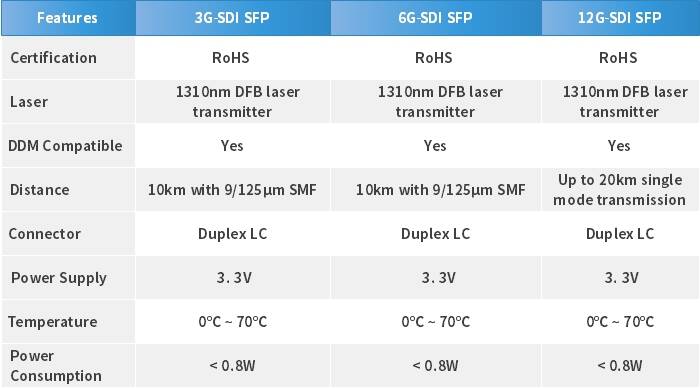
SDI SFP modules can be divided into different categories according to different factors. For example, depending on the operating wavelength, they can be classified into three types: 1310 nm, 1490 nm, and 1550 nm. According to different types of transceivers, SDI SFP modules can be classified into five types: single-receiving,dual-receiving, single-transmitting, dual-transmitting, and transmitting and receiving. According to the transmission rate, they can be divided into three types: 3G-SDI, 6G-SDI and 12G-SDI SFP optical modules.
(1) 3G SDI Video SFP Optical Module
Transceiver-integrated 3G SDI Video SFP, supports data ill-conditioned frame transmission, conforms to SMPTE 297-2006 standard, supports SMPTE 259M, SMPTE 344M, SMPTE 292M and SMPTE 424M series working speed, widely used in high-definition audio-visual system, 3G SDI high-definition video matrix system .
(2) 6G-SDI SFP
The 6G-SDI SFP module has twice the data rate of the 3G-SDI module, which means it has a higher transmission rate. Therefore, the 6G-SDI SFP optical module is not only designed for SMPTE 259M/SMPTE 344M/SMPTE 292M/SMPTE 424M Serial digital video signal, and digital interface for SMPTE 2081. In addition, 6G-SDI SFP modules are also commonly used in camera, video, security surveillance applications and 4K/HDTV/SDTV service interfaces.
(3) 12G-SDI SFP
12G-SDI SFP modules with transfer rates up to 12Gbps can be used for SMPTE 259M, SMPTE 344M, SMPTE 292M, SMPTE 424M, ST2081 and ST-2082 serial digital video signals. In addition, 12G-SDI SFP optical modules are mainly used for SMPTE ST-297-2006, ST2081 and ST-2082 compatible optical interfaces and UHDTV/HDTV/SDTV service interfaces.
Conclusion
3G-SDI, 6G-SDI and 12G-SDI are digital video signals, they are bound to be limited in long-distance transmission, and 3G-SDI, 6G-SDI and 12G-SDI SFP optical modules can solve this problem. By specializing in design, C-light provides customers with one-stop optical network devices and low-cost optical communication products, and supply a range of Video SFP optical module products.
Digital Video SDI Interface FAQ
Q1: What is an SDI optical transceiver?
A: An SDI optical transceiver is a specialized optical module designed to transmit digital video signals over fiber networks. It converts electrical SDI video signals into optical signals and enables long-distance transmission with high reliability, low latency, and minimal signal degradation.
Q2: What is the difference between SDI and traditional video interfaces?
A: SDI is a professional digital video interface designed for uncompressed video transmission, while traditional consumer video interfaces are typically optimized for short-distance applications. SDI supports real-time transmission with stable signal quality and is widely used in broadcast studios, live production, and professional video systems.
Q3: Why are SDI optical transceivers important for broadcast video transmission?
A: SDI optical transceivers are important for broadcast applications because they support high-bandwidth, low-latency, and reliable transmission of uncompressed video signals. They help broadcasters extend transmission distances while maintaining video quality for live events, television production, and professional media networks.
Q4: What video standards are supported by SDI optical interfaces?
A: SDI optical interfaces can support multiple digital video standards depending on the application, including 3G-SDI, 6G-SDI, and 12G-SDI. These standards provide different bandwidth levels to support HD, 4K UHD, and higher-resolution professional video transmission requirements.
Q5: What are the advantages of using fiber-based SDI transmission?
A: Fiber-based SDI transmission provides several advantages, including:
· Longer transmission distance compared with copper solutions
· Lower signal loss over long links
· Immunity to electromagnetic interference
· Stable transmission for real-time video applications
· Support for high-bandwidth video formats
These advantages make optical SDI solutions ideal for professional broadcasting and media production environments.
Q6: What are the typical applications of SDI optical transceivers?
A: SDI optical transceivers are commonly used in:
· Broadcast television systems
· Live event video production
· Studio and control room networks
· Sports broadcasting
· Video monitoring systems
· Professional AV infrastructure
They provide reliable optical connectivity for high-quality digital video transmission.
Q7: What is the difference between SDI over copper and SDI over fiber?
A: SDI over copper is typically suitable for shorter-distance video connections, while SDI over fiber provides extended transmission distance and better resistance to interference. Fiber-based SDI solutions are preferred for large venues, broadcast networks, and applications requiring stable long-distance video transmission.
Q8: How do I choose the right SDI optical transceiver for my video system?
A: Selecting the right SDI optical transceiver depends on several factors, including supported video standard, transmission distance, wavelength, fiber type, equipment compatibility, and bandwidth requirements. For example, 3G-SDI may support HD video applications, while 12G-SDI is more suitable for 4K UHD workflows requiring higher bandwidth.
 >
>

 >
>
 >
>
 >
>
 >
>
 >
>
 >
>
 >
>