TEL:+86 132 6656 7067





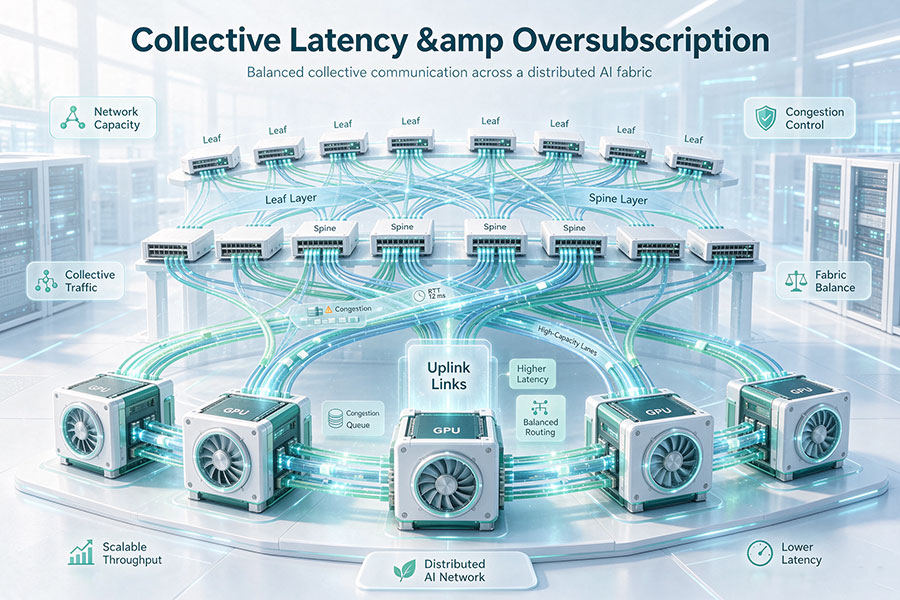
Distributed AI workloads depend on frequent data exchanges between GPUs. Operations such as AllReduce, AllGather and ReduceScatter synchronize model parameters, gradients and intermediate tensors across multiple devices. Their completion time is determined not only by the communication algorithm and message size, but also by the network capacity available to the participating GPUs. When a fabric is oversubscribed, simultaneous collective operations compete for shared uplinks, potentially increasing transfer time, synchronization delays and iteration latency. Understanding this relationship is essential when designing and evaluating high-performance GPU clusters.
1. Why Collective Communication Latency Matters
In distributed training, multiple GPUs work on different portions of a model or dataset. They periodically exchange information to maintain consistent model state and coordinate computation. These exchanges are implemented through collective communication operations.
Common operations include:
AllReduce: Combines values from multiple ranks and distributes the result to every participating rank.
AllGather: Collects data from all ranks and makes the combined data available to each rank.
ReduceScatter: Reduces data across ranks and distributes different portions of the result.
All-to-All: Exchanges data among participating ranks, with each rank sending and receiving data from multiple peers.
Broadcast: Distributes data from one rank to all other ranks.
These operations often sit on the critical path of distributed workloads. If one rank takes longer to complete a collective operation, other ranks may need to wait before proceeding to the next dependent computation.
Consequently, communication latency can affect GPU utilization, training iteration time and the number of inference requests a distributed system can serve.
2. What Network Oversubscription Means
Network oversubscription occurs when the aggregate bandwidth of server-facing links exceeds the available bandwidth of the uplinks connecting those servers to the wider network.
For example, a leaf switch may connect 32 GPU servers through 400G downlinks while using 16 uplinks operating at 400G each. The total downlink capacity is 12.8 Tbps, while the aggregate uplink capacity is 6.4 Tbps.
The resulting oversubscription ratio is 2:1. If all server-facing ports attempt to transmit at full rate toward destinations outside the leaf switch, the uplinks cannot carry all traffic simultaneously at line rate.
Oversubscription ratio:
\(\text{Oversubscription Ratio}=\frac{\text{Aggregate Downlink Bandwidth}}{\text{Aggregate Uplink Bandwidth}}\)
Example: \(12.8\text{ Tbps}/6.4\text{ Tbps}=2:1\)
A 1:1 ratio means the aggregate downlink and uplink capacities are equal. A ratio above 1:1 indicates that the network is designed with less uplink capacity than the total possible downlink traffic.
Oversubscription is not automatically a design failure. It is a capacity-planning decision based on expected traffic patterns, workload concurrency, cost and performance requirements.
3. How Oversubscription Increases Collective Communication Latency
Collective communication can generate traffic between many GPU ranks at the same time. When those ranks are distributed across different servers or leaf switches, their traffic shares the network uplinks and intermediate switching resources.
If aggregate demand exceeds available capacity, packets may queue at congested output ports. This increases the time required to deliver data and can introduce variable delay between communication participants.
Several effects can follow:
Queueing delay: Packets wait for transmission when an output link is busy.
Reduced effective bandwidth: Multiple flows compete for the same uplink capacity.
Latency variation: Different ranks experience different transfer times.
Synchronization delay: Faster ranks wait for slower participants to complete the collective.
Longer communication phases: Network contention extends the time spent in AllReduce, AllGather or other collective operations.
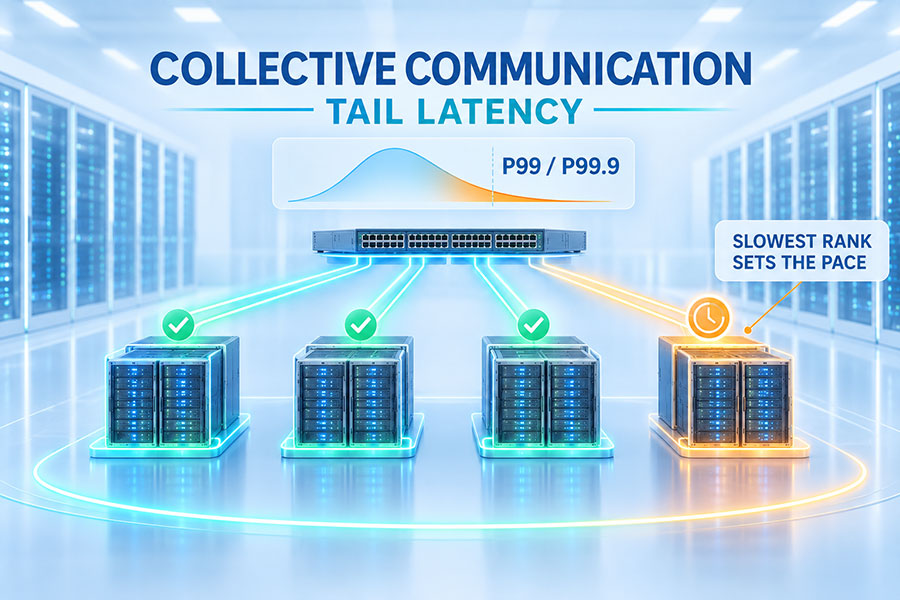
The effect is particularly visible in synchronized workloads. Even if most GPUs finish their communication quickly, a small number of delayed ranks can determine when the entire collective operation completes.
4. Collective Communication Is Sensitive to the Slowest Participants
Many collective operations require coordinated participation from all ranks in a communicator. Their completion time is therefore influenced by the slowest relevant communication path or participant.
A simplified model is:
\(T_{\text{collective}}\approx\max(T_0,T_1,\ldots,T_{N-1})+T_{\text{coordination}}\)
Where \(T_i\) represents the effective completion time associated with rank i, and the coordination term represents algorithm and synchronization overhead.
This is a conceptual model rather than a universal implementation formula. Different collective algorithms pipeline transfers and coordinate progress differently.
It illustrates an important point: average link utilization alone does not explain collective latency. A small number of congested paths can create stragglers that delay the entire operation.
For this reason, network evaluation should consider latency distribution and tail behavior, not just average bandwidth.
5. The Relationship Between Oversubscription and Bisection Bandwidth
Bisection bandwidth measures the aggregate capacity available across a balanced division of a network into two groups. It is useful for evaluating whether a fabric can support substantial communication between different parts of a GPU cluster.
Consider a network divided into two equal groups of GPU servers. If many ranks in one group communicate with ranks in the other, the available bandwidth across the dividing cut limits the aggregate traffic that can pass between them.
A fabric with high bisection bandwidth can better support simultaneous cross-group communication. A fabric with limited bisection bandwidth may experience contention when many collective operations cross the same network boundary.
However, bisection bandwidth and oversubscription ratio are not interchangeable:
Oversubscription ratio describes the relationship between aggregate downlink and uplink capacity at a particular network layer or switch group.
Bisection bandwidth measures the aggregate capacity across a balanced network cut.
Effective collective bandwidth measures the communication performance actually achieved by a workload.
A low oversubscription ratio does not by itself prove that every possible network cut has sufficient capacity. Conversely, a network with some oversubscribed links may still perform well for workloads whose communication patterns remain mostly local.
6. How Different Collective Operations Use Network Bandwidth
Different collective operations generate different traffic patterns. Their sensitivity to oversubscription depends on message size, rank count, algorithm selection and communication topology.
| Operation | Typical communication behavior | Oversubscription sensitivity |
|---|---|---|
| AllReduce | Combines data from all ranks and distributes the result | Can be highly sensitive when large synchronized transfers cross shared uplinks |
| AllGather | Each rank contributes data that becomes available to all ranks | Can create substantial aggregate traffic as rank count and message size increase |
| ReduceScatter | Reduces distributed data and delivers separate result segments | Can compete for uplink bandwidth during large distributed reductions |
| All-to-All | Each rank exchanges data with multiple destination ranks | May generate widespread many-to-many traffic and localized hotspots |
| Broadcast | One rank distributes data to other ranks | Depends on the broadcast tree, source placement and destination distribution |
It is not sufficient to identify the collective operation alone. The physical rank placement and selected communication algorithm determine which network links carry the traffic.
7. Ring and Tree Algorithms Under Oversubscribed Conditions
Collective libraries may use different algorithms depending on the operation, message size, number of ranks and hardware topology.
Ring algorithm
A ring-based AllReduce divides data into chunks and circulates them through participating ranks. In a common implementation, the operation consists of reduce-scatter and all-gather phases.
Ring algorithms can provide efficient bandwidth utilization for large messages when the communication paths are well balanced. However, their performance depends on the quality of the selected ring paths. If several rings share the same oversubscribed uplink, the expected aggregate bandwidth may not be available.
Tree algorithm
Tree-based algorithms organize communication through hierarchical relationships between ranks. They can reduce the number of communication steps for certain workloads and may perform well for smaller messages or latency-sensitive operations.
However, a tree does not automatically avoid network congestion. If multiple branches converge on the same constrained link, that link can become a bottleneck.
| Factor | Ring | Tree |
|---|---|---|
| Communication structure | Sequential ring of ranks | Hierarchical parent-child relationships |
| Typical strength | Efficient large-message bandwidth utilization | Can reduce communication steps for some workloads |
| Potential weakness | Performance depends on balanced ring paths | Concentrated traffic may overload shared branches |
| Oversubscription impact | Shared ring links can limit throughput | Converging tree paths can create hotspots |
Neither algorithm is universally superior. Topology-aware algorithm selection is important because the same collective can perform differently across different cluster designs.
8. Locality and Hierarchical Collective Communication
GPU clusters commonly contain multiple communication domains. GPUs within a server may communicate through high-bandwidth accelerator links, while communication between servers uses NICs and the data center network.
Hierarchical collective algorithms take advantage of this structure by separating local and remote communication stages.
A simplified hierarchical AllReduce may involve:
Reducing data among GPUs within each server.
Exchanging partial results between servers.
Distributing the final reduced data among GPUs within each server.
This structure can reduce redundant cross-server traffic when the local reduction is efficient and the topology supports the chosen hierarchy.
For example, a server with eight GPUs may first combine local contributions before sending the resulting data across the network. The remote stage then operates on fewer aggregated data streams rather than treating every GPU as an entirely independent network endpoint.
The actual benefit depends on the communication algorithm, GPU topology, NIC count, network bandwidth and the distribution of ranks across servers. Hierarchical communication does not eliminate oversubscription if the remote stage still exceeds available uplink capacity.
9. Calculating the Impact of Oversubscription on Available Bandwidth
A simple capacity calculation helps estimate the maximum aggregate uplink bandwidth available to a group of servers.
Consider the following hypothetical leaf-switch configuration:
| Parameter | Configuration |
|---|---|
| Server-facing ports | 32 × 400G |
| Aggregate downlink capacity | 12.8 Tbps |
| Uplink ports | 16 × 400G |
| Aggregate uplink capacity | 6.4 Tbps |
| Oversubscription ratio | 2:1 |
If all 32 server-facing ports attempt to send traffic toward destinations outside the leaf switch, the aggregate offered traffic could reach 12.8 Tbps, while the uplinks provide 6.4 Tbps of capacity.
Under idealized assumptions, the uplinks can carry only half of that simultaneous offered traffic at full aggregate demand. The remaining traffic must be delayed, constrained by flow control or handled according to the network's congestion and queue-management behavior.
This calculation is a capacity illustration, not a prediction that every collective will experience exactly 50% throughput. Actual performance depends on local traffic, destination distribution, routing, flow concurrency and the available paths through the complete fabric.
10. Why a 1:1 Network Does Not Guarantee Low Collective Latency
A 1:1 oversubscription ratio is often associated with a non-oversubscribed network design. It provides equal aggregate downlink and uplink capacity at the evaluated layer, but it does not guarantee that every communication flow will achieve line rate.
Several other factors can affect performance:
Traffic concentration: Many flows may target the same output port even when aggregate fabric capacity is sufficient.
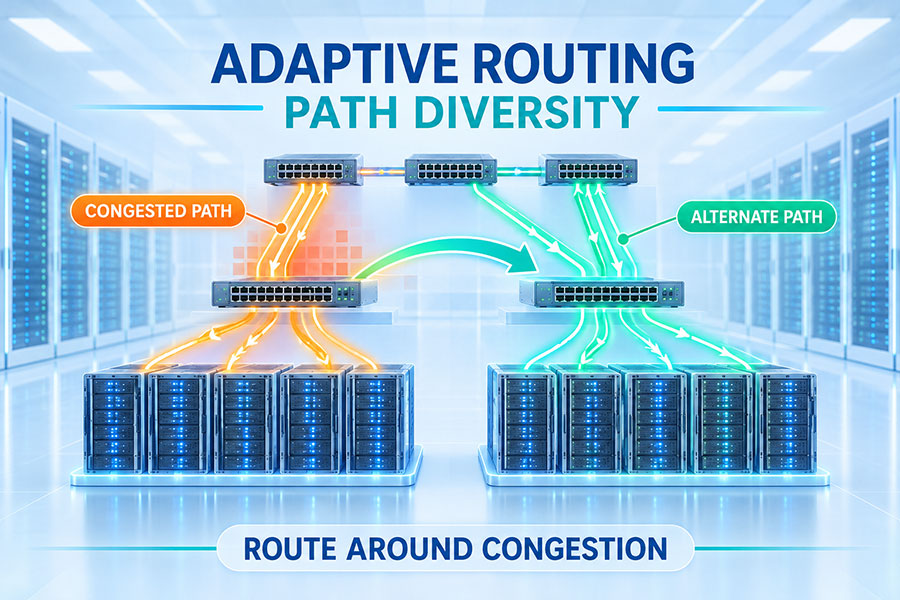
Hash imbalance: Flow hashing may distribute traffic unevenly across available paths.
Microbursts: Short bursts can temporarily exceed queue or link capacity.
Endpoint limitations: NIC, PCIe, GPU interconnect or memory bandwidth may become the bottleneck.
Routing asymmetry: Different flows may traverse paths with different latency or capacity.
Protocol overhead: Transport behavior, packet processing and synchronization add costs beyond raw link bandwidth.
Therefore, a non-oversubscribed topology is a useful capacity target, not a guarantee of congestion-free operation or minimum collective latency.
11. Network Congestion and Tail Latency
Collective operations are particularly sensitive to uneven communication completion times. A congested link may affect only a subset of ranks, but those ranks can delay the overall operation.
Network congestion can increase tail latency through several mechanisms:
Packets queue behind other traffic at constrained output ports.
Bursty transfers create transient queue buildup.
Congestion-control responses can reduce the sending rate of affected flows.
Pause-based flow control, where configured, may propagate backpressure to upstream devices.
Packet loss and retransmission can introduce additional delay and disrupt communication progress.
The impact depends on the transport and congestion-management configuration. For example, RoCE deployments may use ECN-based signaling and transport rate adjustment, while PFC may be part of the lossless Ethernet design. PFC alone does not solve congestion and can introduce its own operational risks.
Network monitoring should therefore include queue behavior, congestion signals, packet drops, retransmissions and link-level errors rather than relying solely on port utilization.
12. InfiniBand and RoCE Fabric Considerations
Both InfiniBand and RoCE can support high-performance GPU communication, but their network architectures and congestion-management mechanisms differ.
| Design consideration | InfiniBand | RoCE over Ethernet |
|---|---|---|
| Fabric | Dedicated InfiniBand switching infrastructure | Ethernet switching infrastructure with RDMA support |
| Communication | InfiniBand transport and RDMA mechanisms | RDMA over Converged Ethernet |
| Congestion management | InfiniBand-specific congestion-control and fabric mechanisms | Often combines ECN-based signaling with transport response; PFC may be used as part of the deployment design |
| Capacity planning | Requires appropriate link, switch and routing capacity | Requires appropriate uplinks, QoS, queue management and end-to-end congestion configuration |
| Operational focus | Fabric health, routing and adapter performance | Ethernet fabric consistency, congestion behavior and RDMA endpoint configuration |
Neither technology removes the need to plan for collective traffic. A high-speed adapter cannot compensate for an undersized network path shared by many simultaneous GPU transfers.
13. How NCCL Performance Reflects Network Oversubscription
NVIDIA Collective Communications Library (NCCL) provides communication primitives for multi-GPU and multi-node workloads, including AllReduce, AllGather, ReduceScatter and Broadcast.
NCCL selects communication algorithms and protocols based on factors such as operation type, message size, rank count and system topology. Its performance therefore reflects the interaction between software decisions and the underlying hardware fabric.
When a network is oversubscribed, NCCL collectives may experience lower effective bandwidth or longer completion time as simultaneous traffic competes for shared links.
However, a slow NCCL result does not prove that oversubscription is the cause. GPU topology, PCIe configuration, NIC placement, CPU affinity, transport configuration, protocol selection and concurrent compute can also affect results.
For this reason, NCCL benchmarking should be combined with network telemetry and hardware-level validation.
14. Measuring Collective Latency and Bandwidth
Reliable evaluation requires measuring both communication latency and effective bandwidth across different message sizes and rank configurations.
| Metric | Meaning | Diagnostic value |
|---|---|---|
| Collective operation time | Time required to complete a collective | Shows the actual operation cost |
| Algorithm bandwidth | Message size divided by operation time | Provides an application-level transfer-rate measure |
| Bus bandwidth | Collective bandwidth adjusted for the communication pattern and rank count | Helps evaluate effective interconnect utilization |
| Per-rank latency | Operation timing observed at individual ranks | Reveals rank-level performance variation |
| NIC throughput | Traffic rate at network interfaces | Identifies endpoint and link utilization |
| Switch port utilization | Traffic rate on switch ports and uplinks | Highlights potential capacity constraints |
| Queue occupancy and ECN | Congestion-related network indicators | Helps identify contention and queue buildup |
| Iteration time | End-to-end distributed training iteration duration | Shows the workload-level impact |
Small messages are useful for examining fixed communication overhead and latency. Large messages are more useful for evaluating sustained bandwidth. A single message size cannot characterize every collective workload.
NCCL test output may include both algorithm bandwidth and bus bandwidth. These values are not interchangeable. Algorithm bandwidth is calculated from message size and elapsed time, while bus bandwidth adjusts for the collective's communication pattern and rank count.
15. A Practical Benchmarking Method
A useful benchmarking process should isolate the network from other possible bottlenecks before evaluating the complete workload.
Establish an intra-node baseline: Measure collective performance among GPUs within a server to understand local interconnect behavior.
Measure inter-node communication: Run tests across servers to evaluate the NIC and network path.
Test multiple message sizes: Include small, medium and large transfers to distinguish latency overhead from bandwidth limitations.
Scale the rank count: Compare performance as more GPUs and servers participate.
Run concurrent operations: Evaluate whether multiple communication groups compete for shared uplinks.
Monitor network telemetry: Observe port utilization, queue occupancy, ECN, packet drops and link errors during each test.
Compare against application performance: Validate the results using actual distributed training or inference workloads.
NCCL Tests can provide a useful starting point. Its performance documentation explains how to interpret operation time, algorithm bandwidth and bus bandwidth. Test results should be recorded with the GPU model, NIC configuration, topology, software versions and rank placement so that different runs can be compared meaningfully.
16. Diagnosing Oversubscription-Related Bottlenecks
When collective latency is higher than expected, the diagnostic process should establish whether the limitation comes from shared network capacity or another part of the system.
| Observed symptom | Possible explanation | Useful investigation |
|---|---|---|
| Latency increases as rank count grows | Shared network resources or scaling overhead | Compare rank placement, uplink utilization and collective scaling |
| Large messages show low effective bandwidth | Insufficient path capacity or endpoint throughput | Check NIC rates, switch uplinks and PCIe/GPU paths |
| Only some ranks are consistently slower | Path imbalance, hotspot or endpoint asymmetry | Compare per-rank timing and port-level traffic |
| Latency varies significantly between runs | Bursty contention or competing workloads | Correlate collective timing with queue and congestion telemetry |
| Network ports are not saturated but performance is low | Protocol, synchronization, CPU or GPU-side bottleneck | Profile communication kernels, NIC counters and host resources |
| Performance drops under concurrent jobs | Shared fabric contention or resource interference | Repeat isolated and concurrent tests with consistent placement |
Port utilization must be interpreted carefully. A link that is not continuously saturated can still experience microbursts or localized queue contention. Likewise, high utilization does not automatically indicate harmful congestion if the workload is completing efficiently.
17. Designing a Fabric for Distributed AI Workloads
Network design should account for the collective communication patterns expected from the GPU cluster rather than relying exclusively on the total number of server ports.
Important design considerations include:
GPU count and server layout: Determine the number of endpoints and their physical distribution.
NIC bandwidth per server: Calculate the total network capacity available to each GPU host.
Leaf uplink capacity: Evaluate the aggregate bandwidth available for traffic leaving each leaf switch.
Spine capacity: Ensure sufficient capacity between leaf groups for expected cross-server communication.
Oversubscription targets: Select ratios based on workload behavior and performance objectives.
Path diversity: Provide suitable network paths and load distribution for concurrent flows.
Congestion management: Configure the network consistently for the selected transport and traffic classes.
Growth capacity: Account for future increases in GPU count, NIC speed and collective traffic volume.
For large distributed training clusters, a balanced Clos or leaf-spine fabric can provide scalable connectivity. However, the number of uplinks, switch capacity and routing behavior must be evaluated against the expected communication load.
18. Optical Connectivity and Network Capacity
High-speed optical connectivity is an important part of the physical infrastructure used by distributed GPU clusters. As switch and NIC port speeds increase, the choice of optical transceivers and cabling affects the reach, density and deployment flexibility of the network.
Common connectivity options include:
DAC: Direct Attach Copper is commonly used for short connections within racks or between nearby devices, subject to distance and platform requirements.
AEC: Active Electrical Cable supports selected high-speed short-reach connections where active signal conditioning is required.
AOC: Active Optical Cable integrates optical transmission into a cable assembly for supported short-reach links.
Optical transceivers: Pluggable optical modules support fiber connections between switches, servers and network equipment.
These technologies provide physical connectivity, but they do not independently determine network oversubscription. The oversubscription ratio is primarily determined by the number and speed of downlink and uplink connections.
For example, replacing a 400G optical connection with an 800G connection increases the capacity of that link only if the switch ports, network architecture and connected endpoints also support the higher rate. Increasing individual port speed without revisiting the complete fabric design may leave other shared links as the limiting factor.
Link reliability also matters. Optical power levels, module temperature, fiber condition, connector cleanliness and link error counters should be monitored as part of ongoing network maintenance.
19. Optimization Strategies for Lower Collective Latency
Reducing collective communication latency requires addressing both network capacity and the way the application uses the fabric.
Reduce unnecessary cross-server traffic: Use topology-aware rank placement and hierarchical collectives where appropriate.
Review oversubscription ratios: Increase uplink capacity where measured traffic demand consistently exceeds available bandwidth.
Balance traffic across paths: Check routing and load-distribution behavior to avoid persistent hotspots.
Optimize collective algorithms: Benchmark ring, tree and other supported algorithms for actual message sizes and topology.
Separate traffic classes: Apply suitable QoS and resource policies to prevent unrelated traffic from disrupting critical communication.
Control congestion: Use transport-appropriate congestion-management mechanisms and validate their end-to-end behavior.
Improve endpoint configuration: Check GPU-to-NIC affinity, PCIe bandwidth, CPU placement and adapter settings.
Benchmark concurrent workloads: Evaluate the fabric under realistic levels of job and communication concurrency.
Validate application-level gains: Measure iteration time, throughput and tail latency after each change.
Increasing network capacity is not always the first or most cost-effective solution. If the bottleneck is caused by poor rank placement, endpoint imbalance or inefficient collective scheduling, improving those areas may deliver better results without redesigning the entire fabric.
20. Conclusion
Collective communication latency is closely related to the available bandwidth and topology of a distributed GPU network. Oversubscription can increase contention when simultaneous communication demand exceeds shared uplink capacity, while congestion and uneven path utilization can create additional latency variation between participating ranks.
However, the relationship is workload-dependent. A 2:1 oversubscribed fabric does not necessarily impose a fixed 50% performance reduction, and a 1:1 design does not guarantee that every collective operation will run without congestion. Traffic locality, collective algorithms, message size, rank placement and endpoint capabilities all influence the final result.
Effective capacity planning combines oversubscription analysis, bisection bandwidth evaluation, NCCL benchmarking and network telemetry. By measuring real collective behavior and matching fabric capacity to the communication patterns of distributed AI workloads, infrastructure teams can improve GPU utilization and maintain more predictable cluster performance.
Evaluate optical transceivers, DAC, AEC and AOC connectivity options for high-speed switch-to-server and switch-to-switch links.
Contact C-LIGHT >

 >
 >
 >
 >
 >
 >
 >