TEL:+86 132 6656 7067




1. Introduction
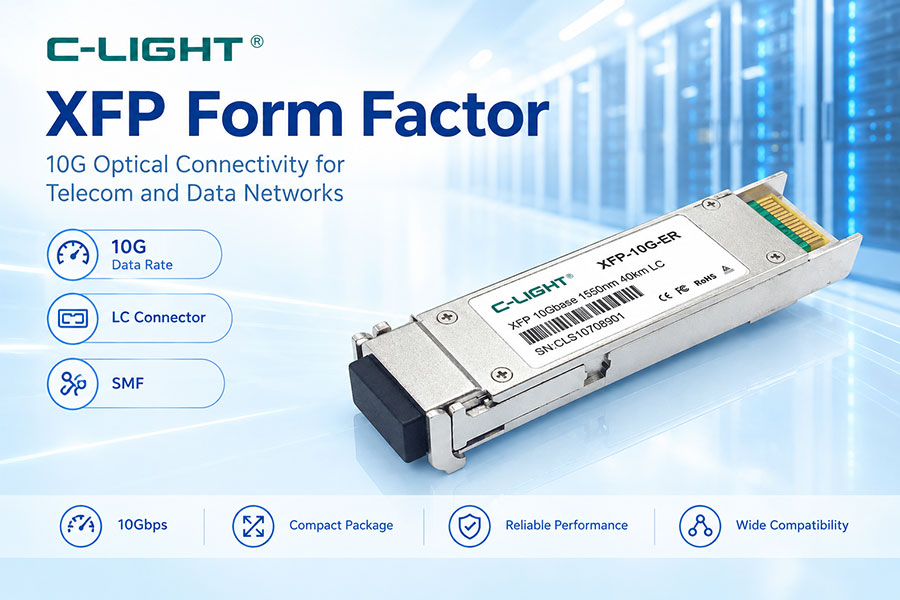
XFP stands for 10 Gigabit Small Form-factor Pluggable. It is a hot-pluggable optical transceiver form factor developed for high-speed serial networking, especially 10GbE, 10G Fibre Channel, SONET/SDH, and OTN applications.
2. What Is the XFP Form Factor?
XFP defines the mechanical, electrical, and management interfaces between a pluggable transceiver and its host system. The XFP MSA was designed around a compact serial interface and supports multiple 10Gbps-class protocols and optical architectures.
3. Why Was XFP Developed?
XFP was developed to provide a smaller and more serviceable alternative to earlier 10G transceiver implementations. Its pluggable architecture allows network operators to replace or upgrade optical modules without replacing the complete host device.
4. XFP Mechanical Design
XFP uses a compact metal housing with a front optical interface, a rear electrical connector, and a removable latch mechanism. Its mechanical structure is larger than SFP+ and provides additional space for thermal management and high-speed components.
5. XFP and SFP+ Form Factors
XFP and SFP+ are both associated with 10Gbps networking, but their electrical architectures are different. XFP places more of the serializer/deserializer and signal-conditioning functionality inside the module, while SFP+ relies more heavily on the host system.
6. XFP Electrical Interface
XFP uses the XFI electrical interface for high-speed serial communication between the module and host system. XFI was designed for approximately 10Gbps-class signaling and is based on a single high-speed serial lane.
7. XFP Electrical Connector
The XFP specification uses a 30-contact electrical interface. These contacts provide high-speed transmit and receive signals, power, ground, module control, management, and status functions.
8. Hot-Pluggable Operation
XFP is designed for hot-plug operation. On compatible networking equipment, a module can be inserted or removed while the host remains powered, simplifying maintenance and network upgrades.
9. XFP Data Rates
The XFP specification supports multiple 10Gbps-class serial data rates, including approximately 9.95Gbps, 10.31Gbps, 10.52Gbps, 10.70Gbps, and higher rates required by some emerging applications.
10. XFP Protocol Applications
XFP was designed to support a broad range of applications, including 10 Gigabit Ethernet, 10G Fibre Channel, SONET OC-192, SDH STM-64, and OTU-2. This protocol flexibility was an important feature of the form factor.
11. XFP Optical Wavelengths
XFP modules can be designed for different optical wavelengths according to the application. Common implementations include 850nm, 1310nm, and 1550nm optical interfaces.
12. XFP Multimode Applications
850nm XFP modules are typically associated with multimode fiber and shorter-reach applications. These modules can be used in suitable enterprise, storage, and data center environments.
13. XFP Single-Mode Applications
1310nm and 1550nm XFP modules are commonly used with single-mode fiber for longer transmission distances. Reach depends on the optical power, receiver sensitivity, dispersion characteristics, and overall link budget.
14. XFP Optical Transmitter
The transmitter converts the electrical signal from the host into an optical signal. Depending on the module design, the optical source can include VCSEL, DFB, EML, or tunable laser technology.
15. XFP Optical Receiver
The receiver converts incoming light into an electrical signal using a photodetector and receiver circuitry. PIN and APD-based receivers can be used for different sensitivity and reach requirements.
16. XFP Serializer and Deserializer
Unlike the simpler SFP+ architecture, XFP modules commonly include serial signal-conditioning and clock-related functions inside the module. This allows the host to interface with the module through the XFI serial electrical interface.
17. XFP CDR
Clock and data recovery can be an important part of XFP architecture. It recovers timing from the incoming signal and helps generate a cleaner serial data stream for the host or optical transmission path.
18. XFP Management Interface
XFP includes a low-speed management interface for module identification, configuration, status, and monitoring. The host can communicate with the transceiver to obtain operating information and control functions.
19. XFP Digital Diagnostics
Many XFP modules support digital diagnostic monitoring. Depending on the implementation, parameters such as temperature, voltage, optical power, and laser bias can be monitored by the host system.
20. XFP Thermal Management
Thermal management is an important consideration because XFP integrates more active electronics than some later compact 10G architectures. Module heat sinks and host airflow help maintain stable operating temperatures.
21. XFP Optical Connectors
LC duplex is common for XFP optical modules, especially for two-fiber communication. Other optical interface configurations may be used depending on the specific module design and application.
22. XFP Power Consumption
XFP power consumption varies according to the optical reach, laser technology, receiver design, serializer/deserializer, clock recovery, and monitoring circuitry. Long-reach and tunable modules can require more power than simple short-reach implementations.
23. XFP and Link Budget
The optical link budget determines whether an XFP link can operate reliably over a specified distance. Transmitter output power, fiber attenuation, connector loss, receiver sensitivity, and system margin must be considered together.
24. XFP and DWDM
XFP is also used in DWDM applications, including tunable optical modules. Tunable XFP designs can adjust the transmission wavelength according to a defined optical channel grid, making them useful in certain telecom and transport systems.
25. XFP vs SFP+
| Feature | XFP | SFP+ |
|---|---|---|
| Typical Application | 10G Ethernet, FC, SONET/SDH, OTN | 10GbE, Fibre Channel |
| Physical Size | Larger | Smaller |
| Electrical Interface | XFI | SFI |
| High-Speed Processing | More functions inside module | More dependent on host |
| Thermal Design | More module space available | More compact |
26. XFP vs X2
XFP and X2 are both associated with 10Gbps networking, but X2 uses a different mechanical architecture and is physically larger. XFP provides a more compact pluggable solution for systems designed around its interface.
27. XFP vs SFP28
SFP28 is a newer SFP-family form factor developed mainly for 25Gbps-class networking. Although SFP28 is physically smaller and operates at a higher data rate, XFP remains relevant in legacy and specialized 10G systems.
28. XFP Compatibility
Compatibility requires more than matching the physical slot. The host must support the XFP electrical interface, data rate, module management, optical specification, coding, connector, and intended protocol.
29. XFP Module Coding
Module identification information can include vendor name, part number, serial number, wavelength, supported capabilities, and diagnostic information. Proper module coding can be important when replacing XFP modules in vendor-specific equipment.
30. XFP in Telecom Networks
XFP has been widely used in telecom and transport equipment because its serial architecture can support SONET, SDH, OTN, DWDM, and other optical transport applications. Specialized long-reach and tunable variants are available for these environments.
31. XFP in Data Networks
10GbE XFP modules can be used in switches, routers, aggregation platforms, and other network devices. Short-reach multimode and longer-reach single-mode options allow the form factor to cover different network segments.
32. Advantages of the XFP Form Factor
XFP offers hot-pluggable operation, broad 10Gbps-class protocol support, multiple optical wavelength options, serial electrical connectivity, and a well-established architecture for telecom and data communication equipment.
33. Limitations of the XFP Form Factor
The main limitation of XFP is its larger physical footprint compared with SFP+. It also has higher module-level complexity than many later 10G designs, making SFP+ more common in newer high-density network equipment.
34. When to Choose XFP
XFP is mainly appropriate when the host equipment is specifically designed for the XFP interface or when a specialized 10G application requires its electrical and optical architecture. Existing telecom, transport, and legacy networking platforms are common use cases.
35. Frequently Asked Questions
Q1. What is the XFP form factor?
Q2. What does XFP stand for?
Q3. What electrical interface does XFP use?
Q4. Is XFP hot-pluggable?
Q5. What wavelengths are available for XFP?
Q6. Is XFP the same as SFP+?
Q7. Is XFP still used?
Q8. What should be checked before selecting an XFP?
36. Summary
XFP is a compact but relatively large 10Gbps-class pluggable form factor designed for high-speed serial networking. Its XFI electrical interface, 30-contact connector, integrated signal-processing functions, and support for multiple protocols made it an important 10G technology. XFP modules are available for multimode and single-mode fiber, with 850nm, 1310nm, and 1550nm-class implementations covering different applications. Although SFP+ became more common in newer high-density systems, XFP remains relevant in existing telecom, transport, storage, and specialized networking platforms where its mechanical and electrical interface is specifically supported.
 >
>

 >
>
 >
>
 >
>
 >
>
 >
>
 >
>
 >
>