TEL:+86 132 6656 7067




1. AI Infrastructure Creates New Networking Challenges
The rapid development of artificial intelligence (AI) is transforming global data center architectures.
Large AI models, generative AI applications, and high-performance computing (HPC) workloads require unprecedented computing power and data exchange capacity. As GPU clusters continue expanding, traditional data center networking technologies are facing increasing challenges in:
Bandwidth scalability
Network latency
Power efficiency
Signal integrity
High-density deployment
AI data centers are no longer limited by computing performance alone. The network connecting thousands of GPUs and accelerators has become a critical factor determining overall system efficiency.
To support next-generation AI workloads, data centers are rapidly upgrading from:
400G Optical Connectivity → 800G Optical Connectivity → 1.6T Optical Networking
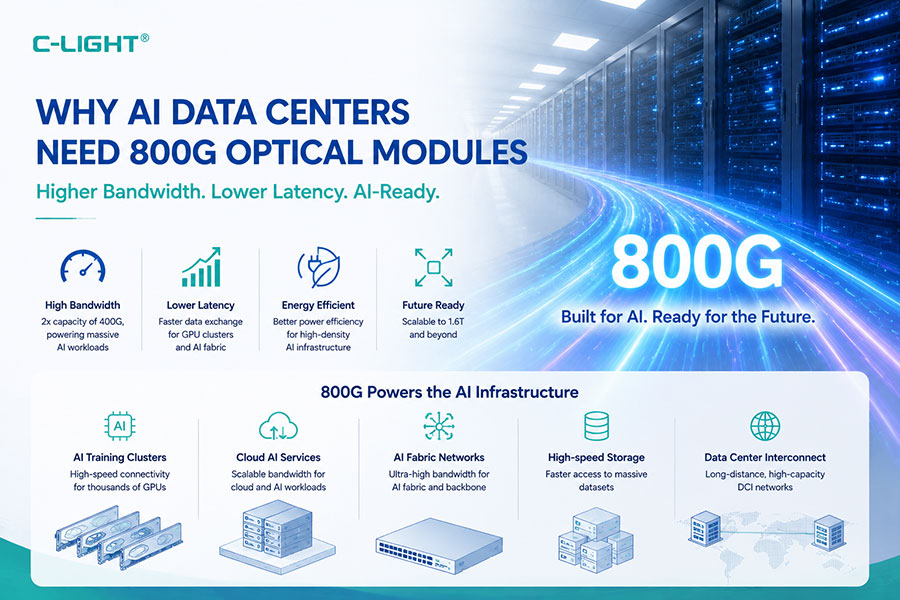
Among these technologies, 800G optical modules have become a key solution for AI data center infrastructure upgrades.
2. Why AI Data Centers Require Higher Bandwidth
2.1 AI Workloads Generate Massive Data Traffic
Traditional cloud applications mainly involve:
Web services
Video streaming
Enterprise applications
Database processing
However, AI workloads are fundamentally different.
AI training and inference require continuous communication between:
GPUs
AI accelerators
Memory systems
Network switches
Storage platforms
Large AI models contain billions or even trillions of parameters, requiring massive data movement during:
Model training
Data synchronization
Distributed computing
AI inference
This creates extremely high east-west traffic inside data centers.
2.2 GPU Clusters Need High-Speed Interconnect
Modern AI data centers are built around large GPU clusters.
A typical AI infrastructure includes:
Compute Layer
NVIDIA GPU servers
AI accelerators
High-performance processors
Network Layer
Ethernet AI Fabric
InfiniBand networks
High-speed switches
Optical Connectivity Layer
Optical transceivers
DAC cables
AEC solutions
As GPU numbers increase from hundreds to thousands or even hundreds of thousands, network bandwidth becomes a major bottleneck.
800G optical modules provide the necessary capacity to connect these high-performance computing systems efficiently.
3. What Is an 800G Optical Module?
3.1 Definition of 800G Optical Module
An 800G optical module is a high-speed optical transceiver capable of transmitting data at 800Gbps.
It is designed for:
AI data centers
Cloud computing infrastructure
High-performance computing
Next-generation Ethernet networks
Compared with 400G optical modules, 800G solutions provide:
Double transmission capacity
Higher switch port efficiency
Better scalability
Lower cost per bit
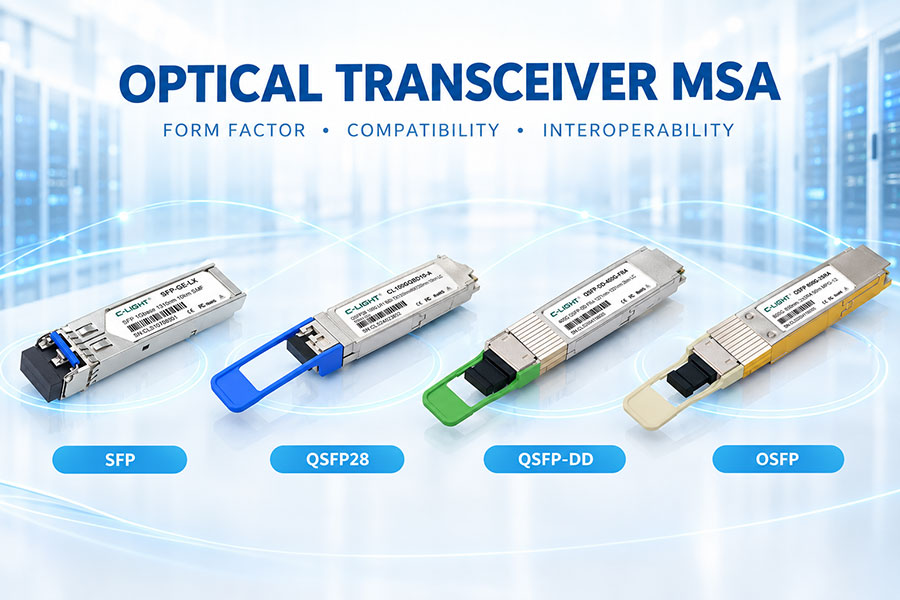
3.2 800G Optical Module Form Factors
The main 800G optical module solutions include:
800G OSFP Optical Module
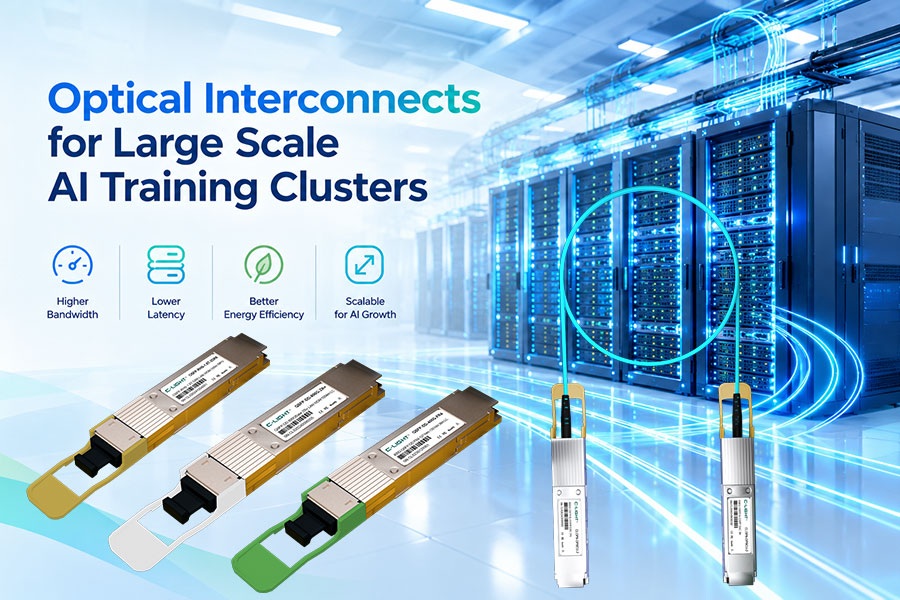
800G OSFP MSA SR8/DR8/2FR4 Optical Transceiver丨C-LIGHT
OSFP (Octal Small Form Factor Pluggable) has become one of the preferred solutions for AI networking.
Advantages:
Higher thermal capability
Suitable for high-power applications
Supports future upgrades
Typical applications:
AI clusters
Hyperscale data centers
HPC networks
800G QSFP-DD Optical Module
800G QSFP DD SR8/DR8/FR4 optical transceiver丨C-LIGHT
QSFP-DD provides compatibility with existing network platforms.
Advantages:
High port density
Flexible deployment
Easier migration from 400G networks
Applications:
Cloud data centers
Enterprise networks
Data center upgrades
4. Key Reasons AI Data Centers Need 800G Optical Modules
4.1 Higher Bandwidth for AI Network Traffic
AI clusters require significantly more bandwidth than traditional workloads.
800G optical modules enable:
Faster GPU communication
Higher switch capacity
Reduced network congestion
For large AI clusters, increasing optical bandwidth directly improves:
Training efficiency
Resource utilization
Data processing speed
4.2 Lower Power Consumption Per Bit
AI data centers face increasing power challenges.
Higher network speeds must balance:
Performance
Energy efficiency
Thermal management
Compared with deploying more lower-speed modules, 800G optical modules can provide:
Higher bandwidth density
Lower power consumption per gigabit
Reduced rack space requirements
This is especially important as AI racks continue moving toward higher power densities.
4.3 Supporting Large-Scale AI Fabric Networks
AI Fabric requires highly efficient communication between computing nodes.
800G optical modules support:
GPU-to-GPU communication
Switch-to-switch connections
Rack-to-rack networking
They provide the foundation for:
Distributed AI training
Large language models
High-performance computing applications
5. 800G Optical Technology Evolution
5.1 PAM4 Modulation Technology
800G optical modules typically use PAM4 modulation technology.
Compared with traditional NRZ signaling:
Advantages:
Higher data transmission efficiency
Better bandwidth utilization
Supports next-generation Ethernet speeds
PAM4 has become a critical technology for:
400G
800G
1.6T optical communication
5.2 Advanced DSP and Signal Processing
High-speed optical transmission requires advanced signal processing.
DSP technology provides:
Signal compensation
Error correction
Channel optimization
However, DSP also increases:
Power consumption
Thermal requirements
This has encouraged the development of new architectures such as:
LPO
CPO
6. 800G Optical Modules and AI Data Center Applications
6.1 AI Training Clusters
AI training requires communication between thousands of processors.
800G optical modules enable:
High-speed GPU networking
Low-latency communication
Large-scale cluster expansion
6.2 Cloud AI Infrastructure
Cloud providers are rapidly building AI computing platforms.
800G optical connectivity supports:
AI services
Cloud computing
Large-scale data processing
6.3 Data Center Interconnect (DCI)
AI infrastructure is increasingly distributed across multiple locations.
800G optical solutions enable:
High-capacity data center connections
Long-distance optical transmission
Cloud resource sharing
7. 800G Optical Modules Compared with Other Solutions
| Technology | Application | Advantage |
|---|---|---|
| 400G Optical Module | Current data centers | Mature deployment |
| 800G Optical Module | AI data centers | Higher bandwidth |
| 1.6T Optical Module | Future AI networks | Next-generation capacity |
| DAC | Short distance | Low cost |
| AEC | AI cluster connections | Extended reach |
The future networking roadmap is:
400G → 800G → 1.6T → 3.2T
8. Challenges of Deploying 800G Optical Modules
8.1 Thermal Management
Higher-speed optical modules generate more heat.
Challenges include:
Increased module power
Dense rack deployment
Cooling requirements
AI data centers require advanced thermal solutions to maintain reliability.
8.2 Signal Integrity
At 800G speeds, signal quality becomes increasingly important.
Testing requirements include:
BER testing
Eye diagram analysis
Jitter measurement
Insertion loss testing
8.3 Supply Chain and Manufacturing
800G optical modules require advanced components:
High-speed lasers
DSP chips
Optical engines
Precision packaging
Manufacturing capability has become a key competitive factor.
9. C-LIGHT 800G Optical Module Solutions
C-LIGHT provides high-speed optical connectivity solutions designed for AI data centers and next-generation networking infrastructure.
800G Optical Transceiver Products
C-LIGHT solutions include:
800G OSFP Optical Module
800G QSFP-DD Optical Module
Applications:
AI data centers
Cloud computing
HPC networks
Ethernet AI Fabric
AI Interconnect Solutions
C-LIGHT also provides:
800G DAC
800G AEC
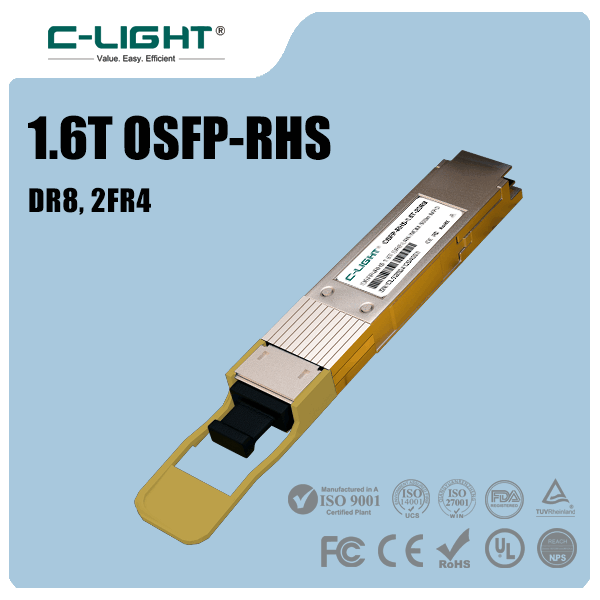
1.6T Optical Interconnect Solutions
These products support:
GPU cluster networking
High-density AI infrastructure
Future AI computing platforms
10. Future Outlook: 800G Leads the AI Networking Upgrade
The demand for 800G optical modules will continue growing as AI infrastructure expands.
Future trends include:
Higher-Speed Optical Networking
The industry will move toward:
800G → 1.6T → 3.2T
Advanced Optical Integration
Future technologies include:
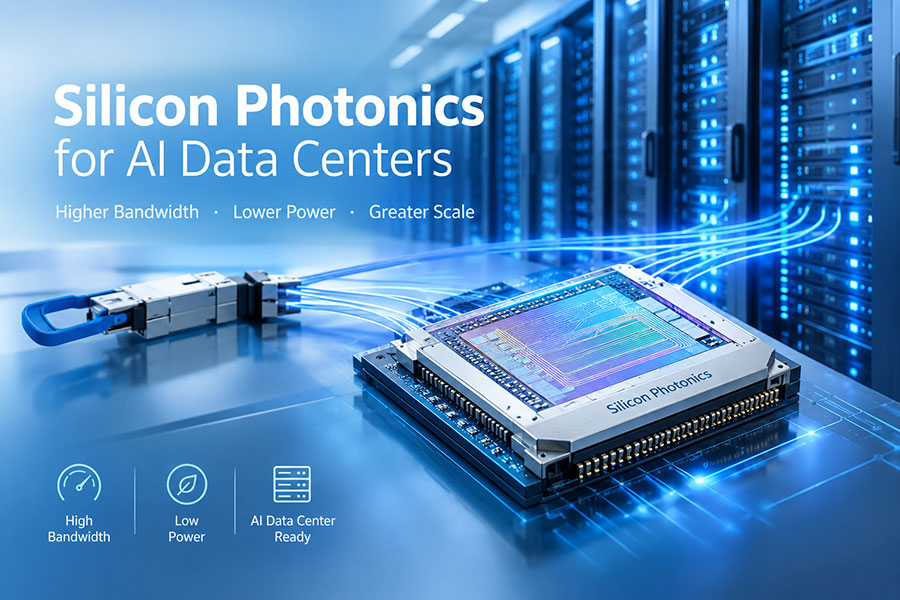
Silicon photonics
LPO
CPO
AI-Optimized Data Center Networks
Optical connectivity will become the backbone of AI computing infrastructure.
800G optical modules are not only a bandwidth upgrade but also a critical technology enabling the next generation of AI data centers.
11.Frequently Asked Questions (FAQ)
Q1: Why do AI data centers need 800G optical modules?
Answer: AI data centers require massive bandwidth communication between GPUs, switches, and computing systems. 800G optical modules provide high-speed, high-density connectivity to support large-scale AI workloads, GPU clusters, and next-generation data center networks.
Q2: What is an 800G optical module?
Answer: An 800G optical module is a high-speed optical transceiver capable of supporting 800Gbps data transmission. It is designed for AI data centers, cloud computing, hyperscale networks, and high-performance computing (HPC) applications.
Q3: What is the difference between 400G and 800G optical modules?
Answer: The main differences between 400G and 800G optical modules include:
400G optical modules provide 400Gbps transmission capacity.
800G optical modules double the bandwidth to 800Gbps per module.
800G solutions are optimized for AI clusters, HPC systems, and high-performance networking environments.
Q4: What are the main types of 800G optical modules?
Answer: Common 800G optical module solutions include:
800G OSFP optical modules
800G QSFP-DD optical modules
800G optical interconnect solutions for AI data centers
Q5: How does 800G improve AI data center performance?
Answer: 800G optical modules help reduce network bottlenecks, increase bandwidth density, and improve communication efficiency between AI computing nodes. They enable faster data exchange for large-scale GPU clusters and advanced AI workloads.
Q6: What technologies support 800G optical communication?
Answer: Key technologies supporting 800G optical communication include:
PAM4 modulation technology
Advanced DSP technology
High-performance optical packaging
Silicon photonics technology
Q7: What 800G products does C-LIGHT provide?
Answer: C-LIGHT provides comprehensive 800G optical networking solutions for AI data centers and high-performance networks.
800G OSFP optical modules
800G QSFP-DD optical modules
800G DAC and AEC high-speed interconnect solutions
AI data center optical interconnect solutions
Q8: What is the future roadmap after 800G?
Answer: The optical networking industry is moving toward higher-speed solutions, including 1.6T and future 3.2T optical connectivity. These technologies are designed to support increasing AI computing requirements, larger GPU clusters, and next-generation data center architectures.
 >
>

 >
>
 >
>
 >
>
 >
>
 >
>
 >
>
 >
>