TEL:+86 132 6656 7067





Large AI training clusters depend on continuous communication between GPU servers. As more accelerators participate in distributed workloads, the network must move increasingly large volumes of data without allowing communication delays to undermine computing efficiency. 800G optical transceivers provide higher bandwidth per network port and support dense fiber connections between servers and switches. They are an important part of the transition toward larger, faster AI data center fabrics.
1. Distributed AI Training Creates Heavy Network Traffic
Training a large AI model involves dividing computational work across multiple GPUs. Each accelerator processes part of the workload, but the results must frequently be exchanged and synchronized with other GPUs.
Common communication operations include:
AllReduce: Combines data such as gradients from multiple GPUs and distributes the resulting values.
AllGather: Collects data from multiple computing nodes and makes the combined result available to participating devices.
ReduceScatter: Reduces distributed data and sends the resulting portions to different participants.
Parameter and activation exchange: Moves model-related data between computing processes during training.
These operations can create significant east-west traffic across GPU servers. When communication takes longer than expected, GPUs may spend additional time waiting for data or synchronization rather than performing useful computation.
2. Why 800G Provides an Advantage Over 400G
An 800G connection provides twice the nominal bandwidth of a 400G connection. This allows a compatible network port to carry more traffic without requiring two separate 400G ports for the same aggregate line rate.
| Characteristic | 400G interface | 800G interface |
|---|---|---|
| Aggregate bandwidth | 400 Gb/s | 800 Gb/s |
| Port capacity | Lower bandwidth per port | Twice the nominal bandwidth per port |
| Network density | More ports may be needed for a given aggregate capacity | Can reduce port count for the same aggregate bandwidth |
| Common applications | Existing AI fabrics and high-speed data center links | High-density GPU fabrics and next-generation switch connections |
| Engineering requirements | 100G-class or supported equivalent lane architecture | Higher-speed electrical and optical lane architecture |
The practical benefit depends on whether the connected switches, NICs, and network architecture can use the additional capacity. An 800G module connected to an endpoint operating at a lower rate will not automatically deliver 800G application throughput.
3. Where 800G Optical Transceivers Fit in an AI Cluster
In a typical scale-out network, GPUs communicate through network adapters and switches. Optical transceivers are installed in compatible network ports to connect servers, leaf switches, and spine switches over fiber.
There are several important optical connection points in this architecture.
GPU server to leaf switch
High-speed NICs or SuperNICs connect GPU servers to the rack-level network. Depending on the distance and platform design, this connection may use DAC, AOC, or pluggable optical transceivers.
Leaf-to-spine connectivity
Leaf switches aggregate traffic from GPU servers and forward it toward the spine layer. These uplinks can carry substantial traffic during distributed training. 800G optical interfaces increase the capacity available on each supported connection.
Connections between network domains
Large clusters may contain multiple network blocks or computing domains. High-speed optical connectivity helps link these sections while supporting structured fiber routing and network expansion.
Not every GPU connection requires an 800G optical module. Internal GPU scale-up links may use dedicated technologies such as NVLink, while short external connections may use copper-based interconnects where supported.
4. How 800G Helps Improve Network Density
Large AI clusters can contain thousands of high-speed network connections. As the cluster grows, the number of switch ports, transceivers, fiber assemblies, and cable pathways becomes an important infrastructure consideration.
Moving from 400G to 800G can provide more bandwidth through each physical port. For the same aggregate link capacity, fewer 800G connections may be required than 400G connections.
For example, an aggregate bandwidth target of 6.4 Tb/s could theoretically be delivered through eight 800G links or sixteen 400G links. This is a capacity illustration, not a complete switch design: actual port availability, redundancy, topology, and traffic distribution determine the required configuration.
Higher bandwidth per port can help reduce:
The number of physical connections needed for a given aggregate capacity.
Switch port consumption in high-density network tiers.
Fiber routing complexity when the architecture can consolidate links.
Pressure on rack space and cable-management pathways.
However, an 800G link may require more demanding thermal and optical engineering than a lower-speed connection. The overall system benefit should be evaluated using port density, power, cooling, and cabling together.
5. 800G Optical Architectures: DR4, DR8, FR4, and SR8
800G describes aggregate bandwidth rather than one universal optical configuration. Different module types use different lane arrangements, fiber types, wavelengths, and connector interfaces.
800G DR4
DR4 uses four parallel optical channels over single-mode fiber. A typical implementation supports up to 500 meters under the specified fiber and link conditions. It is suitable for many intra-data-center connections where single-mode fiber is used.
800G DR8
DR8 uses eight parallel optical channels over single-mode fiber. It is another option for high-bandwidth data center links, with its reach and connector requirements defined by the applicable specification and module design.
800G FR4
FR4 uses wavelength multiplexing to transmit four optical channels over a fiber pair. Typical implementations target distances up to 2 kilometers, making them useful for longer data center routes where the selected platform supports the interface.
800G SR8
SR8 uses parallel optical channels over multimode fiber for short-reach applications. The supported distance depends on the multimode fiber grade and the specific module specification.
| Optical type | Fiber | Transmission method | Typical reach class |
|---|---|---|---|
| DR4 | Single-mode | Four parallel optical channels | Up to 500m |
| DR8 | Single-mode | Eight parallel optical channels | Defined by the specific DR8 implementation |
| FR4 | Single-mode | Four wavelengths over a fiber pair | Up to 2km |
| SR8 | Multimode | Eight parallel optical channels | Short-reach; depends on fiber grade |
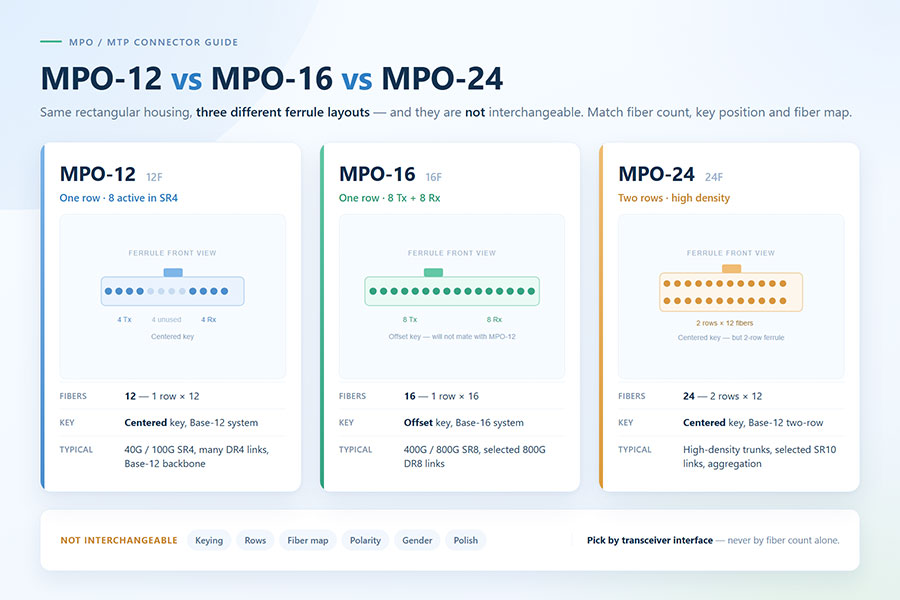
DR4 and DR8 are not interchangeable simply because they share the same aggregate data rate. Their lane counts, optical interfaces, fiber arrangements, and connector configurations differ. Always verify the complete link specification before selecting modules and fiber assemblies.
6. 800G Supports Both Ethernet and InfiniBand AI Fabrics
AI training clusters may use Ethernet with RoCEv2 or InfiniBand for their scale-out networks. Both technologies can use high-speed optical connectivity, but their protocol and platform requirements are different.
| Network characteristic | Ethernet with RoCEv2 | InfiniBand |
|---|---|---|
| Network foundation | Ethernet and IP | Dedicated InfiniBand fabric |
| RDMA | RoCEv2 | Native RDMA |
| Congestion management | Requires appropriate Ethernet congestion configuration | Uses InfiniBand fabric congestion-management mechanisms |
| Optical connectivity | Compatible Ethernet optical modules and cables | Compatible InfiniBand optical modules and cables |
| Deployment focus | Flexible data center and AI network infrastructure | Dedicated HPC and AI computing fabrics |
The module must support the intended protocol and host platform. Matching 800G data rates and connector types alone do not establish Ethernet and InfiniBand interoperability.
7. Power, Cooling, and Reliability at 800G
Higher data rates increase the importance of thermal and signal-integrity management. An 800G module contains high-speed electrical and optical components that must operate within specified conditions.
Power consumption: Module power contributes to total switch power, especially when many ports are populated.
Thermal management: High-density optical ports require suitable airflow, heatsinks, and temperature monitoring.
Signal integrity: Electrical interfaces must meet the required signal quality at the supported lane rate.
Optical performance: Transmit power, receiver sensitivity, and total link loss must remain within specification.
FEC and error monitoring: Forward error correction and diagnostic data help assess link performance and identify developing issues.
Connector quality: Fiber connectors must be inspected and cleaned to reduce contamination-related insertion loss.
For large AI installations, even small reliability or power differences can become significant when multiplied across hundreds or thousands of optical ports.
8. When Should an AI Training Cluster Move to 800G?
800G is most valuable when the network platform and workload can make use of its additional bandwidth. A migration should be based on measured traffic demand and the limitations of the existing network.
| Deployment condition | Recommended consideration |
|---|---|
| Existing 400G fabric has sufficient capacity | Continue using qualified 400G links until expansion or traffic growth justifies an upgrade. |
| New high-density GPU cluster | Evaluate 800G switches, NICs, and optical links as part of the initial network design. |
| Leaf-to-spine links approach capacity limits | Assess 800G uplinks and the required switch architecture. |
| Rack expansion increases east-west traffic | Review aggregate bandwidth, oversubscription, and network-plane capacity. |
| Switch platform supports both 400G and 800G | Plan a phased migration based on port compatibility and endpoint requirements. |
Before upgrading, operators should measure link utilization, congestion, collective communication performance, packet errors, and application-level training time. This helps establish whether the network is the actual performance constraint.
9. C-LIGHT 800G Connectivity Solutions for AI Training Clusters
C-LIGHT provides high-speed copper and optical interconnect products for data center and high-performance computing environments. These products can support different parts of an AI network, depending on the required distance, port type, protocol, and equipment compatibility.
800G Optical and Cable Connectivity
800G AOC – integrated optical cable assemblies for compatible short- and medium-reach connections.
800G DAC – short-reach copper connectivity for supported switch and server interfaces.
800G AEC – active electrical cable solutions for supported high-speed applications.
800G ACC – active copper cable options for compatible system configurations.
Optical Transceiver Portfolio
C-LIGHT Optical Transceivers – pluggable optical connectivity across multiple data rates, form factors, and reach requirements.
For AI training deployments, the correct product should be selected according to the switch and NIC models, Ethernet or InfiniBand requirements, optical standard, fiber type, link distance, and thermal environment.
10. Conclusion
800G optical transceivers are important for AI training clusters because they increase bandwidth per port and support high-density connections between GPU servers and network switches. They help scale leaf-spine fabrics, accommodate growing east-west traffic, and provide fiber connectivity across larger data center environments.
However, higher optical bandwidth alone does not guarantee faster AI training. The complete system must combine compatible GPUs, NICs, switches, optical modules, fiber infrastructure, and effective congestion management.
As AI clusters continue to expand, 800G provides an important networking foundation between established 400G infrastructure and emerging 1.6T platforms.
 >

 >
 >
 >
 >
 >
 >
 >