TEL:+86 132 6656 7067




An optical module consists of optoelectronic devices, functional circuits, and optical interfaces. Optoelectronic devices include two parts: transmitting and receiving.
To put it simply, the function of the optical module is photoelectric conversion. The transmitting end converts the electrical signal into an optical signal. After transmitting through the optical fiber, the receiving end converts the optical signal into an electrical signal.
SFP + and XFP are both 10G optical fiber modules, and can communicate with other types of 10G modules; Because of its smaller size, SFP + incorporates signal modulation, serial / deserializer, MAC, clock and data recovery (CDR), and electronics Dispersion compensation (EDC) function moved from the module to the motherboard card;

XFP compliance protocol: XFP MSA protocol; SFP + complied protocols: IEEE 802.3ae, SFF-8431, SFF-8432;
SFP + is a more mainstream design.
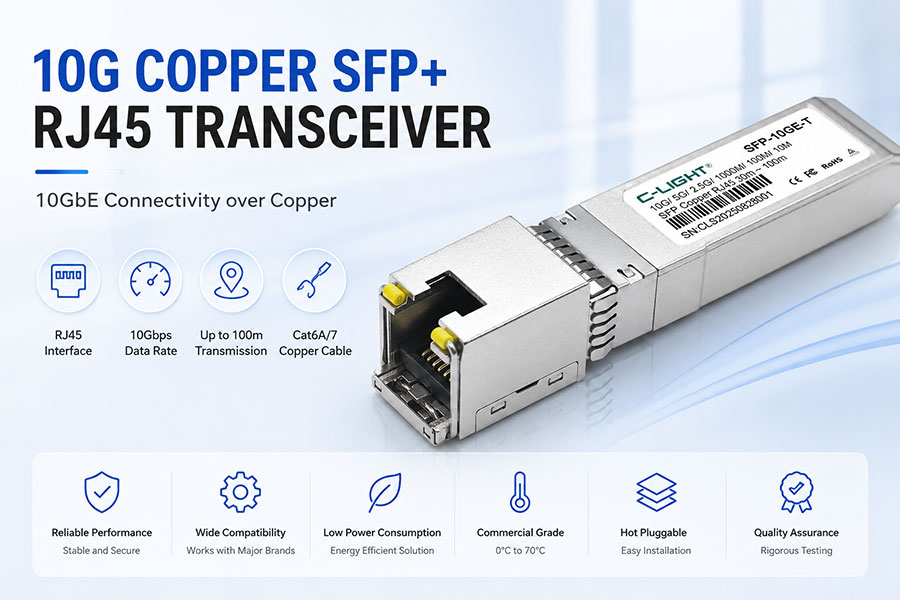
SFP+ - Upgraded SFP, data rates from 8Gb/s, 10Gb/s, 12Gb/s to 16Gb/s, distance up to 100km, 5G/10G Copper SFP+, 850nm, 1310nm, and 1550nm, bi-directional option (1270nm/1330 or 1490nm/1550nm, or any other wavelength required by user), DWDM and CWDM 50GHz 100GHz tunable wavelengths/channel options. LC/APC, SC/APC, PIGTAIL etc. connectors options. -40℃~85℃/ -20℃~85℃ temperatures options. Full range of P2P SFP+, XGSPON OLT ONU and DAC/ AOC cables are available with C-LIGHT.
XFP - data rates from 8Gb/s to 10Gb/s are available in C-LIGHT., distance up to 100km, 850nm, 1310nm, and 1550nm, bi-directional option (1270nm/1330 or 1490nm/1550nm, or any other wavelength required by user), DWDM and CWDM 50GHz 100GHz tunable wavelengths/channel options. LC/APC, SC/APC, PIGTAIL etc. connectors options. -40℃~85℃/ -20℃~85℃ temperatures options.
SFP vs XFP Optical Transceiver FAQ
An SFP (Small Form-factor Pluggable) optical transceiver is a compact, hot-pluggable optical module designed for fiber communication networks.
SFP modules are commonly used for:
1G Ethernet
Gigabit Fiber Channel
Enterprise networks
Access networks
Telecom applications
Key features include:
Compact SFP form factor
Hot-swappable design
Low power consumption
Flexible transmission distance options
SFP modules support various optical interfaces, including multimode and single-mode fiber solutions for different network requirements.
An XFP (10 Gigabit Small Form Factor Pluggable) optical transceiver is a 10Gbps optical module designed for high-speed fiber communication applications.
Compared with traditional SFP modules, XFP was developed specifically for 10G networking.
Key features include:
10Gbps data transmission
XFP MSA compliant package
Long-distance optical transmission support
Telecom and enterprise network applications
C-LIGHT 10G XFP optical modules support multiple transmission distances, including 300m, 10km, 40km, 80km, 100km, and 120km, making them suitable for data center interconnect, telecom networks, and long-distance fiber links.
The main differences between SFP and XFP are transmission speed, package design, and application scenarios.
| Feature | SFP | XFP |
| Full Name | Small Form-factor Pluggable | 10 Gigabit Small Form Factor Pluggable |
| Typical Speed | 1G | 10G |
| Application | Access and enterprise networks | High-speed telecom and data networks |
| Package Size | Smaller | Larger than SFP |
| Standard | SFP MSA | XFP MSA |
SFP focuses on compact and cost-effective connectivity, while XFP is designed for higher-speed 10G optical transmission.
As network bandwidth requirements increased, traditional 1G optical modules could not meet the demand for higher-speed transmission.
XFP was introduced to support:
10Gbps Ethernet
10G Fiber Channel
Telecom backbone networks
Long-distance optical communication
XFP separates high-speed signal processing functions from the optical module, allowing network equipment manufacturers to design flexible 10G systems.
This made XFP an important solution during the early development of 10G optical networks.
SFP applications:
Enterprise LAN networks
Campus networks
Access networks
Gigabit Ethernet systems
XFP applications:
Telecom backbone networks
Metro optical networks
Data center connections
Long-distance 10G transmission
XFP is mainly selected when higher bandwidth and longer transmission distance are required.
Both SFP and XFP provide flexible optical connectivity solutions.
Advantages of SFP:
Compact size
Low power consumption
Cost-effective deployment
Wide compatibility
Advantages of XFP:
10Gbps high-speed transmission
Long-distance communication capability
Reliable telecom network performance
Support for multiple optical standards
Both module types help network operators build scalable fiber communication infrastructure.
Choosing between SFP and XFP depends on several factors.
1. Network Speed
SFP for 1G applications
XFP for 10G applications
2. Transmission Distance
Short-distance fiber links
Metro connections
Long-distance telecom networks
3. Equipment Compatibility
Switches
Routers
Optical transport equipment
4. Network Upgrade Plan
Consider future bandwidth requirements before selecting the optical module.
Proper selection ensures reliable performance and avoids unnecessary infrastructure upgrades.
Although modern networks are moving toward higher-speed technologies such as 25G, 100G, 400G, and 800G, SFP and XFP modules remain important in many existing networks.
Future trends include:
Continued use in legacy networks
Replacement and upgrade of aging infrastructure
Higher-density optical solutions
Specialized telecom applications
SFP remains widely used in access networks, while XFP continues supporting many existing 10G telecom and enterprise systems.
 >
>

 >
>
 >
>
 >
>
 >
>
 >
>
 >
>
 >
>