TEL:+86 132 6656 7067





Large GPU clusters depend on continuous communication between accelerators, servers, and network switches. During distributed AI training, GPUs exchange gradients, parameters, intermediate results, and synchronization messages across the cluster. The performance of these operations depends not only on GPU computing power but also on the bandwidth, latency, and reliability of the network connecting the systems.
Optical transceivers provide the electrical-to-optical and optical-to-electrical conversion required for high-speed fiber links. They allow GPU servers and network switches to communicate over distances and at data rates that are difficult to support with conventional copper connections alone.
1. Why Do GPU Clusters Need Optical Transceivers?
A GPU cluster typically contains multiple servers, each equipped with several GPUs and high-speed network interfaces. Within a server, GPUs communicate through local interconnect technologies. Across servers, network adapters and switches provide the communication fabric that allows the cluster to operate as a distributed computing system.
As the number of GPUs increases, the network must carry more traffic between compute nodes. Distributed training workloads can generate substantial east-west traffic, particularly during collective communication operations such as All-Reduce, All-Gather, and Reduce-Scatter.
Optical transceivers help address several infrastructure requirements:
High bandwidth: Support high-speed connections between GPU servers and network switches.
Longer reach: Extend connectivity beyond the practical reach of many direct copper connections.
Signal integrity: Carry high-speed data over fiber without the same electrical attenuation and electromagnetic interference concerns as copper links.
Port density: Enable dense switch interconnections in large-scale leaf-spine networks.
Network scalability: Support expansion from individual racks to larger multi-rack GPU clusters.
2. Where Are Optical Transceivers Used in a GPU Cluster?
Optical transceivers are primarily used in the external network fabric connecting servers and switches. Their exact deployment depends on the cluster topology, switch generation, link distance, port speed, and whether the network uses InfiniBand or Ethernet.
Server-to-Switch Connections
GPU servers connect to Top-of-Rack (ToR) or leaf switches through high-speed network adapters. Depending on the distance and system design, these links may use optical transceivers and fiber, active optical cables, or direct-attach copper cables.
Leaf-to-Spine Connections
In a leaf-spine architecture, leaf switches connect GPU servers to the wider network, while spine switches provide paths between leaf switches. These switch-to-switch links carry aggregated traffic from many servers and often require high-capacity optical connections.
Connections Between Data Center Networks
Larger AI deployments may connect separate network domains, buildings, or data center locations. Depending on distance and architecture, these links can use higher-reach optical transceivers or coherent optical solutions.
This is a simplified scale-out network model. Actual GPU clusters may use rail-optimized, multi-plane, or other specialized topologies, and not every connection in the architecture uses an optical transceiver.
3. How Does an Optical Transceiver Support GPU Communication?
A network switch or network interface card processes data in an electrical domain. Fiber-optic communication requires the electrical signal to be converted into light at the transmitting end and converted back into an electrical signal at the receiving end.
An optical transceiver performs both operations. It contains optical and electronic components that work together to transmit and receive high-speed data.
At the receiving device, the recovered electrical signal is processed by the network interface or switch. The network protocol and forwarding functions then determine how the data is delivered to the destination server.
In a GPU training cluster, this process supports communication between nodes during synchronization, parameter exchange, distributed data processing, and other network-intensive operations.
4. Which Optical Transceiver Speeds Are Used in GPU Clusters?
GPU cluster networks have progressed from 100G and 200G links toward 400G and 800G infrastructure, while 1.6T connectivity is emerging for higher-capacity systems. The required speed depends on the number of GPUs per server, network adapter capability, switch port capacity, and the target oversubscription ratio.
| Transceiver Speed | Typical Application | Network Considerations |
|---|---|---|
| 100G | Existing data center and selected server connections | Established infrastructure with broad deployment history |
| 200G | High-speed server and switch connections | Useful in intermediate network generations and specific platform designs |
| 400G | GPU server uplinks and leaf-spine connections | Common high-capacity option for AI and data center fabrics |
| 800G | High-density AI cluster and switch interconnects | Supports higher aggregate bandwidth with suitable 100G-per-lane architectures |
| 1.6T | Next-generation high-capacity AI networking | Emerging 200G-per-lane designs require compatible host interfaces and thermal planning |
These speeds describe link capacity, not guaranteed application throughput. Protocol overhead, network congestion, topology, routing, and workload behavior all affect the bandwidth available to GPU applications.
400G and 800G in Scale-Out Networks
400G and 800G optical links are relevant to high-bandwidth server-to-switch and switch-to-switch connections. They can reduce the number of physical links required to deliver a given aggregate capacity, depending on port density and network architecture.
For example, an 800G link can provide twice the nominal line rate of a 400G link. However, moving to 800G requires compatible switches, network adapters, transceiver interfaces, fiber infrastructure, and link configurations.
1.6T and the Next Stage of AI Networking
1.6T optical transceivers are designed for systems moving toward higher per-port bandwidth. Many emerging designs use eight 200G electrical and optical lanes, although implementation details vary by module architecture.
Higher-speed modules also introduce stricter requirements for signal integrity, power consumption, heat dissipation, host electrical interfaces, and fiber connectivity. A 1.6T module should therefore be selected as part of a complete system design rather than simply as a higher-speed replacement for an 800G module.
5. How Do InfiniBand and Ethernet Use Optical Transceivers?
GPU clusters commonly use InfiniBand or Ethernet for scale-out networking. Both technologies can use optical transceivers, but their protocol behavior, platform qualification, and network configuration differ.
| Aspect | InfiniBand | Ethernet |
|---|---|---|
| Primary role | High-performance cluster and HPC networking | General-purpose data center and AI networking |
| Optical links | Used for server-to-switch and switch-to-switch connectivity | Used for server-to-switch and switch-to-switch connectivity |
| Communication technologies | RDMA and InfiniBand transport mechanisms | Ethernet with technologies such as RoCEv2 where configured |
| Deployment considerations | Fabric design, subnet management, adapter and switch compatibility | Congestion management, loss behavior, routing, and network configuration |
The optical transceiver provides the physical optical connection. It does not determine whether the network operates as InfiniBand or Ethernet. Protocol support depends on the host equipment, switch, firmware, and the specific transceiver's qualification.
Similarly, an optical module with the correct data rate and connector is not automatically compatible with every InfiniBand or Ethernet platform. Host support and interoperability must be checked before deployment.
6. Optical Transceivers vs. DAC, AEC, and AOC in GPU Clusters
Optical transceivers are important in GPU clusters, but they are not the only connectivity option. DAC, AEC, and AOC cables are also widely used, particularly for short-distance connections within or between nearby racks.
| Connection Type | Transmission Medium | Typical Use | Main Consideration |
|---|---|---|---|
| DAC | Copper twinax cable | Short server-to-switch or switch-to-switch links | Cost-effective and low power, but reach is limited |
| AEC | Active copper cable | Short-reach high-speed connections | Active signal conditioning extends practical copper reach |
| AOC | Optical fiber with integrated transceivers | Short-to-medium reach connections | Integrated cable assembly simplifies deployment |
| Pluggable Optical Transceiver | Optical fiber with separate modules | Server-to-switch and switch-to-switch links | Flexible fiber routing, reach options, and replaceable modules |
The choice depends on distance, port speed, power budget, cable routing, serviceability, and total deployment cost. Passive copper remains practical for many short connections, while optical transceivers become increasingly useful as reach and bandwidth requirements grow.
7. What Should Engineers Consider When Selecting Optical Transceivers?
Selecting a transceiver for a GPU cluster requires more than matching the nominal data rate. The module, host platform, fiber system, and network architecture must work as one end-to-end link.
Data Rate and Lane Architecture
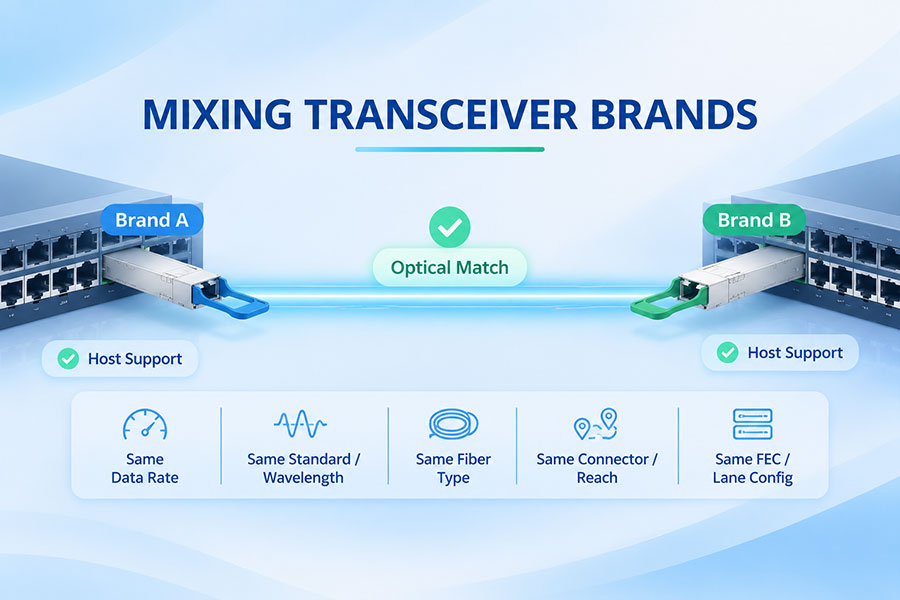
Check the aggregate speed and lane configuration supported by the switch and network adapter. A 400G, 800G, or 1.6T label alone does not establish that two modules can communicate directly.
Transmission Distance and Fiber Type
Select multimode or single-mode fiber according to the transceiver specification and actual link distance. Consider the complete optical path, including patch panels, connectors, and intermediate fiber assemblies.
Connector and Optical Interface
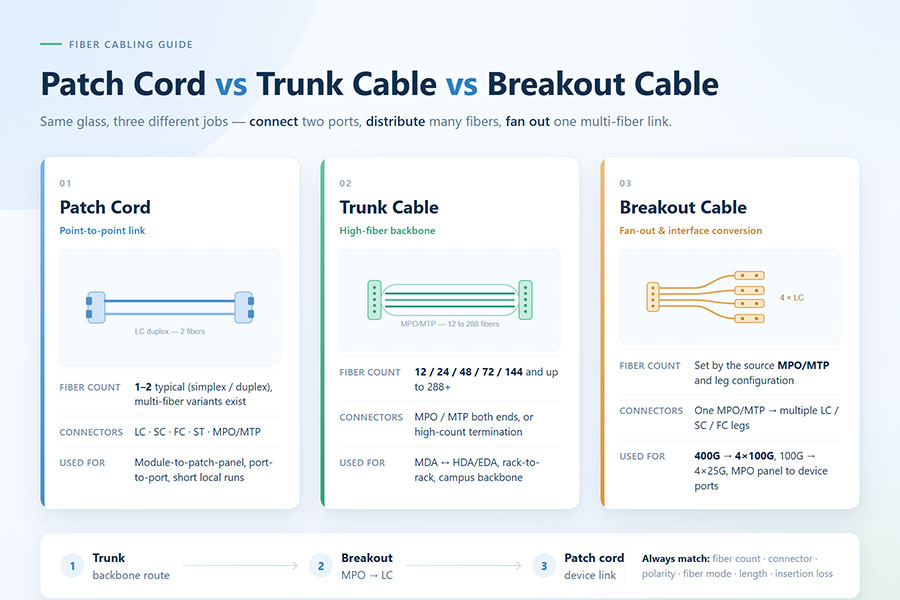
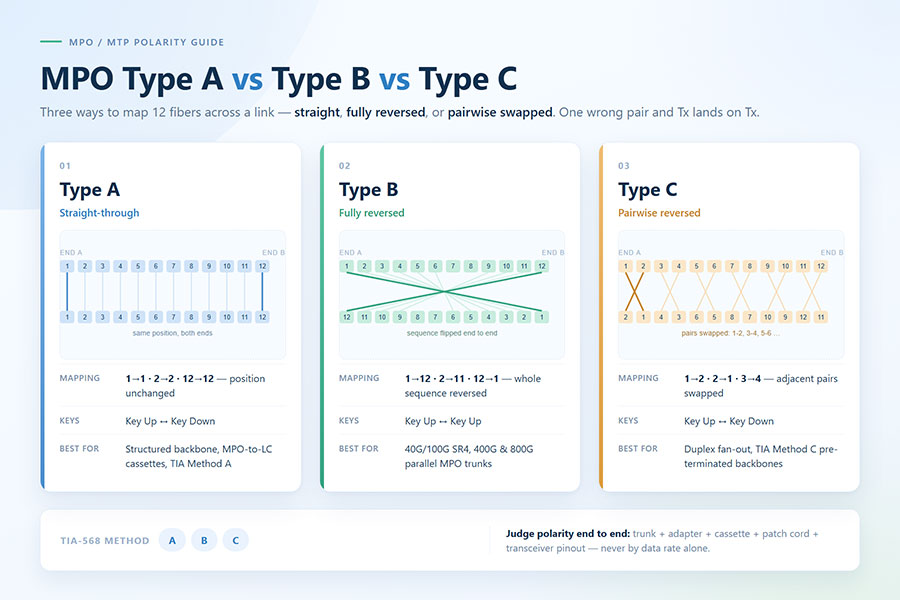
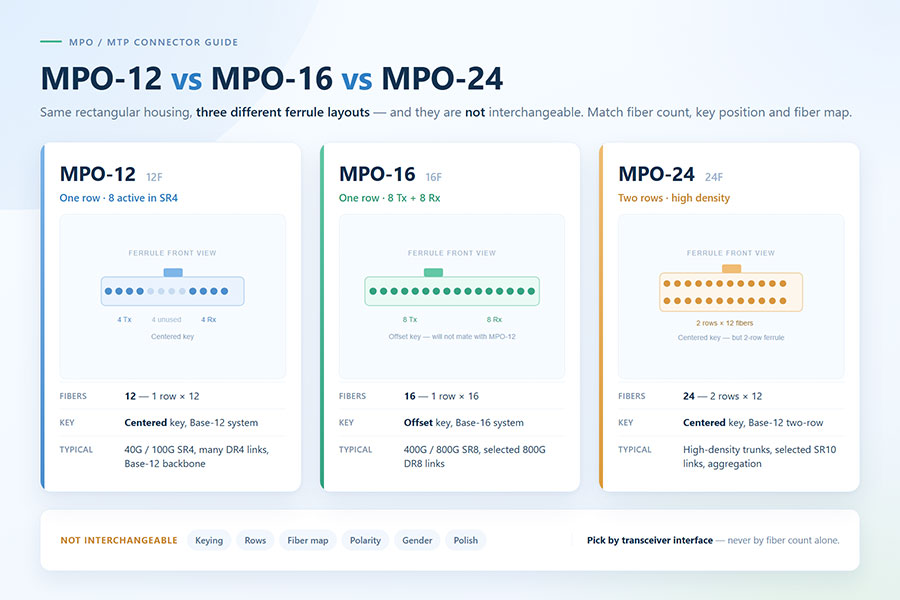
Common interfaces include LC and MPO/MTP, depending on the module design. The connector type, fiber count, polarity, and optical lane mapping must match at both ends.
Host Compatibility
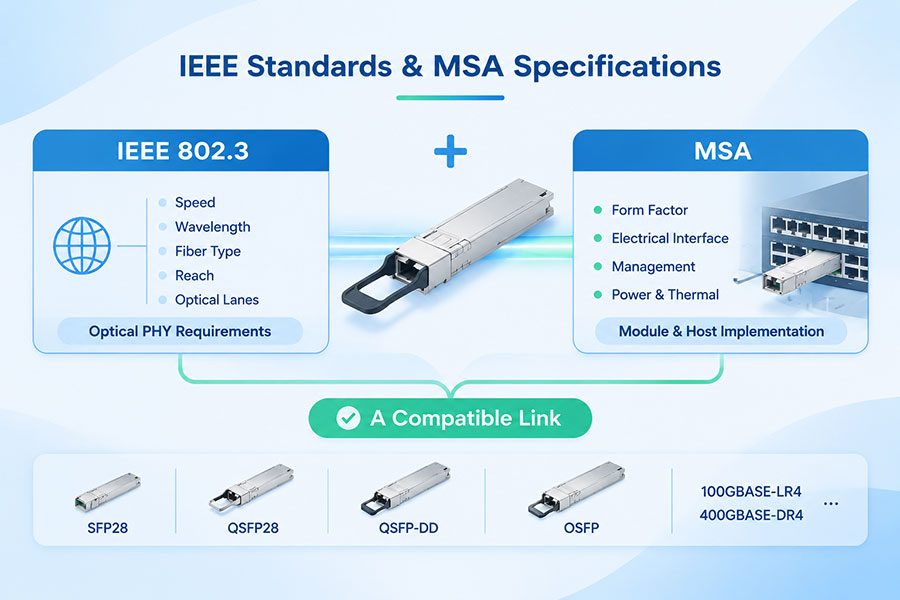
Verify the switch or NIC model, supported form factor, firmware requirements, module coding, and platform qualification. QSFP-DD and OSFP modules, for example, are different physical form factors and should not be treated as interchangeable.
Power and Thermal Management
High-speed optical modules generate heat and require suitable airflow and thermal conditions. Dense GPU switches may contain many high-power modules, making thermal design an important part of system reliability.
Monitoring and Link Reliability
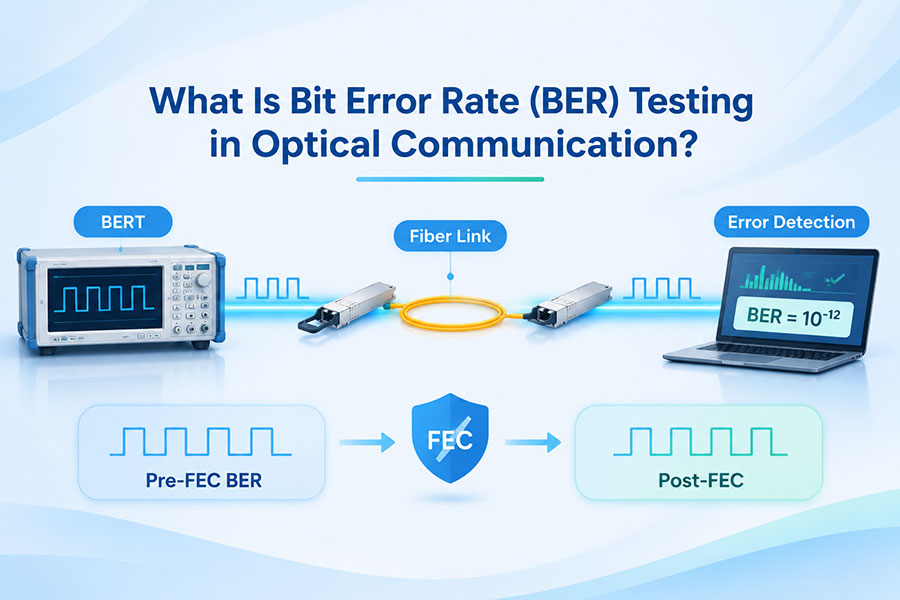
Digital Diagnostic Monitoring (DDM) or Digital Optical Monitoring (DOM), when supported, can provide information such as transmit power, receive power, module temperature, supply voltage, and laser bias current. These measurements help engineers identify abnormal operating conditions and investigate link problems.
8. C-LIGHT Optical Connectivity for GPU Cluster Infrastructure
As AI clusters move toward 400G, 800G, and 1.6T networking, selecting suitable optical modules and high-speed cables becomes an important part of building scalable infrastructure. C-LIGHT provides optical transceivers and high-speed interconnect products for data center, cloud computing, and AI networking applications.
800G connectivity can support high-capacity links in modern GPU cluster networks. C-LIGHT offers 800G DAC, AEC, and AOC product families for different short-reach connection requirements.
800G DAC Cable – passive copper connectivity for supported short-reach applications.
800G AEC Cable – active electrical cable connectivity.
800G AOC Cable – integrated optical cable connectivity.
400G links remain relevant in existing data center networks and new AI infrastructure deployments. C-LIGHT provides 400G DAC and AOC options for different link distances and installation requirements.
For next-generation high-bandwidth networking, C-LIGHT offers 1.6T OSFP-RHS optical transceiver configurations, including:
1.6T OSFP 2DR4 RHS – designed for 500m single-mode fiber applications.
1.6T OSFP 2FR4 RHS – designed for 2km single-mode fiber applications.
Product details are available on the C-LIGHT 1.6T OSFP-RHS product page.
The correct product selection depends on the switch and NIC platform, optical interface, fiber type, transmission distance, and supported protocol. Customers planning GPU cluster deployments should confirm these requirements before ordering.
For optical transceiver and high-speed interconnect requirements, visit the C-LIGHT Optical Transceiver portfolio or AOC and DAC product range. For project-specific configurations and compatibility requirements, Contact C-LIGHT.
9. The Growing Importance of Optical Transceivers in GPU Clusters
Optical transceivers provide the physical connectivity that allows GPU servers and network switches to exchange data across high-speed fiber links. In large AI clusters, they support scale-out networking by connecting servers to leaf switches, linking leaf and spine layers, and extending connectivity across network domains.
As network speeds advance from 400G to 800G and toward 1.6T, optical transceiver selection increasingly involves lane architecture, fiber infrastructure, host compatibility, power consumption, and thermal management. DAC, AEC, and AOC cables continue to serve appropriate short-reach applications, while pluggable optics provide flexible fiber connectivity for longer and higher-density links.
The performance of a GPU cluster ultimately depends on the complete network system. Optical transceivers are one essential part of that system, helping provide the bandwidth and physical reach required for distributed AI computing.
 >

 >
 >
 >
 >
 >
 >
 >