TEL:+86 132 6656 7067





As AI clusters and hyperscale data centers grow, network traffic between compute nodes becomes increasingly demanding. Conventional electrical packet switches provide flexible packet-by-packet forwarding, but they also require substantial switching electronics and power. An Optical Circuit Switch (OCS) takes a different approach: it establishes direct optical paths between fiber ports, allowing data to travel through the switch without being converted into electrical signals inside the device.
OCS technology is attracting attention in AI infrastructure because it can create flexible optical connections between groups of servers, accelerators, and network switches. Rather than replacing every Ethernet or InfiniBand switch, it is generally used as an additional switching layer in architectures that benefit from reconfigurable, high-capacity optical connections.
1. What Is an Optical Circuit Switch?
An Optical Circuit Switch is a physical-layer switching device that connects an optical input port to a selected optical output port. Once a connection is established, the optical signal passes through the device along the configured path until the connection is changed.
Unlike an electrical packet switch, an OCS does not need to inspect packet headers, determine destination addresses, or buffer individual packets. It redirects the optical signal itself.
Because the optical signal remains in the optical domain inside the switching fabric, an OCS can avoid the optical-electrical-optical (O-E-O) conversion performed at an electronic switching hop. This makes it largely independent of the data protocol and line rate carried by a supported optical connection, subject to the device's optical specifications.
2. How Does an Optical Circuit Switch Work?
The operating principle is straightforward: light enters through an input fiber, an internal optical mechanism directs it toward a selected output, and the signal exits through the corresponding output fiber.
Basic OCS Signal Path
The optical path is established by the switch controller and maintained until reconfiguration.
Typical switching sequence
Connection request: A network controller determines that two optical ports need a direct connection.
Path configuration: The controller sends a configuration command to the OCS.
Optical alignment: The internal switching elements direct the incoming light toward the selected output port.
Data transmission: Traffic travels through the established optical circuit.
Reconfiguration: When network traffic patterns or connectivity requirements change, the controller can release or redirect the circuit.
The OCS handles the physical optical connection, while routing decisions, traffic scheduling, and network policy are generally managed by external control software. This separation is important: an OCS does not independently understand application traffic or decide where each packet should go.
3. Main Optical Circuit Switching Technologies
Several optical technologies can implement circuit switching. They differ in how light is redirected, their port scalability, switching speed, optical loss, and operational requirements.
MEMS-Based OCS
Micro-Electro-Mechanical Systems (MEMS) use tiny movable mirrors to redirect optical beams between input and output fibers. Three-dimensional MEMS architectures can support large port counts and are an established approach for optical circuit switching.
Liquid-Crystal-Based OCS
Liquid-crystal technologies control the optical path by changing the behavior of light passing through optical elements. Their design characteristics differ from mechanical mirror systems and depend on the specific implementation.
Piezo-Actuated Optical Switching
Piezoelectric actuators use controlled mechanical movement to adjust optical alignment or beam direction. These systems are designed around precise actuation and optical path control.
Silicon Photonic Switching
Silicon photonics integrates optical switching functions onto photonic chips. It is an active development area for compact, highly integrated switching fabrics and potentially faster reconfiguration architectures.
These approaches should not be treated as interchangeable. A deployment must evaluate the actual device specifications, including switching time, port count, insertion loss, polarization-dependent loss, crosstalk, and reliability.
4. OCS vs. Traditional Electrical Packet Switching
OCS and electrical packet switches solve different networking problems. An electrical packet switch forwards traffic dynamically according to packet information. An OCS establishes a physical optical connection that remains in place until it is reconfigured.
| Characteristic | Optical Circuit Switch (OCS) | Electrical Packet Switch (EPS) |
|---|---|---|
| Switching method | Establishes optical paths between ports | Forwards packets based on packet information |
| Switching layer | Physical optical layer, commonly described as Layer 0 | Typically Layer 2 or Layer 3 |
| Signal processing | Does not require packet decoding inside the optical fabric | Processes packet headers and forwarding information |
| O-E-O conversion inside the switch | Not required in a transparent optical path | Typically used at optical switch interfaces |
| Switching granularity | Connection or circuit level | Packet level |
| Reconfiguration | Depends on optical switching technology; many MEMS systems operate on millisecond-scale timescales | Packet forwarding decisions occur at much shorter timescales |
| Traffic flexibility | Best suited to planned or sufficiently stable traffic patterns | Handles dynamic and bursty traffic flexibly |
| Typical role | Reconfigurable optical connectivity between network groups | General-purpose packet forwarding and routing |
OCS is not a universal replacement for packet switching. Packet switches remain essential for traffic that requires frequent destination changes, fine-grained routing, and statistical multiplexing. OCS is more useful when network operators can identify traffic patterns that justify maintaining dedicated optical paths.
5. Why Is OCS Important for AI Data Centers?
Large AI training clusters generate substantial communication traffic between GPUs and other compute resources. Depending on the parallelism strategy and model architecture, communication can involve frequent synchronization, collective operations, and exchanges of intermediate data.
As clusters expand across racks and network pods, operators need ways to provide high-capacity connectivity while managing network power, congestion, and infrastructure complexity. OCS offers another method of organizing these connections.
Reconfigurable network topology
AI workloads do not always produce identical traffic patterns. Different training jobs, parallelism strategies, or groups of accelerators may need different communication arrangements. An OCS can change optical connections to support different network configurations without manually replacing fiber patch connections.
Reduced electronic switching stages
Where an OCS replaces an electronic switching stage in a suitable network design, the optical path can avoid packet processing and O-E-O conversion at that stage. This can reduce switching-related latency and power consumption, although the total system benefit depends on the complete architecture and workload.
Flexible bandwidth allocation
By changing which ports are connected, an OCS-based fabric can allocate optical connectivity to different network groups. This is useful when traffic demand is uneven or when specific communication patterns persist long enough to justify circuit provisioning.
Support for large-scale GPU fabrics
OCS can serve as an optical layer connecting groups of electronic switches or compute domains. The resulting architecture can combine the packet-level flexibility of Ethernet or InfiniBand switches with the reconfigurable connectivity of optical circuits.
6. How Is OCS Integrated into an AI Network?
In many proposed and deployed architectures, OCS works alongside conventional electronic packet switches. The electronic layer handles server connectivity and packet forwarding, while the optical layer provides reconfigurable connections between larger network groups.
Illustrative Hybrid EPS–OCS Architecture
Simplified conceptual diagram. Actual OCS topologies vary by network design, port mapping, and redundancy requirements.
In this model, servers connect to leaf switches through conventional network interfaces. The leaf switches provide packet-level connectivity within their respective groups. The OCS then establishes optical circuits between selected network groups, allowing the overall topology to be adjusted as required.
Some architectures use OCS to replace or supplement parts of the spine or core layer. Others use it to connect separate compute domains. The exact placement depends on traffic patterns, network scale, failure-domain design, and the capabilities of the switching equipment.
7. Key Performance Parameters of an OCS
Evaluating an optical circuit switch requires more than checking its port count. Its optical performance and operational behavior directly affect the feasibility of the complete link.
| Parameter | What It Means | Why It Matters |
|---|---|---|
| Port Count / Radix | Number of optical input and output ports supported | Determines how many endpoints or optical paths can be connected |
| Insertion Loss | Optical power lost as light passes through the switch | Consumes link power budget and affects achievable reach |
| Switching Time | Time required to establish a new optical connection | Determines how quickly the network can adapt to topology changes |
| Return Loss | Amount of optical power reflected toward the source | Can affect optical signal quality and link performance |
| Crosstalk | Unwanted optical coupling between separate paths | Can interfere with signals on other connections |
| Polarization-Dependent Loss | Variation in insertion loss with the input polarization state | Important for maintaining consistent optical performance |
| Reliability | Stability and repeatability of optical connections over time | Influences network availability and maintenance requirements |
| Power Consumption | Electrical power used by the switching device and control system | Contributes to total network energy efficiency |
Why insertion loss matters
Every optical component in a link contributes to the total loss. When an OCS is inserted into an optical path, its insertion loss must be included in the link budget alongside fiber attenuation, connector loss, splice loss, and other passive components.
A simplified link-budget relationship is:
Total link loss includes the OCS, fiber, connectors, splices, and other optical components in the path. The final design must also account for engineering margin and the transceiver's specified operating conditions.
A transceiver that works on a direct fiber connection may not automatically provide sufficient margin after additional switching components are introduced. The complete optical path must be validated against the specifications of the selected OCS and optical modules.
8. OCS Deployment Challenges and Limitations
Although OCS can provide meaningful advantages in the right architecture, it introduces engineering and operational requirements that differ from conventional packet-switched networks.
Reconfiguration is not packet-level switching
Many MEMS-based OCS devices require milliseconds to establish a new path. This is suitable for topology management and longer-lived traffic arrangements, but it is not designed to make a new forwarding decision for every packet.
Optical link-budget constraints
Insertion loss, connector quality, fiber condition, and the number of optical switching stages all affect the received optical power. Engineers must validate the full path rather than evaluate each component independently.
More complex network control
OCS requires coordination between the optical switch, network controller, topology management software, and packet-switching layer. Poorly coordinated reconfiguration can interrupt active traffic or create temporary connectivity gaps.
Monitoring and troubleshooting
Because an OCS does not process packets in the same way as an electronic switch, traditional packet-based monitoring alone cannot verify every optical path. Fiber connectivity, optical power, path configuration, and link quality require appropriate optical-layer monitoring and validation.
Traffic suitability
OCS is most effective when the network can identify useful circuit assignments and keep them active long enough to justify reconfiguration. Highly unpredictable or short-lived traffic may be better served by conventional packet switching.
Required port count and connection topology
Supported fiber types, connectors, and optical interfaces
Insertion loss and complete optical power budget
Switching time and reconfiguration behavior
Redundancy, failover, and recovery procedures
Controller integration and topology management
Optical monitoring, diagnostics, and maintenance procedures
9. Optical Transceivers and Fiber Connectivity in OCS Networks
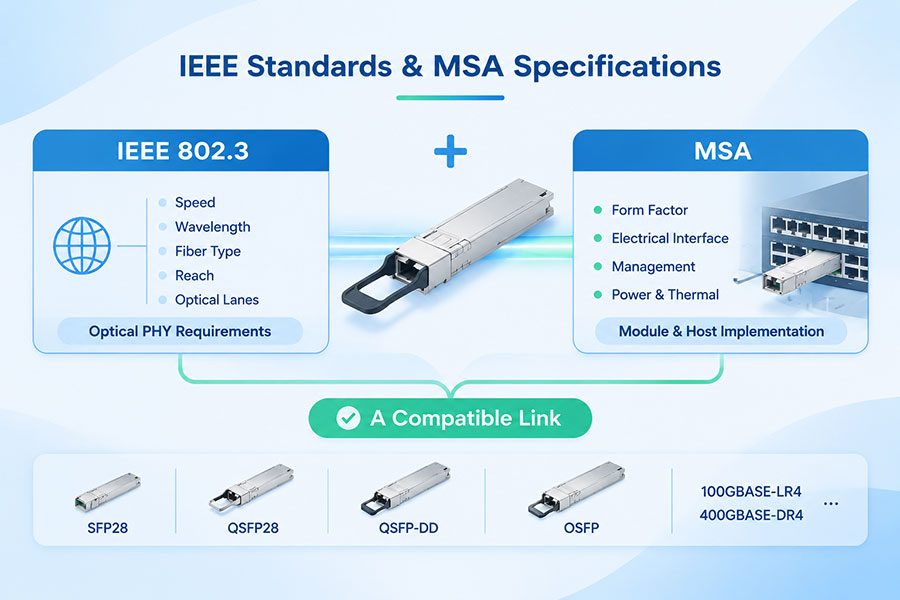
Although an OCS redirects light without performing packet processing, the complete network still needs suitable optical interfaces and fiber connections between the endpoints and switching equipment. The optical transceivers, fiber assemblies, and OCS ports must be selected as one engineered system.
For example, an optical link may use pluggable transceivers at the electronic switch or server endpoints, with fiber connections routed through an OCS. The transceiver's wavelength, supported fiber type, connector, transmission distance, and optical power budget must match the requirements of the complete path.
Optical Transceiver Solutions
C-LIGHT Optical Transceivers cover optical interface options for data center and high-speed networking applications. Selection should be based on the endpoint equipment, link rate, fiber type, reach, and the OCS optical specifications.
High-Speed Data Center Interconnects
For short-reach connections within racks and between nearby network devices, direct-attach and active cable technologies may also be considered where the architecture and equipment support them.
800G DAC Cable – for supported short-distance direct electrical connections.
800G AOC Cable – an integrated active optical cable option for compatible high-speed interfaces.
800G AEC Cable – an active electrical cable option for supported short-reach applications.
These cable types serve different physical interfaces and are not interchangeable with an OCS optical port. Confirm the complete endpoint and cabling design before selection.
High-Density Fiber Connectivity
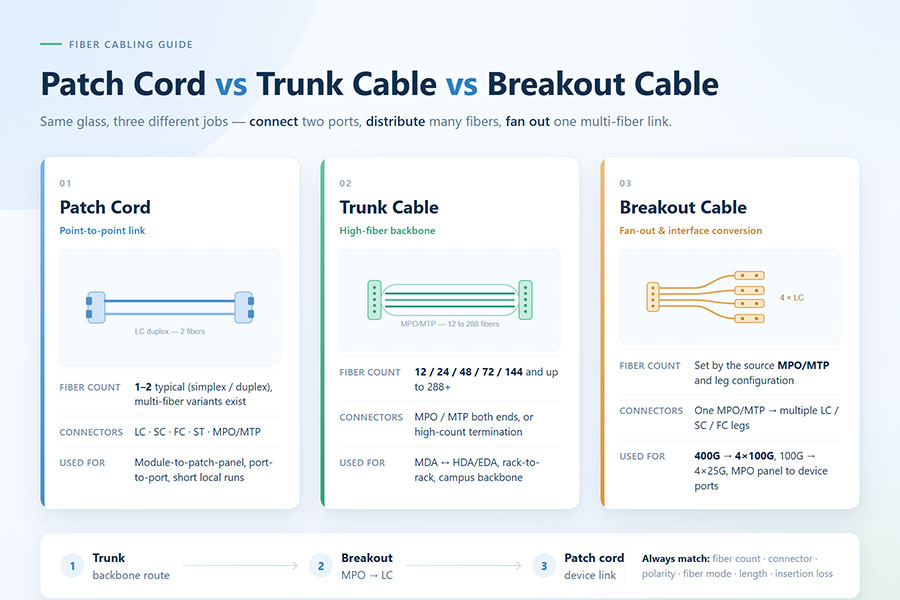
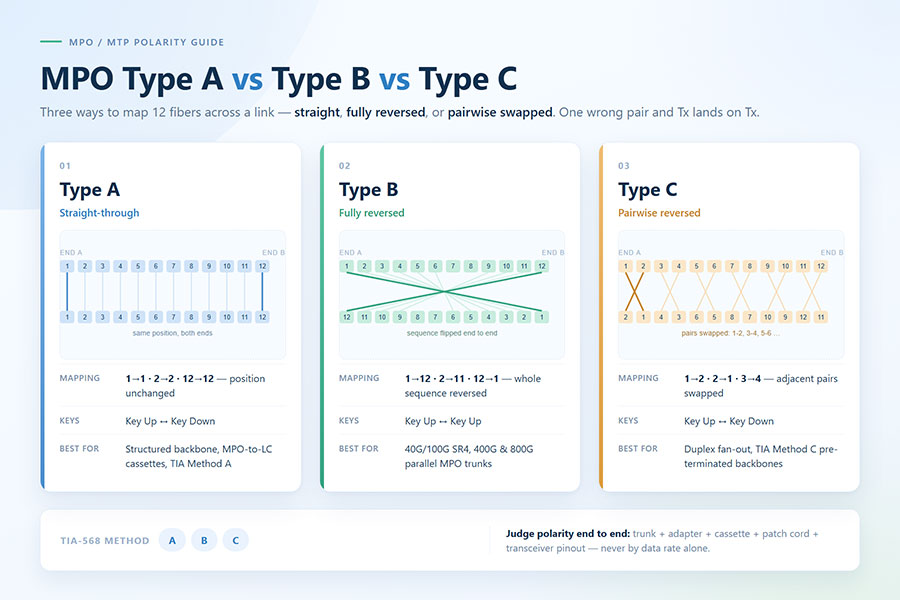
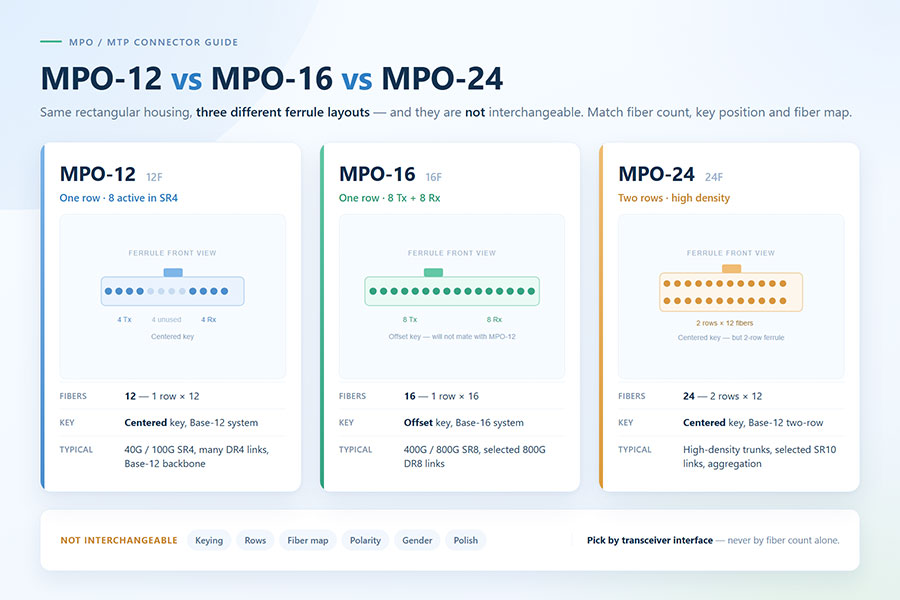
Fiber assemblies provide the physical connections between optical transceivers, patch panels, and optical switching equipment. High-density MPO and MTP assemblies can help organize multi-fiber connections in data center environments.
Connector type, fiber count, polarity, fiber grade, and the OCS port interface must all be verified for the intended deployment.
For OCS-based networks, component compatibility is determined by the complete optical interface and system design—not simply by matching the nominal data rate printed on a transceiver or cable.
10. What Is the Future of Optical Circuit Switching?
As AI clusters increase in size and communication requirements become more demanding, optical circuit switching is receiving greater attention from data center operators, network equipment suppliers, and the broader photonics industry.
Industry development is moving in several directions:
Open specifications and interoperability: Industry initiatives are working toward more consistent hardware interfaces, control models, telemetry, and software integration.
Higher port density: Continued development aims to support larger optical fabrics and more flexible connectivity between network groups.
Faster optical reconfiguration: New switching approaches are investigating faster circuit establishment for more dynamic network environments.
AI-aware network control: Coordinating workload scheduling with optical topology management may help align network resources with changing communication requirements.
Hybrid optical-electrical architectures: OCS is likely to coexist with packet switches, pluggable transceivers, and other optical interconnect technologies.
The Open Compute Project's OCS initiative reflects this growing industry interest, with work covering open hardware and software specifications, SDN integration, telemetry, and AI data center applications.
11. Conclusion
An Optical Circuit Switch establishes direct optical connections between fiber ports without requiring packet-level processing or O-E-O conversion inside the switching fabric. Its ability to reconfigure physical optical paths makes it a useful option for selected data center and AI cluster architectures.
OCS does not eliminate the need for electrical packet switches. Instead, it complements them by providing a reconfigurable optical layer for traffic patterns that benefit from dedicated circuits. Successful deployment depends on topology design, switching speed, optical loss, fiber connectivity, control software, and end-to-end compatibility.
As high-performance computing and AI infrastructure continue to scale, OCS is becoming an important technology to consider when designing flexible, high-capacity optical networks.
For optical transceiver, fiber connectivity, and high-speed interconnect requirements, visit C-LIGHT or Contact C-LIGHT.
 >

 >
 >
 >
 >
 >
 >
 >