TEL:+86 132 6656 7067





1. What Is a High-Radix Switch?
A high-radix switch is a network switch with a large number of physical or logical ports. In data center networking, radix generally refers to the number of network interfaces available for connecting servers, other switches, or network devices.
For AI infrastructure, these ports may operate at 100G, 200G, 400G, or 800G Ethernet speeds. A high-radix switch can therefore provide many high-bandwidth connections within a relatively compact switching platform.
For example, a switch ASIC with 51.2 Tb/s of aggregate switching bandwidth may support different port configurations depending on its SerDes capabilities and system design:
64 ports operating at 800G
128 ports operating at 400G
256 ports operating at 200G
2. Why Does AI Networking Need High-Radix Switches?
AI training clusters may contain hundreds or thousands of GPU servers. Each server can have one or more high-speed network interfaces, and these interfaces need paths to other nodes across the backend fabric.
In a conventional network with limited port counts, connecting a growing number of endpoints may require additional switching layers. Every extra tier introduces more devices, links, configuration requirements, and potential points of congestion.
High-radix switches provide more connection capacity at each network layer. This can help network architects build larger fabrics with fewer tiers, provided that the available switching bandwidth and uplink capacity are sufficient.
More Endpoint Connections
A larger port count allows a switch to connect more GPU servers or downstream switches without requiring as many separate devices at that layer.
Fewer Network Tiers
Higher radix can increase the number of endpoints supported by a two-tier Clos or leaf-spine fabric before an additional switching layer is required.
Higher Port Density
More high-speed interfaces can be concentrated in a switching platform, helping manage rack space, cabling, and network deployment complexity.
Cluster Expansion
A well-sized high-radix design provides additional connection options as more GPU servers and network capacity are added.
However, port count alone does not determine AI application performance. The fabric must also provide appropriate bandwidth, low congestion, effective load balancing, and enough path diversity for the traffic generated by distributed workloads.
3. How Does Radix Affect a Leaf-Spine Network?
Leaf-spine is a common architecture for AI backend networks. GPU servers connect to leaf switches, while spine switches provide paths between leaf devices. In a larger Clos network, additional spine or super-spine layers can be introduced as the cluster grows.
In a two-tier leaf-spine topology, each leaf switch uses some ports for server connections and the remaining ports for uplinks to spine switches. Each spine switch connects to the leaf layer.
A higher-radix switch can provide more ports for both server-facing connections and spine-facing links. This gives network designers more flexibility when allocating ports and planning the number of endpoints supported by the fabric.
Illustrative port allocation
Consider a simplified 64-port switch operating at one consistent port speed. A non-oversubscribed two-tier design could allocate half of its ports to GPU-facing connections and half to uplinks.
Example: 64-port switch
Illustrative equal-bandwidth allocation, not a universal deployment rule
In this example, a leaf switch uses 32 ports for endpoints and 32 ports to connect to the spine layer. The spine layer must have enough corresponding ports to connect all leaf switches and provide the intended network capacity.
Actual cluster size depends on the number of leaf and spine switches, the number of NICs per server, port breakout configuration, network planes, and the desired oversubscription ratio. Multi-rail and dual-plane designs also change how ports are allocated.
4. High-Radix Switches and AI Cluster Scaling
AI networking places demanding requirements on the backend fabric because distributed training involves frequent communication among GPU nodes. A high-radix design can help reduce the number of switching stages needed to connect a large group of servers.
For example, NVIDIA's AI factory reference architectures describe GPU compute fabrics using rail-optimized leaf-spine topologies. Their designs use high-port-count switches and separate network planes to connect GPU interfaces and provide bandwidth and resilience as clusters expand.
High radix is especially useful in the following situations:
Large GPU clusters: More server interfaces need to be connected within a scalable fabric.
High-speed NIC deployments: Each GPU server may generate substantial network traffic through 400G or 800G interfaces.
Two-tier Clos designs: A larger port count can increase the potential endpoint scale before another switching tier is needed.
High-density data centers: Network architects need to balance port density, rack space, power, and fiber routing.
High-radix switches do not remove the need for careful topology planning. If the spine layer has insufficient capacity, or if too much traffic is concentrated on particular links, the network can still experience congestion and reduced application throughput.
5. High Radix Does Not Automatically Mean Higher AI Performance
One common misconception is that a switch with more ports will always deliver better GPU cluster performance. In practice, radix is only one part of the network design.
| Design Factor | Why It Matters | Potential Impact if Poorly Designed |
|---|---|---|
| Aggregate switching capacity | Determines the total bandwidth available across switch ports. | Insufficient capacity can limit traffic throughput. |
| Oversubscription ratio | Describes the relationship between downlink bandwidth and uplink bandwidth. | Congestion can occur when multiple endpoints transmit simultaneously. |
| Buffer architecture | Helps manage bursts and temporary traffic contention. | Queue buildup or packet drops may affect latency and throughput. |
| Routing and load balancing | Distributes traffic across available paths. | Uneven link utilization can create bottlenecks. |
| Port speed consistency | Maintains the intended bandwidth between network layers. | Lower-speed segments can constrain end-to-end throughput. |
| Topology and path diversity | Provides multiple communication paths and supports resilience. | Limited paths can increase congestion and reduce fault tolerance. |
AI workloads can generate large and synchronized traffic flows. Collective communication operations such as All-Reduce and All-to-All may involve many GPU nodes transmitting at the same time. Consequently, effective bandwidth, congestion management, and tail latency are important alongside port count.
6. What Is the Relationship Between High-Radix Switches and Optical Connectivity?
High-radix switches need physical connections for every active port. As port counts and interface speeds increase, optical connectivity becomes increasingly important for connecting switches and GPU servers across racks or network rows.
Optical transceivers convert electrical signals from the switch into optical signals for transmission over fiber. At the receiving end, another transceiver converts the optical signal back into an electrical signal.
Optical connectivity supports high-radix AI fabrics in several ways:
High-speed connections: Optical interfaces support high-bandwidth links such as 400G and 800G, with 1.6T technology emerging for next-generation platforms.
Rack-to-rack connectivity: Fiber can connect switches and servers across distances that are less practical for passive copper.
Dense port deployment: Optical modules and fiber assemblies support large numbers of high-speed connections in compact network environments.
Flexible reach options: Different optical designs support different distances, fiber types, and connector configurations.
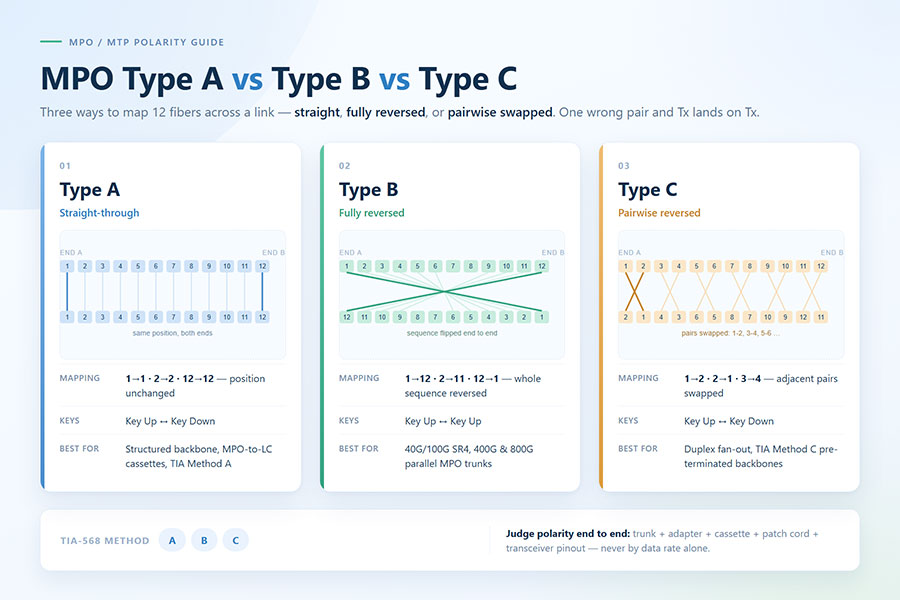
Structured cabling: MPO/MTP and duplex fiber assemblies can support organized, high-density optical distribution when the required polarity and fiber mapping are planned correctly.
It is important to distinguish switch radix from optical bandwidth. A high-radix switch provides more ports, while the optical transceivers and fiber links provide the physical media for connecting those ports. Optical modules do not increase the switch's radix or switching capacity.
7. 400G, 800G, and 1.6T Interfaces in High-Radix Designs
High-radix switches are increasingly associated with high-speed Ethernet interfaces. The relationship between port count and interface speed determines the aggregate bandwidth available from a switching ASIC or platform.
| Example Port Configuration | Aggregate Port Bandwidth | Potential Application |
|---|---|---|
| 64 × 400G | 25.6 Tb/s | High-speed leaf or spine switching |
| 64 × 800G | 51.2 Tb/s | High-bandwidth AI backend fabrics |
| 128 × 400G | 51.2 Tb/s | High-port-density switching platforms |
| 256 × 200G | 51.2 Tb/s | Large numbers of 200G connections |
These are illustrative aggregate port-bandwidth calculations. Actual supported configurations depend on the switch ASIC, system implementation, SerDes architecture, port breakout options, and platform specifications.
For example, Broadcom's Tomahawk 5 BCM78900 family is specified for up to 51.2 Tb/s of switching bandwidth, with configurations including 64 × 800GbE, 128 × 400GbE, or 256 × 200GbE. This illustrates how one switching capacity can support different combinations of port count and interface speed.
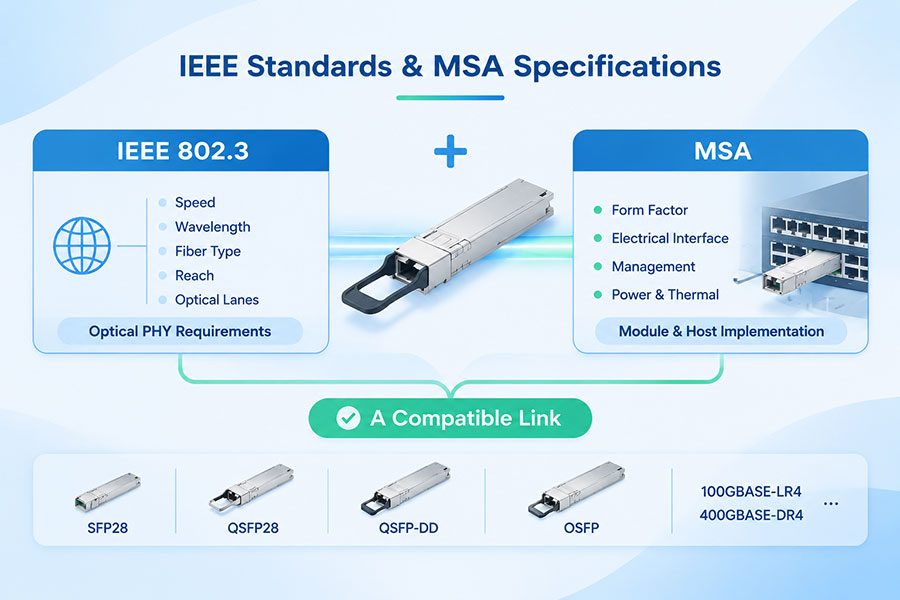
When selecting optical modules for these platforms, engineers should verify the actual port configuration, supported form factor, optical reach, fiber type, and host compatibility.
8. How Do DAC, AEC, AOC, and Pluggable Optics Support High-Radix Switches?
A high-radix switch may have dozens or hundreds of active interfaces. The physical connection method must be selected according to link distance, cable density, power consumption, and equipment compatibility.
DAC: Passive Copper
Direct Attach Copper cables are suitable for short connections between nearby switches or servers. They provide a simple electrical connection without separate optical transceivers.
AEC: Active Copper
Active Electrical Cables use signal-conditioning electronics to support selected high-speed copper connections over distances beyond the practical range of passive DAC.
AOC: Active Optical Cable
Active Optical Cables integrate optical components into a fixed cable assembly. They are useful when an integrated optical connection is preferred.
Pluggable Optical Transceivers
Separate transceivers and fiber patch cables provide modular optical connectivity for connections between racks, rows, and network switching layers.
In a typical deployment, short in-rack connections may use DAC or AEC, while AOC or pluggable optical transceivers can be selected for longer or more flexible fiber connections. The exact allocation depends on the network layout and supported equipment.
9. What Should Engineers Check When Selecting a High-Radix Switch?
Switch selection should begin with the required GPU cluster size and network topology, rather than port count alone. The following factors help determine whether a particular platform can support the intended deployment.
Port count and port speed: Confirm the number of available interfaces and the supported speeds for each configuration.
Aggregate switching capacity: Ensure the switching bandwidth can support the intended traffic without creating an unexpected bottleneck.
GPU and NIC requirements: Match the switch interfaces to the network adapters and server connection design.
Topology: Determine whether the platform will operate as a leaf, spine, or another switching layer.
Oversubscription: Calculate downlink and uplink bandwidth based on expected traffic patterns.
Optical compatibility: Verify supported transceiver form factors, wavelengths, fiber types, connectors, and reach.
Power and cooling: Account for switch power consumption, airflow, module temperature, and rack-level thermal limits.
Resilience: Evaluate redundant links, independent network planes, and failure recovery.
Network software: Confirm routing, congestion control, telemetry, and load-balancing capabilities.
For AI clusters, it is also important to evaluate how the switch behaves under synchronized traffic and collective communication patterns. A fabric that performs well under light utilization may behave differently when many GPU nodes transmit simultaneously.
10. C-LIGHT Connectivity Products for High-Radix AI Networks
High-radix AI switches require large numbers of high-speed connections. Depending on the network design, these connections may use direct-attach copper, active electrical cables, active optical cables, pluggable optical transceivers, and high-density fiber assemblies.
800G DAC and AEC
800G copper-based connectivity can support short-reach connections in compatible high-bandwidth switching environments. DAC and AEC address different electrical reach and signal-conditioning requirements.
800G AOC and ACC
For selected high-speed connections, integrated cable solutions can simplify physical deployment. The choice between optical and active copper assemblies depends on distance, port compatibility, and system requirements.
400G DAC and AOC
400G connections remain relevant in AI backend networks and high-speed data center switching. These products can be considered for compatible server-to-switch and switch-to-switch links.
1.6T OSFP-RHS Optical Transceivers
As switch platforms move toward higher interface rates, 1.6T optical transceivers are relevant to next-generation high-density optical infrastructure. C-LIGHT offers 1.6T OSFP-RHS 2DR4 and 2FR4 product configurations for specified single-mode fiber applications. Exact host platform and optical interface compatibility should be confirmed before deployment.
MPO and MTP Fiber Patch Cables
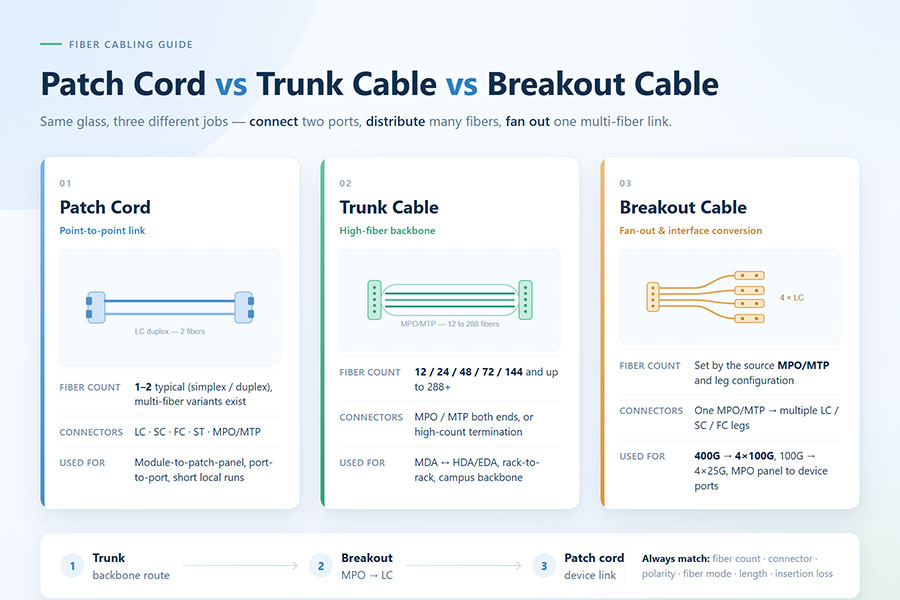
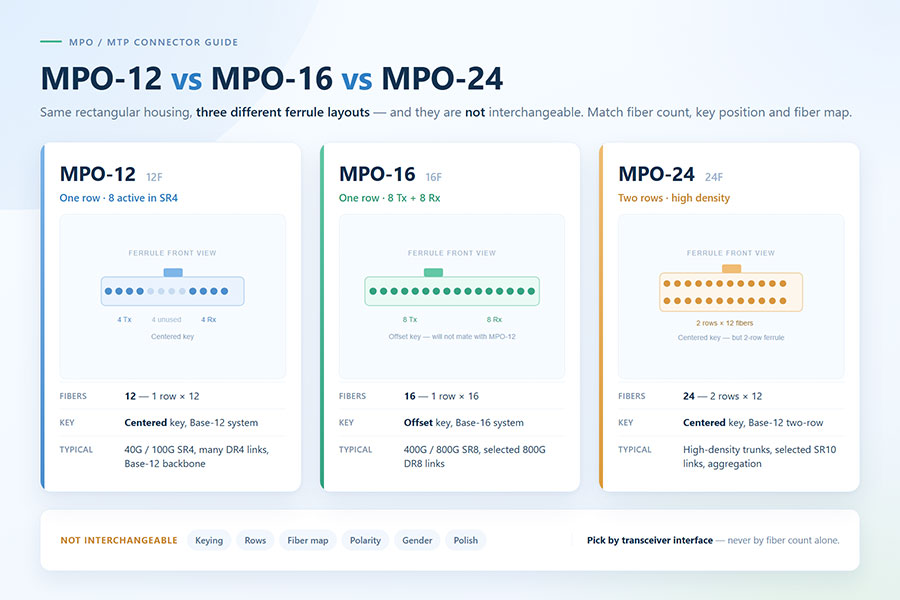
High-density optical networks may require parallel-fiber cabling for supported transceiver interfaces. C-LIGHT MPO and MTP fiber patch cable options support different fiber counts and fiber types. Connector polarity, fiber mapping, and insertion-loss requirements should be checked for each link.
For high-radix switch deployments, C-LIGHT can support connectivity planning around the required data rate, cable type, optical reach, and host interface. Product selection should be verified against the exact switch model and its supported transceiver specifications.
11. The Future of High-Radix Switching in AI Data Centers
As AI clusters grow, switch platforms are evolving toward higher aggregate bandwidth, faster SerDes, denser port configurations, and more advanced traffic-management capabilities.
Several developments are influencing future AI network designs:
800G and 1.6T interfaces: Higher-speed ports increase the bandwidth available to individual network connections.
Higher-capacity switching ASICs: More aggregate switching bandwidth supports larger and faster network fabrics.
Advanced congestion management: Adaptive routing, dynamic load balancing, and telemetry help manage demanding AI traffic patterns.
Optical integration: Silicon photonics, near-packaged optics, and co-packaged optics are being developed to address the electrical and physical challenges of increasingly dense interconnects.
Fabric optimization: Rail-optimized and multi-plane architectures help distribute GPU traffic across multiple network paths.
Higher radix will remain an important design characteristic, but future AI networks will increasingly be evaluated as complete systems. Switching capacity, optical connectivity, routing, power, cooling, and application-level communication performance all contribute to the result.
12. Conclusion
A high-radix switch provides a large number of high-speed ports for connecting GPU servers, network devices, and other switches. In AI data centers, it can help increase endpoint density and support larger leaf-spine fabrics with fewer switching tiers.
Optical transceivers and fiber connections provide the physical connectivity needed to link high-speed switch ports across racks and network layers. DAC, AEC, and AOC remain useful for appropriate short-reach connections, while pluggable optics support modular fiber infrastructure.
Ultimately, a successful high-radix AI network depends on more than port count. Engineers must balance radix, aggregate bandwidth, oversubscription, congestion control, topology, optical reach, and system compatibility to build a scalable GPU fabric.
 >

 >
 >
 >
 >
 >
 >
 >