TEL:+86 132 6656 7067





1. What Is a GPU Fabric?
A GPU fabric is a high-performance interconnection architecture that links GPUs and the networking equipment supporting them. It enables accelerators to exchange data, coordinate computing tasks, and access shared resources across a multi-GPU system or distributed cluster.
Unlike a conventional enterprise network that primarily connects users, applications, and services, a GPU fabric is designed around the communication requirements of accelerated computing. It must support high throughput, predictable latency, efficient data movement, and reliable communication between large numbers of computing nodes.
GPU fabrics can include several interconnected technologies:
GPU interconnects: Technologies such as NVIDIA NVLink connect GPUs within a tightly integrated computing domain.
Network adapters: High-speed NICs and DPUs connect servers to external compute networks.
Network switches: Ethernet or InfiniBand switches forward traffic between GPU servers and racks.
Cabling and optical links: DAC, AEC, AOC, and optical transceivers provide the physical connections.
Network software: Communication libraries, drivers, routing, and congestion-management mechanisms coordinate data movement.
2. How Is a GPU Fabric Organized?
GPU fabric architecture is commonly divided into scale-up and scale-out domains. Larger deployments may also extend connectivity across facilities through scale-across networking. These domains serve different purposes and can use different physical interconnect technologies.
Scale-Up Fabric
Connects a relatively small group of accelerators into a high-bandwidth computing domain. It is commonly used for GPU-to-GPU communication within a server or rack-scale system.
Typical technologies: NVLink, NVSwitch, and platform-specific accelerator interconnects.
Scale-Out Fabric
Connects multiple GPU servers or scale-up domains into a larger AI cluster. It carries distributed training and inference traffic between computing nodes.
Typical technologies: InfiniBand, RoCE Ethernet, high-speed NICs, switches, and optical links.
Scale-Across Connectivity
Extends coordinated computing and data movement across separate facilities or data center locations. Distance, latency, routing, and resilience become especially important.
Typical technologies: DCI, coherent optics, routed Ethernet, and WDM systems.
Supporting Networks
Frontend, storage, and management networks provide access to applications, datasets, orchestration systems, and operational services.
Typical technologies: Ethernet, storage networking, management interfaces, and dedicated control networks.
The exact boundaries depend on the platform. Some systems use separate physical networks for GPU compute, storage, frontend access, and management. Others share physical infrastructure while maintaining logical separation.
3. How Do GPUs Communicate Through the Fabric?
Distributed AI workloads divide computation across multiple GPUs. Each accelerator processes part of the workload, but the overall result depends on exchanging intermediate data and synchronizing computing operations.
For example, during distributed model training, GPUs may need to exchange gradients and synchronize updated parameters. Common communication operations include All-Reduce, All-Gather, Reduce-Scatter, and All-to-All.
In a typical scale-out architecture, GPU servers connect to network adapters, which send traffic into a switching fabric. Leaf and spine switches provide paths between nodes in different racks. The receiving servers then deliver the data to their GPUs for further processing.
Remote Direct Memory Access (RDMA) can reduce CPU involvement in data transfers between servers. Technologies such as InfiniBand and RoCE can support RDMA-based communication, helping distributed workloads move data efficiently.
Communication performance depends on more than nominal link speed. Network congestion, topology, routing, oversubscription, packet handling, and collective communication algorithms all influence the time required to complete a distributed workload.
4. Where Does Optical Connectivity Fit into a GPU Fabric?
Optical connectivity is especially important when GPU traffic must travel beyond the practical reach of short electrical connections. In large AI clusters, servers are distributed across racks and rows, creating a need for high-bandwidth links that can maintain signal integrity over longer distances.
Optical transceivers convert electrical signals from switches or network adapters into optical signals for transmission over fiber. At the receiving end, another transceiver converts the optical signal back into an electrical signal.
Optical links support several important GPU fabric requirements:
Longer reach: Fiber supports connections between racks and network layers that may exceed practical direct copper distances.
High bandwidth: High-speed optical modules support 400G, 800G, and emerging 1.6T interconnect architectures.
Lower cable bulk: Fiber can simplify dense cable routing in large data center environments.
Signal integrity over distance: Optical transmission avoids many electrical-channel limitations associated with long high-speed copper links.
Deployment flexibility: Different optical reaches and fiber types can serve connections within a rack, between racks, or across larger facilities.
5. Which Interconnect Technologies Are Used in GPU Fabrics?
A GPU fabric normally combines multiple physical connection types. The appropriate choice depends on the distance, bandwidth, topology, port density, power budget, and equipment compatibility.
| Technology | Physical Medium | Typical Application | Main Consideration |
|---|---|---|---|
| NVLink / NVSwitch | Platform-specific electrical interconnect | GPU scale-up communication | Platform architecture and supported GPU topology |
| DAC | Passive copper | Short server-to-switch or switch-to-switch links | Reach, cable routing, and electrical channel limits |
| AEC | Active copper | Short-reach high-speed connections requiring signal conditioning | Power consumption and host compatibility |
| AOC | Integrated optical fiber | Fixed optical connections between servers and switches | Fixed cable assembly and endpoint compatibility |
| Pluggable Optical Transceivers | Optical fiber with removable modules | Rack-to-rack and leaf-to-spine connections | Optical reach, fiber type, connector, and module compatibility |
| CPO / NPO | Integrated or near-package optical engines | High-density switch and accelerator interconnect designs | Thermal design, serviceability, and system integration |
DAC remains useful for very short connections because it is simple and does not require separate optical modules. AEC can extend the practical reach of copper connections through active signal conditioning. AOC integrates optical components into a cable assembly, while pluggable transceivers provide a modular approach for fiber-based network links.
CPO and NPO represent more integrated optical approaches. They aim to bring optical interfaces closer to high-speed switching or computing silicon, potentially improving bandwidth density and system-level power efficiency. Their deployment involves different thermal, manufacturing, and maintenance considerations compared with conventional pluggable optics.
6. Why Are 400G, 800G, and 1.6T Optics Important?
As GPU clusters grow, the amount of data exchanged between nodes increases. Network bandwidth must scale with accelerator performance; otherwise, GPUs may spend more time waiting for communication rather than performing computation.
Higher-speed optical interfaces increase the capacity available on individual network links. They can also reduce the number of physical ports needed to deliver a given aggregate bandwidth, depending on the switch architecture and port configuration.
| Optical Interface Generation | Nominal Aggregate Rate | Potential GPU Fabric Role |
|---|---|---|
| 400G | 400 Gb/s | High-speed server connections and switch uplinks |
| 800G | 800 Gb/s | Higher-capacity GPU cluster connections and spine links |
| 1.6T | 1.6 Tb/s | Next-generation high-density network and AI infrastructure designs |
These rates describe aggregate interface bandwidth, not guaranteed application throughput. Actual performance depends on lane configuration, protocol overhead, switch capacity, network design, and the capabilities of connected devices.
For example, an 800G optical link can provide a high-capacity connection between compatible network devices. However, the complete fabric must also have sufficient switching capacity, appropriate port allocation, and a topology that avoids excessive congestion.
7. How Do DAC, AEC, AOC, and Optical Transceivers Work Together?
GPU fabric cabling is not based on one universal connection type. Different sections of the network have different reach, density, and maintenance requirements.
DAC for Short Connections
Passive DAC cables are commonly used for short connections between servers and top-of-rack switches, or between nearby switches. They offer a straightforward and cost-effective electrical connection.
AEC for Extended Copper Reach
Active Electrical Cables use electronic signal conditioning to support certain connections beyond the practical reach of passive copper. Their suitability depends on the host interface and cable specifications.
AOC for Integrated Optical Links
Active Optical Cables integrate optical components into the cable assembly. They are useful for fixed optical connections where a complete cable solution is preferred.
Pluggable Optics for Fiber Infrastructure
Separate optical transceivers and fiber patch cables provide modular connections. They are widely used where reach, fiber routing, and replacement flexibility are important.
A practical GPU cluster may use DAC or AEC for short connections within a rack, AOC for selected fixed optical links, and pluggable transceivers for connections between racks or network switching layers. The actual design should follow the supported topology and the equipment manufacturer's specifications.
8. What Should Engineers Consider When Designing a GPU Fabric?
Choosing optical modules based only on data rate is not sufficient. The physical and logical design must work together to deliver the required performance and reliability.
GPU and NIC compatibility: Confirm that network adapters, GPU platforms, and switch interfaces support the intended connection and data rate.
Switch capacity: Check aggregate switching bandwidth, port count, uplink capacity, and oversubscription.
Network topology: Evaluate leaf-spine design, rail optimization, multiple network planes, and redundancy requirements.
Optical reach: Match SR, DR, FR, or other optical variants to the actual fiber route and required distance.
Fiber and connector type: Verify single-mode or multimode fiber, connector format, polarity, and fiber count.
Power and thermal limits: Check module power consumption, airflow, switch thermal capacity, and operating temperature.
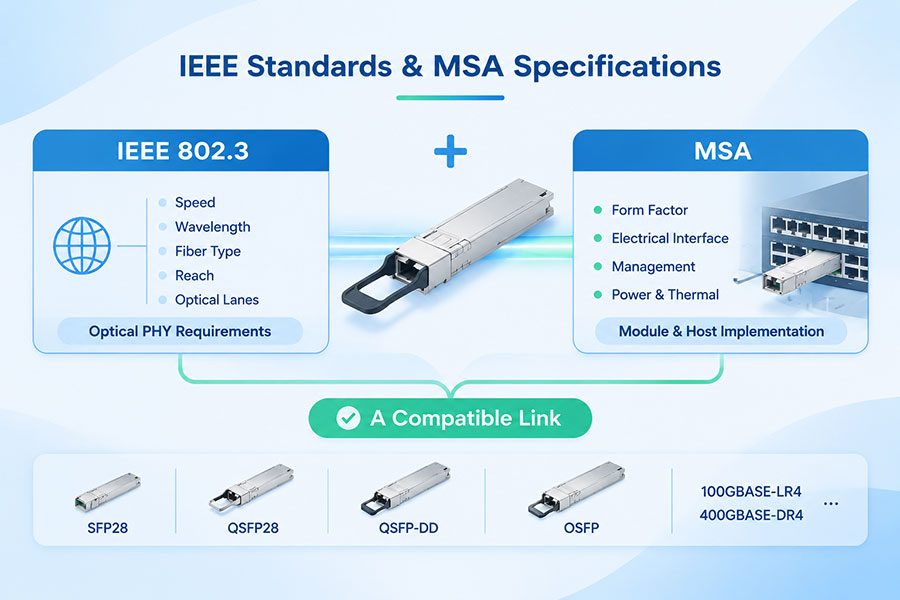
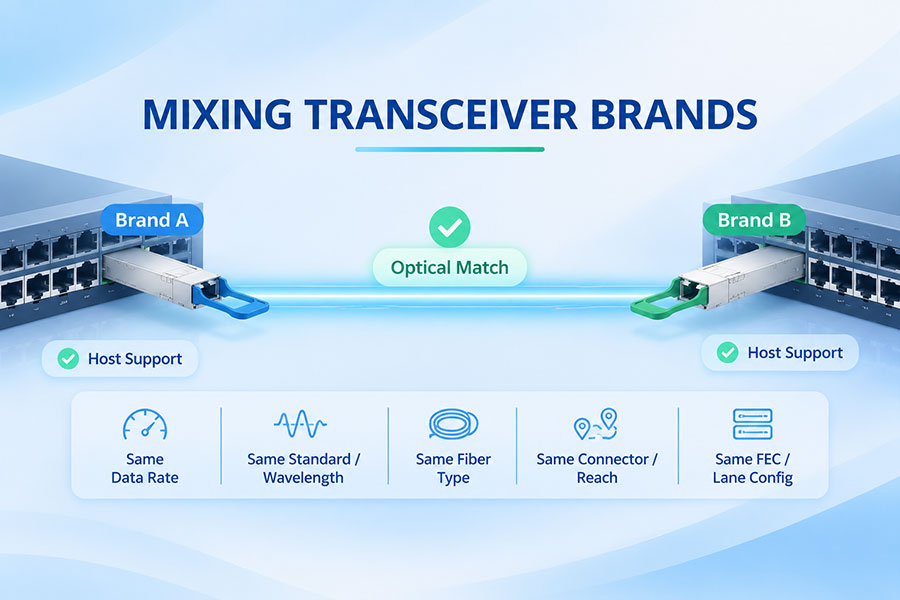
Interoperability: Confirm coding, supported protocols, host acceptance, and vendor-specific qualification requirements.
Monitoring: Use supported Digital Diagnostic Monitoring (DDM) functions to observe optical power, temperature, voltage, and other available parameters.
Resilience: Consider redundant paths, multiple network planes, link failure handling, and recovery behavior.
For large distributed training systems, network congestion and link imbalance can affect the completion time of collective operations. A well-designed physical layer is therefore only one part of the solution; routing, traffic distribution, and network software also matter.
9. C-LIGHT Optical Connectivity for GPU Fabric Infrastructure
GPU fabric deployments require a combination of high-speed optical transceivers, direct-attach cables, active electrical cables, and fiber assemblies. C-LIGHT provides connectivity products for data center and high-performance networking applications, including 400G, 800G, and 1.6T product categories.
400G DAC and AOC
400G DAC and AOC solutions support high-bandwidth short-reach connections in compatible data center switching environments. DAC is suited to short copper links, while AOC provides an integrated optical cable option.
800G DAC, AEC, ACC, and AOC
800G connectivity options support higher-capacity network designs. The choice between copper-based cables and optical cable assemblies depends on the connection distance, host interface, power budget, and system qualification.
1.6T OSFP-RHS Optical Transceivers
For next-generation high-density optical infrastructure, C-LIGHT offers 1.6T OSFP-RHS transceiver options. The product family includes 2DR4 and 2FR4 configurations for different single-mode fiber applications. Selection should be based on the required reach, connector arrangement, host platform, and optical specifications.
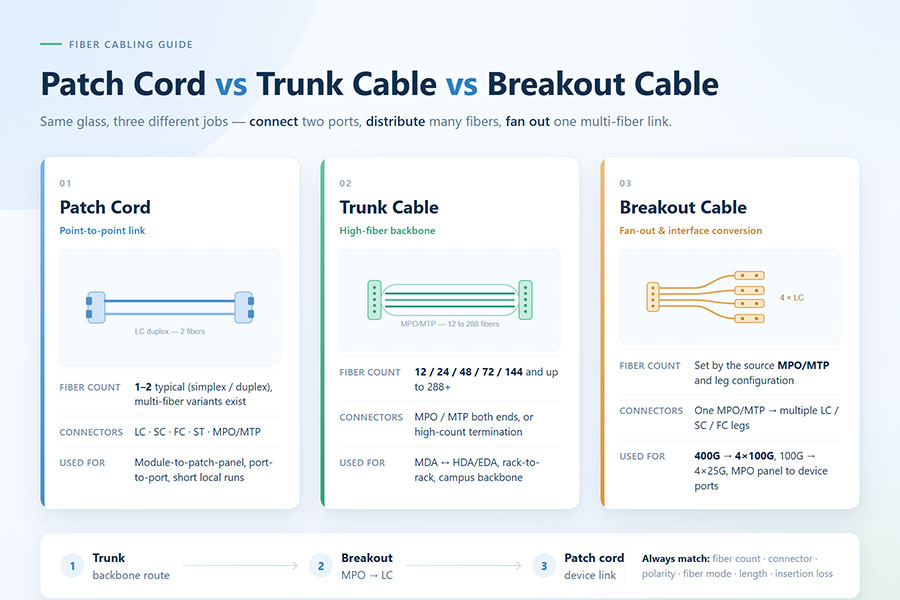
MPO and MTP Fiber Patch Cables
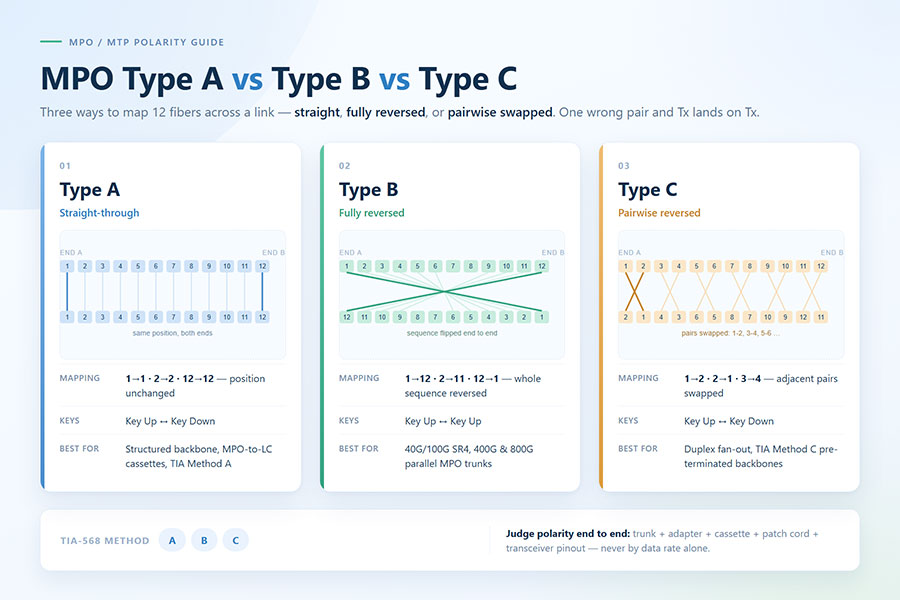
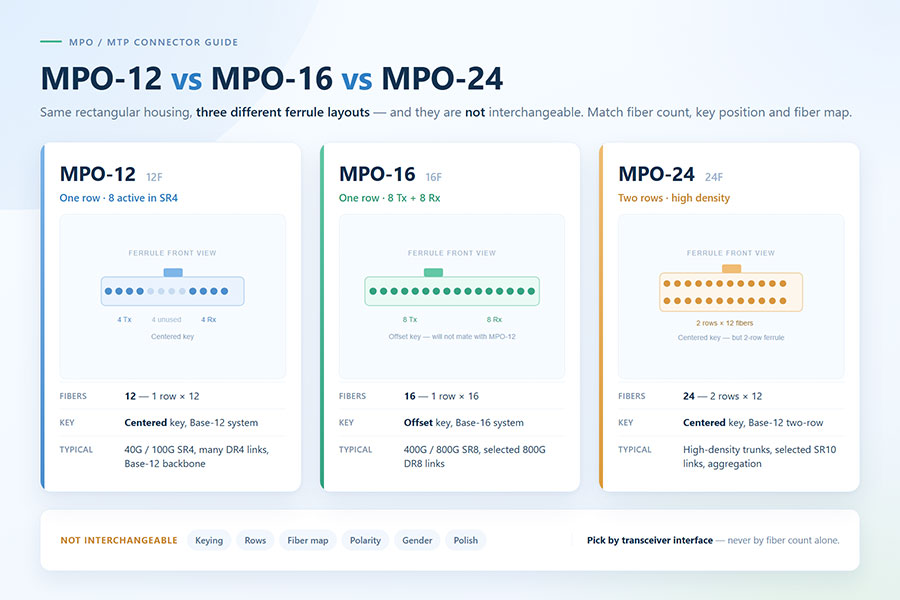
Parallel-fiber connectivity is important in high-density optical systems. C-LIGHT MPO and MTP fiber patch cables are available in multiple fiber-count configurations and fiber types for supported data center cabling applications. Connector polarity and fiber mapping must be verified before deployment.
For GPU fabric projects, module and cable selection should be confirmed against the exact switch, NIC, port type, firmware, and required optical reach. Contact C-LIGHT for product specifications and connectivity options for your network deployment.
10. The Future of GPU Fabrics and Optical Interconnects
GPU fabrics are evolving alongside accelerator performance, AI model size, and data center scale. Higher-speed Ethernet and InfiniBand platforms, denser switch architectures, and more advanced optical technologies are changing how large clusters are connected.
Several developments are shaping this evolution:
800G and 1.6T networking: Higher interface rates support increasing bandwidth requirements and more capable switching platforms.
Silicon photonics: Integrated photonic technologies are being developed to support higher optical bandwidth density and improve system-level interconnect efficiency.
Co-Packaged Optics: CPO places optical engines close to switch silicon, reducing the length of high-speed electrical connections inside the system.
Near-Packaged Optics: NPO brings optical interfaces closer to processing or switching components while retaining a different integration approach from CPO.
Advanced network fabrics: Improved congestion management, multi-plane topologies, and traffic engineering help maintain predictable performance as clusters expand.
These technologies do not eliminate the need for conventional pluggable optics or copper connections. Instead, GPU fabric infrastructure is likely to use a combination of interconnect technologies selected for different distances, bandwidth requirements, and system designs.
11. Conclusion
A GPU fabric connects accelerators into a coordinated computing system, enabling high-speed communication across GPUs, servers, and racks. Scale-up interconnects provide tightly coupled communication within accelerator domains, while scale-out networks connect multiple servers and racks through Ethernet or InfiniBand fabrics.
Optical connectivity is a key part of this architecture because it provides high-bandwidth links over distances that are difficult to support with conventional copper cabling. As AI clusters move toward 800G and 1.6T networking, optical transceivers, AOCs, fiber assemblies, and emerging integrated photonic technologies will continue to shape GPU fabric design.
The most effective architecture combines the right interconnect technology at each layer, with careful attention to bandwidth, latency, reach, compatibility, power, and network resilience.
 >

 >
 >
 >
 >
 >
 >
 >