TEL:+86 132 6656 7067




1. Introduction
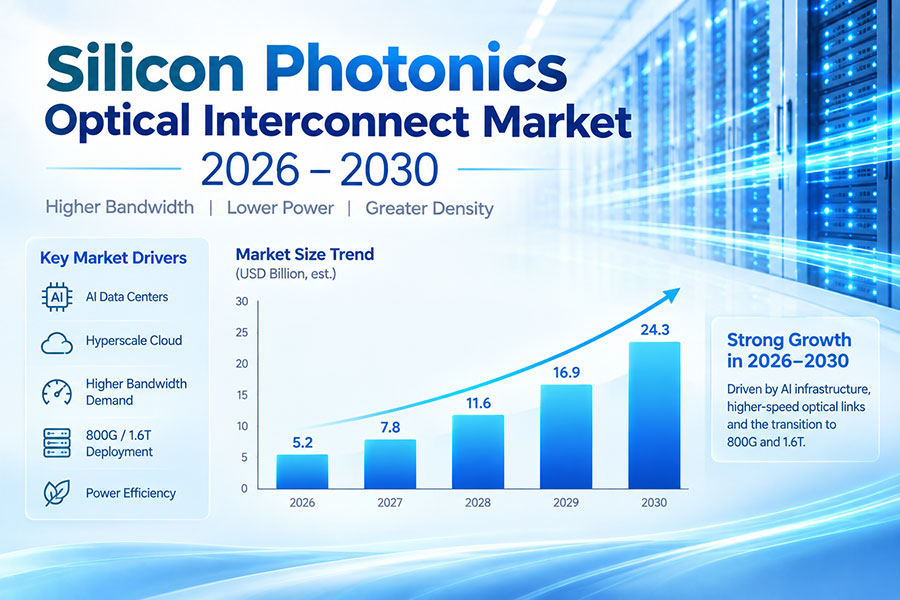
Silicon photonics is an optical technology that integrates photonic functions with silicon-based semiconductor manufacturing. It is increasingly important in high-speed data center networking because it can combine optical routing, modulation, wavelength management, and detection into compact photonic integrated circuits.
2. What Is Silicon Photonics?
Silicon photonics uses silicon-based photonic integrated circuits (PICs) to guide, modulate, combine, separate, and detect light. Instead of building every optical function from separate components, multiple functions can be integrated onto a single photonic platform.
3. Why Silicon Is Used for Photonics
Silicon is widely available and benefits from mature semiconductor manufacturing processes. At communication wavelengths, silicon can be used to build optical waveguides and other photonic structures while taking advantage of established semiconductor fabrication techniques.
4. Silicon Photonics vs Traditional Optics
| Feature | Silicon Photonics | Traditional Optical Architecture |
|---|---|---|
| Core Technology | Integrated photonic circuit | Discrete or separately packaged components |
| Waveguides | Integrated on PIC | Separate optical paths |
| Modulation | Integrated photonic modulator | Separate modulator or EML |
| WDM | Can be integrated | Often uses separate components |
| Manufacturing | Semiconductor-oriented | Component assembly |
| Integration | High | Varies by architecture |
5. What Is a Photonic Integrated Circuit?
A photonic integrated circuit is the optical equivalent of an integrated electronic circuit. It contains optical structures such as waveguides, modulators, splitters, filters, multiplexers, and photodetectors on a compact chip.
6. How Silicon Photonics Works
A simplified silicon photonics link follows:
Electrical Signal → Driver → Optical Modulator → Silicon Waveguide → Fiber
The receiving path reverses the process:
Fiber → Photodetector → TIA / Receiver → Electrical Signal
7. Optical Waveguides
Waveguides direct light through the silicon photonic circuit. They replace many of the discrete optical paths that would otherwise be required between individual optical components.
8. Optical Modulators
Optical modulators encode electrical information onto an optical carrier. Silicon photonic modulators can be integrated into the PIC, helping reduce the physical size of the optical engine and enabling multi-channel architectures.
9. Photodetectors
Photodetectors convert received optical signals into electrical signals. Silicon photonic platforms can integrate or closely couple photodetection with the PIC to create compact receiver architectures.
10. Silicon Photonics Does Not Create Light by Itself
Silicon photonics is primarily an optical integration technology. A practical optical engine still needs a light source, commonly provided by a semiconductor laser that may be external, hybrid-integrated, or integrated into the photonic platform.
11. Hybrid Silicon Lasers
Hybrid laser architectures combine silicon photonic structures with laser materials such as III-V semiconductors. This approach allows the photonic circuit to benefit from silicon integration while retaining an efficient optical light source.
12. External Laser Sources
Some optical engines use an external continuous-wave laser source. The laser supplies light to the silicon PIC, while the PIC performs modulation, routing, wavelength multiplexing, and other optical functions.
13. Integrated Lasers
More advanced silicon photonics platforms can integrate laser sources into the photonic manufacturing process. Integrated laser technology can simplify some optical coupling and enable wafer-level fabrication and testing.
14. Wavelength Division Multiplexing
Silicon photonics is well suited to wavelength division multiplexing because wavelength filters and multiplexers can be integrated into the PIC. Multiple optical channels can therefore share a fiber connection.
15. Optical Multiplexing
A multiplexer combines several optical wavelengths into a common optical path. In a silicon photonic engine, this function can be implemented directly within the photonic circuit.
16. Optical Demultiplexing
A demultiplexer separates incoming wavelengths into individual channels. Integrated demultiplexers can reduce the number of discrete optical components required in a high-density receiver.
17. Silicon Photonics and 100G
Silicon photonics has been used in 100G optical transceivers, including DR, FR, and LR architectures. Its integrated approach is useful where multiple optical channels must fit into a compact module.
18. Silicon Photonics and 400G
400G networking has increased the need for compact multi-channel optical engines. Silicon photonics can integrate multiple modulation, detection, and WDM functions and is therefore suitable for selected 400G architectures.
19. Silicon Photonics and 800G
At 800G, higher lane rates and greater port density increase pressure on optical integration, power, and thermal design. Silicon photonics provides one approach to building compact high-bandwidth optical engines.
20. Silicon Photonics and 1.6T
1.6T optical networking introduces 200G-class lane requirements in common architectures. Silicon photonics is being developed for these systems because integrated photonic circuits can support high channel density and scalable optical-engine designs.
21. PAM4 and Silicon Photonics
Silicon photonics can support PAM4-based optical links. PAM4 uses four signal levels to carry two bits per symbol, enabling higher data rates while increasing sensitivity to noise, distortion, and signal-integrity limitations.
22. Silicon Photonics and DSP
Silicon photonics does not automatically eliminate DSP. A complete silicon photonic transceiver can still contain DSP, CDR, drivers, TIAs, and controllers. Optical integration and digital signal processing are separate parts of the system architecture.
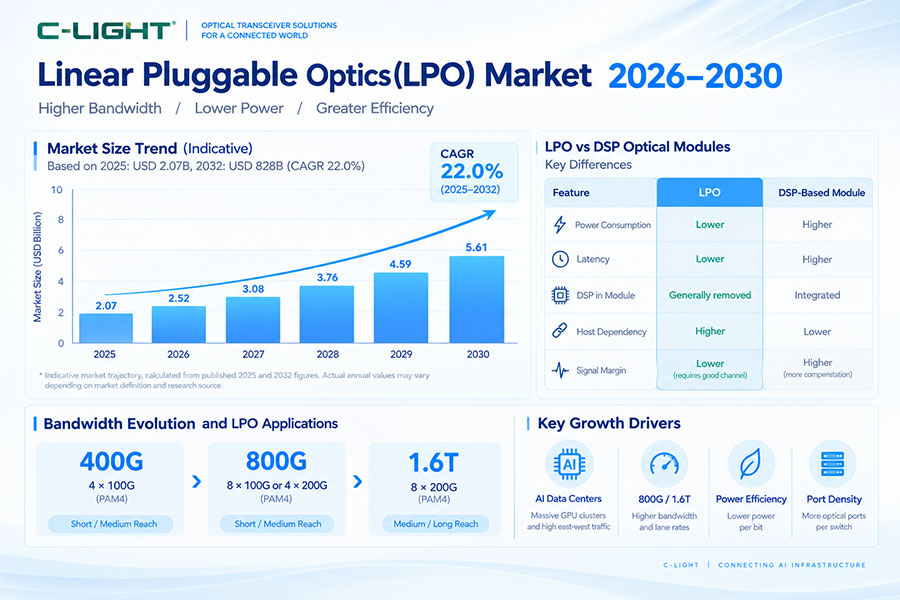
23. Silicon Photonics and LPO
LPO defines a more linear pluggable architecture that reduces or bypasses selected module-level signal processing. Silicon photonics defines the optical technology. A silicon photonic optical engine can therefore be used in an LPO module.
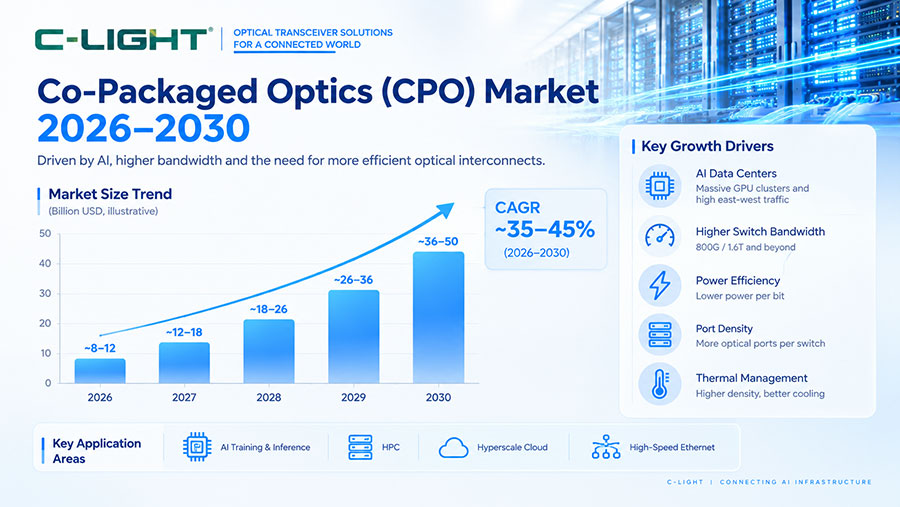
24. Silicon Photonics and CPO
CPO places optical engines close to switching silicon. Silicon photonics is one technology that can implement these optical engines. The two concepts are related but describe different layers of the system.
25. Silicon Photonics and Optical I/O
Silicon photonics is also relevant to optical I/O, where optical connections move closer to CPUs, GPUs, memory, or other compute devices. This can reduce the distance of high-speed electrical interconnects and support higher bandwidth density.
26. Power Consumption
Silicon photonics can reduce component count and improve integration, but it does not guarantee lower total module power. Laser efficiency, driver power, DSP, TIA, modulator design, control electronics, and thermal management all contribute to the final power budget.
27. Power per Bit
Power per bit is often more useful than total module power when comparing optical generations. A higher-bandwidth silicon photonic module may consume more absolute power while still improving energy efficiency per transmitted bit.
28. Thermal Management
High-speed silicon photonic modules still generate heat through lasers, drivers, receivers, DSPs, and other electronics. Heat sinks, heat spreaders, airflow, and liquid-based cooling can be considered according to the system architecture.
29. Packaging
Packaging is one of the most important parts of silicon photonics. The package must connect the PIC, laser, electronic ICs, fibers, and thermal structures while maintaining optical alignment and high-speed electrical performance.
30. Fiber Coupling
Light must be coupled efficiently between the silicon PIC and external optical fiber. Edge coupling, grating coupling, and other approaches can be used depending on the PIC and package design.
31. Optical Alignment
Optical alignment must remain stable during assembly, temperature changes, vibration, and long-term operation. Small coupling losses can have a noticeable effect on optical power and link margin.
32. Manufacturing
One important advantage of silicon photonics is the potential to use semiconductor-style wafer manufacturing for photonic circuits. This provides a scalable path for fabricating large numbers of integrated photonic devices.
33. Wafer-Level Testing
Integrated photonic circuits can be tested before final module assembly. Wafer-level testing can help identify defective PICs early and improve the efficiency of final optical-module manufacturing.
34. Manufacturing Yield
Manufacturing yield depends on PIC fabrication, laser integration, optical coupling, packaging, electrical assembly, and testing. High integration can reduce component count but increases the importance of precise process control.
35. Reliability
Silicon photonic reliability depends on the complete optical engine rather than the PIC alone. Laser lifetime, optical coupling, thermal cycling, electrical connections, package materials, and fiber interfaces all contribute to long-term performance.
36. Fiber Type
Silicon photonics is commonly associated with single-mode fiber and WDM applications, especially for medium- and long-reach connectivity. The actual fiber type depends on the specific optical engine and module architecture.
37. Short-Reach Applications
Silicon photonics can be used for short- and medium-reach data center applications where compact multi-channel optical integration is valuable. Traditional VCSEL-based solutions remain common for many short multimode links.
38. Long-Reach Applications
Silicon photonics can support longer single-mode links when paired with appropriate lasers, modulators, receivers, and signal processing. Transmission distance is determined by the complete optical system rather than the PIC technology alone.
39. AI Data Center Applications
AI data centers require high-bandwidth communication between GPUs, NICs, switches, and storage systems. Silicon photonics can support these environments through high-density optical engines designed for 400G, 800G, and 1.6T connectivity.
40. Silicon Photonics vs EML
| Category | Silicon Photonics | EML |
|---|---|---|
| Core Architecture | Integrated photonic circuit | Laser + electro-absorption modulator |
| Integration | High | Device-level integration |
| WDM | Can be integrated | Often combined with external mux |
| Typical Use | High-density multi-channel optics | Established high-speed single-mode optics |
| Laser | External, hybrid, or integrated | Integrated laser/modulator device |
41. Silicon Photonics vs VCSEL
| Category | Silicon Photonics | VCSEL |
|---|---|---|
| Typical Wavelength | Commonly 1310nm/1550nm-class architectures | Commonly 850nm-class |
| Fiber | Often SMF | Often MMF |
| Typical Reach | Short to longer | Short reach |
| Integration | High photonic integration | Laser-focused architecture |
| Typical Application | High-density optical engines | Short-reach data center links |
42. Common Misunderstandings
Silicon photonics is not a synonym for an optical module, LPO, or CPO. It is an optical integration technology. It also does not automatically determine module power, transmission distance, laser architecture, or whether DSP is required.
43. How to Evaluate Silicon Photonics
Evaluation should cover optical performance, bandwidth, lane rate, reach, wavelength architecture, laser source, power consumption, thermal design, packaging, fiber coupling, manufacturing yield, reliability, host compatibility, and total system cost.
44. Frequently Asked Questions
Q1. What is silicon photonics?
Q2. What is a silicon photonic optical engine?
Q3. Does silicon photonics include the laser?
Q4. Can silicon photonics support 400G?
Q5. Can silicon photonics support 800G and 1.6T?
Q6. Does silicon photonics always consume less power?
Q7. Is silicon photonics the same as LPO?
Q8. Is silicon photonics the same as CPO?
Q9. What are the main benefits of silicon photonics?
Q10. What are the main challenges of silicon photonics?
45. Summary
Silicon photonics integrates multiple optical functions into compact silicon-based photonic circuits and provides an important technology path for high-speed optical networking. It can combine waveguides, modulators, multiplexers, photodetectors, and other photonic functions while working with external, hybrid, or integrated laser sources. The technology is relevant to 400G, 800G, 1.6T, AI data center optics, optical engines, LPO, CPO, and emerging optical I/O architectures. Its main strengths are integration, multi-channel scalability, and compatibility with semiconductor manufacturing approaches. However, silicon photonics does not automatically determine power, reach, cost, or reliability. Laser integration, fiber coupling, packaging, thermal management, manufacturing yield, testing, and host-system compatibility remain critical to the final optical solution.
 >
>

 >
>
 >
>
 >
>
 >
>
 >
>
 >
>
 >
>