TEL:+86 132 6656 7067





AI clusters need more than powerful GPUs. They also need fast communication paths between processors inside a computing system and between separate servers across a data center. Scale-up and scale-out networking address these two levels of connectivity. Understanding their roles helps engineers design AI infrastructure with the right balance of bandwidth, latency, expansion capacity, and operational flexibility.
1. Scale-Up and Scale-Out: Two Different Networking Goals
Scale-up networking increases the computing capacity of a tightly integrated system by connecting multiple GPUs or accelerators through a high-bandwidth, low-latency interconnect. The goal is to let the processors communicate efficiently as parts of a larger computing domain.
Scale-out networking expands computing capacity by connecting multiple servers, racks, or groups of accelerators. It provides the network fabric needed for distributed training and other workloads that run across many computing nodes.
| Characteristic | Scale-Up | Scale-Out |
|---|---|---|
| Primary purpose | Connect GPUs within a tightly integrated computing domain | Connect multiple servers and computing systems |
| Typical scope | Server, GPU tray, or rack-scale system | Multiple servers, racks, and cluster sections |
| Main priority | High bandwidth and low communication latency | Scalability, aggregate bandwidth, and network efficiency |
| Common technologies | NVLink, NVSwitch, AMD Infinity Fabric and other accelerator interconnects | InfiniBand and Ethernet with RoCEv2 |
| Typical topology | Direct or switched accelerator interconnect | Leaf-spine or other multi-tier network fabrics |
| Expansion approach | Increase the size of a tightly coupled computing domain | Add servers, racks, and network capacity |
2. How Scale-Up Networking Connects GPUs
Scale-up networking focuses on communication among accelerators that work closely together. During AI training, GPUs may exchange model parameters, intermediate results, and other data many times during a training iteration.
When communication between GPUs is frequent, the interconnect must provide sufficient bandwidth and predictable latency. A high-performance scale-up fabric helps reduce the communication overhead associated with parallel computing.
Common scale-up technologies
NVIDIA NVLink: A high-speed interconnect designed for communication among supported NVIDIA GPUs and other system components.
NVIDIA NVSwitch: A switching technology that creates larger GPU communication domains in supported systems.
AMD Infinity Fabric: AMD's interconnect technology for communication among supported CPUs and GPUs.
Other accelerator fabrics: Different vendors and platforms may use dedicated interconnect technologies to connect processors within a system or rack.
Some modern rack-scale systems extend the scale-up domain beyond a traditional server chassis. The exact number of GPUs, interconnect topology, and physical reach depend on the platform architecture.
3. How Scale-Out Networking Connects AI Servers
Scale-out networking connects separate GPU servers so that a training workload can be distributed across a larger cluster. Each server has its own processors, memory, and network interfaces, while the fabric carries communication between computing nodes.
For example, a model may be divided across several GPU servers. These servers exchange gradients, activations, parameters, or other distributed data through the scale-out network.
Common scale-out technologies
InfiniBand: A high-performance networking technology widely used in HPC and AI clusters.
Ethernet with RoCEv2: Uses Ethernet infrastructure to support Remote Direct Memory Access for high-performance distributed communication.
High-speed NICs and SuperNICs: Provide the server-side network interfaces that connect GPU systems to the cluster fabric.
Optical transceivers and cables: Provide connectivity between servers and switches, particularly when electrical cable reach or routing density becomes a constraint.
In a leaf-spine design, server-facing leaf switches connect to spine switches through high-capacity uplinks. This structure supports communication between racks and can be expanded by adding network capacity and additional computing nodes.
4. Scale-Up vs. Scale-Out: How Data Moves
The difference becomes clearer when looking at a distributed AI training workload. A model may use several GPUs within one server or rack and also distribute work across multiple servers.
| Communication example | Networking layer | What happens |
|---|---|---|
| GPU 1 exchanges data with GPU 2 in the same computing domain | Scale-Up | Accelerators communicate through their supported local interconnect fabric. |
| GPUs within one rack communicate through a rack-scale fabric | Scale-Up, depending on system design | A larger tightly coupled GPU domain supports parallel computation. |
| GPU server in Rack A exchanges gradients with a server in Rack B | Scale-Out | Traffic travels through NICs and the cluster network fabric. |
| Additional GPU servers are added to the training cluster | Scale-Out | New nodes join the distributed computing environment. |
Actual communication paths depend on the GPU platform, topology, software framework, and parallelization strategy. Some systems also use additional network layers for storage, management, and external application traffic.
5. Why AI Clusters Need Both Architectures
Scale-up and scale-out are complementary. A large GPU domain can provide efficient communication among closely connected accelerators, while scale-out allows the infrastructure to grow beyond the capacity of one system or rack.
Scale-up supports tightly coupled GPU workloads
Model parallelism and other communication-intensive operations may require frequent exchanges among GPUs. A suitable scale-up fabric provides the bandwidth and latency characteristics needed for these interactions.
Scale-out supports larger distributed workloads
Data parallelism and distributed training can spread computation across many servers. Scale-out networking provides the connectivity required for synchronization and data exchange between those nodes.
The combined architecture
A large AI deployment can use scale-up inside each computing rack and scale-out between racks. This allows the system to combine tightly integrated GPU communication with cluster-wide expansion.
6. The Role of Optical Transceivers in Scale-Out Networks
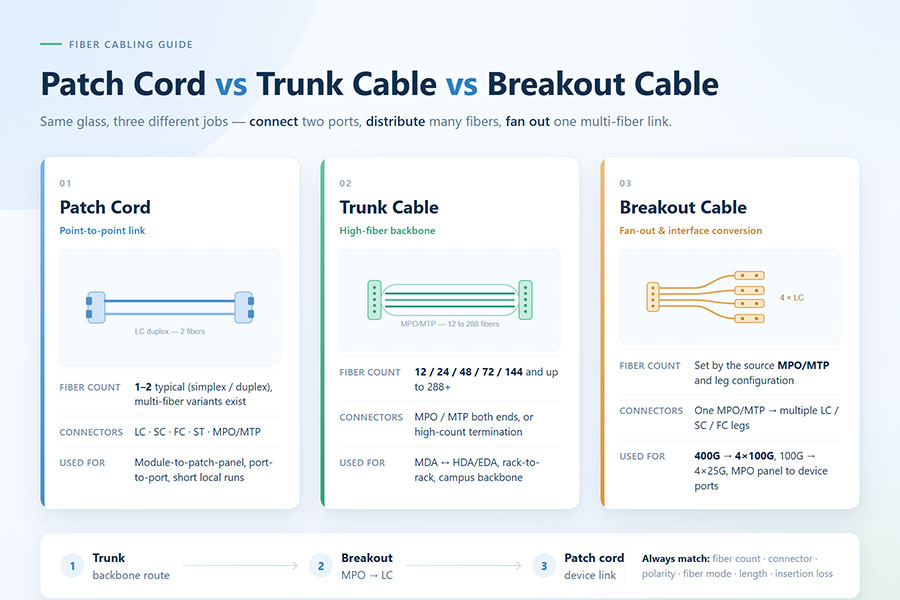
Optical transceivers are particularly important in scale-out infrastructure because connections often extend between servers, racks, and network switches. Fiber provides a practical way to support high data rates over distances that may be difficult to serve with passive copper cables.
Common optical and cable choices include:
| Connectivity type | Typical application | Selection considerations |
|---|---|---|
| DAC | Short connections between compatible equipment | Port type, cable length, power, and signal support |
| AEC | Supported high-speed electrical links requiring active signal conditioning | Host compatibility, reach, and power |
| AOC | Integrated optical cable connections | Reach, connector type, and endpoint compatibility |
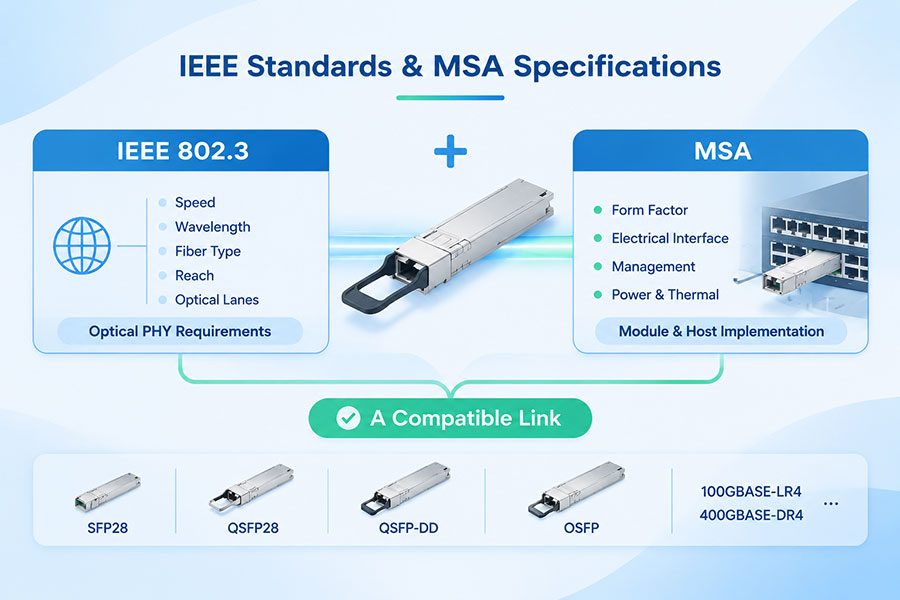
| Pluggable optical transceivers | Fiber links between switches and servers or between switches | Optical standard, wavelength, fiber type, connector, and link budget |
400G and 800G in scale-out fabrics
As AI clusters grow, higher-speed interfaces help increase bandwidth per switch port. 400G and 800G links can be used in supported network designs to connect leaf and spine switches or other high-capacity network endpoints.
The correct data rate depends on switch capacity, NIC interfaces, traffic patterns, oversubscription targets, and the number of network paths. An 800G interface is not automatically necessary for every server connection.
Optical modules used in scale-out networks must also match the host platform and protocol. Ethernet and InfiniBand compatibility should be verified by exact equipment model and module specification rather than inferred from the data rate alone.
7. Key Engineering Considerations
Designing a balanced AI network requires more than selecting high-bandwidth components. Engineers need to evaluate both the internal accelerator fabric and the network connecting separate computing systems.
Bandwidth balance
The scale-up fabric and scale-out network should provide sufficient capacity for the communication patterns generated by the workload. A bottleneck at either layer can reduce overall system efficiency.
Latency and congestion
Frequent synchronization can make communication delays particularly important. Scale-out fabrics need appropriate congestion control, routing, and traffic management to maintain predictable performance.
Topology and oversubscription
The number of server-facing ports, uplink capacity, network planes, and available paths affects the performance of the complete cluster. A leaf-spine topology should be sized around expected traffic rather than GPU count alone.
Power and thermal management
High-speed NICs, switches, and optical modules contribute to system power and heat. Dense AI racks need appropriate airflow, cooling capacity, and monitoring.
Interoperability
GPU interconnects, NICs, switches, transceivers, and cables must be validated as a complete system. Matching connector shapes or advertised data rates does not guarantee interoperability.
8. C-LIGHT Connectivity Products for AI Scale-Out Networks
C-LIGHT offers high-speed interconnect products for data center and AI networking applications. DAC, AEC, ACC, AOC, and optical transceiver solutions can serve different connection points in a scale-out network, depending on the equipment platform and transmission distance.
800G Connectivity
800G DAC – copper connectivity for compatible short-reach applications.
800G AEC – active electrical cable connectivity for supported systems.
800G ACC – active copper cable options for compatible high-speed links.
800G AOC – integrated optical cable connectivity for supported endpoints.
400G Connectivity
400G DAC – short-distance copper interconnects for compatible 400G ports.
400G AOC – optical cable assemblies for supported 400G connections.
Optical Transceiver Portfolio
C-LIGHT Optical Transceivers – pluggable optical connectivity for different data rates, form factors, and reach requirements.
For a scale-out deployment, product selection should consider switch and NIC models, Ethernet or InfiniBand protocol, port configuration, link distance, fiber type, and host compatibility.
9. Conclusion
Scale-up and scale-out networking form two essential layers of modern AI infrastructure. Scale-up connects GPUs within a tightly integrated computing domain, emphasizing high bandwidth and low latency. Scale-out connects servers and racks, enabling distributed training to expand across a larger cluster.
Neither layer replaces the other. A scalable AI architecture needs an efficient accelerator interconnect as well as a high-capacity external network. Optical transceivers and high-speed cables play an important role in scale-out connectivity, while dedicated accelerator interconnect technologies serve the scale-up domain.
 >

 >
 >
 >
 >
 >
 >
 >