TEL:+86 132 6656 7067




1. Introduction
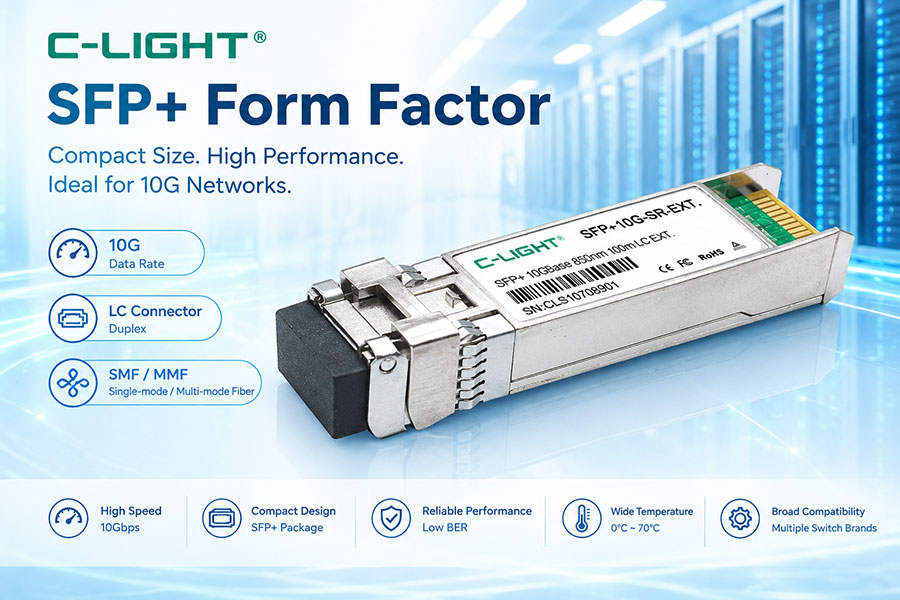
SFP+ stands for Enhanced Small Form-factor Pluggable. It is a compact, hot-pluggable transceiver form factor developed for higher-speed networking, most commonly 10GbE and 10Gb/s-class Fibre Channel applications. SFP+ keeps a compact footprint while providing a significantly faster electrical interface than the original SFP.
2. What Is the SFP+ Form Factor?
The SFP+ form factor defines the mechanical and electrical interface between a pluggable module and its host system. The SFF-8431 specification defines the high-speed electrical interface, while related SFF specifications cover the module, cage, connector, and management functions.
3. Why SFP+ Was Developed
The original SFP form factor was widely used for lower-speed networking. As 10Gbps networking became common, SFP+ provided a way to increase bandwidth without moving to a much larger module package.
4. SFP+ Mechanical Design
SFP+ uses a compact metal housing that fits into a compatible host cage. A front optical or copper interface provides the network connection, while a card-edge connector at the rear provides the electrical connection to the host board.
5. SFP+ Module and Cage
The SFP+ module and cage are designed as a matched mechanical system. The cage provides retention, shielding, grounding, and mechanical alignment, while the module provides the transceiver electronics and external media interface.
6. SFP+ Dimensions
SFP+ uses a small footprint closely related to the original SFP family. The applicable mechanical specifications define the module envelope, cage dimensions, connector position, and tolerances required for reliable insertion and removal.
7. SFP+ Electrical Interface
The SFP+ host interface uses a high-speed serial electrical connection commonly known as SFI. The interface was designed for high-speed differential signaling with the electrical channel extending between the host ASIC or PHY and the transceiver.
8. 20-Contact Electrical Connector
SFP+ uses a 20-position electrical connector with a 0.8mm pitch. The contacts carry power, ground, high-speed transmit and receive signals, and lower-speed management and control functions.
9. Hot-Pluggable Operation
SFP+ modules are hot-pluggable, allowing supported equipment to insert or remove modules while the host remains powered. This simplifies maintenance, upgrades, and network expansion.
10. Optical and Copper SFP+
SFP+ is not limited to optical modules. The form factor can be used for optical transceivers, copper transceivers, and active cable applications. This flexibility allows the same host cage architecture to support different physical media.
11. Optical SFP+ Modules
Optical SFP+ modules convert electrical data from the host into optical signals and perform the reverse conversion on the receive side. Common implementations include multimode and single-mode modules with different wavelengths and transmission distances.
12. Copper SFP+ Modules
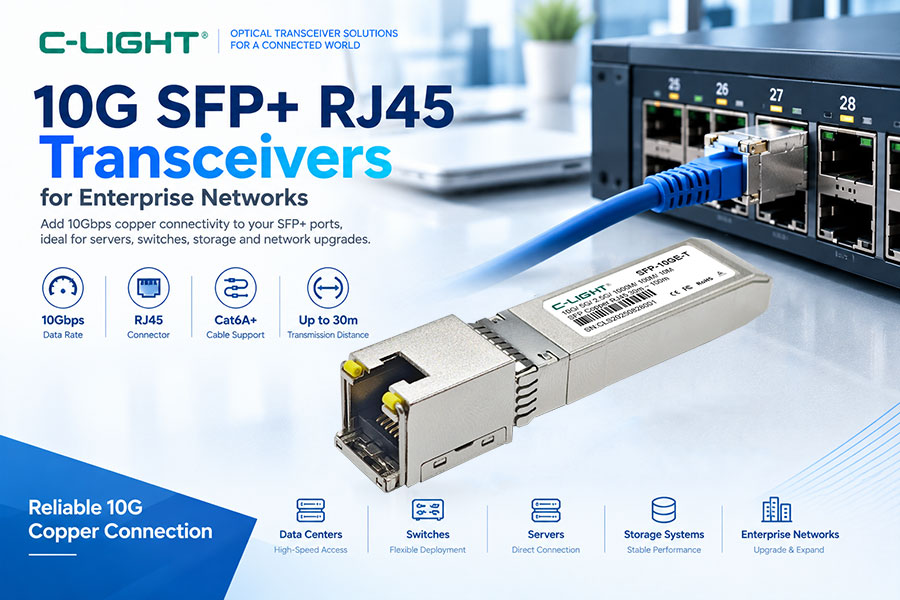
Copper SFP+ modules provide electrical networking through the SFP+ cage. A common example is 10GBASE-T SFP+, which uses an RJ45 connector and twisted-pair copper cabling rather than optical fiber.
13. SFP+ Optical Wavelengths
SFP+ optical modules can use different wavelengths depending on the application. Common implementations include 850nm multimode, 1310nm single-mode, and 1550nm-class designs.
14. SFP+ and Multimode Fiber
Short-reach 10G SFP+ modules commonly use 850nm VCSEL technology with multimode fiber. The actual reach depends on the fiber grade, transceiver specification, and link conditions.
15. SFP+ and Single-Mode Fiber
Single-mode SFP+ modules are used when longer transmission distances are required. 1310nm and 1550nm-class optical solutions are available for different reach and network requirements.
16. SFP+ Data Rate
SFP+ was primarily designed around 10Gb/s-class serial electrical and optical applications. The SFF-8431 specification defines the high-speed interface for 10Gb/s SFP+ modules and hosts, while some implementations support lower signaling rates.
17. SFP+ and 10GbE
10GbE is one of the most common applications for SFP+. Modules such as 10GBASE-SR, 10GBASE-LR, 10GBASE-ER, and copper 10GBASE-T use the compact SFP+ interface with different media and reach characteristics.
18. SFP+ and Fibre Channel
SFP+ is also widely associated with high-speed Fibre Channel applications. The same compact mechanical concept can support different protocol and optical requirements depending on the host equipment and module specification.
19. Main Components Inside an SFP+
A typical optical SFP+ contains a laser, photodetector, driver, receiver circuitry, control electronics, power-management components, and optical coupling structures. More advanced modules may also include additional signal-conditioning functions.
20. Transmitter Section
The transmitter converts the host electrical signal into an optical signal. VCSELs are common for short multimode links, while DFB and other laser technologies are used for longer single-mode applications.
21. Receiver Section
The receiver uses a photodetector to detect incoming light. A transimpedance amplifier converts the detector current into a usable electrical signal before subsequent processing.
22. SFP+ Management Interface
SFP+ modules include low-speed management and control functions in addition to the high-speed data interface. The host can access module identification and operating information through the management interface.
23. EEPROM and Module Identification
Module memory can contain vendor information, part number, serial number, wavelength, supported capabilities, and diagnostic parameters. Host devices use this information for identification and monitoring.
24. Digital Diagnostic Monitoring
Many SFP+ modules support digital diagnostic monitoring. Depending on the implementation, parameters such as temperature, supply voltage, laser bias, transmit power, and receive power can be monitored.
25. Connector Options
LC duplex is common for dual-fiber SFP+ optical modules. BiDi SFP+ modules generally use a single LC interface and separate transmit and receive wavelengths. Copper SFP+ modules can use RJ45 connectors.
26. SFP+ Electrical Channel
Because SFP+ operates at high serial data rates, the electrical path between the host ASIC and module is important. PCB loss, connector characteristics, impedance discontinuities, and signal reflections can affect link quality.
27. Host Signal Integrity
SFP+ was designed to leverage host-side signal conditioning such as transmitter pre-emphasis and receiver equalization. This architecture helps compensate for electrical channel impairments between the host and module.
28. Power Consumption
SFP+ power consumption varies with the optical technology, transmission distance, laser, driver, receiver, monitoring functions, and copper or optical architecture. Copper 10GBASE-T modules can have different power requirements from optical SFP+ modules.
29. Thermal Management
Although SFP+ is relatively compact, its components still generate heat. The host cage, module housing, airflow, and thermal interface should maintain the operating temperature required by the selected transceiver.
30. SFP+ Link Budget
For optical SFP+, reliable transmission depends on the complete optical link budget. Transmitter output power, fiber attenuation, connector loss, splice loss, and receiver sensitivity determine the available optical margin.
31. SFP+ vs SFP
| Feature | SFP | SFP+ |
|---|---|---|
| Common Speed | 1G-class applications | 10G-class applications |
| Form Factor | Compact pluggable | Similar compact pluggable |
| Electrical Interface | Lower-speed host interface | High-speed SFI interface |
| Typical Applications | Enterprise, access, telecom | 10GbE, storage, data center |
32. SFP+ vs SFP28
SFP28 keeps the general SFP-family mechanical concept but is designed for 25Gbps-class applications. The higher electrical speed requires different signal-integrity and host-interface requirements, so mechanical similarity does not guarantee operational compatibility.
33. SFP+ vs XFP
SFP+ and XFP are both associated with 10Gbps networking, but SFP+ is physically smaller. SFP+ also uses a different host architecture and places more high-speed signal-processing responsibility on the host compared with earlier 10G module approaches.
34. SFP+ vs QSFP+
SFP+ is a single-lane pluggable architecture, while QSFP+ uses multiple electrical and optical lanes within a larger quad-channel form factor. QSFP+ is therefore suited to higher aggregate bandwidth and parallel optical transmission.
35. SFP+ Compatibility
Compatibility depends on more than the physical cage. Data rate, wavelength, fiber type, transmission distance, electrical interface, module coding, firmware, connector type, and host-port support should all be checked.
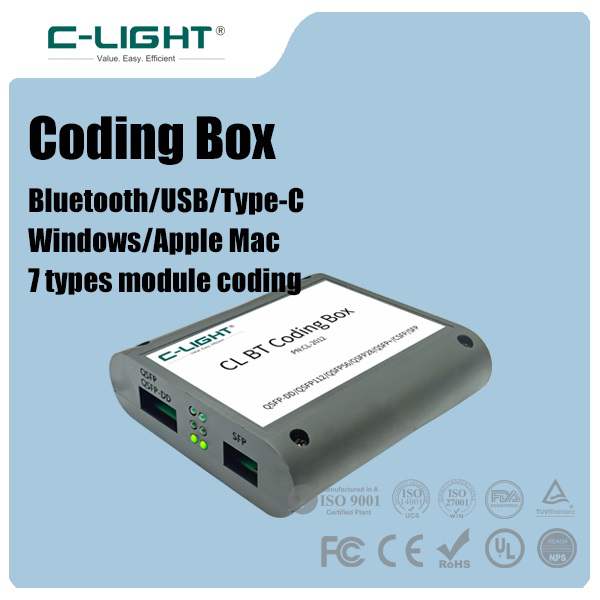
36. Module Coding
Some network equipment uses vendor or application-specific coding to determine whether a module is accepted. Proper EEPROM information and coding can therefore be important when deploying third-party or replacement SFP+ modules.
37. SFP+ in Data Center Networks
SFP+ remains useful for server connections, access switches, aggregation links, storage networks, and other 10GbE applications. Its compact size allows high port density while maintaining replaceable transceiver interfaces.
38. SFP+ in Enterprise Networks
Enterprise networks use SFP+ for switch uplinks, fiber distribution, campus aggregation, and server connectivity. Different optical reaches allow the same basic form factor to support both short and longer links.
39. SFP+ in Network Upgrades
SFP+ can provide a practical path from lower-speed SFP networking to 10GbE without requiring a completely different front-panel module architecture. The host equipment must still support the required electrical and protocol configuration.
40. Advantages of the SFP+ Form Factor
SFP+ combines a compact footprint, hot-pluggable operation, flexible optical and copper media options, high port density, and broad use across 10GbE and storage networking environments.
41. Limitations of the SFP+ Form Factor
SFP+ is optimized for 10Gbps-class networking and is not intended to provide the aggregate bandwidth of newer multi-lane form factors. Higher-speed applications increasingly use SFP28, SFP56, SFP-DD, QSFP28, QSFP-DD, QSFP112, and OSFP architectures.
42. SFP+ and Network Evolution
The SFP+ form factor established an important transition from 1G-class SFP to higher-speed pluggable networking. Later generations maintained similar concepts while increasing lane speed, bandwidth, and port density.
43. When to Choose SFP+
SFP+ is appropriate when a network requires compact, replaceable 10GbE-class interfaces using optical fiber, copper, or active cables. The final module should be selected according to host capability, media, reach, power, and compatibility requirements.
44. Frequently Asked Questions
Q1. What is the SFP+ form factor?
Q2. Is SFP+ the same size as SFP?
Q3. What electrical interface does SFP+ use?
Q4. Is SFP+ hot-pluggable?
Q5. Can SFP+ use RJ45 copper?
Q6. What optical wavelengths are used by SFP+?
Q7. Is SFP+ compatible with SFP28?
Q8. What should be checked before choosing an SFP+?
45. Summary
The SFP+ form factor provides a compact and hot-pluggable platform for 10GbE, Fibre Channel, copper, optical, and active cable applications. Its mechanical design is closely related to the original SFP, while its high-speed SFI electrical interface supports 10Gb/s-class networking. Optical SFP+ modules are available for multimode and single-mode fiber, while copper versions can provide RJ45 connectivity. Reliable deployment depends on electrical signal integrity, optical link budget, host compatibility, module coding, thermal conditions, and the specific requirements of the network.
 >
>

 >
>
 >
>
 >
>
 >
>
 >
>
 >
>
 >
>