TEL:+86 132 6656 7067




1. Introduction
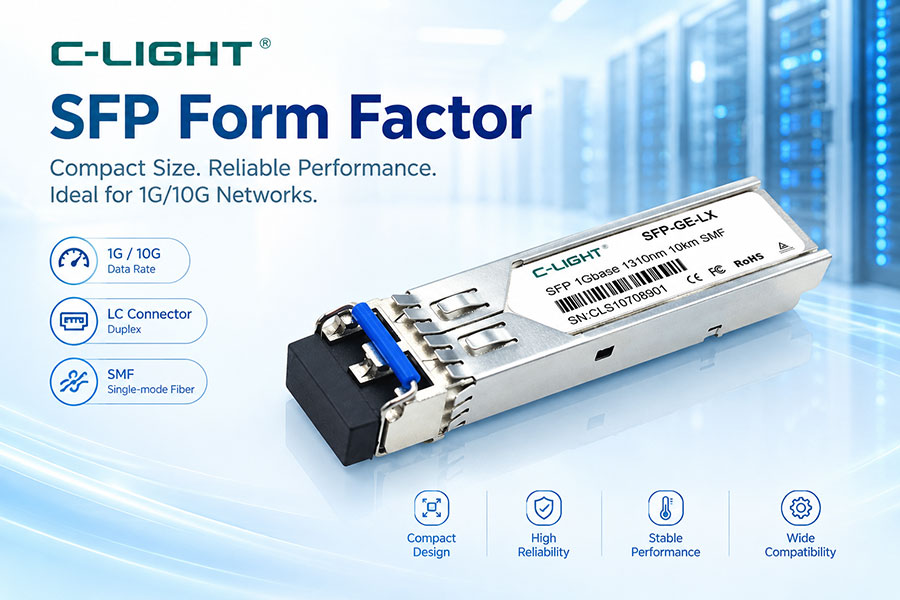
SFP stands for Small Form-factor Pluggable. It is a compact, hot-pluggable transceiver form factor widely used in Ethernet, Fibre Channel, SONET, and other networking systems. Its small physical size allows network equipment to support high port density while keeping transceivers replaceable.
2. What Is the SFP Form Factor?
The SFP form factor defines the mechanical, electrical, and interface characteristics of a compact pluggable transceiver. The original SFP MultiSource Agreement (MSA) established a common package and host interface so modules from different manufacturers could be designed around a common form factor.
3. Why Was SFP Developed?
Earlier optical transceivers were often larger and less convenient to replace. SFP reduced the size of the optical interface and made transceivers easier to install, remove, upgrade, and maintain in switches, routers, storage systems, and communication equipment.
4. SFP Mechanical Design
An SFP module uses a compact metal or metal-and-plastic housing with a standard host connector, optical interface, and latch mechanism. The mechanical envelope is defined by the SFP specifications, allowing the module to fit into a compatible SFP cage.
5. Typical SFP Dimensions
The original SFP MSA defines a package approximately 13.4 mm wide and 8.5 mm high at the rear, with an overall module length of roughly 56.5 mm depending on the specific mechanical reference points. Exact dimensions and tolerances are controlled by the applicable mechanical specification.
6. SFP Cage and Host Interface
The SFP cage is mounted on the host PCB and provides mechanical retention, grounding, shielding, and thermal contact. The transceiver slides into the cage and mates with the electrical connector on the host board.
7. Electrical Connector
The original SFP interface uses a 20-contact electrical connector. These contacts provide power, ground, high-speed transmit and receive signals, module identification, status, and control functions.
8. Hot-Pluggable Design
A major advantage of SFP is hot-pluggability. A compatible module can generally be inserted or removed without shutting down the complete networking device, provided the host equipment supports hot-swapping and the proper operational procedures are followed.
9. Optical Interface
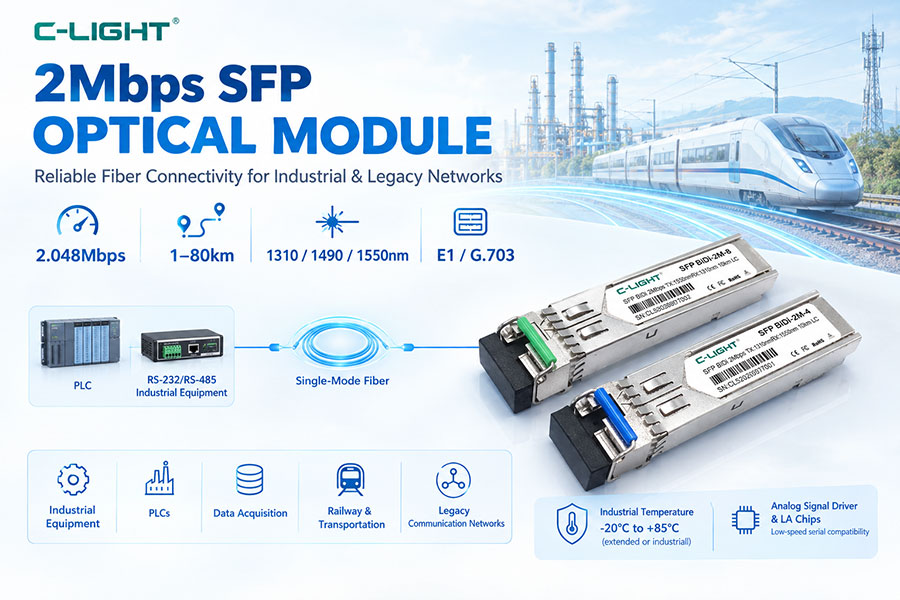
SFP modules can use different optical connector configurations depending on the application. LC duplex is common for two-fiber optical links, while BiDi SFPs use a single LC interface with separate transmit and receive wavelengths.
10. SFP Electrical-to-Optical Conversion
An optical SFP converts electrical data from the host into an optical signal for transmission. On the receive side, the optical signal is detected and converted back into an electrical signal for the host device.
11. Main Components Inside an SFP
A typical optical SFP contains a transmitter, receiver, optical components, driver and receiver circuitry, monitoring functions, power-management circuitry, and a small printed circuit board. The exact architecture depends on the speed, wavelength, and transmission distance.
12. Transmitter Section
The transmitter converts the host electrical signal into an optical signal. Depending on the module type, the light source may be a VCSEL, Fabry-Perot laser, DFB laser, or another appropriate semiconductor laser.
13. Receiver Section
The receiver uses a photodetector to convert incoming light into an electrical signal. A transimpedance amplifier and additional signal-conditioning circuitry then prepare the signal for the host interface.
14. SFP Management Interface
SFP modules provide low-speed management and identification functions through the electrical interface. The host can access module information such as identification data, operating parameters, and diagnostic information depending on the module implementation.
15. EEPROM and Identification Data
Module memory can store information including vendor identification, part number, serial number, wavelength, supported characteristics, and other configuration data. This information helps network equipment identify and manage the installed transceiver.
16. SFP Optical Wavelengths
SFP modules are available across different optical bands. Common implementations include 850nm multimode modules and 1310nm or 1550nm single-mode modules, depending on the required reach and network architecture.
17. SFP Multimode Applications
Multimode SFPs are commonly used for shorter optical links. 850nm VCSEL-based modules are widely associated with multimode fiber and applications inside data centers and enterprise networks.
18. SFP Single-Mode Applications
Single-mode SFPs are designed for longer-distance transmission and commonly use 1310nm or 1550nm-class optical sources. They can support applications ranging from several kilometers to much longer distances depending on the optical design.
19. SFP Data Rates
The original SFP form factor was designed around lower-speed networking applications compared with modern SFP+ and SFP28 generations. Typical SFP products are associated with 1G-class Ethernet and related applications, although the physical form factor can support different implementations defined by specific standards.
20. SFP vs SFP+
| Feature | SFP | SFP+ |
|---|---|---|
| Common Application | 1G Ethernet and related systems | 10GbE and related systems |
| Form Factor | Compact SFP | Similar compact SFP form factor |
| Electrical Speed | Lower-speed electrical interface | Higher-speed SFI interface |
| Typical Use | Access, enterprise, telecom | Data center, storage, aggregation |
21. SFP vs SFP28
SFP28 keeps a similar physical concept but is designed for higher-speed applications, commonly around 25Gbps. Although the external form factor is closely related, the electrical interface, signal integrity requirements, and host compatibility are different.
22. SFP Backward Compatibility
Physical compatibility does not always mean operational compatibility. A device may accept an SFP module mechanically but still require a specific data rate, electrical specification, coding profile, or firmware configuration.
23. SFP and RJ45 Copper
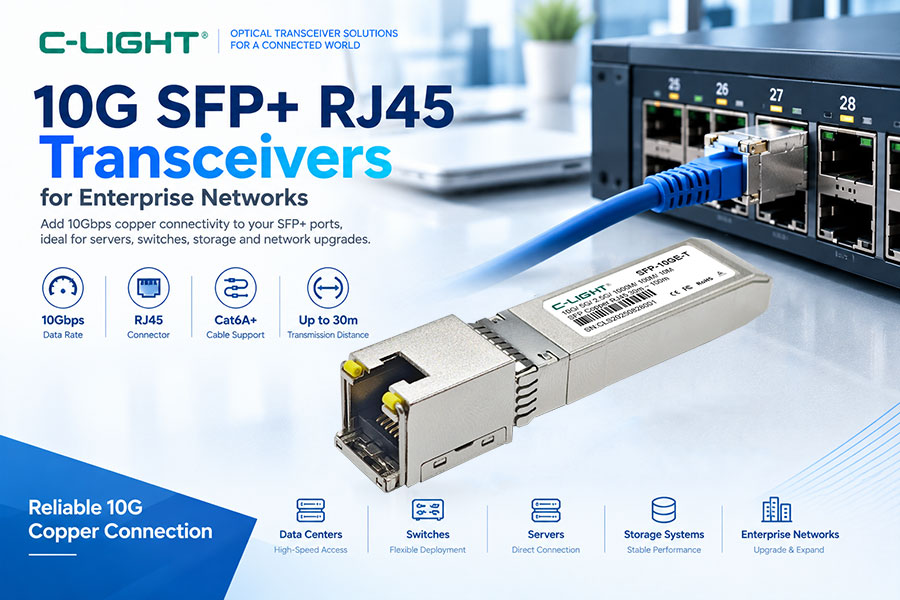
SFP is not limited to optical transceivers. Copper SFP modules can provide Ethernet connectivity through electrical interfaces such as RJ45, making the SFP cage useful for both fiber and copper networking applications.
24. SFP DAC and Active Cable Applications
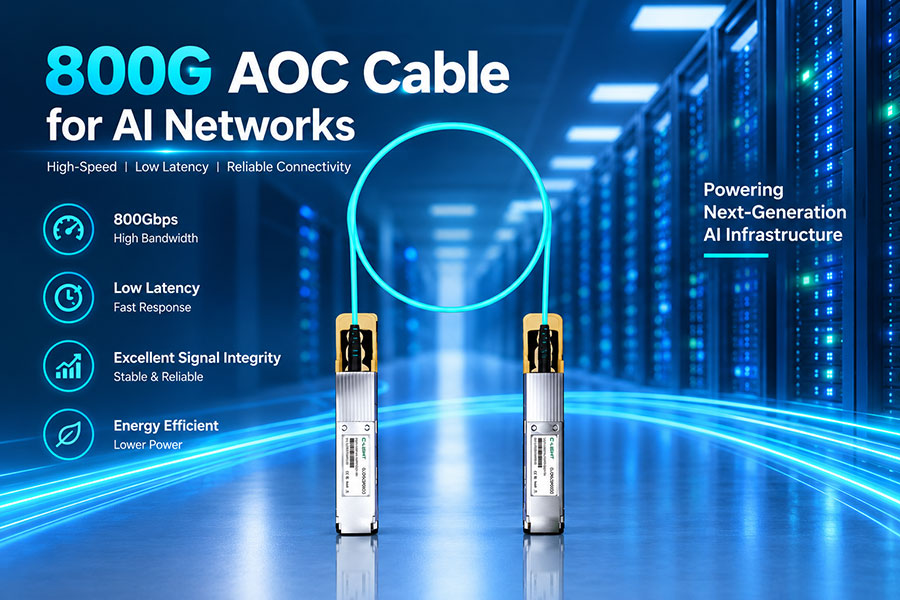
Related SFP-family form factors can also be used in direct-attach and active cable solutions. In these designs, the pluggable interface connects directly to a cable rather than an optical fiber transceiver.
25. SFP Form Factor and Port Density
The compact SFP package allows equipment manufacturers to place many ports within a relatively small front-panel area. This is particularly useful in switches and routers where increasing port density can reduce equipment space requirements.
26. Thermal Characteristics
Thermal requirements for an SFP are generally lower than those of many modern high-speed optical modules, but power still depends on the optical source, driver, receiver, monitoring circuitry, and transmission distance.
27. Power Consumption
SFP power consumption varies by module type. Short-reach multimode modules, long-reach single-mode modules, BiDi modules, and specialized optical solutions can have different power requirements even though they share a similar physical form factor.
28. SFP and DOM Monitoring
Many modern SFP modules provide digital optical monitoring functions. Depending on the implementation, the host can monitor parameters such as temperature, supply voltage, transmit optical power, receive optical power, and laser bias.
29. SFP Compatibility
Compatibility involves more than physical insertion. Important factors include host port support, data rate, optical wavelength, fiber type, transmission distance, connector type, module coding, temperature range, and management behavior.
30. SFP Fiber Compatibility
The selected SFP must match the fiber used in the link. Multimode SFPs generally require compatible multimode fiber, while single-mode SFPs are designed for single-mode fiber. Using the wrong fiber type can significantly affect optical performance.
31. SFP Link Budget
The optical link budget includes transmitter output power, fiber attenuation, connector loss, splice loss, and receiver sensitivity. The available optical margin must be sufficient for reliable operation across the intended transmission distance.
32. SFP BiDi Modules
BiDi SFPs transmit and receive through a single fiber using different wavelengths for the two directions. They normally operate as matched pairs, such as one wavelength combination at one end and the complementary combination at the other end.
33. SFP in Enterprise Networks
SFP modules remain useful in enterprise switching, campus networks, aggregation systems, security appliances, and other environments where replaceable fiber interfaces and moderate data rates are required.
34. SFP in Telecom Networks
Telecom equipment can use specialized SFP modules for access, aggregation, transport, and legacy network interfaces. Module selection depends on the required wavelength, reach, protocol, and optical budget.
35. SFP in Storage Networks
SFP technology is also associated with Fibre Channel and storage networking. Different optical specifications are available for different Fibre Channel speeds, fiber types, and transmission distances.
36. Advantages of the SFP Form Factor
The main advantages include compact size, hot-pluggability, modular replacement, broad application coverage, high port density, and availability across multiple optical and copper interface options.
37. Limitations of the SFP Form Factor
SFP is not designed for the highest modern network speeds. As bandwidth requirements increased, the industry developed related form factors such as SFP+, SFP28, SFP56, and SFP-DD to support higher-speed electrical and optical interfaces.
38. Evolution of the SFP Family
The SFP concept became the foundation for several later generations. SFP+ increased electrical bandwidth for 10G applications, SFP28 extended the concept to 25G-class networking, while newer designs continue to increase lane rates and density.
39. When to Choose SFP
SFP is suitable when the network requires a compact pluggable interface for lower-speed Ethernet, Fibre Channel, telecom, enterprise, or copper connectivity. The selection should always be based on the host specification and actual link requirements.
40. Frequently Asked Questions
Q1. What is the SFP form factor?
Q2. What is the typical size of an SFP module?
Q3. What connector does an SFP use?
Q4. Is SFP the same as SFP+?
Q5. Is SFP compatible with SFP28?
Q6. Can SFP modules use single-mode fiber?
Q7. Can SFP support copper networking?
Q8. What should be checked before installing an SFP?
41. Summary
The SFP form factor provides a compact and flexible platform for pluggable networking interfaces. Its standardized mechanical and electrical design supports hot-swappable installation and allows equipment to use interchangeable transceiver modules. Although newer form factors support much higher data rates, SFP remains relevant in 1G-class Ethernet, Fibre Channel, enterprise, telecom, and copper applications. Correct host compatibility, optical specifications, fiber type, link budget, and module coding are essential for reliable SFP deployment.
 >
>

 >
>
 >
>
 >
>
 >
>
 >
>
 >
>
 >
>