TEL:+86 132 6656 7067




1. Introduction
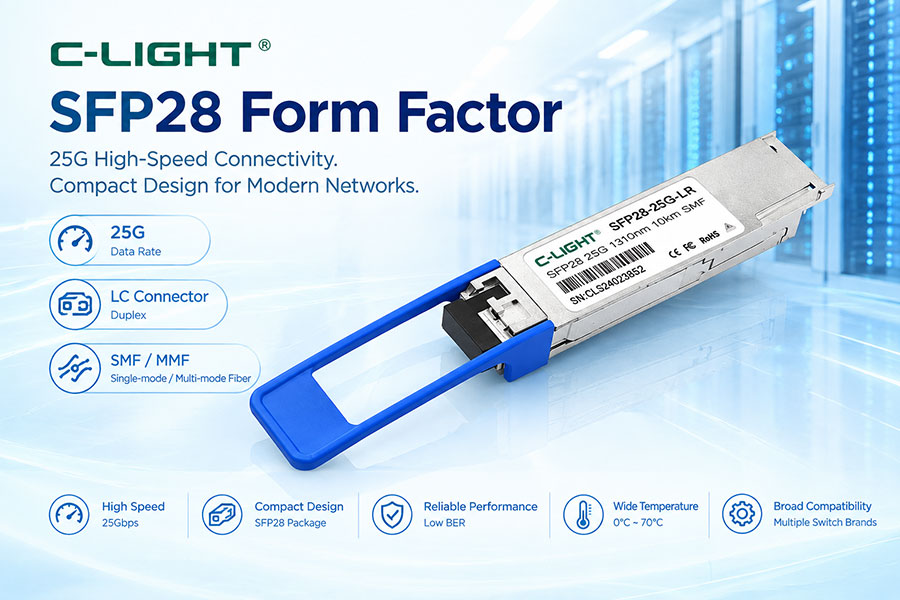
SFP28 is a compact, hot-pluggable transceiver form factor developed for 25Gbps-class networking. It keeps the small physical footprint of the SFP/SFP+ family while providing a higher-speed electrical interface for applications such as 25GbE and high-speed Fibre Channel.
2. What Is the SFP28 Form Factor?
SFP28 refers to the 28Gb/s-class SFP-family pluggable transceiver solution. The mechanical design is closely related to SFP and SFP+, while the electrical interface is designed for substantially higher signaling rates.
3. Why Was SFP28 Developed?
As data center and server networks moved beyond 10GbE, more bandwidth was required without significantly increasing the space occupied by each transceiver. SFP28 provides a 25Gbps-class interface while maintaining the familiar compact SFP-style package.
4. SFP28 and the SFF Specifications
SFP28 mechanical and electrical characteristics are defined through the SFF specification family, including SFF-8402 and related interface specifications. These documents cover areas such as the module interface, electrical signaling, and host connectivity.
5. SFP28 Dimensions
SFP28 uses a compact envelope closely related to SFP and SFP+. Common published dimensions are approximately 56.5mm × 13.4mm × 8.5mm, although the complete mechanical implementation also depends on the cage, connector, latch, and applicable specification.
6. SFP28 Module and Cage
The SFP28 transceiver slides into a compatible SFP-family cage mounted on the host PCB. The cage provides mechanical retention, electrical grounding, shielding, and alignment between the module and host connector.
7. Electrical Connector
SFP28 uses the familiar SFP-family card-edge interface. The connector carries high-speed transmit and receive signals together with power, ground, management, and control functions.
8. Hot-Pluggable Operation
SFP28 is designed for hot-plug operation on supported host equipment. This allows network operators to replace or upgrade a module without powering down the entire system.
9. SFP28 Electrical Interface
The electrical interface is designed for 25Gbps-class operation and can support signaling rates up to the 28Gb/s range defined by the relevant SFF specifications. At these speeds, PCB loss, connector performance, impedance, and equalization become increasingly important.
10. SFP28 and 25GbE
25GbE is the most common Ethernet application associated with SFP28. Typical optical implementations include 25GBASE-SR for short multimode links and 25GBASE-LR for longer single-mode links.
11. SFP28 Optical Architecture
An optical SFP28 converts electrical data from the host into an optical signal and converts received optical data back into an electrical signal. A typical module contains a transmitter, receiver, driver, TIA, monitoring circuitry, and management functions.
12. SFP28 Transmitter
The transmitter generates and modulates the optical signal. Short-reach modules commonly use 850nm VCSEL technology, while longer-reach single-mode modules can use laser technologies such as DFB at 1310nm.
13. SFP28 Receiver
The receiver detects the incoming optical signal through a photodiode and converts it into an electrical signal. The receiver chain normally includes a TIA and additional signal-conditioning circuitry.
14. SFP28 Wavelengths
Common SFP28 implementations include 850nm-class multimode modules and 1310nm-class single-mode modules. The wavelength should always be matched with the intended fiber type and transmission distance.
15. SFP28 Multimode Applications
850nm SFP28 modules are typically used with multimode fiber for short-reach connections. They are suitable for server links, switch connections, and data center networks where the required distance is relatively short.
16. SFP28 Single-Mode Applications
Single-mode SFP28 modules are used for longer links and commonly operate around 1310nm. Depending on the optical specification, they can support kilometer-scale transmission.
17. SFP28 Fiber Interfaces
Duplex LC is widely used for two-fiber SFP28 optical modules. Specialized SFP28 designs can also use other optical configurations according to the application, including BiDi architectures that transmit and receive at different wavelengths over a single fiber.
18. SFP28 Copper Options
The SFP28 form factor is primarily associated with optical networking, but the SFP-family interface can also be used for certain copper and active-cable solutions. Host compatibility and electrical specifications must be checked for each implementation.
19. SFP28 Management
SFP28 modules provide a low-speed management interface for identification and monitoring. Depending on the module, the host can read information such as vendor data, part number, serial number, temperature, voltage, transmit power, receive power, and laser bias.
20. EEPROM and Module Coding
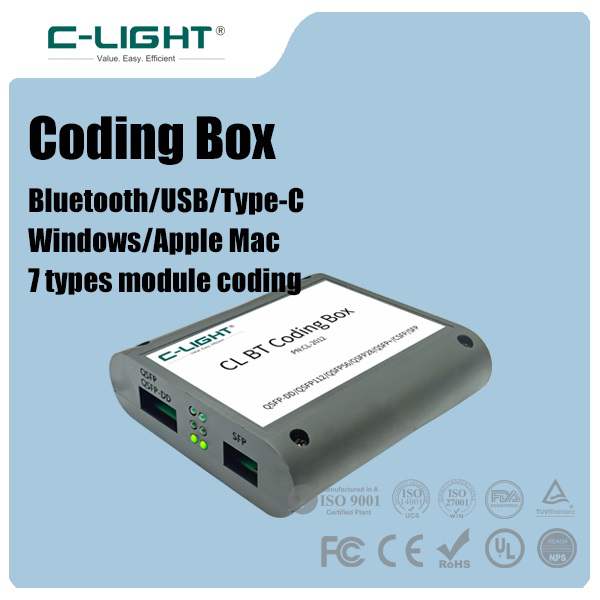
Module memory stores identification and configuration information. In some networking platforms, EEPROM contents and vendor-specific coding can influence module acceptance, making coding compatibility an important part of deployment.
21. SFP28 and DOM
Digital Optical Monitoring allows the host to monitor important operating parameters. DOM information can help identify abnormal optical power, excessive temperature, voltage problems, or changes in laser bias.
22. SFP28 Power Consumption
SFP28 power consumption depends on the transmitter, receiver, driver, monitoring circuitry, and module architecture. Optical modules generally have different power requirements from copper or active-cable implementations.
23. SFP28 Thermal Management
Although SFP28 is compact, its higher signaling speed requires careful thermal design. Module power, airflow, host cage design, ambient temperature, and optical technology all affect operating conditions.
24. Signal Integrity
At 25Gbps-class data rates, signal integrity is a major design consideration. Host PCB traces, connectors, vias, module contacts, and electrical equalization all contribute to the quality of the high-speed channel.
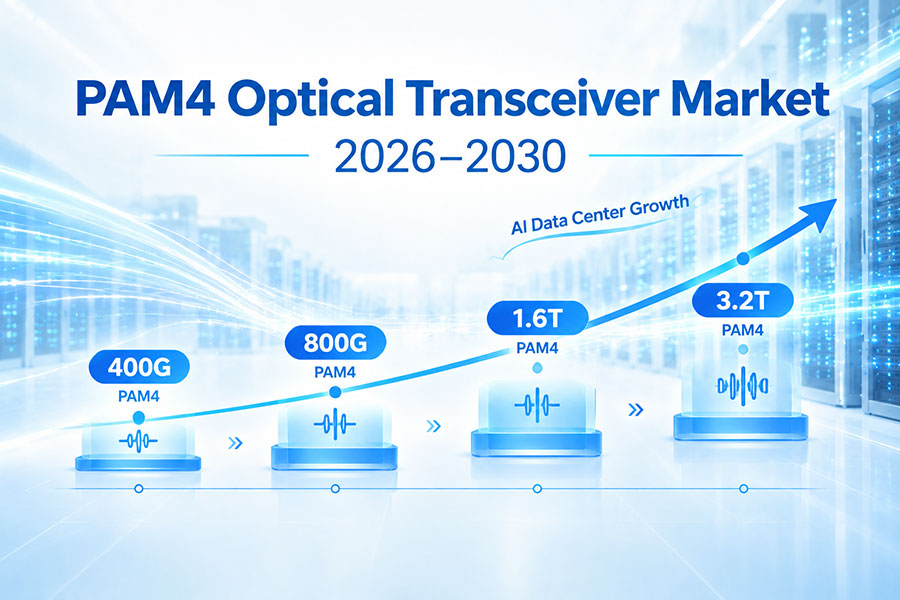
25. SFP28 and PAM4
Most conventional 25GbE SFP28 optical links use NRZ signaling rather than the PAM4 architectures commonly associated with newer 100G-per-lane systems. This makes SFP28 relatively straightforward compared with many higher-speed optical generations.
26. SFP28 vs SFP+
| Feature | SFP+ | SFP28 |
|---|---|---|
| Typical Ethernet Speed | 10GbE | 25GbE |
| Electrical Signaling | 10Gb/s-class | 25Gb/s-class, up to 28Gb/s signaling |
| Physical Size | Compact SFP family | Similar SFP-family size |
| Typical Applications | 10GbE, storage | 25GbE, server and data center |
27. SFP28 vs SFP
SFP28 and SFP share a similar physical concept, but their electrical interfaces are designed for very different speeds. A host that accepts the same cage mechanically may still not support an SFP28 module electrically.
28. SFP28 vs QSFP28
Despite the similar names, SFP28 and QSFP28 are different form factors. SFP28 is a single-lane compact pluggable interface, while QSFP28 uses four electrical lanes and is commonly associated with 100G aggregate applications.
29. SFP28 vs SFP56
SFP56 continues the SFP-family approach for higher-speed applications. It uses a similar compact physical concept but is designed for much higher electrical signaling rates than SFP28.
30. SFP28 Compatibility
Mechanical compatibility does not guarantee operational compatibility. Before installation, check the host port, supported speed, electrical interface, module coding, optical wavelength, fiber type, connector, reach, and firmware requirements.
31. SFP28 Link Budget
Optical performance depends on the complete link budget. Transmitter output power, fiber attenuation, connector loss, splice loss, and receiver sensitivity determine the available optical margin.
32. SFP28 Transmission Reach
SFP28 reach depends on the optical standard and module design. Short-reach 850nm multimode modules are intended for data center links, while single-mode implementations can support longer distances such as 10km depending on the specific specification.
33. SFP28 in Data Center Networks
SFP28 is widely used for 25GbE server-to-switch connections, leaf or top-of-rack uplinks, and other data center applications. Its compact size enables high port density without moving to a larger multi-lane form factor.
34. SFP28 in Telecom and Enterprise Networks
SFP28 can also be used in telecom, enterprise, aggregation, and network equipment that requires 25Gbps-class connectivity. The selected module must match the protocol, optical reach, host interface, and environmental requirements.
35. SFP28 and Network Upgrades
SFP28 provides a migration path from 10GbE to 25GbE while retaining a familiar SFP-family mechanical interface. This can simplify upgrades when existing equipment supports SFP28 cages and 25Gbps-class host ports.
36. Advantages of the SFP28 Form Factor
The main advantages of SFP28 include compact size, hot-pluggability, high port density, flexible optical reach, and compatibility with 25GbE data center architectures. It offers substantially more bandwidth than SFP+ without requiring a larger transceiver package.
37. Limitations of the SFP28 Form Factor
SFP28 provides a single high-speed lane and is not intended for the aggregate bandwidth requirements of 100G, 400G, 800G, or 1.6T networking. Higher-speed systems therefore use multi-lane and higher-performance form factors such as QSFP28, QSFP-DD, QSFP112, and OSFP.
38. SFP28 and Port Density
The compact package allows switches and network adapters to place many 25G ports within limited front-panel space. This is particularly useful in high-density server and data center environments.
39. SFP28 Selection Guide
When selecting an SFP28 module, consider the host platform, 10G or 25G operating mode, optical wavelength, fiber type, transmission distance, connector, power consumption, temperature range, DOM support, coding requirements, and interoperability.
40. Frequently Asked Questions
Q1. What is the SFP28 form factor?
Q2. What is the typical speed of SFP28?
Q3. Is SFP28 the same physical size as SFP+?
Q4. What fiber is used with SFP28?
Q5. Can SFP28 work in an SFP+ port?
Q6. Does SFP28 use PAM4?
Q7. What is the difference between SFP28 and QSFP28?
Q8. What should be checked before installing an SFP28?
41. Summary
SFP28 extends the SFP-family form factor to 25Gbps-class networking while maintaining a compact, hot-pluggable design. Its main applications include 25GbE server connectivity, data center switching, enterprise networks, and selected telecom systems. SFP28 supports different optical technologies, wavelengths, fiber types, and transmission distances, but its high-speed electrical interface requires careful attention to signal integrity and host compatibility. Although SFP28 shares a similar physical concept with SFP and SFP+, the electrical and performance specifications are different. Correct module selection should therefore consider the complete host, optical, electrical, thermal, and management environment.
 >
>

 >
>
 >
>
 >
>
 >
>
 >
>
 >
>
 >
>