TEL:+86 132 6656 7067




1. Introduction
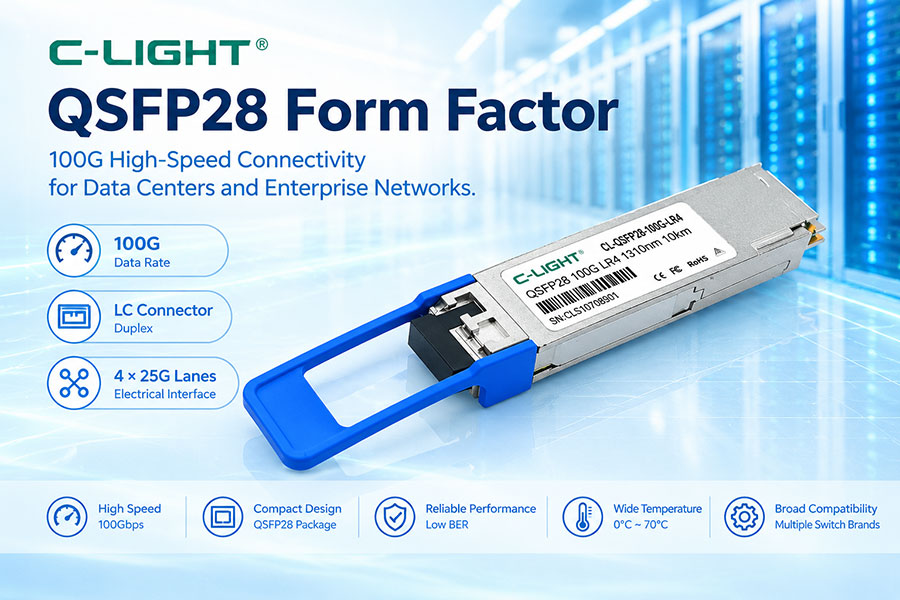
QSFP28 is a compact, hot-pluggable pluggable transceiver form factor developed primarily for 100Gbps-class networking. It extends the four-lane QSFP architecture by increasing the lane rate to approximately 25Gbps, enabling 100G connectivity without requiring a much larger module footprint.
2. What Is the QSFP28 Form Factor?
QSFP28 is the 28Gb/s-class four-lane version of the QSFP family. The form factor is defined through the SFF specification family, with SFF-8665 covering the QSFP28 4X pluggable solution and related specifications defining electrical, mechanical, cage, connector, and management characteristics.
3. Why Was QSFP28 Developed?
As data center networks moved from 40GbE toward 100GbE, higher bandwidth was required while maintaining high front-panel port density. QSFP28 achieves this by using four electrical and optical lanes at approximately 25Gbps per lane.
4. QSFP28 Four-Lane Architecture
A typical QSFP28 module contains four transmit lanes and four receive lanes. In common 100G implementations, each lane operates around 25.78Gbps, producing an aggregate electrical or optical line rate of approximately 100Gbps.
5. QSFP28 Mechanical Design
QSFP28 keeps the compact rectangular QSFP-style package with a pull-tab or bail-latch mechanism. Its mechanical design is closely related to QSFP+, allowing high-density equipment to support multiple generations of QSFP-family modules.
6. QSFP28 Dimensions
The QSFP28 mechanical envelope is approximately 18.35mm wide and 8.5mm high. Module length varies according to the specific mechanical reference and implementation, but the compact package is designed for dense switch and network-interface applications.
7. QSFP28 Cage
The host cage provides mechanical retention, alignment, grounding, shielding, and thermal contact for the module. Cage design is particularly important in high-density systems where airflow and connector placement must be carefully controlled.
8. QSFP28 Electrical Connector
QSFP28 uses the four-lane QSFP electrical interface with a 38-contact host connection. The contacts provide high-speed transmit and receive lanes together with power, ground, management, and control functions.
9. QSFP28 Electrical Interface
Common 100G Ethernet QSFP28 implementations use a four-lane electrical architecture commonly associated with CAUI-4. Each lane operates in the 25Gbps class, allowing the module to interface with a 100G host SerDes architecture.
10. QSFP28 Hot-Pluggable Operation
QSFP28 is designed for hot-plug operation on compatible host equipment. This enables transceiver replacement, upgrades, and maintenance without shutting down the entire networking platform.
11. QSFP28 Optical Signal Path
The transmit path converts four electrical lanes into optical signals, while the receive path converts incoming optical signals back into four electrical lanes. The exact optical architecture depends on the module type.
12. QSFP28 Optical Architectures
QSFP28 can support several optical approaches, including parallel-fiber SR4 and PSM4 as well as wavelength-multiplexed designs such as CWDM4, LR4, and ER4. This makes QSFP28 a form factor rather than a single optical technology.
13. QSFP28 SR4
100GBASE-SR4 is a common short-reach QSFP28 application. It typically uses four parallel optical channels around 850nm and an MPO/MTP interface for multimode fiber connections.
14. QSFP28 LR4
100GBASE-LR4 uses four wavelength channels combined over a duplex single-mode fiber interface. It is designed for substantially longer reach than SR4 and commonly uses LC duplex connectors.
15. QSFP28 CWDM4
CWDM4 uses four coarse wavelength channels, typically centered around 1271nm, 1291nm, 1311nm, and 1331nm. The four wavelengths are multiplexed onto a single pair of single-mode fibers, reducing the fiber count compared with parallel-fiber designs.
16. QSFP28 ER4
ER4 extends the wavelength-multiplexed QSFP28 concept to longer-reach single-mode applications. The exact transmission distance, optical budget, and FEC requirements depend on the specific implementation and standard.
17. QSFP28 PSM4
PSM4 uses four parallel single-mode optical channels rather than wavelength multiplexing. It provides a practical architecture for 100G links where parallel single-mode fiber connectivity is preferred.
18. QSFP28 Multimode Fiber
Short-reach QSFP28 modules such as SR4 commonly use multimode fiber and 850nm VCSEL technology. Actual reach depends on the fiber grade, connector loss, module specification, and installation conditions.
19. QSFP28 Single-Mode Fiber
Single-mode QSFP28 modules support longer transmission distances and commonly use 1310nm-class wavelength architectures. The appropriate design depends on the optical standard, fiber infrastructure, and required reach.
20. QSFP28 Optical Connectors
MPO/MTP is common for parallel-lane modules such as SR4 and PSM4. Duplex LC is commonly used for wavelength-multiplexed solutions such as LR4, CWDM4, and selected ER4 modules.
21. QSFP28 Transmitter
The transmitter contains four optical channels together with the associated laser drivers and control circuitry. VCSEL arrays are commonly used for short multimode links, while longer-reach single-mode modules can use DFB or other laser technologies.
22. QSFP28 Receiver
The receiver converts the optical signals into electrical signals using photodetectors and receiver electronics. Receiver sensitivity, overload level, and per-lane performance affect the overall optical link margin.
23. QSFP28 Management Interface
QSFP28 modules provide a low-speed management interface for identification, configuration, status, and diagnostics. SFF-8636 is widely associated with the management and memory map for QSFP-family modules.
24. EEPROM and Module Identification
Module memory can store vendor information, part number, serial number, wavelength, supported capabilities, compliance information, and diagnostic parameters. These data help the host identify and monitor the installed module.
25. Digital Diagnostic Monitoring
Many QSFP28 modules support digital monitoring of parameters such as temperature, supply voltage, transmit optical power, receive optical power, and laser bias. Per-lane monitoring can be especially useful when troubleshooting a four-channel optical link.
26. QSFP28 and NRZ
Traditional 100G QSFP28 architectures commonly use four lanes of approximately 25Gbps NRZ signaling. This differs from newer higher-speed generations that use PAM4 to increase the amount of information carried per symbol.
27. QSFP28 and FEC
FEC requirements vary by optical interface. Some 100G architectures require or commonly rely on host-side FEC, while others have different error-performance requirements. Host and module configuration should therefore be checked against the specific optical standard.
28. QSFP28 Power Consumption
Power consumption depends on the optical architecture, laser technology, receiver, monitoring circuitry, and operating conditions. Parallel and wavelength-multiplexed modules can have different power characteristics even though they share the same QSFP28 form factor.
29. QSFP28 Thermal Management
High-density 100G systems require practical thermal management. Module heat generation, cage airflow, switch temperature, heat-sink design, and front-panel port density all affect stable operation.
30. QSFP28 Signal Integrity
Four 25Gbps-class electrical lanes require careful signal-integrity design. PCB insertion loss, connector performance, crosstalk, impedance discontinuities, via transitions, and host SerDes equalization can affect link quality.
31. QSFP28 Breakout
A major advantage of QSFP28 is breakout capability. A 100G QSFP28 port can, in compatible systems, be divided into four independent 25G links, commonly connecting to four SFP28 ports.
32. QSFP28 DAC and AOC
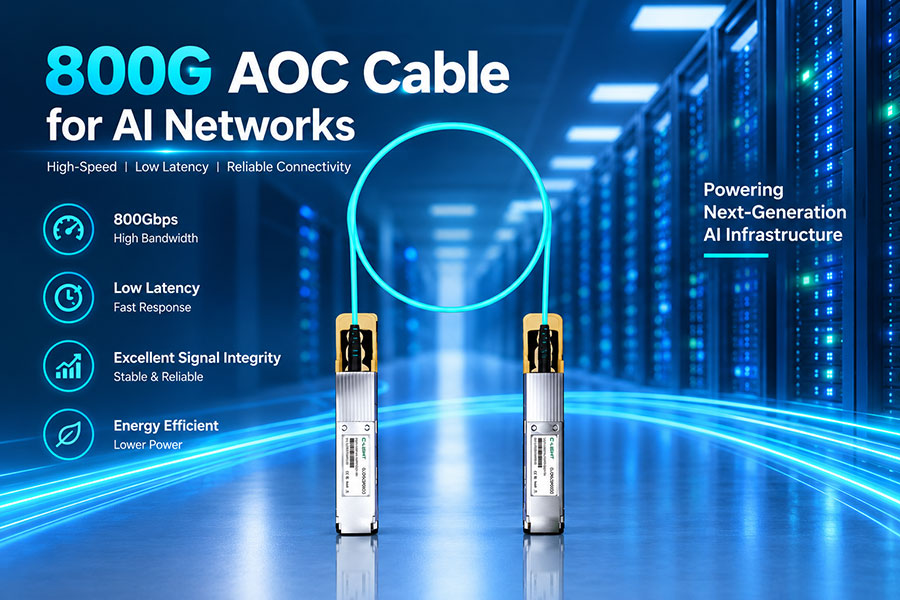
The QSFP28 form factor is also used for direct-attach copper cables and active optical cables. These solutions provide short-reach 100G connectivity without requiring separate optical transceivers at both ends of the cable.
33. QSFP28 Link Budget
Optical link performance depends on transmitter output power, fiber attenuation, connector loss, passive component loss, receiver sensitivity, and system margin. The link budget should be evaluated according to the specific QSFP28 optical variant.
34. QSFP28 Transmission Reach
Reach varies significantly by optical architecture. SR4 targets short multimode links, while LR4, CWDM4, PSM4, and ER4 address different single-mode transmission requirements. The stated reach should always be matched with the module specification and installed fiber.
35. QSFP28 vs QSFP+
| Feature | QSFP+ | QSFP28 |
|---|---|---|
| Typical Aggregate Rate | 40Gbps | 100Gbps |
| Typical Lane Rate | 10Gbps-class | 25Gbps-class |
| Common Signaling | NRZ | NRZ |
| Lane Count | 4 | 4 |
| Typical Ethernet Application | 40GbE | 100GbE |
36. QSFP28 vs SFP28
| Feature | SFP28 | QSFP28 |
|---|---|---|
| Typical Aggregate Rate | 25Gbps | 100Gbps |
| Lane Architecture | 1 lane | 4 lanes |
| Physical Density | Smaller module | Higher bandwidth per port |
| Typical Application | 25GbE | 100GbE |
| Breakout | Single link | 4×25G possible |
37. QSFP28 vs QSFP56
QSFP56 keeps the QSFP family architecture but increases the lane rate to the 50Gbps class. QSFP28 uses four 25Gbps-class lanes for 100G, while QSFP56 is designed for higher-speed applications such as 200G.
38. QSFP28 vs QSFP-DD
QSFP-DD adds a second row of electrical contacts and increases lane density. It supports much higher aggregate rates such as 200G, 400G, and 800G, while retaining compatibility with many QSFP-family modules depending on the host implementation.
39. QSFP28 vs OSFP
QSFP28 and OSFP use different mechanical architectures. OSFP provides a larger package designed for newer high-speed generations, while QSFP28 remains strongly associated with 100G networking.
40. QSFP28 Compatibility
Compatibility involves more than physical insertion. The host must support the required electrical lane rate, optical standard, management interface, coding, power class, and operating configuration. Optical parameters must also match the remote module and fiber infrastructure.
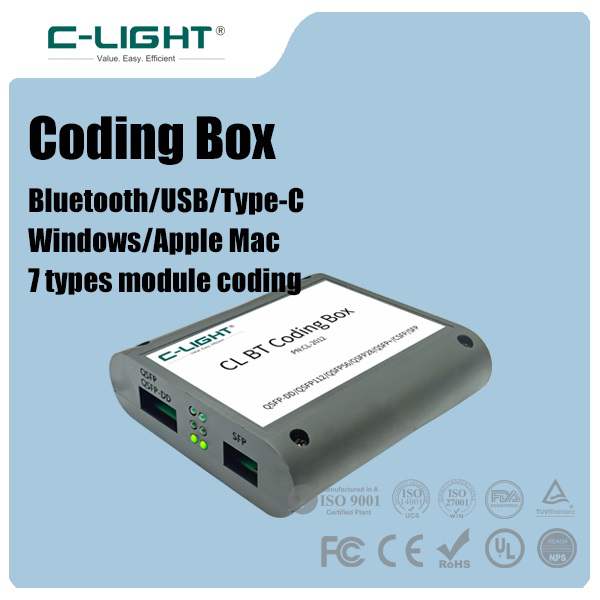
41. QSFP28 Module Coding
Some network equipment checks module identification and compliance information before enabling a port. Accurate coding and properly configured EEPROM data can therefore be important when deploying replacement or third-party QSFP28 modules.
42. QSFP28 in Data Center Networks
QSFP28 became a major 100G form factor for data center switches, network adapters, aggregation systems, and server connectivity. Its combination of four lanes, compact size, and breakout capability supports dense 100G network architectures.
43. QSFP28 in Telecom and Enterprise Networks
QSFP28 can also be used in enterprise aggregation, telecom equipment, storage, and other high-speed networking environments. The appropriate optical type depends on reach, wavelength, protocol, and fiber infrastructure.
44. Advantages of the QSFP28 Form Factor
QSFP28 provides 100Gbps-class bandwidth in a compact four-lane package. Key benefits include high port density, hot-plug capability, multiple optical architectures, breakout support, and broad deployment across data center networks.
45. Limitations of QSFP28
QSFP28 is primarily a 100G-generation form factor and its four 25Gbps-class lanes limit its aggregate bandwidth compared with newer designs. Higher-speed networks increasingly use QSFP56, QSFP-DD, QSFP112, and OSFP technologies.
46. QSFP28 Selection Guide
When selecting a QSFP28 module, check the host port, optical standard, lane configuration, wavelength, fiber type, connector, reach, optical budget, FEC requirements, module coding, power consumption, temperature range, and diagnostic support.
47. Frequently Asked Questions
Q1. What is the QSFP28 form factor?
Q2. How many lanes does QSFP28 use?
Q3. What is the typical speed of QSFP28?
Q4. What connectors are used with QSFP28?
Q5. Can QSFP28 support 4×25G breakout?
Q6. Does QSFP28 use PAM4?
Q7. Is QSFP28 compatible with QSFP+?
Q8. What should be checked before installing a QSFP28?
48. Summary
QSFP28 is a compact four-lane pluggable form factor that enabled widespread adoption of 100GbE networking. By using four 25Gbps-class electrical and optical lanes, it provides substantially higher aggregate bandwidth than QSFP+ while maintaining a practical high-density package. QSFP28 supports multiple architectures, including SR4, LR4, CWDM4, PSM4, ER4, DAC, and AOC solutions. Its management, thermal, signal-integrity, optical-budget, and host-compatibility requirements must be considered together. Although newer form factors now target 200G, 400G, 800G, and beyond, QSFP28 remains an important 100G interface for data center, enterprise, telecom, and storage networking.
 >
>

 >
>
 >
>
 >
>
 >
>
 >
>
 >
>
 >
>