TEL:+86 132 6656 7067




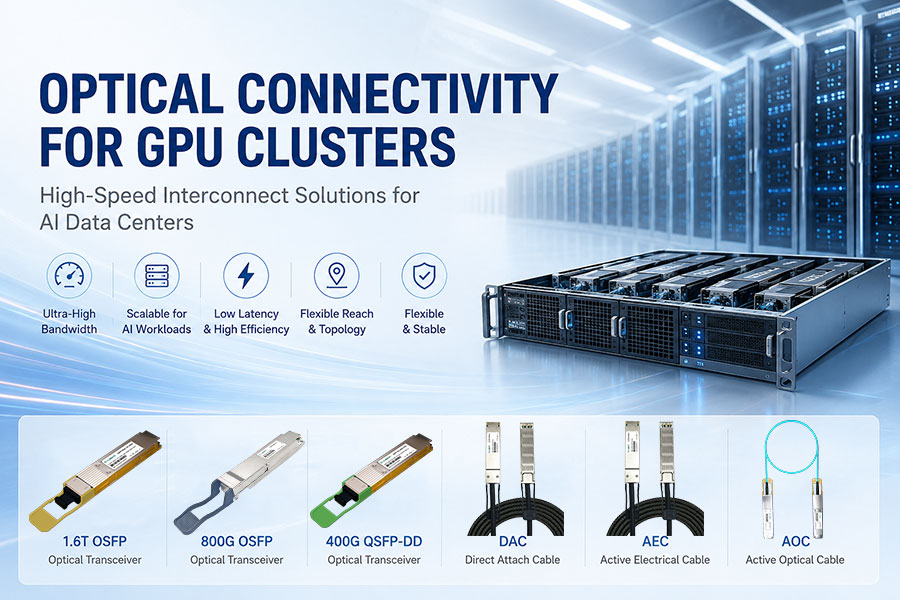
GPU clusters are becoming the core computing infrastructure for AI training, inference, and high-performance computing. As the number of GPUs in a cluster increases, the network must move massive amounts of data between servers, switches, and computing nodes with low latency and high reliability. Optical connectivity provides the bandwidth and reach required for these high-performance environments.
Modern AI data centers are moving from 400G toward 800G and 1.6T network connectivity. This transition is driving demand for high-speed optical transceivers, active electrical cables, and other optical interconnect solutions designed specifically for large-scale GPU clusters.
1. Why GPU Clusters Need High-Speed Optical Connectivity
A GPU cluster does not operate as a collection of isolated computing devices. GPUs continuously exchange model parameters, training data, gradients, and other information across the network. Network performance can therefore have a direct impact on overall cluster utilization.
As GPU performance increases, traditional copper-based connectivity becomes increasingly difficult to scale across longer distances and higher bandwidths. Optical interconnects provide several advantages for AI infrastructure, including high bandwidth, low signal loss, electromagnetic immunity, and efficient connectivity over longer distances.
High bandwidth for GPU-to-GPU and server-to-switch traffic
Low latency for distributed AI workloads
Longer transmission distances compared with passive copper connections
High-density connectivity inside data center networks
Better scalability for 400G, 800G, and future 1.6T networks
2. Optical Connectivity in the AI Data Center Network
Optical connectivity can be deployed at different points within a GPU cluster. The appropriate interconnect depends on bandwidth, distance, switch architecture, rack design, and power requirements.
High-speed optical transceivers are commonly used between network switches and servers or between different switching layers. For shorter connections inside racks and between adjacent racks, DAC, AEC, and AOC solutions can provide different combinations of cost, power consumption, flexibility, and transmission distance.
A typical AI networking architecture may therefore combine several types of interconnects rather than relying on a single solution.
3. 400G, 800G and 1.6T Optical Connectivity
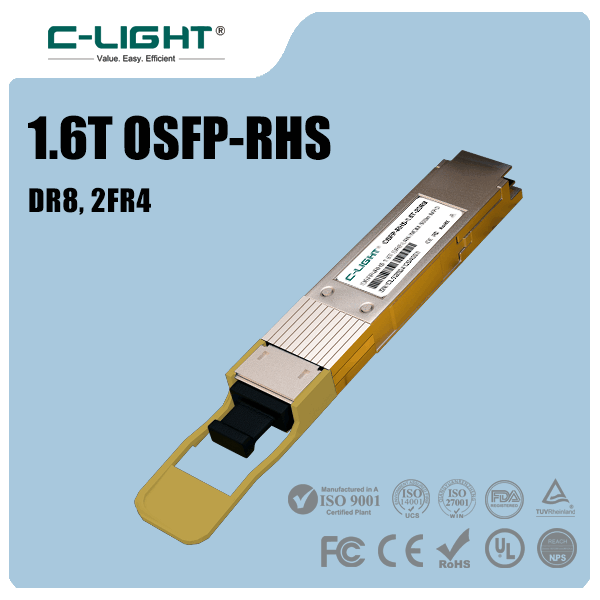
The rapid growth of AI computing is pushing network bandwidth to higher levels. 400G has become an important generation for high-performance data center networks, while 800G is increasingly important for large-scale AI clusters. Future network architectures are expected to continue moving toward 1.6T and higher bandwidth.
| Network Generation | Typical Application | Key Requirement |
|---|---|---|
| 400G | High-performance data center networks | High bandwidth and efficient optical connectivity |
| 800G | Large-scale AI and GPU clusters | Higher density, bandwidth, and power efficiency |
| 1.6T | Next-generation AI infrastructure | Extreme bandwidth and advanced optical technology |
4. Optical Transceivers for GPU Clusters
Optical transceivers convert electrical signals into optical signals and provide high-speed communication between network equipment. In GPU clusters, 400G and 800G transceivers are becoming increasingly important as switch and server bandwidth continues to increase.
Depending on the required transmission distance, data center operators can select different optical configurations. Multimode solutions are suitable for shorter data center links, while single-mode optical transceivers can support longer connections between network locations.
Form factors such as QSFP-DD, QSFP112, and OSFP are used across different generations of high-speed networking equipment. The choice depends on switch design, electrical interface, thermal requirements, and the target network architecture.
5. DAC, AEC and AOC for GPU Clusters
Optical transceivers are not the only option for GPU cluster connectivity. Direct Attach Cables (DAC), Active Electrical Cables (AEC), and Active Optical Cables (AOC) can be used for different short-distance interconnect scenarios.
DAC: A cost-effective solution for short-distance connections with low latency and simple deployment.
AEC: Uses active signal conditioning to extend the practical reach of electrical connectivity while maintaining a relatively compact cable architecture.
AOC: Integrates optical transceivers and fiber into a single cable assembly, making it suitable for longer short-reach connections.
Optical Transceivers: Provide greater flexibility because the transceiver and fiber infrastructure can be selected separately.
For high-density GPU clusters, the right combination can help balance bandwidth, reach, power consumption, cable management, and deployment cost.
6. Key Factors When Selecting Optical Connectivity
Selecting connectivity for a GPU cluster requires more than simply choosing the highest available data rate. Network engineers need to consider the complete system architecture and the operating environment.
6.1 Bandwidth
The required bandwidth depends on GPU count, switch capacity, topology, and workload characteristics. As AI clusters scale, 800G and 1.6T connectivity can provide a path toward higher aggregate network capacity.
6.2 Transmission Distance
Different links within a GPU cluster may require different transmission distances. DAC and AEC solutions are generally suited to short connections, while AOC and optical transceiver solutions can address longer links.
6.3 Power Consumption
Power efficiency is particularly important in AI data centers because high-density GPU racks already have significant power and thermal requirements. Optical connectivity solutions should therefore be evaluated together with switch and server power budgets.
6.4 Thermal Management
As networking speeds increase, thermal management becomes increasingly important. High-speed optical modules must operate reliably within the thermal conditions of modern data centers, including systems using advanced air or liquid cooling architectures.
6.5 Compatibility
Optical connectivity must be compatible with the switches, network adapters, servers, and networking platforms used in the GPU cluster. Electrical interface specifications, optical parameters, firmware, and interoperability should all be considered before deployment.
7. LPO and CPO for Future GPU Networks
As network bandwidth moves beyond 800G, new optical architectures are attracting attention. Linear Pluggable Optics (LPO) reduces some of the active electronic processing inside optical modules, potentially improving power efficiency and reducing latency in suitable applications.
Co-Packaged Optics (CPO) takes optical connectivity further by integrating optical engines more closely with switching ASICs. These technologies are being investigated as potential approaches for addressing the bandwidth and power challenges of future AI networks.
For near-term deployments, conventional pluggable optical transceivers remain an important connectivity option, while LPO and CPO represent potential directions for future high-bandwidth GPU cluster architectures.
8. C-LIGHT Optical Connectivity Solutions for AI Data Centers
C-LIGHT provides optical transceivers and high-speed interconnect solutions for data center and AI networking applications. Its product portfolio covers high-speed connectivity options including 400G, 800G, and 1.6T solutions, as well as DAC and AEC products.
These solutions can be considered for different connection scenarios within AI data centers, including server-to-switch links, switch-to-switch connections, and high-density GPU cluster networks.
By selecting the appropriate combination of optical transceivers, DAC, AEC, and AOC solutions, network designers can build a scalable connectivity architecture that matches bandwidth, distance, power, and deployment requirements.
9. Future of Optical Connectivity for GPU Clusters
GPU cluster networking will continue to evolve alongside AI accelerator performance. Higher-speed Ethernet and InfiniBand networks, increasing switch bandwidth, and larger GPU clusters will place additional demands on optical interconnect technology.
The transition from 400G to 800G and eventually 1.6T will require improvements in optical engines, signal integrity, thermal management, power efficiency, and module density. Optical connectivity will remain a fundamental part of this evolution because copper-based connections become increasingly challenging as bandwidth and distance requirements increase.
For AI data centers, the objective is not simply to achieve higher link speeds. The overall interconnect architecture must provide sufficient bandwidth while maintaining reliability, efficiency, scalability, and manageable power and thermal requirements.
10. Frequently Asked Questions
Q1:What type of connectivity is used in GPU clusters?
GPU clusters can use a combination of optical transceivers, DAC, AEC, and AOC depending on the required bandwidth, transmission distance, power budget, and network architecture.
Q2:Why are optical connections important for AI data centers?
Optical connectivity provides high bandwidth and efficient transmission over longer distances, making it suitable for the high-density networking requirements of large GPU clusters.
Q3:Is 800G suitable for GPU clusters?
800G is increasingly relevant to large-scale AI and GPU cluster networks because it provides substantially higher bandwidth than 400G while supporting the continuing growth of AI networking infrastructure.
Q4:What is the difference between DAC and optical transceivers?
DAC integrates the electrical connection directly into the cable and is typically used for short-distance links. Optical transceivers use optical transmission and provide greater flexibility for longer or higher-density network connections.
Q5:Will GPU clusters move to 1.6T connectivity?
As AI clusters continue to scale, 1.6T is emerging as an important next-generation networking target. Its adoption will depend on switch bandwidth, optical technology, system power, thermal design, and ecosystem maturity.
11.Conclusion
Optical connectivity is becoming a critical infrastructure component for modern GPU clusters. The combination of 400G, 800G, and future 1.6T optical technologies provides a scalable path for supporting increasingly demanding AI workloads.
For data center operators and network designers, choosing the right mix of optical transceivers, DAC, AEC, and AOC can help create a high-bandwidth, reliable, and scalable interconnect architecture for current and future AI computing environments.
 >
>

 >
>
 >
>
 >
>
 >
>
 >
>
 >
>
 >
>