TEL:+86 132 6656 7067





OS2 and OM4 patch cords serve different optical network architectures. OS2 is a single-mode fiber designed for long-distance transmission and wavelength-based applications, while OM4 is a laser-optimized multimode fiber commonly used for short-reach links inside data centers. Their connector appearance can be similar, but their optical characteristics, transceiver requirements, and supported link distances are not interchangeable.
1. What Are OS2 and OM4 Fiber Patch Cords?
OS2 Single-Mode Fiber Patch Cord
OS2 is a single-mode optical fiber specification with a nominal core diameter of approximately 9 μm and a cladding diameter of 125 μm. Its small core supports a single propagation mode, reducing modal dispersion and making it suitable for high-capacity links over longer distances.
OS2 patch cords are commonly used with single-mode optical transceivers operating at wavelengths such as 1310 nm and 1550 nm. Typical applications include telecom networks, campus connections, data-center interconnects, and links between buildings or network facilities.
OM4 Multimode Fiber Patch Cord
OM4 is a laser-optimized multimode fiber with a 50/125 μm core and cladding structure. It is designed to provide high modal bandwidth for short-reach, high-speed optical transmission, particularly with 850 nm VCSEL-based transceivers.
OM4 is widely deployed in data centers, enterprise server rooms, and equipment rooms where switches, servers, and storage systems are connected over relatively short distances.
Long-distance optical links
Small core, single-mode transmission, and compatibility with single-mode optical transceivers.
Typical applications: Telecom, campus networks, and data-center interconnects.
Short-reach high-speed links
50 μm core, laser-optimized transmission, and high modal bandwidth at 850 nm.
Typical applications: Data-center racks, server rooms, and short-reach switch connections.
2. Core Size and Optical Transmission Principles
The most fundamental difference between OS2 and OM4 is their core structure and the way light propagates through the fiber.
| Parameter | OS2 | OM4 |
|---|---|---|
| Fiber classification | Single-mode | Multimode |
| Nominal core diameter | Approximately 9 μm | 50 μm |
| Cladding diameter | 125 μm | 125 μm |
| Transmission modes | Single propagation mode | Multiple propagation modes |
| Modal dispersion | Very low compared with multimode fiber | Managed through laser-optimized fiber design |
| Typical optical source | Single-mode laser | 850 nm VCSEL |
In single-mode fiber, the small core limits the propagation of light to one spatial mode under the intended operating conditions. This minimizes modal dispersion and supports long-distance transmission.
In multimode fiber, light can travel through multiple modes. Different modes may arrive at different times, creating modal dispersion. OM4 uses a carefully controlled refractive-index profile and optimized modal bandwidth to reduce this effect and support higher data rates over short distances.
3. Wavelength Differences: 1310 nm, 1550 nm, and 850 nm
OS2 and OM4 are commonly associated with different optical wavelengths because their transceiver technologies and fiber characteristics differ.
| Fiber type | Common wavelengths | Typical optical source | Common applications |
|---|---|---|---|
| OS2 | 1310 nm and 1550 nm | Single-mode laser | Long-reach Ethernet, telecom, and DCI |
| OM4 | 850 nm; 1300 nm may be used in some legacy applications | VCSEL for common high-speed short-reach links | SR and other multimode optical applications |
For modern data-center applications, OM4 is frequently used with 850 nm SR transceivers. OS2 is commonly paired with single-mode LR, ER, and other single-mode optical modules, depending on the required distance and optical interface.
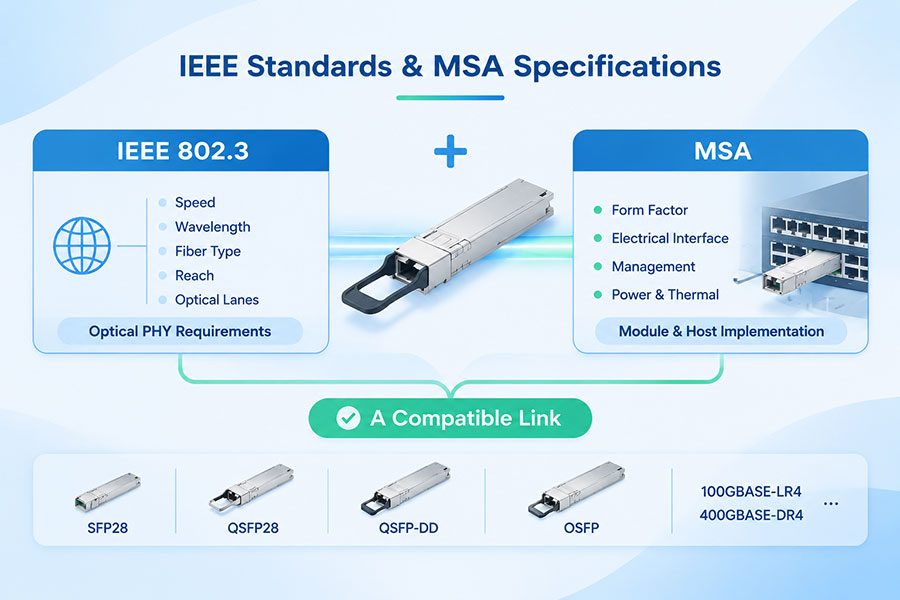
The wavelength alone does not determine compatibility. The transceiver's optical interface, modulation, connector, fiber specification, and supported link budget must all match.
4. Transmission Distance: OS2 vs OM4
OS2 supports much longer transmission distances than OM4 in many standardized optical applications. OM4 is optimized for shorter links where multimode optics can provide an economical solution.
| Network application example | OS2 | OM4 |
|---|---|---|
| 10GBASE | 10GBASE-LR: up to 10 km | 10GBASE-SR: up to 550 m |
| 40GBASE | 40GBASE-LR4: up to 10 km | 40GBASE-SR4: up to 150 m |
| 100GBASE | 100GBASE-LR4: up to 10 km | 100GBASE-SR4: up to 100 m |
These are representative Ethernet application limits, not guaranteed distances for every transceiver or fiber installation. Actual reach depends on the exact optical standard, module specification, connector loss, fiber attenuation, and total channel design.
Why does OM4 have shorter reach?
OM4 reduces modal dispersion compared with older multimode grades, but it remains a multimode fiber. At higher data rates, modal and other transmission impairments limit the distance over which a signal can be reliably received.
Why can OS2 support longer distances?
Single-mode transmission avoids the modal dispersion associated with multimode propagation. This makes OS2 suitable for longer links, although attenuation, chromatic dispersion, optical power budget, and transceiver design still determine the supported reach.
5. Connector Types and Jacket Colors
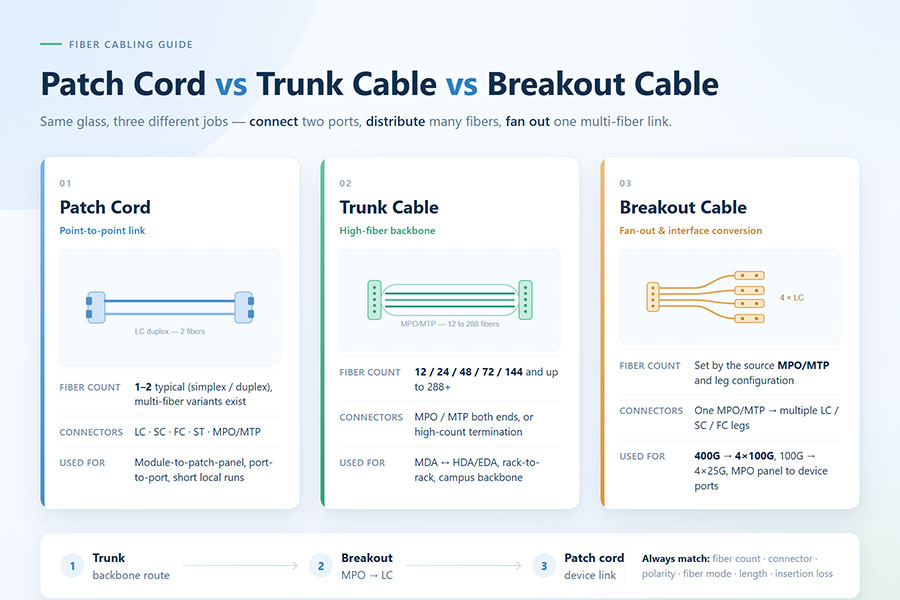
OS2 and OM4 patch cords can use many of the same connector formats. LC and SC are common for duplex connections, while MPO/MTP assemblies are used in parallel-optics and high-density cabling systems.
| Feature | OS2 patch cord | OM4 patch cord |
|---|---|---|
| Common connector types | LC, SC, FC, ST | LC, SC, FC, ST |
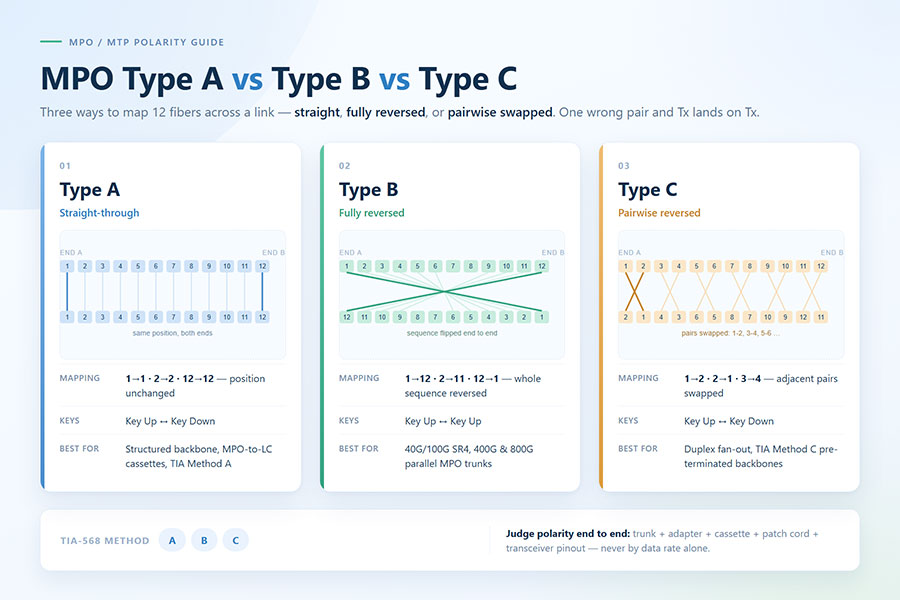
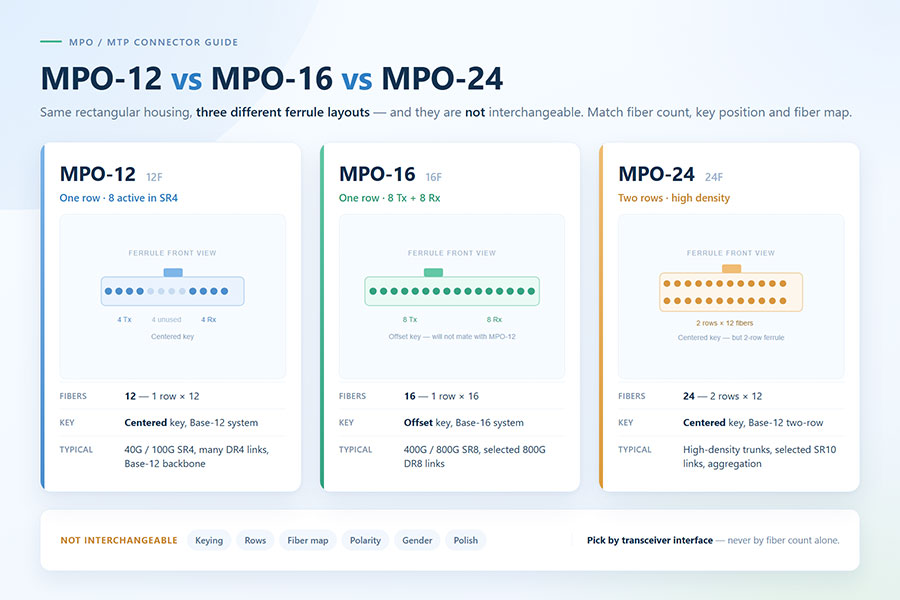
| Parallel-optics connectors | MPO/MTP for supported single-mode systems | MPO/MTP for supported multimode systems |
| Common jacket color | Yellow | Aqua |
| Common duplex connection | LC duplex | LC duplex |
Jacket colors are useful identification conventions, but they should not be treated as definitive proof of fiber type. Always check cable labels, product specifications, and test records before connecting a patch cord.
6. Are OS2 and OM4 Patch Cords Interchangeable?
No. OS2 and OM4 patch cords should not be substituted for one another simply because their connectors fit the same adapter or equipment port.
For example, an LC connector may physically fit an LC adapter on both single-mode and multimode equipment. However, this does not mean that an OS2 cord can replace an OM4 cord in an 850 nm multimode link.
Common compatibility problems
Fiber-mode mismatch: Single-mode and multimode transceivers are designed for different fiber characteristics.
Launch mismatch: The optical source and fiber type may not provide the intended launch conditions.
Excessive loss: Connecting mismatched fiber types can introduce additional coupling and transmission problems.
Unreliable link performance: The connection may fail to establish or may not meet the required optical performance.
7. Cost and Deployment Considerations
The total cost of an optical link includes more than the patch cord. Transceivers, fiber infrastructure, installation, testing, and future expansion all contribute to the overall deployment cost.
| Cost factor | OS2 deployment | OM4 deployment |
|---|---|---|
| Patch cord | Depends on connector, length, and cable construction | Depends on connector, length, and cable construction |
| Optical transceiver | Single-mode optics may have a higher cost in some applications | Multimode SR optics can be economical for suitable short links |
| Infrastructure | Suitable for campus, backbone, and longer inter-building routes | Suitable for short-reach equipment and data-center cabling |
| Expansion flexibility | Useful where future longer-distance connections may be required | Best suited to applications within its supported reach |
| Engineering priority | Optical budget, reach, and single-mode compatibility | Channel length, modal bandwidth, and multimode compatibility |
OM4 can reduce optical transceiver costs for suitable short-reach connections, but it is not automatically the least expensive option for every data center. OS2 may be more practical where longer reach, campus connectivity, or a consistent single-mode infrastructure is required.
8. How to Choose Between OS2 and OM4 Patch Cords
The correct selection starts with the optical interfaces on both ends of the link. The cable should be selected after confirming the transceiver specifications and the intended network distance.
Choose OS2 when:
The connection uses single-mode optical transceivers.
The link extends between buildings, network rooms, or data-center facilities.
The application requires LR, ER, or another compatible single-mode optical interface.
The network design prioritizes longer reach and single-mode infrastructure consistency.
The project requires single-mode backbone or distribution cabling.
Choose OM4 when:
The connection uses compatible 850 nm multimode SR optics.
The link is located within a rack, row, or data-center room.
The required transmission distance falls within the OM4 channel specification.
The network already uses OM4 multimode infrastructure.
The project benefits from multimode transceiver economics for short-reach links.
Before placing an order
Confirm the optical transceiver model and fiber type.
Check the required wavelength and supported transmission distance.
Confirm connector type and polish at both ends.
Specify simplex, duplex, or multi-fiber construction.
Choose the appropriate cable length and jacket material.
Verify insertion loss, return loss, and relevant cable specifications.
9. C-LIGHT OS2 and OM4 Fiber Cabling Solutions
C-LIGHT provides fiber-optic cabling products for data centers, enterprise networks, telecom infrastructure, and optical distribution systems. Patch cord configurations can be selected according to fiber type, connector interface, cable length, and installation requirements.
Multimode Fiber Patch Cords
C-LIGHT 2.0mm MMF Patch Cord is designed for compact fiber routing and high-density cabling. The product page lists OM1, OM2, OM3, OM4, and OM5 configurations, with connector options including LC, SC, FC, and ST.
The 2.0 mm cable construction helps reduce cable bulk in equipment racks and other space-constrained installations. PVC and LSZH jacket options are listed for different deployment environments.
MPO/MTP Fiber Assemblies
For parallel-optics and high-density fiber systems, C-LIGHT also provides:
MPO-MPO Fiber Patch Cable — multi-fiber cabling options for supported fiber infrastructure.
MTP-MTP Fiber Patch Cable — multi-fiber assemblies for high-density optical connections.
For OS2 single-mode patch cord projects, specify the required OS2 fiber, connector type, polish, cable length, and jacket construction when requesting a configuration. Confirm the exact product specification before ordering.
Contact C-LIGHT for fiber patch cord requirements, connector configurations, and customized cabling solutions.
10. Conclusion
OS2 and OM4 patch cords are designed for different optical transmission environments. OS2 single-mode fiber is suitable for long-distance links and single-mode optical systems, while OM4 multimode fiber is optimized for high-speed, short-reach connections commonly found in data centers.
The key selection factors are fiber mode, transceiver compatibility, wavelength, channel distance, connector type, and optical performance. Choosing the correct fiber type helps maintain reliable links and avoids compatibility problems during deployment.
Rather than selecting a patch cord based only on connector appearance or jacket color, verify the optical interface and network design before installation.
 >

 >
 >
 >
 >
 >
 >
 >