TEL:+86 132 6656 7067




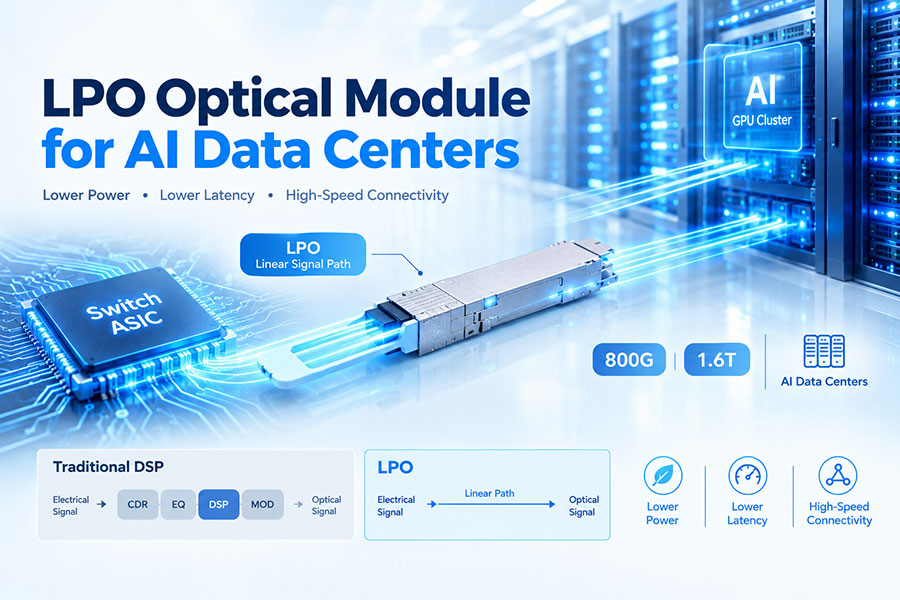
Linear Pluggable Optics (LPO) is emerging as an important optical technology for next-generation AI data centers. As GPU clusters scale from 400G to 800G and toward 1.6T networking, the power consumption and latency of high-speed optical interconnects have become increasingly important.
LPO optical modules simplify the signal path by reducing or eliminating the digital signal processing traditionally performed inside conventional optical transceivers. This architecture can reduce power consumption and latency while supporting the high-speed connectivity required by AI and high-performance computing networks.
1. What Is an LPO Optical Module?
LPO stands for Linear Pluggable Optics. It is a pluggable optical module architecture designed to maintain a relatively linear electrical and optical signal path between the host system and optical components.
Unlike conventional pluggable optical modules that commonly use DSPs to compensate for signal impairments, LPO solutions move more of the signal processing responsibility to the host ASIC, switch, or network interface. The optical module can therefore use a simpler electrical architecture.
This approach is particularly attractive for AI data centers, where thousands of optical links may operate simultaneously and even small reductions in per-port power can have a significant impact on total data center power consumption.
2. Why LPO Is Important for AI Data Centers
AI workloads generate large volumes of east-west traffic between GPUs, servers, switches, and storage systems. As GPU clusters become larger, network bandwidth must scale accordingly without allowing optical interconnect power to grow at the same rate.
LPO addresses part of this challenge by simplifying the optical module's signal processing architecture. Its potential benefits become particularly relevant at 800G and higher speeds.
Lower optical module power consumption
Reduced signal processing latency
Simplified module architecture
Higher power efficiency for high-density networks
Potentially improved scalability for AI clusters
Compatibility with high-speed Ethernet and other data center architectures
3. LPO vs. Traditional DSP-Based Optical Modules
A conventional high-speed optical transceiver typically includes a DSP to compensate for channel loss, dispersion, and other signal impairments. This processing helps maintain signal quality over challenging electrical channels, but it also introduces additional power consumption and latency.
LPO takes a different approach. By reducing or eliminating DSP processing within the optical module, the system relies more heavily on the host switch ASIC, retimer, or other system-level components to manage the electrical signal.
| Feature | Traditional DSP Optical Module | LPO Optical Module |
|---|---|---|
| Signal Processing | DSP inside the module | More processing handled by the host system |
| Module Power | Higher due to DSP processing | Potentially lower |
| Latency | Additional DSP processing latency | Lower processing latency potential |
| Link Margin | Generally more flexible | More dependent on system and channel quality |
| Interoperability | Mature ecosystem | Requires careful system-level validation |
4. Key Advantages of LPO Optical Modules
4.1 Lower Power Consumption
Power efficiency is one of the strongest reasons for considering LPO in AI data centers. Removing the DSP from the optical module can significantly reduce module power compared with some conventional DSP-based designs.
At the scale of a large GPU cluster, hundreds or thousands of optical ports may operate continuously. Reducing the power consumed by each connection can therefore contribute to lower overall rack power and cooling requirements.
4.2 Lower Latency
AI workloads can be highly sensitive to network performance. LPO reduces the amount of signal processing performed inside the optical module, which can help minimize processing latency in suitable system architectures.
4.3 Higher Port Density
Lower module power can make thermal management easier when many high-speed ports are installed in a single switch. This is increasingly important as switch bandwidth moves from 400G to 800G and eventually toward 1.6T.
4.4 Simplified Optical Architecture
LPO modules can use a simpler signal path than conventional DSP-based modules. This can potentially reduce component complexity and create opportunities for more efficient high-speed optical designs.
5. LPO for 800G AI Networking
800G is an important bandwidth generation for modern AI data center networks. Large GPU clusters require high-capacity connections between network switches and compute nodes, making power efficiency increasingly important.
An 800G LPO optical module can be designed around multiple high-speed electrical and optical lanes. The exact architecture depends on the host interface, optical technology, modulation format, and system implementation.
In an AI network with a large number of 800G ports, the cumulative power savings from lower-power optical modules can become substantial. This makes LPO particularly interesting for large-scale switch systems and GPU fabrics.
6. LPO and 1.6T Optical Connectivity
The transition toward 1.6T networking places even greater pressure on optical module power and thermal management. Simply increasing bandwidth while maintaining the same module architecture can result in significant increases in power density.
LPO is therefore being considered as one of the technologies that could help address the power challenge of next-generation optical connectivity. Lower-power optical modules can be particularly valuable in high-density switch environments where thermal capacity is limited.
However, 1.6T LPO requires careful consideration of electrical channel loss, signal integrity, optical performance, host-device compatibility, and overall system design. LPO should be evaluated as a complete link architecture rather than only as an optical module specification.
7. LPO Optical Module Components
Although the architecture is different from a conventional DSP-based transceiver, an LPO module still contains key electrical and optical components required to convert and transmit high-speed signals.
Optical transmitter: Converts electrical signals into optical signals.
Optical receiver: Converts incoming optical signals into electrical signals.
Laser: Provides the optical carrier for transmission.
Photodetector: Converts received optical power into an electrical signal.
Driver and TIA: Provide electrical interface functions for the optical components.
Host electrical interface: Connects the optical module with the switch ASIC, NIC, or other host device.
The exact component selection depends on the target data rate, optical reach, modulation technology, and host platform.
8. LPO and PAM4 Technology
PAM4 is widely used in modern high-speed data center networking because it can transmit two bits per symbol, allowing higher data rates without simply doubling the signaling frequency.
LPO and PAM4 can work together in high-speed optical networking architectures. However, PAM4 signals are more sensitive to noise, insertion loss, crosstalk, reflections, and other signal integrity issues than lower-speed NRZ systems.
As a result, an LPO implementation requires careful control of the complete electrical channel. PCB design, connector performance, cable characteristics, host ASIC capability, and optical module parameters all contribute to the final link performance.
9. Challenges of LPO Optical Modules
LPO offers significant potential advantages, but it is not a universal replacement for conventional DSP-based optical modules. Its main challenge is the reduced signal conditioning available inside the optical module.
9.1 Limited Link Margin
Without the same level of DSP-based equalization, LPO systems can have stricter requirements for the electrical channel. Loss, reflections, crosstalk, and other impairments must be carefully controlled.
9.2 Host-System Dependence
LPO performance depends strongly on the capabilities of the host switch ASIC, NIC, and electrical interface. The module cannot be evaluated independently from the platform in which it will operate.
9.3 Interoperability
High-speed LPO links require careful interoperability testing between optical modules and host equipment. Different implementations may have different electrical and optical characteristics.
9.4 Transmission Distance
LPO is generally more attractive for controlled data center environments and relatively short optical links. Longer-reach applications may continue to benefit from DSP-based solutions because of their stronger signal compensation capabilities.
10. LPO vs. LRO and CPO
LPO is one of several approaches being explored to improve the efficiency of high-speed optical networking. Linear Receive Optics (LRO) and Co-Packaged Optics (CPO) take different approaches to addressing power, latency, and signal integrity challenges.
| Technology | Basic Approach | Main Focus |
|---|---|---|
| LPO | Reduce DSP processing in pluggable modules | Lower power and latency |
| LRO | Linear architecture focused on the receive path | Power efficiency and signal optimization |
| CPO | Integrate optical engines closely with the switch ASIC | Future bandwidth density and power efficiency |
LPO has an important practical advantage because it retains the pluggable optical module form factor. This can make it easier to consider within existing data center networking architectures than solutions requiring major changes to switch hardware.
11. Where LPO Fits in AI Data Centers
LPO is particularly relevant to high-bandwidth connections where power efficiency and latency are critical. Potential applications include AI GPU clusters, high-performance computing networks, Ethernet AI fabrics, and high-density data center switches.
GPU-to-switch connectivity
Switch-to-switch connections
AI Ethernet fabrics
High-performance computing clusters
Large-scale data center networks
800G and future 1.6T optical interconnects
12. C-LIGHT Optical Connectivity for AI Data Centers
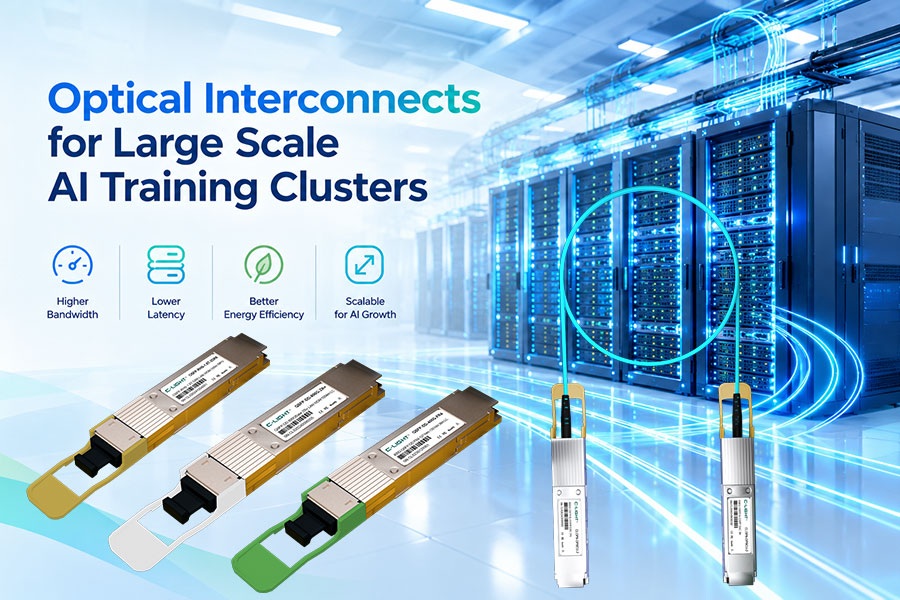
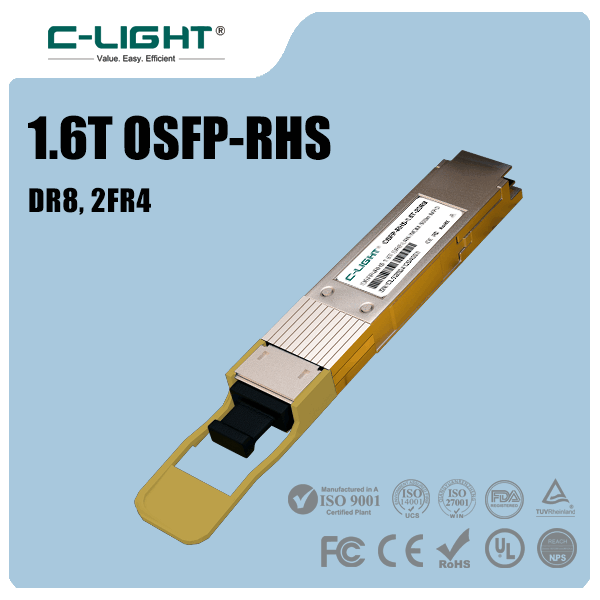
C-LIGHT provides high-speed optical transceivers and data center interconnect solutions designed for evolving network architectures. Its portfolio includes 400G, 800G, and next-generation 1.6T optical connectivity, together with DAC and AEC solutions for different short-distance networking requirements.
For AI data center deployments, the selection of optical connectivity should consider the complete link, including bandwidth, transmission distance, host platform, power consumption, thermal conditions, and interoperability.
As LPO technology develops, system-level testing and compatibility validation will remain important for achieving reliable high-speed links in large GPU clusters.
13. Future of LPO Optical Modules
The demand for higher bandwidth and lower power consumption will continue to influence optical module development. As AI clusters expand, the total number of high-speed optical ports will increase, making per-port power efficiency increasingly important.
LPO is well positioned for applications where low power, low latency, and high-density connectivity are more important than the extended link margins provided by traditional DSP-based architectures.
Future developments may combine LPO with improved optical engines, advanced laser technologies, higher-performance electrical interfaces, and 1.6T networking architectures. The result could be a more power-efficient optical interconnect platform for increasingly demanding AI data centers.
14. Frequently Asked Questions
Q1:What is an LPO optical module?
LPO, or Linear Pluggable Optics, is a high-speed optical module architecture that reduces or eliminates DSP processing inside the module and relies more heavily on the host system for signal processing.
Q2:Why is LPO important for AI data centers?
AI data centers use a large number of high-speed optical connections. LPO can potentially reduce per-port power consumption and latency, making it attractive for high-density GPU and switch networks.
Q3:Is LPO suitable for 800G?
Yes. 800G is one of the key application areas being considered for LPO because high port counts make power efficiency increasingly important.
Q4:Can LPO be used for 1.6T?
LPO is being considered for next-generation 1.6T optical connectivity. However, 1.6T LPO requires stringent electrical and optical performance and careful system-level validation.
Q5:What is the main advantage of LPO?
The main advantages are the potential for lower module power consumption and reduced processing latency compared with conventional DSP-based optical modules.
Q6:What is the main limitation of LPO?
LPO has tighter requirements for electrical channel quality and host-system performance because less signal compensation is performed inside the optical module.
15.Conclusion
LPO optical modules are becoming an important technology direction for high-speed AI data center networking. By simplifying the optical module signal path and reducing DSP processing, LPO can provide potential benefits in power consumption, latency, and port density.
As AI networks progress from 400G to 800G and 1.6T, optical connectivity must balance bandwidth, power efficiency, thermal management, signal integrity, and interoperability. LPO offers a promising approach for selected high-density applications, while traditional DSP-based optical modules will continue to play an important role where greater link margin and flexibility are required.
 >
>

 >
>
 >
>
 >
>
 >
>
 >
>
 >
>
 >
>