TEL:+86 132 6656 7067





The rapid growth of AI clusters, GPU computing, and high-density Ethernet networks is changing how optical connections are integrated into data center switches. As 800G and 1.6T interfaces become increasingly important, conventional front-panel optical transceivers face growing challenges involving power consumption, electrical signal integrity, port density, and thermal management.
Linear Pluggable Optics (LPO), Near-Packaged Optics (NPO), and Co-Packaged Optics (CPO) represent different approaches to addressing these challenges. LPO simplifies signal processing inside a pluggable module, while NPO and CPO bring optical engines closer to the switching ASIC. Each architecture offers different advantages in power efficiency, integration, maintenance, and system design.
LPO changes how the electrical signal is processed. NPO and CPO change where the optical engine is physically positioned relative to the switch ASIC.
1. What Is LPO (Linear Pluggable Optics)?
LPO stands for Linear Pluggable Optics. It is an optical transceiver architecture that removes the conventional DSP-based retiming function from the module and uses a more direct, linear electrical-to-optical and optical-to-electrical signal path.
In a conventional DSP-based optical transceiver, the module processes incoming electrical signals through a DSP. The DSP can perform functions such as equalization, signal conditioning, and retiming. In an LPO module, much of this processing responsibility shifts to the host switch ASIC and its SerDes circuitry.
How LPO works
Because the module does not contain a conventional retiming DSP, it can reduce module power consumption, latency, and component complexity. However, the host electrical interface must provide sufficient signal quality and equalization capability to support the complete link.
Main advantages of LPO
Lower module power: Removing the DSP reduces the power consumed inside the optical module.
Lower latency: Eliminating module-level DSP retiming removes an associated signal-processing stage.
Reduced module complexity: A simpler signal path can reduce component count and manufacturing cost.
Pluggable flexibility: LPO retains a front-panel optical module form factor, allowing module replacement without replacing the entire switch.
Main limitations of LPO
Host dependency: Link performance relies heavily on the switch ASIC SerDes and host electrical channel.
Signal integrity: PCB traces, connectors, module electronics, and optical components must work together within the available signal margin.
Interoperability: Different host and module combinations require careful qualification.
Monitoring and diagnostics: Some DSP-based diagnostic and loopback functions may not be available in the same way.
LPO is particularly relevant to short-reach, high-bandwidth data center connections where the host platform and optical module can be jointly validated.
2. What Is NPO (Near-Packaged Optics)?
NPO stands for Near-Packaged Optics. It places optical engines close to the switch ASIC, typically on the same circuit board or within a closely integrated board-level assembly, rather than installing them inside conventional front-panel transceiver cages.
The main objective is to shorten the high-speed electrical connection between the switch ASIC and the optical engine. Shorter electrical paths can reduce channel loss and the need for extensive signal conditioning, helping improve power efficiency and support higher bandwidth density.
How NPO works
Unlike a front-panel pluggable module, the NPO optical engine is positioned near the ASIC. The electrical connection between them is therefore much shorter than the path typically required by a front-panel transceiver.
Main advantages of NPO
Shorter electrical paths: Reduces the distance high-speed electrical signals travel between the ASIC and optical engine.
Improved bandwidth density: Supports dense optical connectivity around high-performance switching devices.
Potential power savings: Shorter electrical channels can reduce equalization and signal-conditioning requirements.
Separate optical subsystem: The optical engine remains a distinct assembly rather than being integrated directly into the ASIC package.
Main limitations of NPO
Board-level integration: Requires careful PCB layout, electrical routing, optical alignment, and mechanical design.
Maintenance complexity: Replacing an optical engine may require more work than changing a front-panel pluggable module.
Thermal considerations: Optical engines operate close to high-power switching components and need an appropriate thermal design.
Fiber management: High-density fiber connections require organized routing and reliable connector interfaces.
NPO is often considered an intermediate integration approach between front-panel pluggable optics and fully co-packaged optical engines. Its exact implementation can vary by manufacturer and system architecture.
3. What Is CPO (Co-Packaged Optics)?
CPO stands for Co-Packaged Optics. It integrates optical engines within the same package structure or closely integrated package assembly as the switch ASIC.
Traditional pluggable optics require high-speed electrical signals to travel from the ASIC across the switch PCB to the front-panel module. CPO moves optical conversion much closer to the switching chip, significantly shortening the electrical connection.
How CPO works
By reducing the electrical distance between the ASIC and optical engines, CPO can reduce electrical channel losses and the power required to drive long high-speed electrical connections.
External laser sources in CPO
Some CPO architectures use external laser sources (ELS) to supply continuous-wave optical power to the optical engines. Separating the laser source from the switching package can help manage laser replacement, reliability, and thermal requirements.
The exact laser arrangement depends on the CPO implementation. External laser sources are an important design option, but they are not a universal requirement for every possible co-packaged architecture.
Main advantages of CPO
Very short electrical connections: Optical engines are positioned extremely close to the ASIC.
High bandwidth density: Supports a large number of optical connections around high-performance switching silicon.
Potential system-level power savings: Reduces the electrical channel distance and can lower signal-conditioning requirements.
Advanced integration: Allows optical and electronic components to be designed as a closely coordinated package-level system.
Main limitations of CPO
Complex packaging: Requires advanced integration of photonic devices, ASICs, electrical connections, and optical interfaces.
Thermal management: Optical engines must operate reliably near high-power switching silicon.
Serviceability: Optical engines are generally not replaced like independent front-panel transceivers.
System-level qualification: The ASIC, optical engine, fiber interface, package, and cooling system must be validated together.
Upgrade flexibility: Optical technology changes may require changes to the overall switch platform rather than a simple module replacement.
4. LPO vs. NPO vs. CPO: Key Differences
Although all three approaches aim to improve high-speed optical connectivity, they differ in physical placement, signal processing, integration level, and maintenance requirements.
| Parameter | LPO | NPO | CPO |
|---|---|---|---|
| Full name | Linear Pluggable Optics | Near-Packaged Optics | Co-Packaged Optics |
| Optical engine location | Front-panel pluggable module | Near the ASIC on the board or in a nearby assembly | Within the ASIC package or closely integrated package assembly |
| Primary design change | Removes module DSP retiming | Moves optical engines closer to the ASIC | Integrates optical engines with the ASIC package |
| Electrical path | Through the host board to the front-panel module | Short board-level connection | Very short package-level connection |
| Module DSP | Typically absent | Depends on implementation | Depends on system architecture |
| Power-saving approach | Reduces module DSP power | Reduces electrical channel length | Minimizes electrical interconnect distance |
| Latency | Reduces module DSP-related latency | Can reduce electrical signal-path delay | Can reduce electrical interconnect delay |
| Serviceability | Pluggable and replaceable | More complex than front-panel modules | Generally integrated into the switch assembly |
| System integration | Host and module coordination | Board-level optical integration | Package-level optical and electronic integration |
| Design complexity | Host-channel and interoperability challenges | PCB, optical, and thermal integration | Advanced packaging, thermal, and serviceability challenges |
5. How Do LPO, NPO, and CPO Affect Power Consumption?
Power efficiency is one of the main reasons the industry is developing alternative optical interconnect architectures. At 800G and 1.6T, the combined power consumption of optical modules and high-speed electrical interfaces becomes an important factor in data center design.
LPO: Removing the module DSP
Traditional DSP-based optical modules use digital processing to recover and condition high-speed electrical signals. LPO removes the conventional module DSP retiming function, shifting more signal-processing responsibility to the host ASIC.
This can reduce module power consumption, but the host SerDes and the complete electrical channel must be capable of maintaining signal integrity.
NPO: Reducing electrical channel losses
NPO places optical engines close to the switch ASIC. The shorter electrical path can reduce signal attenuation and the need for extensive equalization, potentially improving system power efficiency.
CPO: Integrating optics near the switching silicon
CPO further reduces the electrical distance by placing optical engines within the ASIC package structure or a closely integrated package assembly. This can reduce the power required for high-speed electrical signal transmission and enable higher bandwidth density.
However, total system power must include optical engines, laser sources, ASIC power, cooling, and supporting electronics. A reduction in one component does not automatically translate into the same percentage reduction in total switch power.
6. Which Architecture Is Better for 800G and 1.6T Networks?
There is no single architecture that is best for every data center. The choice depends on network topology, port density, deployment scale, cooling design, equipment lifecycle, and maintenance requirements.
LPO: Flexible pluggable connectivity
LPO is suitable for systems where the host ASIC and optical module can be qualified as a coordinated link. It retains front-panel module replacement while reducing module DSP power.
Considerations: Host SerDes capability, channel quality, link margin, and interoperability.
NPO: Board-level optical integration
NPO is suitable for platforms seeking shorter electrical paths and greater optical integration without placing the optical engine directly inside the ASIC package.
Considerations: Board design, optical attachment, thermal management, and service access.
CPO: Package-level integration
CPO is aimed at highly integrated switching platforms where bandwidth density and electrical power efficiency are major design priorities.
Considerations: Advanced packaging, system reliability, cooling, and long-term maintenance.
Application scenarios
| Application | Potentially suitable architecture | Primary reason |
|---|---|---|
| Existing switch platforms requiring replaceable modules | LPO or conventional pluggable optics | Retains front-panel module access and familiar maintenance procedures |
| High-density switch boards | NPO | Moves optical conversion closer to the ASIC |
| Large-scale AI switching systems | NPO or CPO | Supports high bandwidth density and shorter electrical connections |
| Systems prioritizing package-level integration | CPO | Coordinates optical engines and switching silicon within a common package architecture |
| Deployments requiring flexible field upgrades | Pluggable optics or LPO | Allows individual modules to be replaced or upgraded |
7. LPO, NPO, and CPO in AI Data Center Networks
AI training clusters require high-bandwidth communication between GPUs, switches, and storage systems. As cluster sizes increase, optical interconnects become essential for connecting equipment across racks and network layers.
The choice of optical architecture affects the design of the entire network, not just the optical conversion component.
Bandwidth density
Higher-speed switch ASICs require more aggregate bandwidth at the network edge. NPO and CPO can support denser optical integration by moving optical engines closer to the switching silicon.
Power and cooling
AI data centers operate large numbers of high-power accelerators and switches. Optical architecture affects both electrical power consumption and the thermal load around switching equipment. CPO introduces additional thermal design considerations because optical engines are located close to the ASIC.
Fiber infrastructure
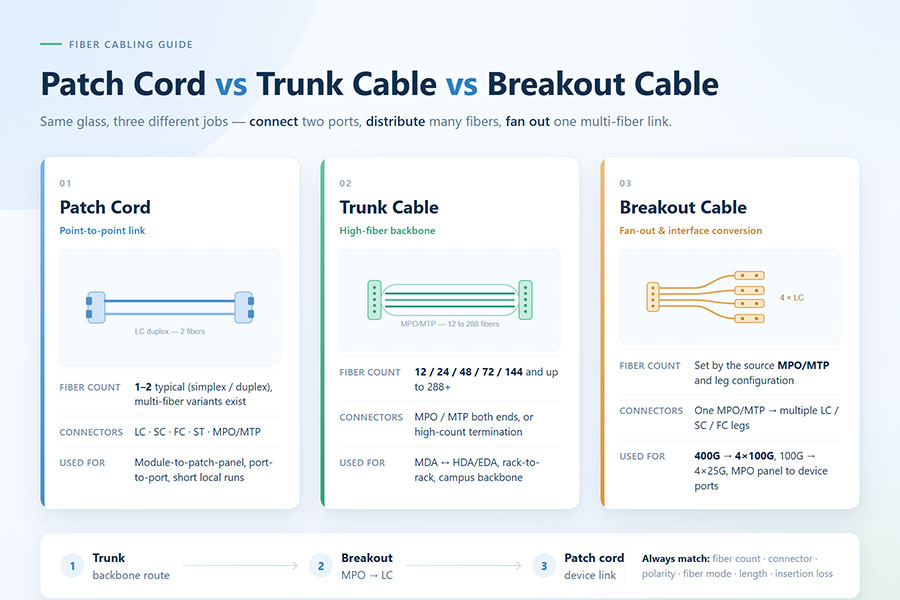
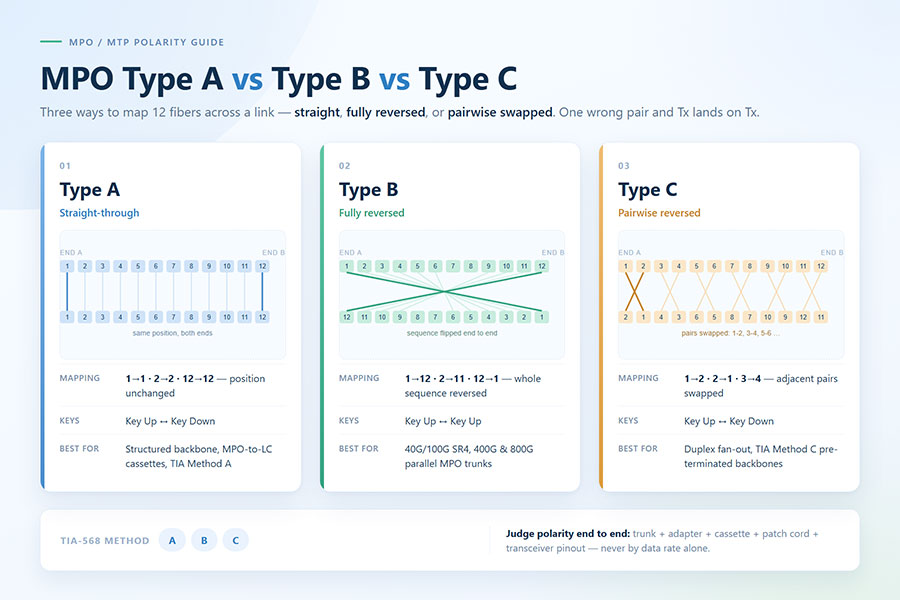
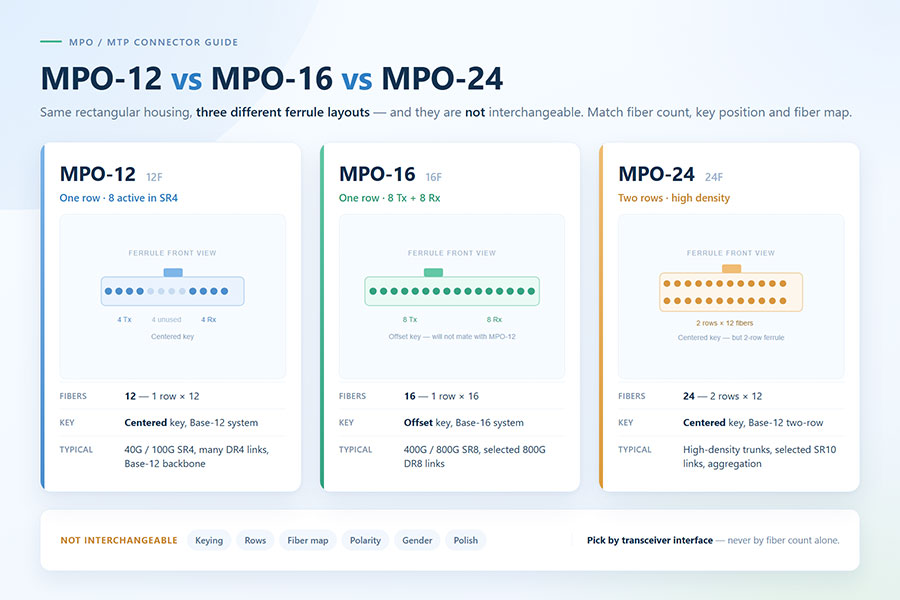
As optical engines move closer to the ASIC, fiber routing and connector placement become important parts of the equipment design. High-density fiber arrays, trunk cables, connector polarity, and service access must be considered during system planning.
Network maintenance
Pluggable optics allow engineers to replace individual transceivers at the front panel. NPO and CPO require different maintenance strategies because the optical engines are integrated more closely into the system. External laser sources, fiber connectors, and replaceable assemblies may become important service points depending on the platform.
8. Does CPO Replace Pluggable Optical Transceivers?
CPO is an important direction for high-density optical integration, but it does not automatically replace all pluggable optical transceivers.
Pluggable optics remain useful because they offer standardized form factors, flexible deployment, and convenient field replacement. They also support a broad range of transmission distances and optical interfaces.
CPO is more tightly integrated with the switching platform. Its advantages are most relevant when electrical channel limitations, bandwidth density, and system-level power efficiency justify the additional packaging and maintenance complexity.
LPO also provides an alternative for reducing module power while retaining a pluggable form factor. NPO offers another integration approach between front-panel optics and package-level optical integration.
LPO, NPO, and CPO are not mutually exclusive modulation formats or optical wavelengths. They describe different aspects of optical system architecture. The actual optical transmission may still use PAM4, different wavelength arrangements, and different fiber types depending on the product.
9. C-LIGHT High-Speed Optical Interconnect Solutions
As data center networks transition toward 400G, 800G, and 1.6T connectivity, optical transceivers and high-speed cable assemblies remain important components of network infrastructure. The appropriate solution depends on the host equipment, interface type, transmission distance, and deployment architecture.
800G Optical and Electrical Interconnects
400G Connectivity
Optical Transceiver Portfolio
For pluggable optical connectivity across different data rates, form factors, wavelengths, and transmission distances, visit the C-LIGHT optical transceiver catalog.
The products above represent high-speed interconnect options. Their inclusion does not imply that every product uses LPO, NPO, or CPO technology. The exact architecture, DSP implementation, and compatibility should be confirmed against the corresponding product specifications.
10. Conclusion
LPO, NPO, and CPO are three important approaches to improving optical interconnect efficiency as data center bandwidth continues to increase.
LPO reduces module power by removing the conventional DSP retiming function while retaining a pluggable form factor. NPO places optical engines near the switch ASIC to shorten electrical connections while keeping the optical engine as a separate assembly. CPO integrates optical engines within the ASIC package structure or a closely integrated package assembly to achieve very short electrical paths and high bandwidth density.
For current network deployments, LPO offers a path to lower-power pluggable connectivity, while NPO and CPO provide increasingly integrated optical architectures for high-density switching systems. Their long-term adoption will depend on power efficiency, manufacturing maturity, reliability, thermal management, and serviceability.
Contact C-LIGHT for high-speed optical transceiver and cable assembly solutions for data center and network applications.
Contact C-LIGHT >

 >
 >
 >
 >
 >
 >
 >