TEL:+86 132 6656 7067





An AI data center requires more than powerful GPUs to train and operate large models. When hundreds or thousands of GPUs work together, they must exchange parameters, gradients, activations, and other data across multiple servers. The network carrying this traffic has a direct influence on training efficiency, GPU utilization, and distributed inference performance.
The AI backend network provides the high-performance communication fabric between GPU servers. It is designed for intensive east-west traffic, where compute nodes exchange large amounts of data with one another rather than simply communicating with external users or applications.
Technologies such as InfiniBand, Ethernet with RoCEv2, RDMA, high-speed switches, optical transceivers, and fiber-optic cabling work together to build this fabric.
1. What Is an AI Backend Network?
An AI backend network is the dedicated or logically isolated network fabric used to connect GPU servers and support communication between distributed computing nodes. It is commonly called the GPU backend fabric, compute fabric, inter-GPU network, or east-west network.
During distributed AI training, a model may be divided across multiple GPUs and servers. Each GPU performs part of the computation, but the results must be exchanged and synchronized so that the complete training process can continue. The backend network transports this communication between nodes.
The backend fabric is designed around several performance requirements:
High throughput: Carry large volumes of GPU-to-GPU traffic.
Low latency: Reduce communication delays during synchronization and data exchange.
Predictable performance: Maintain stable communication under heavy concurrent traffic.
Scalability: Connect additional GPU servers without redesigning the entire infrastructure.
Congestion control: Manage competing traffic flows and prevent network bottlenecks.
2. How Is the AI Backend Network Different from the Frontend Network?
AI infrastructure commonly separates network traffic according to workload and operational requirements. A typical deployment may include a GPU backend fabric, frontend fabric, storage network, and out-of-band management network. These can be physically separate or combined in selected architectures.
Connects GPU servers and carries distributed training, GPU synchronization, and multi-node inference traffic.
Traffic: East-west
Connects the AI cluster to users, applications, external services, and general data-center infrastructure.
Traffic: North-south
Provides access to datasets, model files, checkpoints, and shared storage systems.
Traffic: Data access and transfer
| Network Type | Main Function | Typical Traffic | Key Requirement |
|---|---|---|---|
| Backend | GPU-to-GPU communication across servers | Gradients, parameters, activations, collective operations | High bandwidth and low latency |
| Frontend | External access to AI services | API requests, inference traffic, application data | Availability, security, and service connectivity |
| Storage | Connects compute nodes to data systems | Training datasets, model files, checkpoints | High throughput and reliable data access |
| Management | Device administration and monitoring | Configuration, telemetry, control traffic | Isolation and operational reliability |
These networks do not always require separate physical switches. Some architectures combine frontend and storage traffic, while others use dedicated fabrics to isolate workloads. The appropriate design depends on cluster size, application requirements, security boundaries, and infrastructure cost.
3. How Does an AI Backend Network Work?
The backend network connects the network interfaces of GPU servers through a switching fabric. When one server needs to exchange data with another, its network adapter sends packets into the fabric. Switches forward the traffic toward the destination server, where the receiving adapter delivers the data to the appropriate application or GPU communication process.
In a high-performance AI system, the communication path may use Remote Direct Memory Access (RDMA). RDMA allows supported network adapters to transfer data between memory regions on different servers with reduced CPU involvement compared with conventional networking paths.
GPU-aware communication frameworks can coordinate these transfers so that data moves efficiently between GPU memory and remote nodes. Technologies such as GPUDirect RDMA can enable supported network adapters to access GPU memory directly, reducing unnecessary data copies through the host CPU.
What Happens During Distributed Training?
Consider a training job distributed across several GPU servers. Each server processes a portion of the workload and produces intermediate results. The training framework then coordinates communication between the nodes.
Each GPU performs computation on its assigned data or model partition.
GPU communication software organizes the data exchange.
The backend network transports information between participating servers.
Collective communication operations synchronize the required results.
The training process continues with updated parameters or the next computation stage.
If the backend fabric cannot deliver data quickly enough, GPUs may spend more time waiting for communication to finish. This can reduce overall cluster utilization even when the GPUs themselves have substantial unused computing capacity.
4. What Network Architecture Is Used in AI Backend Networks?
Leaf-spine architecture is widely used in data center networks because it provides a scalable way to connect large numbers of servers. AI backend fabrics may use conventional Clos designs, rail-optimized topologies, or other multi-plane arrangements depending on the GPU platform and communication pattern.
Leaf-Spine Architecture
In a leaf-spine network, GPU servers connect to leaf switches. Each leaf switch connects to multiple spine switches, creating multiple paths between different parts of the cluster.
The design can scale by adding leaf switches for more GPU servers and increasing spine capacity as traffic grows. Multiple paths also provide opportunities for load balancing and network resilience.
Non-Blocking Network Design
A non-blocking fabric is designed with enough available network capacity to support the intended simultaneous traffic demand without an internal oversubscription bottleneck. In practice, the design target depends on the number of server-facing ports, uplink capacity, traffic patterns, and cost constraints.
For example, a leaf switch with 64 server-facing 400G connections would require substantial uplink capacity to provide a 1:1 bandwidth ratio. A design with less uplink bandwidth may be oversubscribed. That can be acceptable for some workloads, but it may constrain performance when many GPU nodes communicate simultaneously.
Rail-Optimized Topology
Some GPU platforms use multiple network interfaces per server. A rail-optimized design organizes corresponding interfaces across servers into separate network paths, or rails. This can help align network paths with GPU communication patterns and reduce unnecessary switching stages for selected traffic flows.
Rail optimization is not simply a matter of adding more switches. It requires careful coordination among GPU placement, NIC-to-GPU mapping, switch ports, network routing, and the communication framework.
5. InfiniBand vs. RoCEv2 in AI Backend Networks
InfiniBand and Ethernet with RoCEv2 are two important technologies used to build high-performance AI backend networks. Both can support RDMA-based communication, but they use different network ecosystems and operational models.
| Aspect | InfiniBand | Ethernet with RoCEv2 |
|---|---|---|
| Network foundation | InfiniBand fabric | Ethernet fabric |
| RDMA support | Native RDMA transport | RDMA over Converged Ethernet |
| Congestion handling | InfiniBand fabric congestion-management mechanisms | Ethernet mechanisms such as ECN and PFC, depending on design |
| Switch ecosystem | InfiniBand-compatible switches and adapters | Ethernet switches and RoCE-capable adapters |
| Deployment focus | Dedicated high-performance computing and AI fabrics | High-performance AI networking within Ethernet environments |
| Engineering priorities | Fabric configuration, subnet management, and performance tuning | Loss behavior, congestion control, routing, and interoperability |
InfiniBand
InfiniBand is designed for high-performance computing and large-scale cluster communication. It supports RDMA and provides a specialized fabric architecture for low-latency, high-throughput communication between servers.
RoCEv2
RoCEv2 carries RDMA operations over Layer 3 Ethernet networks using UDP/IP encapsulation. It allows AI clusters to use Ethernet infrastructure for high-performance communication, provided that the adapters, switches, and network configuration support the required features.
RoCEv2 deployments commonly use Explicit Congestion Notification (ECN) and may use Priority Flow Control (PFC) as part of a congestion-management strategy. These features require coordinated configuration and monitoring. PFC alone does not guarantee a lossless or congestion-free network.
6. Why Are Optical Transceivers Important in AI Backend Networks?
As AI clusters expand across multiple racks, high-speed connections must carry large amounts of data between GPU servers and network switches. Optical transceivers provide the fiber-optic interfaces needed for many of these links.
A typical pluggable optical transceiver converts electrical signals from a switch or network adapter into optical signals for transmission over fiber. At the receiving end, another transceiver converts the optical signals back into electrical signals.
High Bandwidth Across Multiple Racks
Optical links support high data rates over fiber, making them suitable for dense switch-to-switch connections and server uplinks where copper reach or cable-management constraints become significant.
Longer Transmission Distance
Fiber can connect equipment across racks and data center areas without the same distance limitations associated with many passive copper links. The appropriate optical reach depends on the transceiver specification, fiber type, connector system, and link budget.
High-Density Network Deployment
High-speed optical modules allow network designers to build dense interconnections while managing the physical routing of large numbers of cables. Connector type, fiber count, polarity, and cable pathways remain important installation considerations.
400G, 800G, and 1.6T Connectivity
AI backend networks increasingly use high-capacity links. 400G and 800G connectivity are important in current high-performance deployments, while 1.6T modules are emerging for next-generation switch platforms.
| Optical Speed | Example Application | Design Considerations |
|---|---|---|
| 400G | GPU server uplinks and leaf-spine connections | Host interface, lane mapping, fiber type, and reach |
| 800G | High-capacity GPU backend and switch interconnects | Electrical interface, optical lane configuration, and thermal limits |
| 1.6T | Next-generation high-bandwidth switch interconnects | 200G-per-lane architecture, host compatibility, and power budget |
Higher link speeds do not automatically improve application performance. The switch architecture, NIC capacity, topology, congestion behavior, and GPU communication software must all support the required throughput.
7. How Do DAC, AEC, and AOC Fit into the Backend Network?
Optical transceivers are not required for every backend connection. Short-distance links inside a rack or between nearby devices may use direct-attach copper or active cable solutions. The choice depends on reach, bandwidth, power, cost, and installation requirements.
| Interconnect | Medium | Typical Deployment Role | Key Characteristics |
|---|---|---|---|
| DAC | Passive copper twinax | Short connections within a rack | Simple, cost-effective, and low power |
| AEC | Active copper | Short-reach connections requiring signal conditioning | Active electronics improve practical copper reach |
| AOC | Optical fiber with integrated transceivers | Connections where an integrated optical cable is suitable | Flexible optical cable assembly |
| Pluggable Optics | Optical transceivers and separate fiber | Server uplinks and switch-to-switch connections | Flexible reach, fiber routing, and module replacement |
A practical AI backend network may combine several interconnect types. DAC can serve short connections, AEC can support selected active copper links, and AOC or pluggable optics can provide fiber connectivity where reach or cable density requires it.
There is no universal distance at which copper must be replaced by optical fiber. Actual reach depends on the cable product, data rate, host interface, and system qualification.
8. What Are the Main Challenges in AI Backend Network Design?
Increasing GPU density and network speed create several engineering challenges. A backend fabric must deliver enough bandwidth while controlling latency, congestion, power consumption, and operational complexity.
Network Congestion
Multiple GPU servers may send large amounts of data at the same time. If traffic exceeds the available capacity of a network path, queues build up and communication slows down. Congestion management, load balancing, topology planning, and traffic monitoring are therefore essential.
Oversubscription
Oversubscription occurs when the aggregate capacity of server-facing links exceeds the available uplink capacity. It can reduce infrastructure cost, but it may also limit performance during communication-intensive training workloads.
Latency and Communication Overhead
Distributed training involves repeated communication between GPUs. Even when the network has high aggregate bandwidth, inefficient routing, excessive switching stages, congestion, or software overhead can increase the time required for synchronization.
Power and Thermal Management
High-speed switches, network adapters, and optical modules consume power and generate heat. Dense deployments require appropriate airflow, power distribution, cable organization, and module thermal management.
Interoperability
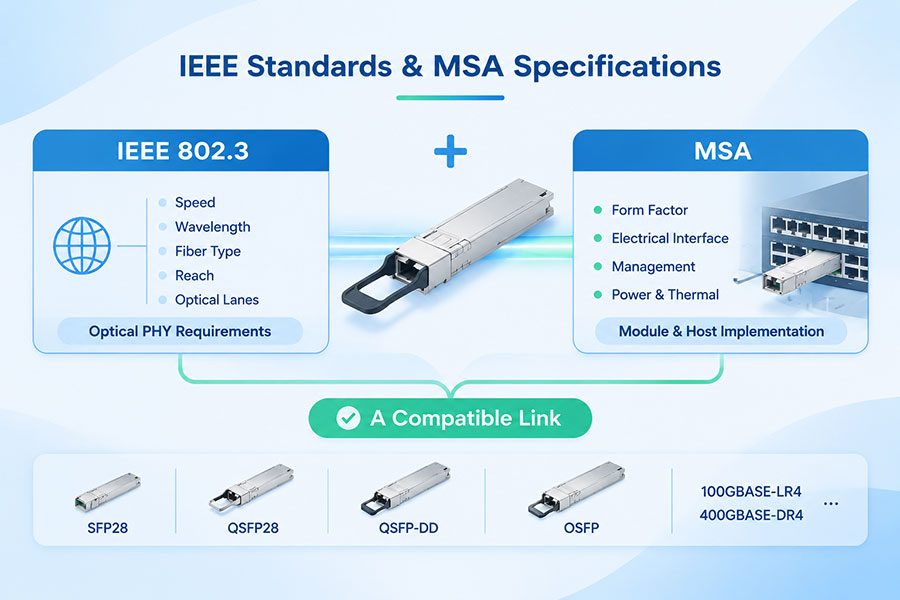
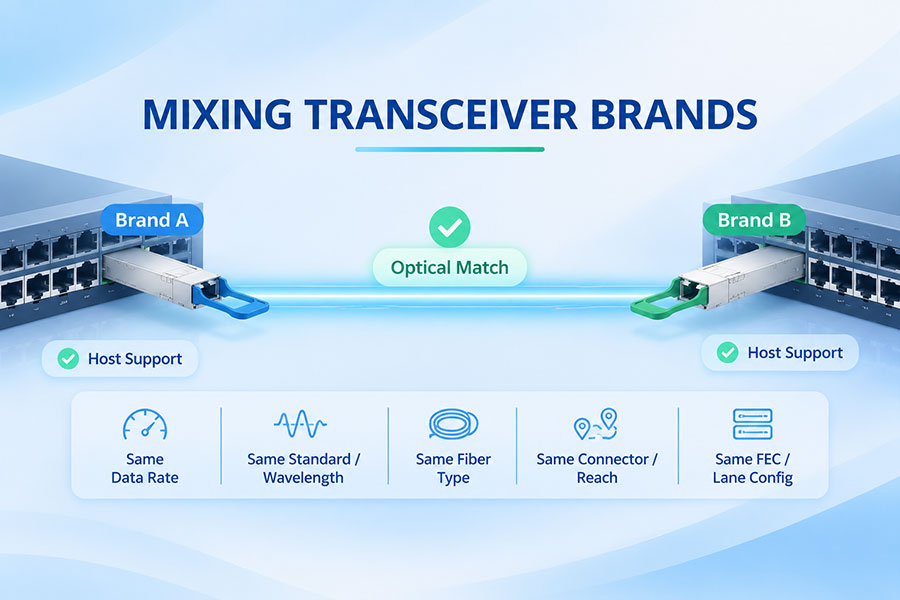
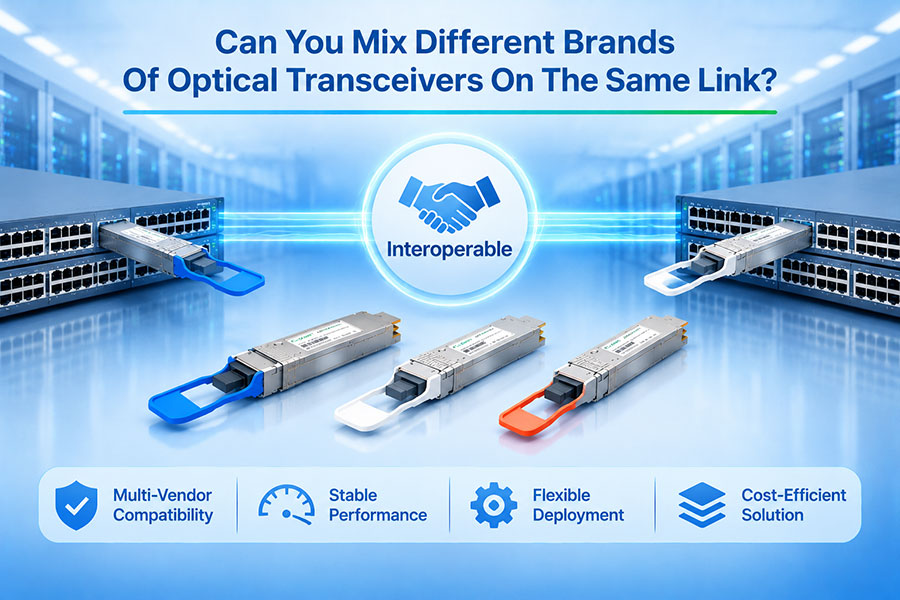
Network adapters, switches, transceivers, and cables must support the intended data rate, protocol, and physical interface. A mismatch in form factor, lane configuration, firmware, or optical specification can prevent a link from operating correctly.
Monitoring and Troubleshooting
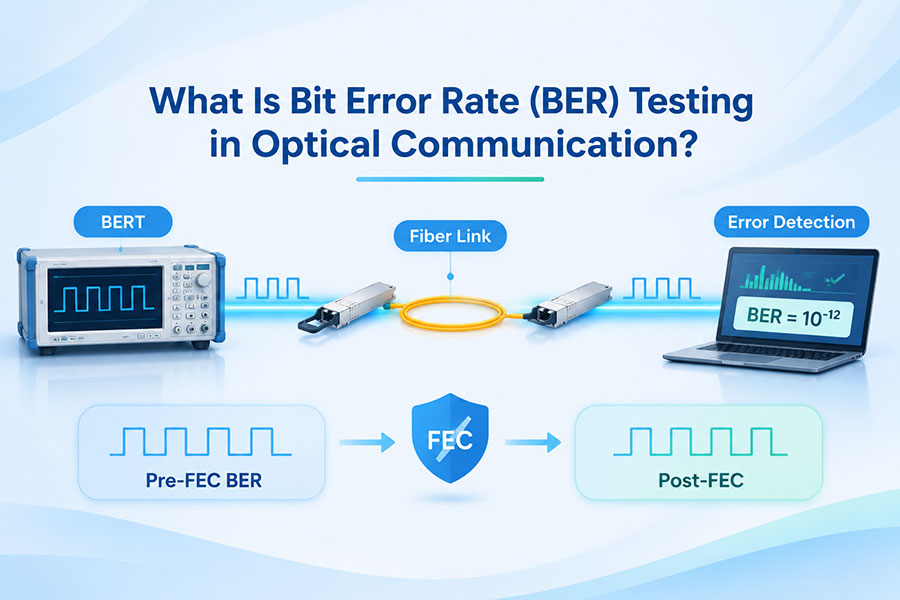
Network performance depends on more than whether a link is up. Engineers need visibility into throughput, packet drops, congestion, latency, optical receive power, module temperature, and interface errors to identify performance problems.
9. C-LIGHT Connectivity Products for AI Backend Networks
AI backend network deployment requires a combination of high-speed optical transceivers and electrical or optical cable assemblies. The appropriate product depends on switch and NIC compatibility, link distance, fiber infrastructure, and the target network speed.
800G connectivity is relevant to high-capacity GPU fabrics and switch interconnections. C-LIGHT provides several 800G cable options for different short-reach deployment requirements.
800G DAC Cable – passive copper connectivity for supported short-reach links.
800G AEC Cable – active electrical cable connectivity.
800G AOC Cable – integrated optical cable connectivity.
400G links remain important in AI infrastructure and data center switching. C-LIGHT offers 400G cable solutions for supported host platforms and link configurations.
For next-generation high-bandwidth switching platforms, C-LIGHT provides 1.6T OSFP-RHS optical transceiver configurations:
1.6T OSFP 2DR4 RHS – 500m single-mode fiber configuration.
1.6T OSFP 2FR4 RHS – 2km single-mode fiber configuration.
Product details are available on the C-LIGHT 1.6T OSFP-RHS product page.
These products represent different connectivity options rather than interchangeable solutions. Before deployment, verify the switch or NIC model, supported form factor, module coding, protocol, fiber type, connector, and transmission distance.
View the complete C-LIGHT Optical Transceiver portfolio and AOC and DAC product range for additional connectivity options.
For AI data center interconnect requirements, platform compatibility, or customized high-speed connectivity solutions, Contact C-LIGHT.
10. The Role of Backend Networks in Future AI Infrastructure
The AI backend network is the communication foundation of distributed GPU computing. It connects GPU servers through high-performance switching fabrics and enables the exchange of data required for model training, synchronization, and multi-node inference.
As AI clusters expand, backend networks must scale in bandwidth, port density, and traffic-management capability. InfiniBand and RoCEv2 provide important RDMA-based networking options, while leaf-spine and rail-optimized architectures help organize communication across large numbers of compute nodes.
Optical transceivers, DAC, AEC, and AOC cables each serve different physical connectivity requirements. The right combination allows network designers to balance reach, bandwidth, power, thermal performance, and deployment cost.
Ultimately, GPU performance depends on the complete system. A well-designed backend network helps prevent communication bottlenecks and allows distributed AI infrastructure to operate more efficiently as cluster size and workload complexity increase.
 >

 >
 >
 >
 >
 >
 >
 >