TEL:+86 132 6656 7067





Large AI clusters depend on continuous communication between GPUs distributed across servers, racks, and network pods. As training workloads grow, the network must move large volumes of data while controlling congestion, power consumption, and communication delays. Optical Circuit Switching (OCS) addresses this challenge by dynamically establishing direct optical connections between selected network endpoints. In an AI data center, OCS works alongside conventional Ethernet or InfiniBand switches, allowing the network topology to adapt to changing workload requirements.
The important difference is that an OCS does not forward individual packets. Instead, a network controller determines which optical connections are needed, configures the switching fabric, and maintains those paths while the corresponding traffic is transmitted.
1. Why Do AI Data Centers Need Optical Circuit Switching?
AI training involves multiple forms of communication. GPUs exchange gradients, synchronize model parameters, distribute data, and transfer intermediate results. The network traffic pattern depends on the parallelism method, model structure, cluster layout, and training stage.
Traditional electrical packet switches provide flexible forwarding, but large multi-tier fabrics can require considerable switching capacity and power. They may also experience congestion when many compute groups communicate simultaneously.
High-Bandwidth Communication
Distributed training can generate substantial east-west traffic between GPU servers. OCS can establish additional optical paths between selected network groups when their communication demand justifies dedicated connectivity.
Changing Traffic Patterns
Different AI jobs may produce different communication patterns. A reconfigurable optical fabric can adapt its connections instead of relying entirely on one permanently fixed topology.
Network Power Efficiency
An optical circuit can bypass packet-processing electronics at the OCS switching stage. This can reduce switching-related power in suitable architectures, although the complete system still requires power for transceivers, control, and other network equipment.
Topology Flexibility
OCS allows network operators to change physical optical connectivity through software-controlled configuration, supporting different arrangements of compute and network resources.
2. The Main Components of an OCS-Based AI Network
An OCS-based AI network is not a standalone optical switch connected directly to every GPU. It is a coordinated system consisting of compute endpoints, electronic packet switches, optical interfaces, fiber connections, an optical switching fabric, and network control software.
Typical OCS-Based AI Network Structure
Simplified logical architecture. Some deployments use OCS at the core, while others integrate it differently into the fabric.
What each component does
| Component | Primary Function | Role in OCS Networking |
|---|---|---|
| GPU Servers | Execute AI workloads and exchange data | Generate the traffic that drives network connectivity requirements |
| Electronic Packet Switches | Forward Ethernet or InfiniBand packets | Handle fine-grained packet forwarding within the electronic fabric |
| Optical Transceivers | Convert electrical signals into optical signals and back | Provide optical interfaces at supported network endpoints |
| Optical Circuit Switch | Connect selected optical input and output ports | Creates the physical optical circuits between network groups |
| Fiber Links | Carry optical signals between devices | Provide the physical transmission paths |
| Network Controller | Manage connectivity and configuration | Coordinates circuit assignments and topology changes |
| Telemetry and Orchestration Software | Collect network status and coordinate workloads | Provides information for circuit scheduling and operational decisions |
3. How Does OCS Establish an Optical Connection?
The operating process begins with network demand rather than with an individual packet. A controller or orchestration system identifies the network groups that need additional connectivity and determines whether an optical circuit is appropriate.
OCS Connection Workflow
The network management system obtains information about AI jobs, communication requirements, link utilization, congestion, and available optical resources.
The controller determines which network ports should be connected. It checks port availability, topology constraints, optical path feasibility, and the expected duration of the traffic demand.
Configuration commands are sent to the optical switching device. Depending on the technology, internal mirrors, beam-steering elements, or other photonic components establish the requested path.
The system verifies that the intended connection is established and that the optical link has acceptable signal conditions before carrying production traffic.
Traffic travels through the established optical path. The OCS redirects the optical signal without inspecting packet headers or making packet-by-packet forwarding decisions.
When workload requirements change, the controller can retain, release, or reassign optical circuits according to network policy and switching-device capabilities.
This process can be summarized as:
The timing of this workflow depends on the OCS technology and control system. Many MEMS-based devices operate on millisecond or longer switching timescales, so they are generally used for topology-level changes rather than packet-level forwarding.
4. How Does OCS Work with GPU Communication?
GPU communication is not uniform throughout an AI cluster. Some operations require frequent exchanges among many GPUs, while others concentrate traffic between particular groups of servers or pods.
OCS can help when the network identifies communication patterns that are sufficiently stable or predictable to justify establishing dedicated optical paths.
Example: Communication between two GPU pods
Consider an AI training environment with two groups of GPU servers. Each group connects to its own leaf and spine switches. The groups exchange data during distributed training, creating traffic between their respective network pods.
Illustrative Optical Connection Between Two AI Pods
AI Pod A
AI Pod B
The diagram illustrates a logical inter-pod connection. Actual port mapping and traffic direction depend on the selected OCS architecture.
When the controller establishes the optical path, traffic between the selected network ports can use that circuit. The electronic switches continue handling packet forwarding on their respective sides, while the OCS provides the configured optical connection between them.
This arrangement can add connectivity where demand is concentrated. It does not mean that every GPU communicates directly through the OCS, nor that all traffic must pass through the optical circuit.
5. How OCS Adapts to Different AI Workloads
The value of OCS depends heavily on how well its circuit assignments match the communication behavior of the workload. Different AI workloads can benefit in different ways.
| AI Workload | Communication Characteristics | Potential OCS Role |
|---|---|---|
| Data Parallel Training | Frequent synchronization and collective communication across GPU groups | Provide additional optical connectivity between groups when traffic demand is sustained |
| Tensor Parallel Training | Frequent exchanges between GPUs participating in the same model computation | Support selected inter-group paths when the topology and communication placement make them useful |
| Pipeline Parallel Training | Data moves between model stages assigned to different GPU groups | Establish optical paths between network domains carrying sustained stage-to-stage traffic |
| Mixture-of-Experts (MoE) | Token dispatch and expert communication can create changing all-to-all traffic patterns | Adapt connectivity to recurring communication patterns when circuit scheduling can keep pace with workload phases |
| Distributed Inference | Communication varies with model placement, batching, and serving architecture | Provide dedicated paths for predictable, high-volume communication between inference groups |
MoE workloads are particularly interesting because expert traffic can be uneven and change between execution phases. However, a reconfigurable optical topology does not automatically eliminate congestion. The controller must understand the traffic pattern, and the network must be able to change circuits at a useful point in the workload.
6. What Happens When AI Network Traffic Changes?
An OCS fabric is useful because its optical connections are not permanently fixed. The controller can modify the port-to-port mapping when network demand changes, provided the switching hardware and topology support the requested configuration.
For example, a cluster may initially allocate optical circuits between Pod A and Pod B. Later, another training job may require more communication capacity between Pod A and Pod C. The controller can schedule a different connection arrangement.
Initial Circuit Assignment
Optical ports are configured to connect selected network groups based on the current workload and available resources.
New Traffic Demand
Telemetry and workload information indicate that a different group of endpoints now requires additional connectivity.
Controlled Reconfiguration
The controller checks resource availability and coordinates the change to avoid disrupting active traffic unnecessarily.
Updated Optical Topology
The OCS establishes the new connections, and the network updates its forwarding and operational state accordingly.
Reconfiguration is not instantaneous. The system must account for switching time, traffic draining or migration, route updates, and link verification. For this reason, OCS is generally better suited to planned or coordinated topology changes than unpredictable packet-by-packet traffic fluctuations.
7. OCS and Electrical Packet Switching: How They Work Together
OCS and electrical packet switching have complementary functions. An OCS provides circuit-level optical connectivity, while Ethernet and InfiniBand switches handle packet forwarding and network protocols.
| Network Function | Electrical Packet Switch | Optical Circuit Switch |
|---|---|---|
| Forwarding granularity | Individual packets | Configured optical circuits |
| Traffic decisions | Uses packet headers and forwarding tables | Uses externally configured port connections |
| Buffering | May buffer packets during congestion | Does not provide packet buffering in a transparent optical path |
| Topology changes | Managed through routing, forwarding, and network control mechanisms | Requires optical circuit reconfiguration |
| Best-suited traffic | Dynamic, bursty, and destination-variable traffic | Traffic that can benefit from sustained or scheduled optical connections |
| Typical deployment | Server access, leaf-spine forwarding, and packet routing | Reconfigurable connectivity between selected network groups |
A hybrid design allows operators to retain the flexibility of packet networking while introducing optical circuits where they offer measurable benefits. The best architecture depends on the workload, scale, traffic predictability, optical budget, and operational requirements.
8. Optical Transceivers and Fiber Requirements in OCS Networks
OCS changes the way optical paths are connected, but it does not remove the need for reliable optical interfaces. Transceivers and fiber assemblies remain essential wherever the selected architecture uses pluggable optical connections at its endpoints.
Optical transceiver selection
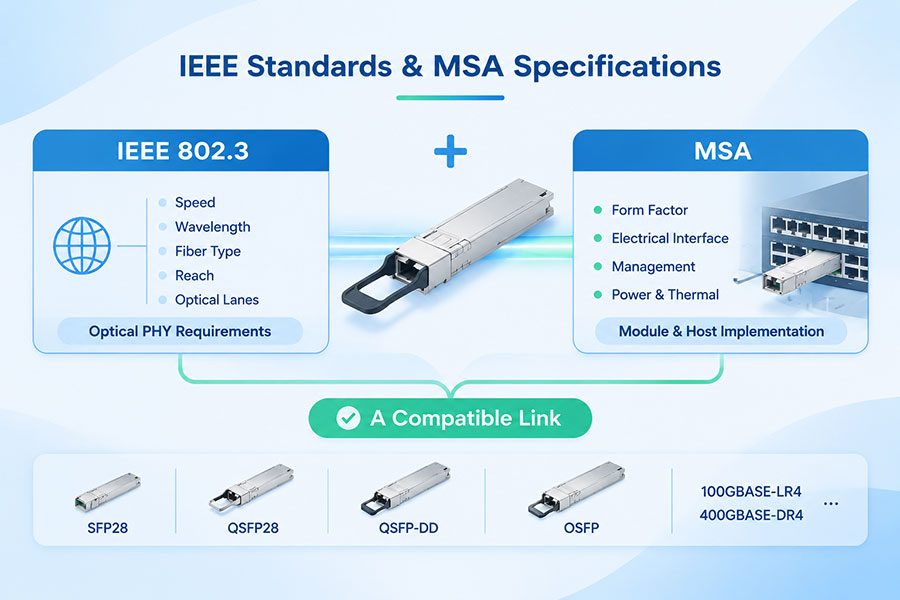
The transceiver must match the endpoint switch or server interface and the optical path. Relevant parameters include data rate, wavelength, modulation, fiber type, connector, reach, transmit power, receiver sensitivity, and supported optical loss.
C-LIGHT Optical Transceiver Portfolio
C-LIGHT Optical Transceivers provide interface options for data center and high-speed networking applications. For an OCS deployment, the selected module must be validated against the complete optical path, including the OCS insertion loss and the endpoint equipment specifications.
High-speed optical interconnects
AI data centers use different connection technologies depending on distance, port density, and equipment design. Pluggable optical transceivers, active optical cables, and passive or active electrical cables serve different link requirements.
Relevant C-LIGHT High-Speed Connectivity Products
800G AOC – integrated optical cabling for compatible short-reach connections.
800G DAC – passive direct-attach connectivity for supported short-distance electrical links.
800G AEC – active electrical cabling for compatible high-speed interfaces.
1.6T OSFP-RHS – high-speed optical transceiver options for supported next-generation data center platforms.
These products are not interchangeable OCS components. Their suitability depends on whether the architecture uses a pluggable optical endpoint, an integrated cable assembly, or a separate optical switching interface.
Fiber connectivity and optical loss
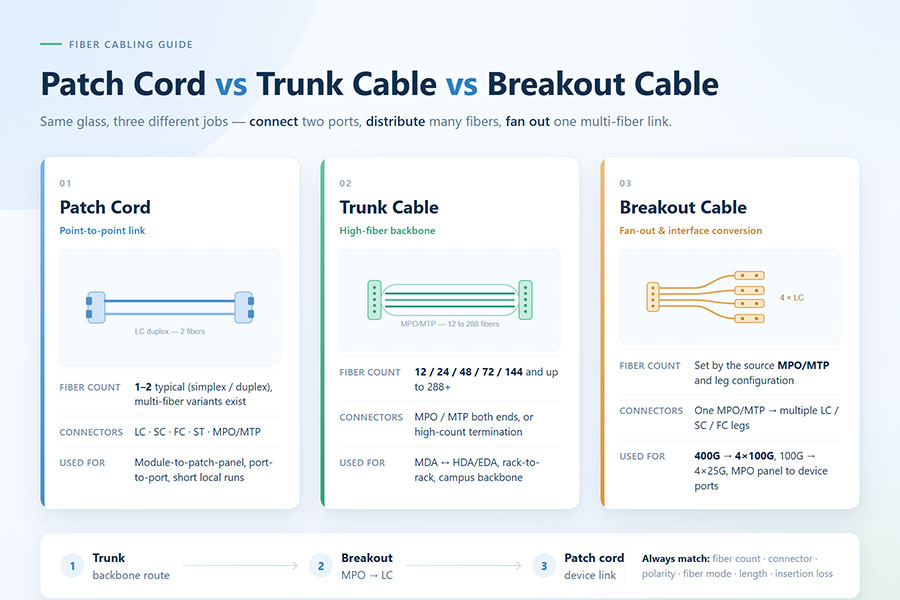
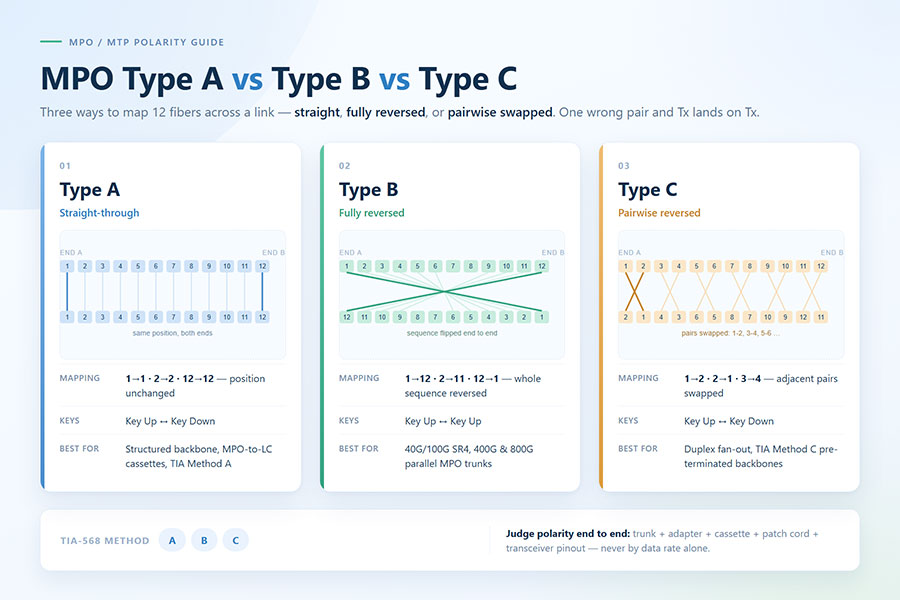
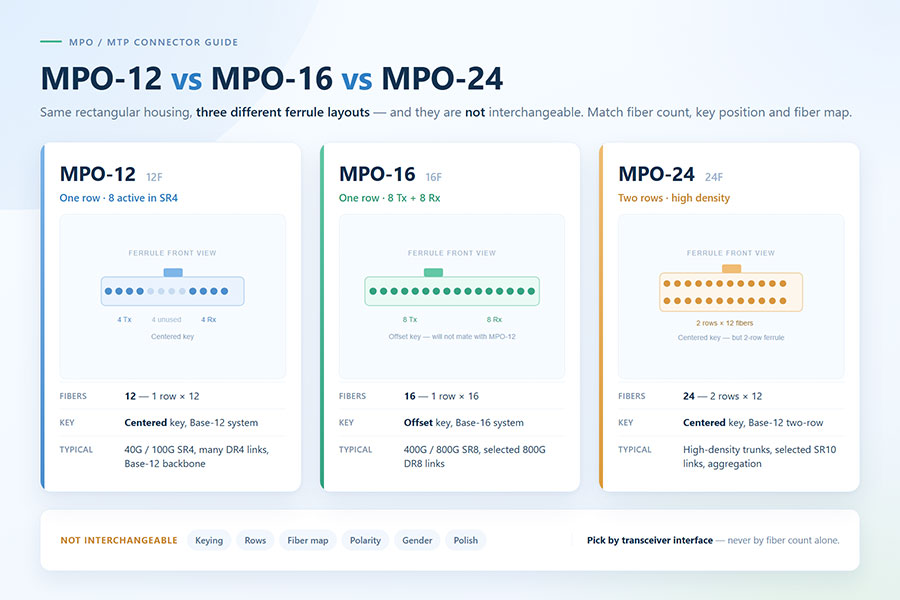
Fiber assemblies connect transceivers, patch panels, and OCS ports. High-density multi-fiber connections can simplify cabling in large network environments, but connector type and polarity must match the equipment design.
C-LIGHT Fiber Assemblies
Before deployment, verify fiber grade, fiber count, connector gender, polarity, insertion loss, and the OCS port interface. The complete optical budget must include the OCS, fiber, connectors, and other components along the path.
9. Key Engineering Challenges in AI OCS Deployment
Integrating OCS into an AI data center requires coordinated optical, network, and workload engineering. The physical switching device is only one part of the system.
Switching time and workload scheduling
Optical circuit reconfiguration takes longer than ordinary packet forwarding. The network controller must select appropriate moments for topology changes and coordinate them with workload phases. Frequent changes that provide little sustained traffic benefit can reduce the value of the optical fabric.
Optical power budget
OCS insertion loss consumes part of the available link budget. Engineers must verify that the selected transceivers can operate across the complete path, including all fiber connections, connectors, and optical switching stages.
The total path loss must include the OCS and all other optical components. Engineering margin and the transceiver's specified operating conditions must also be considered.
Traffic imbalance and circuit assignment
OCS creates specific port-to-port connections rather than providing unrestricted packet-level any-to-any forwarding. Poor circuit allocation can leave some links underused while other paths become congested. Traffic engineering must consider the actual distribution of communication demand.
Failure detection and recovery
OCS does not inherently exchange packets or perform conventional packet-based neighbor discovery. Operators therefore need optical-layer verification, link monitoring, and controller coordination to identify faulty paths and restore connectivity.
Operational complexity
The OCS controller, electronic switches, workload orchestrator, and telemetry system must maintain a consistent view of the network. Port mappings, optical path status, and forwarding configuration must be coordinated during every topology change.
10. Where Is Optical Circuit Switching Heading in AI Networking?
OCS is developing from a specialized optical switching technology into an important architectural option for large-scale data center networking. Industry work is increasingly focused on making OCS easier to integrate with software-defined networking, telemetry systems, and AI workload orchestration.
Several development areas are particularly relevant:
Higher-radix optical fabrics: More ports can provide additional connectivity options and support larger network domains, subject to optical loss and physical design constraints.
Improved control software: Better coordination between workload scheduling and circuit allocation can make topology changes more useful.
Optical-layer telemetry: More comprehensive monitoring can improve fault detection, path verification, and operational reliability.
Hybrid electrical-optical networks: OCS is expected to complement packet switching rather than eliminate the need for Ethernet or InfiniBand fabrics.
Workload-aware topology design: Network configurations can be optimized around the communication characteristics of distributed training and other high-performance workloads.
Open industry initiatives, including the Open Compute Project's OCS work, are addressing hardware and software specifications, SDN integration, telemetry, and interoperability. These efforts are important for making optical circuit switching easier to deploy across multi-vendor data center environments.
11. Conclusion
Optical Circuit Switching works in AI data centers by establishing configurable optical paths between selected network ports. A controller analyzes workload demand, schedules circuits, configures the OCS, and coordinates traffic over the resulting connections. This allows network operators to adapt physical connectivity to communication patterns that benefit from dedicated optical paths.
OCS is not a replacement for all packet switches or a mechanism for forwarding every GPU packet individually. Its value comes from combining optical circuit-level connectivity with the flexibility of conventional Ethernet or InfiniBand networks.
Successful deployment depends on traffic engineering, switching time, optical link budgets, fiber connectivity, monitoring, and workload coordination. As AI clusters continue to expand, OCS will remain an important technology in the development of flexible and energy-conscious data center network architectures.
For optical transceivers, high-speed interconnects, and fiber connectivity solutions, visit C-LIGHT or Contact C-LIGHT.
 >

 >
 >
 >
 >
 >
 >
 >