TEL:+86 132 6656 7067





1. Why Do GPUs Need to Communicate With Each Other?
A GPU can process large volumes of parallel calculations, but the memory and computing resources of one accelerator are often insufficient for a large model or a demanding training workload. AI frameworks therefore distribute computation across multiple GPUs.
Each GPU handles a portion of the workload. Depending on the parallelization strategy, it may process a different batch of training data, hold part of the model parameters, or calculate a section of a neural network layer.
These separate computations must be coordinated. GPUs exchange information for several important reasons:
Gradient synchronization: GPUs combine gradient information so that distributed model replicas can update consistently.
Parameter distribution: Model weights and updated parameters are made available to the GPUs that need them.
Tensor exchange: Intermediate results move between GPUs when a model is divided across multiple devices.
Attention and sequence processing: Distributed model components exchange data required by different stages of computation.
Inference coordination: Multiple GPUs cooperate when a model is too large for one accelerator or when workloads are distributed for throughput.
2. Two Communication Domains: Inside a Server and Across Servers
GPU communication generally operates across two physical domains. The first connects accelerators inside the same server or computing platform. The second connects GPUs located in different servers through a high-speed data center network.
Intra-Node Communication
Intra-node communication takes place between GPUs within one server or a tightly integrated computing system. Depending on the platform, the data path can use NVLink, NVSwitch, or PCI Express (PCIe).
NVLink provides a high-bandwidth GPU-to-GPU connection. NVSwitch expands the available connectivity by allowing multiple GPUs to communicate through a switching fabric. PCIe can also support peer-to-peer communication when the hardware topology and system configuration permit it.
These technologies reduce the need to route every transfer through the CPU and system memory. The actual communication path depends on GPU placement, supported links, switch topology, and platform configuration.
Inter-Node Communication
When GPUs are installed in different servers, their data must travel through network interface cards (NICs), switches, and network links. Common network technologies include InfiniBand and RoCEv2 over Ethernet.
For distributed AI training, the network is often designed as a dedicated backend fabric. It carries high-volume GPU communication traffic separately from general-purpose services such as user access, storage management, and application traffic.
3. How NVLink, NVSwitch, and PCIe Move Data
Inside a multi-GPU server, communication performance depends heavily on how accelerators are connected. A GPU may have direct peer access to another GPU, or its traffic may need to pass through an intermediate switching component.
NVLink
NVLink is a high-speed interconnect designed for communication between supported NVIDIA GPUs and related platform components. It provides a faster GPU communication path than relying exclusively on conventional PCIe transfers in supported configurations.
NVSwitch
NVSwitch is a switching technology that expands GPU connectivity. It enables communication among multiple GPUs through a high-bandwidth fabric and supports large multi-GPU systems.
PCIe
PCI Express connects GPUs, CPUs, and other devices. It can support GPU peer-to-peer transfers when the platform, drivers, and PCIe topology allow direct access.
GPU Peer-to-Peer Access
Peer-to-peer (P2P) access allows one GPU to access another GPU's memory without requiring a conventional copy through host memory. The available path depends on system support.
These technologies are not interchangeable. A system may use several of them together, and the best path depends on the physical topology and the communication pattern generated by the workload.
4. How GPUs Communicate Across Different Servers
When a training job spans multiple servers, the communication path typically involves a GPU, a high-speed NIC, the network fabric, and the destination server's NIC and GPU.
InfiniBand
InfiniBand is a high-performance networking technology used in many large-scale computing environments. It provides high bandwidth, low latency, and RDMA capabilities, making it suitable for communication-intensive distributed workloads.
RoCEv2
RoCEv2, or RDMA over Converged Ethernet version 2, carries RDMA traffic over an Ethernet and IP network. It allows compatible network adapters to transfer data between system memories while reducing conventional CPU involvement in the data path.
RoCEv2 can make use of Ethernet switching infrastructure, but its performance depends on careful network engineering. Congestion management, traffic distribution, queue configuration, and switch behavior all influence communication efficiency.
GPUDirect RDMA
GPUDirect RDMA enables a compatible network adapter to access GPU memory directly for data transfers. Instead of requiring every transfer to pass through a CPU-managed host-memory copy, the technology can establish a more direct path between GPU memory and the network adapter.
This is particularly useful when distributed training generates frequent exchanges between GPUs on different servers. It can reduce CPU overhead and avoid unnecessary data movement, provided the GPU, NIC, drivers, and platform are configured to support it.
5. What Is NCCL and Why Is It Important?
Hardware provides the communication paths, but AI applications also need software to coordinate data exchange. For NVIDIA GPU systems, the NVIDIA Collective Communications Library (NCCL) is a widely used communication library.
NCCL provides collective communication operations and point-to-point send and receive functions. It detects available system topology and selects communication methods suited to the GPUs and interconnects in the system.
It can use supported paths involving PCIe, NVLink, NVSwitch, InfiniBand, and RoCE. This allows AI frameworks to coordinate multi-GPU and multi-node operations without implementing every low-level transfer themselves.
| Communication Operation | How It Works | Typical Purpose |
|---|---|---|
| All-Reduce | Combines values from multiple GPUs and distributes the resulting value to all participating GPUs. | Gradient synchronization in distributed training. |
| All-Gather | Collects data from all GPUs and makes the combined data available to every participant. | Reconstructing distributed parameter or tensor sections. |
| Reduce-Scatter | Reduces values across GPUs and distributes different portions of the result to individual GPUs. | Sharded model training and distributed optimization. |
| Broadcast | Sends data from one GPU to all participating GPUs. | Sharing parameters or common information. |
| All-to-All | Each GPU exchanges data with multiple other GPUs. | Expert routing and distributed model operations. |
| Send / Receive | Transfers data between specified GPU processes or communication endpoints. | Point-to-point tensor and pipeline communication. |
These operations are selected according to the model architecture and parallelization strategy. For example, data-parallel training commonly uses All-Reduce to synchronize gradients, while fully sharded training can rely heavily on All-Gather and Reduce-Scatter.
6. What Happens During a Distributed Training Step?
Consider a training job running across several GPU servers. Each GPU processes a portion of the training workload, but the model must remain coordinated as the training iteration progresses.
In a typical data-parallel example, each GPU processes a different portion of the training data and calculates local gradients. The communication library coordinates gradient reduction across the participating GPUs. Once the required synchronization is complete, the training process can apply the updated parameters.
In model-parallel training, the communication pattern is different. A model may be divided into layers, tensor sections, or pipeline stages. GPUs exchange intermediate activations and other tensors as the computation moves through the model.
Communication can also overlap with computation. For example, some gradient transfers may begin while other layers are still completing their backward pass. This helps reduce idle time, although the achievable overlap depends on the framework, model, hardware, and communication schedule.
7. Why Optical Networking Matters for Multi-Node GPU Communication
Inside a server, short-reach electrical interconnects and GPU fabrics handle much of the local communication. Between servers, however, data must cross the network fabric. As clusters expand, the physical links connecting GPU servers become a major part of the system's communication capacity.
High-speed optical transceivers and fiber links are used to connect switches, racks, and network equipment over the distances and bandwidths required by the cluster architecture.
Optical connectivity is especially relevant when AI infrastructure moves from 400G toward 800G and 1.6T network interfaces. Higher aggregate link capacity can support larger traffic volumes and higher-density network designs, provided the switches, NICs, optics, and network topology are designed as a compatible system.
| Connectivity Option | Typical Role | Important Design Factors |
|---|---|---|
| DAC | Short connections between equipment in the same rack or nearby positions. | Reach, cable routing, port compatibility, power, and cable density. |
| AEC | Active electrical connectivity for supported short-reach links. | Reach extension, signal integrity, power consumption, and host compatibility. |
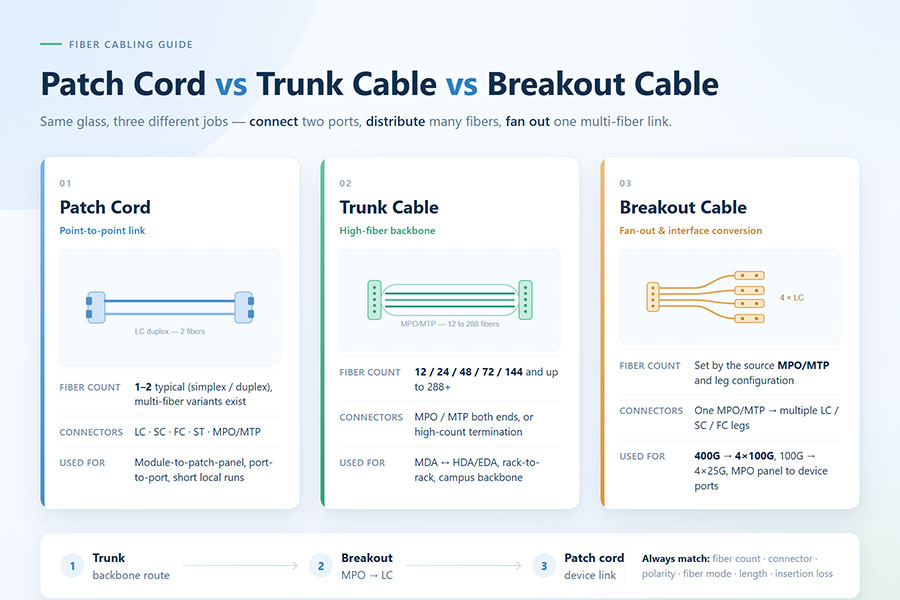
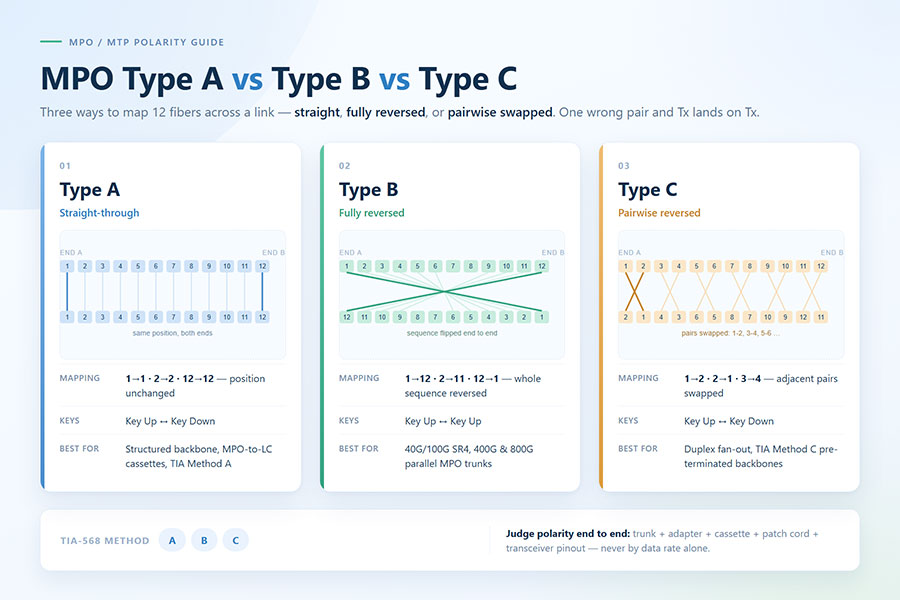
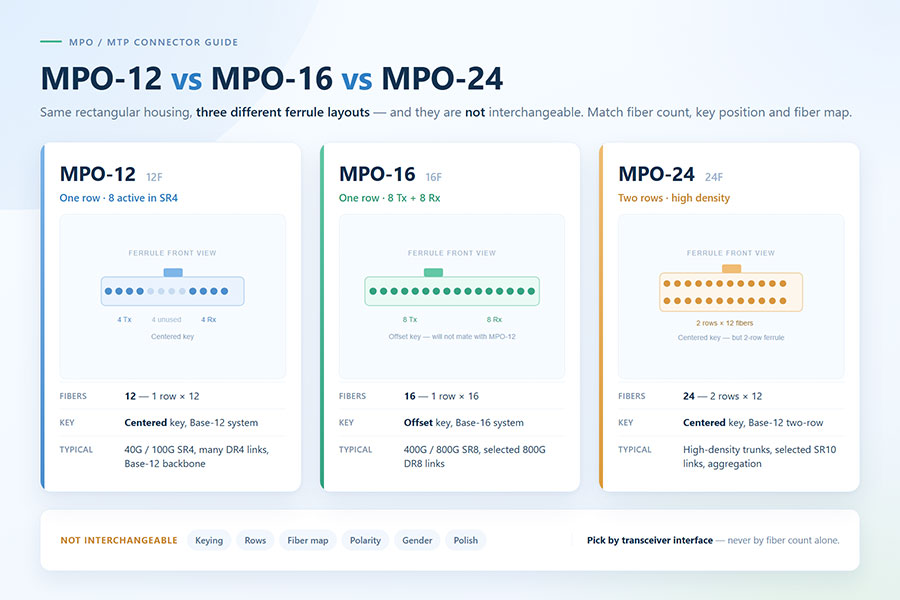
| AOC | Optical cable assemblies for high-speed connections over supported short and medium distances. | Fiber type, connector configuration, reach, and module compatibility. |
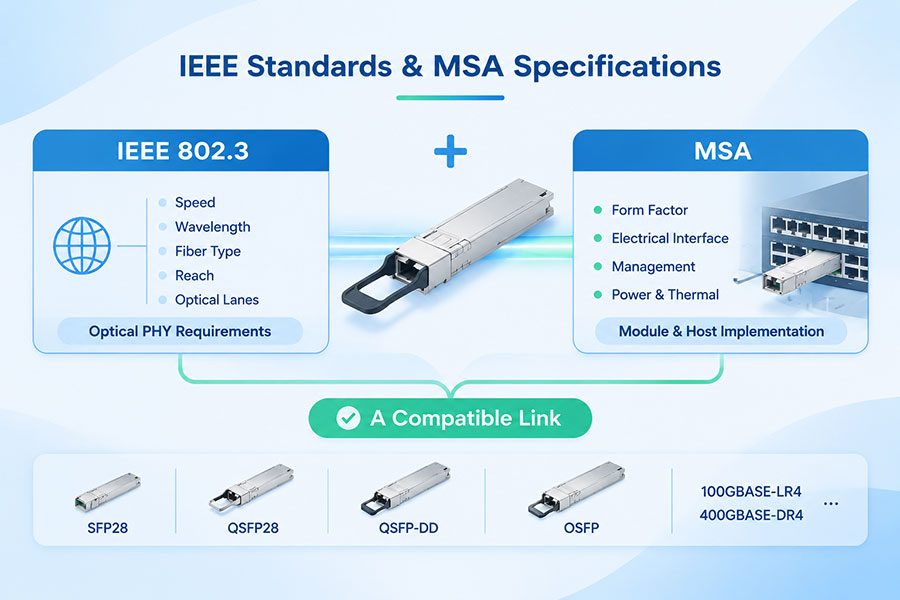
| Optical Transceivers | Optical links between servers, switches, and network devices. | Data rate, wavelength, fiber type, reach, form factor, and switch support. |
400G, 800G, and 1.6T in AI Network Fabrics
Different AI cluster designs use different link speeds according to GPU count, NIC bandwidth, switch capacity, oversubscription targets, and traffic patterns. A 400G connection may be suitable for one deployment, while larger or more bandwidth-intensive fabrics may use 800G or 1.6T interfaces.
Higher-speed optics do not automatically make GPU communication faster. The complete path must be considered, including GPU interconnect bandwidth, NIC throughput, switch capacity, network congestion, and the communication algorithms used by the training framework.
High-Speed Connectivity for AI Data Center Networks
C-LIGHT provides high-speed connectivity products for data center and AI infrastructure applications. Relevant product categories include:
400G DAC Cables – short-reach electrical connectivity for compatible high-speed equipment.
800G DAC Cables – high-bandwidth short-reach connections for supported 800G platforms.
800G AEC Cables – active electrical connectivity for supported high-speed links.
800G AOC Cables – optical cable assemblies for supported short-reach applications.
1.6T OSFP-RHS Optical Transceivers – high-capacity optical connectivity options for compatible next-generation network platforms.
Optical Transceiver Products – additional optical connectivity options across multiple data rates and form factors.
Product selection should be based on the switch or NIC model, supported port type, link distance, fiber infrastructure, and required interoperability. A higher data rate or matching connector alone does not guarantee compatibility.
For project requirements and product compatibility support, Contact C-LIGHT.
8. What Limits GPU-to-GPU Communication Performance?
GPU communication performance is determined by more than the advertised bandwidth of an individual link. Several factors can affect how quickly a distributed workload completes its communication operations.
Bandwidth and Link Utilization
Large tensor transfers and collective operations can consume substantial network bandwidth. If the available link capacity is insufficient for the workload, GPUs may spend more time waiting for data rather than performing calculations.
Latency and Synchronization
Some operations involve many small messages or require multiple GPUs to reach a synchronization point. In these cases, latency can matter as much as aggregate bandwidth.
Network Congestion
When many GPU servers transmit data simultaneously, traffic can compete for shared switch ports and uplinks. Congestion can increase communication time and create uneven progress across the training job.
Topology and Oversubscription
The number of network paths, switch stages, and available uplink capacity influences how traffic moves through the cluster. A network with insufficient bandwidth between layers may become a bottleneck during communication-intensive workloads.
GPU, NIC, and Software Configuration
Even high-performance hardware may not deliver its expected results if peer-to-peer access, RDMA support, driver configuration, topology detection, or communication-library settings are incorrect.
9. How to Build an Efficient GPU Communication Architecture
Designing a GPU cluster requires matching communication capacity to the workload rather than selecting network equipment based only on peak port speed.
Understand the parallelism strategy: Data parallelism, tensor parallelism, pipeline parallelism, and expert parallelism create different communication patterns.
Map the GPU topology: Identify which GPUs communicate locally and which exchanges cross server boundaries.
Match NIC and switch capacity: Ensure network bandwidth is appropriate for the number of GPUs and their expected traffic.
Choose the transport: Evaluate InfiniBand and RoCEv2 according to infrastructure, operational requirements, and application performance.
Plan optical connectivity: Select DAC, AEC, AOC, or optical transceivers according to reach, port speed, density, and platform support.
Validate end-to-end performance: Test actual communication operations and monitor throughput, latency, congestion, and GPU utilization.
A scalable architecture also needs room for future bandwidth upgrades. Moving from 400G to 800G or 1.6T may require changes to NICs, switches, cabling, optics, and the network topology rather than simply replacing one transceiver.
10. Conclusion
GPU-to-GPU communication is the foundation of distributed AI computing. Within a server, technologies such as NVLink, NVSwitch, and PCIe provide communication paths between accelerators. Across servers, InfiniBand and RoCEv2 networks carry data through high-speed NICs and switch fabrics, while GPUDirect RDMA can reduce unnecessary CPU and host-memory involvement.
Software libraries such as NCCL coordinate collective operations including All-Reduce, All-Gather, and Reduce-Scatter. As AI clusters grow, optical transceivers, DAC, AEC, AOC, and high-capacity network switches become increasingly important parts of the overall communication architecture.
Reliable GPU communication therefore depends on a balanced design that combines computing hardware, interconnect technology, network bandwidth, software coordination, and optical infrastructure.
 >

 >
 >
 >
 >
 >
 >
 >