TEL:+86 132 6656 7067





AI data centers must move enormous volumes of data between accelerators, switches, storage systems, and other facilities. As GPU performance and cluster size increase, network design is increasingly determined not only by total bandwidth, but also by how much bandwidth can be delivered within a limited physical space, power envelope, and cabling footprint. This is the practical importance of bandwidth density.
1. What Is Bandwidth Density?
Bandwidth density describes the amount of data-transfer capacity available within a defined physical or architectural boundary. Depending on the design context, it can refer to bandwidth per rack, per switch, per front-panel unit, per fiber, or per unit of equipment space.
In AI infrastructure, bandwidth density is particularly important because many accelerators operate as a coordinated cluster. They exchange model parameters, gradients, activations, and other intermediate data during distributed training and inference. The network must provide enough capacity to keep communication from limiting accelerator utilization.
Several measurements help describe bandwidth density:
| Measurement | What It Describes | Design Relevance |
|---|---|---|
| Bandwidth per port | Capacity of an individual network interface | Determines link speed and endpoint connectivity |
| Bandwidth per switch | Aggregate switching capacity of a device | Influences switch count, radix, and network tiers |
| Bandwidth per rack | Network capacity available to equipment in a rack | Affects rack architecture and uplink requirements |
| Bandwidth per fiber | Capacity carried by an individual fiber strand or optical path | Influences fiber count, connector density, and cable management |
| Bandwidth per rack unit | Network capacity relative to equipment installation space | Helps evaluate physical infrastructure efficiency |
2. Why AI Workloads Require Higher Bandwidth Density
Conventional enterprise applications often generate traffic between users, application servers, databases, and storage systems. AI training clusters add a much heavier east-west communication requirement: accelerators exchange data with other accelerators throughout distributed computing operations.
When a training job is distributed across many GPU servers, communication becomes part of the execution process. Operations such as All-Reduce, All-Gather, and All-to-All can generate substantial traffic across the backend fabric. If the network cannot deliver sufficient throughput with predictable latency, communication delays can reduce overall training efficiency.
More Accelerators
Larger GPU clusters create more communicating endpoints and increase the aggregate traffic that the fabric must support.
Higher Link Speeds
Faster network interfaces increase the capacity required from switches, optical modules, and physical links.
Distributed Workloads
Multi-node training depends on communication across servers and racks, making fabric capacity a direct part of system performance.
Limited Physical Space
High port counts and cable volumes compete for rack space, airflow, power, and service access.
These requirements make bandwidth density a system-level consideration rather than a specification that can be addressed by selecting faster transceivers alone.
3. How Bandwidth Density Changes Network Architecture
A network architecture must connect the required number of accelerator endpoints while providing enough capacity between switching layers. Higher bandwidth density can support flatter network designs, but only when switch capacity, port count, topology, and link speeds are properly matched.
Switch radix and aggregate capacity
Switch radix refers to the number of ports available for network connections. A high-radix switch can connect more endpoints or provide more uplinks within a given switching layer. Combined with higher per-port speeds, it can help reduce the number of switches and network tiers required for a target cluster size.
However, a high port count does not automatically guarantee a non-blocking network. Designers must also consider the switch's aggregate switching capacity, port configuration, oversubscription, traffic patterns, and the bandwidth required by each endpoint.
Leaf-spine and Clos fabrics
Many AI backend networks use leaf-spine or Clos-based architectures. Servers connect to leaf switches, while spine switches provide paths between leaf groups. The capacity and number of uplinks between these layers determine how much traffic can move across the fabric.
If bandwidth demand grows faster than the available switching capacity, the network may need additional switches, links, or tiers. That increases the number of optical connections and the complexity of the physical deployment. A design with adequate bandwidth density can help control this expansion.
4. The Relationship Between Bandwidth Density and Rack Design
Rack design is one of the most visible areas affected by increasing network capacity. AI racks may contain high-power accelerator servers, network switches, power distribution equipment, and extensive cable assemblies. Each additional connection consumes physical space and creates requirements for routing, labeling, airflow, and maintenance.
Higher bandwidth per port can reduce the number of parallel links needed for a given aggregate capacity. Higher-capacity switches can also consolidate network connections. However, faster interfaces may introduce greater thermal and power demands, so physical consolidation does not always mean lower total rack power.
| Rack Design Factor | Effect of Increasing Bandwidth Density | Engineering Consideration |
|---|---|---|
| Switch footprint | Higher-capacity devices may consolidate network functions | Check port layout, rack units, and service clearance |
| Cable volume | Higher-capacity links may reduce parallel cable requirements | Plan bend radius, routing paths, and connector access |
| Airflow | Dense equipment and cable bundles can obstruct airflow | Coordinate cable pathways with cooling design |
| Power distribution | Higher-speed switches and optics can increase local power demand | Validate rack power budgets and redundancy |
| Maintenance | More connections increase inspection and replacement complexity | Use clear labeling and accessible cable management |
5. How Optical Transceivers Support Higher Bandwidth Density
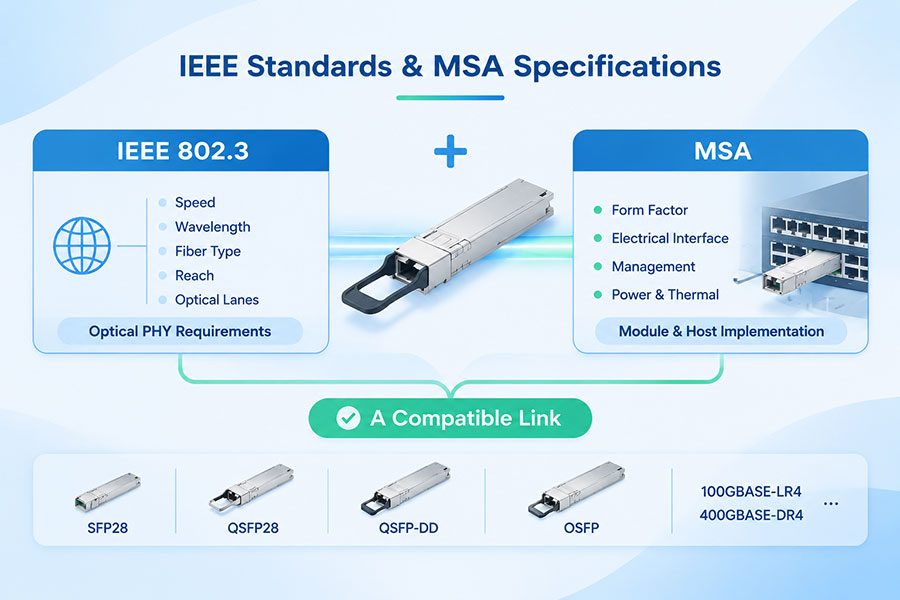
Optical transceivers are essential when high-capacity links must extend beyond the practical reach of electrical connections. They convert electrical signals from network equipment into optical signals for transmission over fiber, then convert received optical signals back into electrical form.
As per-port speeds increase, optical interfaces help data center operators deliver higher link capacity between servers, leaf switches, spine switches, and other network locations. The appropriate module depends on data rate, reach, fiber type, connector configuration, port form factor, and equipment compatibility.
| Optical or Cable Type | Typical Role | Bandwidth Density Consideration |
|---|---|---|
| 400G optical transceivers | High-speed server and switch interconnections | Provide 400G-class capacity per interface |
| 800G optical transceivers | Higher-capacity AI cluster and data center links | Increase capacity per port and can reduce the number of parallel interfaces |
| 1.6T optical transceivers | Emerging next-generation high-bandwidth interconnects | Support higher aggregate capacity in a single interface as platforms mature |
| AOC | Integrated optical cable connections | Combines optical transceivers and fiber into a factory-terminated assembly |
| DAC and AEC | Short-reach electrical connections | Can be practical for suitable short-distance links without separate optical modules |
For high-speed deployments, C-LIGHT provides product options including 800G DAC, 800G AEC, 800G AOC, and 1.6T OSFP-RHS connectivity options. The appropriate solution depends on the network equipment, transmission distance, interface requirements, and deployment architecture.
6. Fiber Density, Connectorization, and Cable Management
Higher network bandwidth density also increases the importance of the optical fiber plant. A large AI cluster can require many connections between server racks and switching equipment. The resulting fiber count, connector density, and cable routing requirements must be considered during the initial facility design.
Fiber count and parallel optics
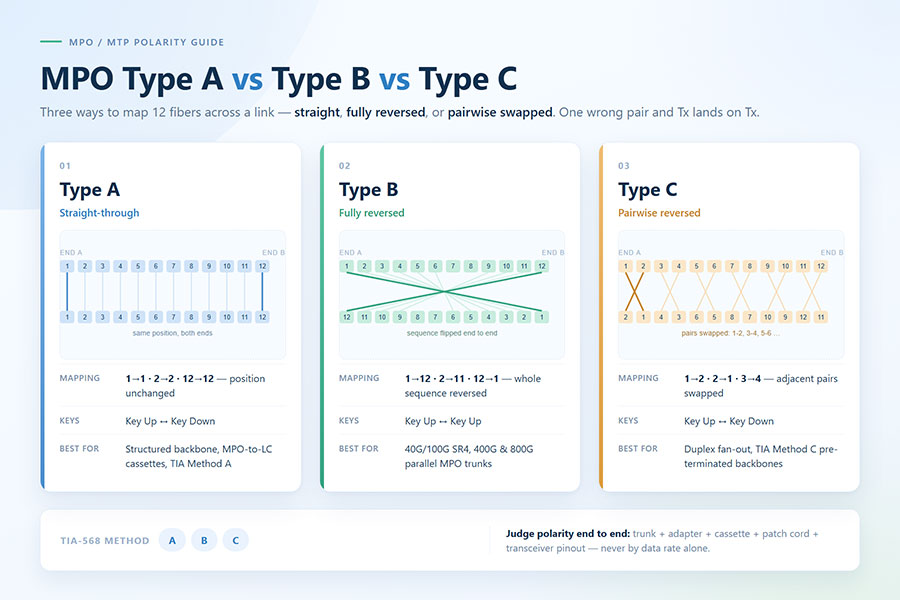
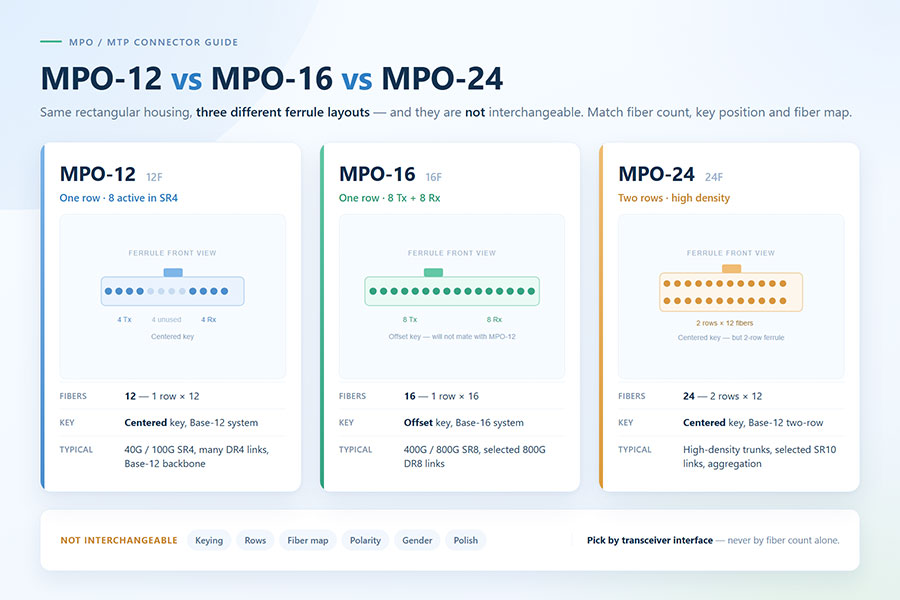
Some optical interfaces use multiple transmit and receive fiber lanes. Parallel-optics designs can provide high aggregate bandwidth, but they also require careful planning for fiber polarity, lane mapping, connector type, and end-to-end link configuration.
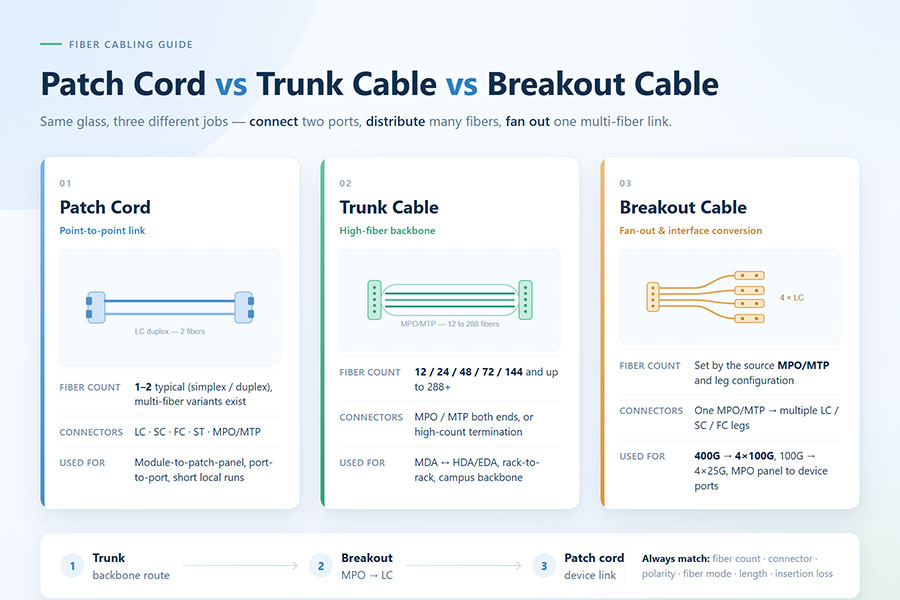
High-density MPO and MTP cabling
MPO and MTP multi-fiber connectors consolidate multiple fiber strands into a single connector interface. They can simplify high-density fiber deployment when the selected connector, fiber count, polarity, and optical interface are compatible.
C-LIGHT's MPO-MPO Fiber Patch Cables and MTP-MTP Fiber Patch Cables provide multi-fiber cabling options for structured optical connectivity. Cable selection should be based on the required fiber type, connector configuration, insertion-loss budget, and polarity scheme.
7. Power and Cooling Constraints at Higher Bandwidth Density
Increasing network capacity affects more than data throughput. Switch ASICs, optical engines, transceivers, retimers, and other signal-conditioning components consume electrical power and generate heat. When many high-speed ports are installed in a compact space, their combined thermal load becomes an important rack-level design factor.
Optical technology can provide reach and bandwidth advantages over electrical cabling in appropriate applications, but optical links are not automatically lower-power in every configuration. Power consumption depends on the module generation, reach, optical architecture, host interface, and equipment implementation.
Engineering teams should evaluate:
Switch power consumption at the intended port configuration.
Transceiver power per port and total optical-port power.
Airflow direction and cooling capacity around densely populated switch panels.
Thermal conditions inside cable-management spaces and rack enclosures.
Power distribution capacity, redundancy, and expected future expansion.
Monitoring and replacement procedures for components operating in dense environments.
Co-packaged optics (CPO) and near-packaged optics (NPO) are among the approaches being developed to address bandwidth, reach, and power challenges at increasingly dense switching and compute interfaces. They represent different levels of optical integration and should be evaluated according to platform maturity, serviceability, reliability, and system requirements. They do not eliminate the need for conventional pluggable optics across all data center links.
8. How to Plan an AI Network for Higher Bandwidth Density
A practical design begins with workload and traffic requirements, then translates them into switch capacity, link speeds, optical specifications, and physical infrastructure. Planning around GPU count alone can miss important differences in communication patterns and network utilization.
Key design checks
Define traffic requirements: Identify the number of accelerators, communication patterns, storage traffic, and expected east-west bandwidth.
Set a target oversubscription ratio: Match uplink capacity to workload requirements rather than assuming every topology needs the same ratio.
Validate switch capacity: Check port count, supported speeds, aggregate switching capacity, and the intended operating mode.
Match optical interfaces: Confirm form factor, lane configuration, wavelength, reach, fiber type, connector, and host compatibility.
Calculate optical power margin: Account for fiber attenuation, connector loss, splice loss, and other passive components along the link.
Plan physical pathways: Reserve sufficient space for fiber trunks, patch panels, cable trays, and future connections.
Validate power and cooling: Assess the combined thermal and electrical impact of switches and connected optical modules.
Allow for expansion: Design spare port capacity, fiber pathways, and rack power headroom where practical.
9. Bandwidth Density and the Move Toward 800G and 1.6T Networks
The transition from 400G to 800G and emerging 1.6T interfaces reflects the growing demand for more capacity per network connection. Higher data rates can help increase bandwidth density, but they also place greater demands on signal integrity, optical performance, thermal management, and equipment compatibility.
The actual benefit depends on how the interfaces are deployed. Moving to a higher-speed port does not automatically double useful application throughput or eliminate congestion. Switch capacity, topology, traffic distribution, endpoint capabilities, and oversubscription all remain important.
| Interface Generation | Nominal Port Rate | Design Focus |
|---|---|---|
| 400G | 400 Gb/s | High-speed connectivity for current AI and data center fabrics |
| 800G | 800 Gb/s | Higher per-port capacity and denser switch interconnection |
| 1.6T | 1.6 Tb/s | Next-generation interface capacity and more demanding integration requirements |
For AI infrastructure planners, the objective is not simply to deploy the highest available data rate. It is to select a balanced combination of port speed, switch radix, optical reach, fiber infrastructure, power efficiency, and operational reliability.
10. Conclusion
Bandwidth density influences nearly every layer of AI data center design, from switch architecture and rack layouts to optical transceivers, fiber cabling, power distribution, and cooling. As accelerator clusters grow, the ability to deliver more network capacity within limited physical and energy resources becomes increasingly important.
A successful design balances aggregate bandwidth with per-port capacity, switch radix, topology, optical link performance, cable density, and serviceability. 400G and 800G connectivity already play important roles in high-performance fabrics, while 1.6T interfaces and advanced optical integration are shaping future network designs.
Selecting compatible optical modules, high-density fiber assemblies, and suitable electrical or optical cables helps build a scalable physical network foundation for AI workloads.
Planning optical connectivity for an AI data center?
C-LIGHT offers optical transceivers, DAC, AEC, AOC, and fiber cabling options for high-speed data center applications.
Contact C-LIGHT >

 >
 >
 >
 >
 >
 >
 >