TEL:+86 132 6656 7067





Data Center Interconnect (DCI) links geographically separated data centers through high-capacity optical networks. It supports cloud resource distribution, storage replication, disaster recovery, workload migration, distributed computing and connections between hyperscale facilities. As traffic volumes increase, optical transceivers provide the bandwidth, reach and transmission efficiency required to connect independent data center environments.
Depending on the distance and network architecture, DCI can use direct-detect Ethernet optics, coherent pluggable transceivers or dedicated optical transport equipment. Technologies such as 400G, 800G, DWDM and coherent DSP allow operators to scale inter-data-center bandwidth while making more efficient use of existing fiber infrastructure.
1. The Role of Optical Transceivers in DCI Architecture
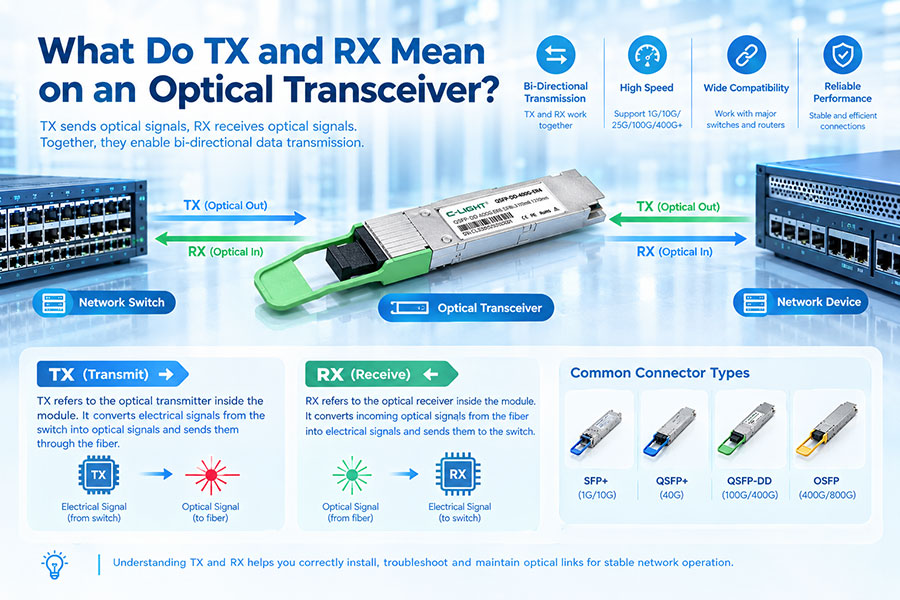
Optical transceivers convert electrical signals from switches, routers and transport equipment into optical signals for fiber transmission. At the receiving end, another transceiver converts the optical signal back into an electrical interface that the network device can process.
In DCI environments, transceivers are responsible for several important functions:
High-bandwidth connectivity: Provide 100G, 400G, 800G and higher-speed interfaces for interconnecting data center networks.
Long-distance transmission: Support campus, metropolitan and regional links through different optical technologies.
Wavelength utilization: Enable multiple optical channels to share fiber infrastructure through DWDM systems.
Signal integrity: Use appropriate optical power, receiver sensitivity, modulation and FEC to maintain transmission performance.
Network scalability: Allow operators to increase link capacity through higher-rate interfaces and additional wavelengths.
The optical interface is part of a complete end-to-end system. Switch capacity, routing architecture, fiber characteristics, optical line equipment and transceiver performance must all be considered when engineering a DCI connection.
2. Major DCI Deployment Scenarios
DCI networks vary considerably in distance, bandwidth demand and physical infrastructure. The optical technology used for a connection between two buildings on one campus may be very different from the solution required to connect data centers across a metropolitan region.
| DCI Scenario | Typical Application | Common Optical Approach | Primary Design Concern |
|---|---|---|---|
| Intra-Campus DCI | Connections between buildings or nearby data center facilities | 400G/800G DR, FR or LR Ethernet optics, depending on distance | Fiber reach, port density and link cost |
| Metro DCI | Interconnection between data centers across a metropolitan area | 400ZR, OpenZR+ and other coherent DWDM solutions | OSNR, wavelength planning and optical amplification |
| Regional DCI | Connectivity between regional cloud or colocation facilities | Coherent DCO and amplified DWDM transport | Multi-span transmission and accumulated optical impairments |
| Long-Distance DCI | Connections between geographically separated data center regions | Coherent transport systems and engineered optical line systems | End-to-end OSNR, latency, protection and capacity planning |
These categories are architectural examples rather than fixed distance standards. The actual optical solution depends on the fiber route, available wavelengths, transceiver specifications and line-system configuration.
3. Direct-Detect and Coherent Transceivers in DCI
Two major optical transmission approaches are used in modern DCI networks: direct-detect and coherent transmission. They address different reach and capacity requirements.
Direct-detect optics recover data through optical intensity detection. They are widely deployed in Ethernet networks and are suitable for many short- and medium-distance connections.
400G DR4 and DR8 interfaces support high-density single-mode fiber connectivity over shorter distances.
400G FR4 and 800G 2×FR4 configurations support selected campus and extended-reach applications.
LR-class Ethernet interfaces can support longer direct connections when the required optical specification is met.
These modules are commonly integrated into data center switches and routers without a separate coherent transport layer.
Coherent optics recover both amplitude and phase information from the optical signal. They use coherent receivers and digital signal processing to support higher-capacity transmission over more demanding optical paths.
Support high-capacity wavelength transmission over metro and regional fiber infrastructure.
Use coherent modulation formats such as DP-QPSK and DP-16QAM, depending on the selected operating mode.
Provide digital compensation for chromatic dispersion and polarization-related impairments within supported limits.
Support tunable DWDM wavelengths for more flexible use of fiber capacity.
| Parameter | Direct-Detect | Coherent |
|---|---|---|
| Detection Method | Optical intensity detection | Amplitude and phase detection |
| Common Modulation | NRZ or PAM4, depending on data rate | DP-QPSK, DP-8QAM, DP-16QAM and other supported formats |
| Signal Processing | Depends on the module architecture | Coherent DSP with advanced signal compensation |
| Typical DCI Use | Campus and shorter-distance connections | Metro, regional and longer-distance connections |
| DWDM Operation | Possible with suitable optical interfaces and line systems | Commonly used for tunable DWDM transmission |
4. 400G and 800G Optical Transceivers for DCI
As cloud platforms, AI infrastructure and distributed storage systems expand, 400G and 800G optical interfaces are becoming important building blocks for high-capacity DCI. These data rates increase the bandwidth available between data centers while reducing the number of individual connections required for a given aggregate capacity.
However, the data rate alone does not determine the transmission distance. A 400G DR4 module and a 400ZR coherent transceiver have different optical architectures and deployment requirements, even though both support a 400G-class connection.
| Optical Interface | Typical Reach Category | Fiber Type | DCI Application |
|---|---|---|---|
| 400G DR4 | Up to 500m, depending on specification | Single-mode fiber | Short campus and building interconnects |
| 400G FR4 | Up to 2km, depending on specification | Single-mode fiber | Campus and nearby facility connections |
| 400G LR4 | Up to 10km, depending on specification | Single-mode fiber | Extended campus and metropolitan edge links |
| 400ZR | Coherent DCI operating range defined by its specification and link conditions | Single-mode fiber | Point-to-point coherent metro DCI |
| 800G 2×FR4 | Up to 2km, depending on specification | Single-mode fiber | High-capacity campus DCI |
| 800ZR / 800ZR+ | Coherent reach depends on the selected mode and optical line system | Single-mode fiber | High-capacity coherent DCI and metro transport |
Reach values should always be checked against the exact module standard and product datasheet. They are not interchangeable between different optical technologies or transmission modes.
5. How 400ZR and OpenZR+ Enable Coherent DCI
400ZR was developed to provide a standardized 400G coherent optical interface for data center interconnection and related applications. It enables compatible routers and switches to connect directly to an appropriate DWDM optical line system through a coherent pluggable module.
OpenZR+ extends the coherent pluggable concept with additional operating modes and flexibility for metro and regional transport applications. Depending on the implementation, supported modes can include different line rates, modulation formats and FEC configurations.
| Technology | Primary Positioning | Key Characteristics | Deployment Consideration |
|---|---|---|---|
| 400ZR | Coherent 400G DCI | Defined coherent optical interface for interoperable applications | Requires a compatible optical path and line-system design |
| OpenZR+ | Flexible coherent metro and regional transport | Additional line-rate and modulation options | Verify the selected mode and interoperability profile |
| 800ZR | Higher-capacity coherent transport | 800G-class coherent interface | Requires suitable OSNR, bandwidth and optical infrastructure |
| 800ZR+ | Flexible high-capacity metro and regional transport | Higher-capacity coherent modes with implementation-dependent flexibility | Check supported line modes and end-to-end optical performance |
The main advantage of coherent pluggables is the ability to combine client connectivity and optical transmission functions in a compact module. In suitable architectures, this reduces the need for a separate external transponder between the router and the DWDM line system.
6. DWDM: Increasing DCI Capacity over Existing Fiber
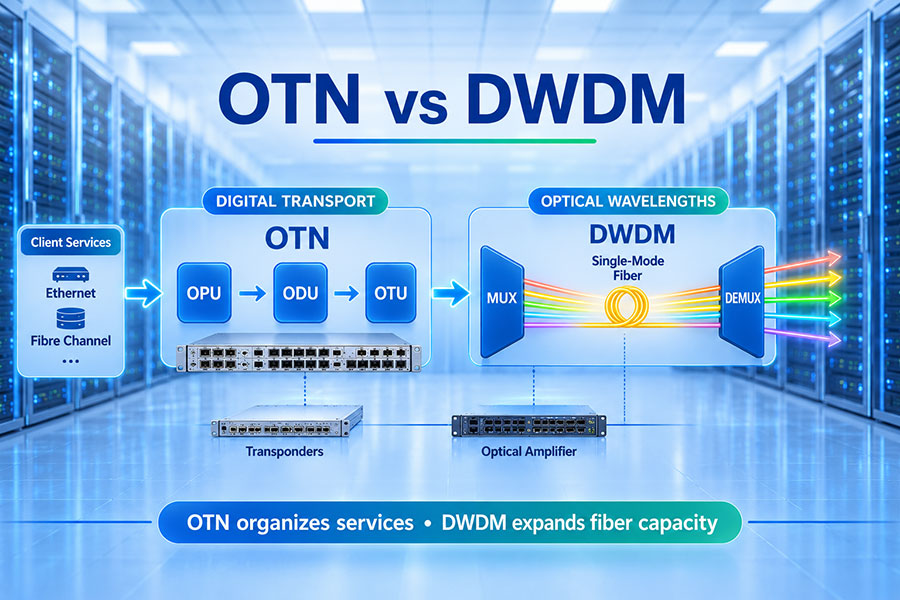
Fiber availability is a major consideration in DCI deployment. Building new fiber routes can involve significant construction costs, long deployment schedules and physical infrastructure limitations. Dense Wavelength Division Multiplexing (DWDM) increases the capacity of existing fiber by transmitting multiple optical wavelengths simultaneously.
Each DWDM channel operates at a different wavelength or frequency within the supported optical spectrum. A multiplexer combines these channels onto a common fiber, while a demultiplexer separates them at the receiving location.
A DWDM-based DCI architecture can carry multiple high-speed services over one fiber pair. For example, several 400G coherent channels can be combined to create a multi-terabit inter-data-center link, provided that the fiber, optical amplifiers, wavelength plan and line system support the required channel configuration.
Important DWDM components include:
DWDM MUX/DEMUX: Combines and separates wavelength channels.
EDFA: Amplifies optical signals to compensate for transmission loss.
ROADM: Adds, drops or routes selected wavelengths at intermediate network nodes.
Optical monitoring: Tracks channel power, wavelength, OSNR and other optical performance indicators.
Coherent DCO: Provides tunable high-capacity optical transmission between network endpoints.
7. Latency, OSNR and Transmission Reliability
DCI performance is not measured by bandwidth alone. Storage replication, distributed databases, application synchronization and active-active data center architectures can also depend on predictable latency and stable packet delivery.
Optical transceivers influence link performance through their signal processing, optical characteristics and supported transmission modes. However, the total DCI latency also includes fiber propagation, switching, routing, queuing and transport equipment.
Fiber propagation delay increases with physical route length. The optical signal travels through the fiber at a speed lower than the speed of light in a vacuum, making route distance a fundamental latency constraint. A shorter and more direct fiber route can therefore be as important as selecting a higher-speed transceiver.
OSNR is another critical factor in coherent DCI. Optical amplifiers introduce noise, and noise accumulates as the signal travels through multiple amplified spans. The receiver must maintain sufficient OSNR for the selected modulation and FEC mode.
| Parameter | Impact on DCI | Engineering Consideration |
|---|---|---|
| Fiber Distance | Affects propagation latency and optical loss | Use actual route length rather than straight-line geographic distance |
| OSNR | Determines signal quality at the coherent receiver | Evaluate amplifier noise, channel loading and receiver requirements |
| Chromatic Dispersion | Causes wavelength-dependent signal delay and pulse spreading | Confirm the supported compensation range |
| FEC | Improves error correction capability | Verify FEC mode, coding gain and implementation-specific latency |
| Optical Power | Influences receiver operating margin | Check transmitter output, fiber loss and receiver sensitivity |
| Network Congestion | Can increase end-to-end packet latency | Evaluate switch capacity, buffering and traffic engineering |
A link with adequate received optical power can still fail its coherent performance target if OSNR is insufficient. Likewise, a high-capacity optical interface cannot eliminate latency introduced by a long physical route or congested network equipment.
8. Pluggable DCO and IP-over-DWDM Architectures
Traditional DCI systems often use transponders to convert client signals into wavelengths suitable for optical transport. In an IP-over-DWDM architecture, coherent pluggable modules can be installed directly into compatible routers or switches, allowing the client device to connect to the optical line system without a separate transponder at each endpoint.
This approach can simplify equipment architecture, reduce the number of intermediate devices and improve port utilization. It also places more responsibility on the host platform and optical engineering design.
| Architecture | Signal Path | Advantages | Considerations |
|---|---|---|---|
| Transponder-Based DCI | Switch → Transponder → DWDM line system | Dedicated transport functions and established optical management workflows | Additional equipment, power and operational complexity |
| IP-over-DWDM | Router / Switch with coherent DCO → Optical line system | Fewer intermediate devices and direct optical integration | Requires host support, optical interoperability and suitable line-system design |
| Open Optical Line System | Coherent pluggables connected through an open DWDM infrastructure | Greater separation between client equipment and optical transport infrastructure | Requires careful validation of wavelength, power and OSNR compatibility |
Direct pluggable deployment is not automatically compatible with every router, switch or DWDM system. Host software, module power limits, management interfaces, wavelength plans and optical operating profiles must be verified before deployment.
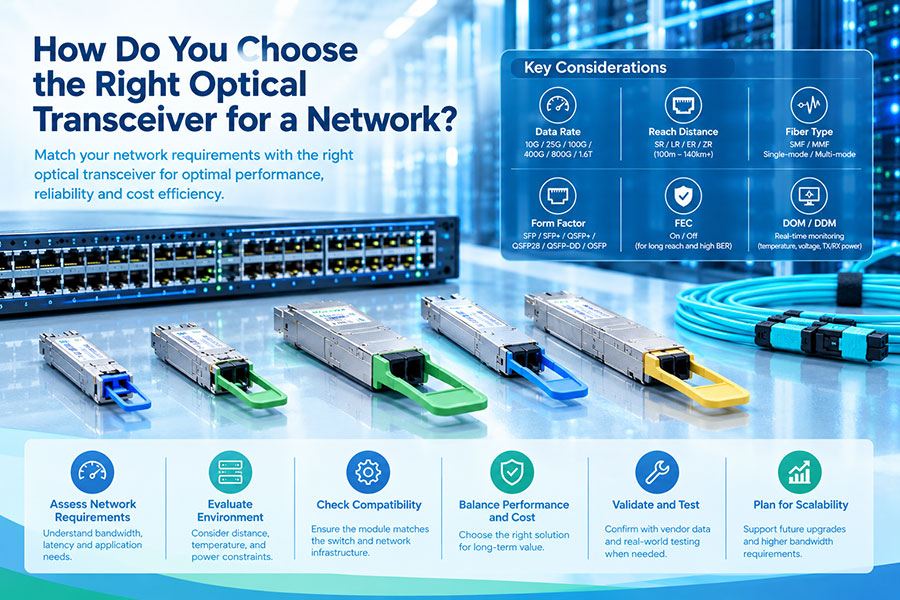
9. Selecting the Right Optical Transceiver for a DCI Project
A practical DCI selection process should begin with the physical network requirements and then move toward the optical interface and equipment platform.
Define the bandwidth: Establish whether the link requires 100G, 400G, 800G or multiple aggregated wavelengths.
Confirm the route: Determine the actual fiber distance, route loss and number of intermediate sites.
Choose the transmission technology: Select direct-detect Ethernet optics for suitable shorter links or coherent DCO for appropriate DWDM applications.
Evaluate the optical budget: Check transmit power, receiver sensitivity, insertion loss and engineering margin.
Validate OSNR: For coherent links, calculate the expected end-to-end OSNR and compare it with the receiver requirements.
Check wavelength compatibility: Confirm the transceiver tuning range, channel spacing and MUX/DEMUX or ROADM passband.
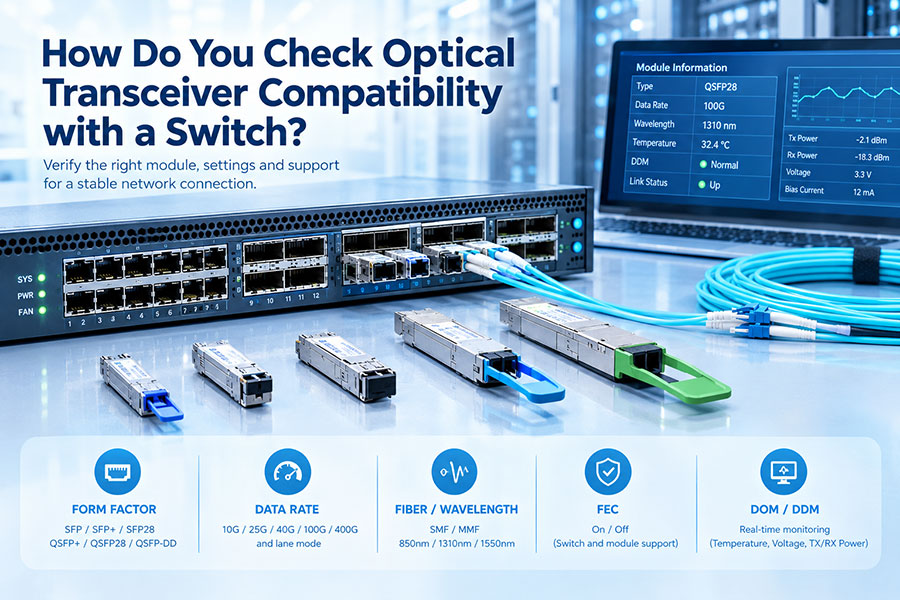
Verify host compatibility: Check form factor, electrical interface, firmware, management protocol, power and cooling.
Plan protection and expansion: Consider redundant fiber routes, additional wavelengths and future bandwidth requirements.
DCI design principle: Select the optical interface according to the complete transmission path. A 400G or 800G label describes capacity, not guaranteed distance, interoperability or end-to-end network performance.
10. C-LIGHT Optical Transceiver and DCI Product Solutions
C-LIGHT provides optical transceivers and WDM-related products for data center connectivity, high-speed networking and optical transport applications. Different product families address short-reach Ethernet connections, campus interconnects and coherent DWDM transmission.
800G OSFP Optical Transceivers
The C-LIGHT 800G OSFP product family includes multiple configurations for different data center link distances. Listed options include SR8 up to 100m, DR8 up to 500m and 2×FR4 up to 2km, depending on the specific module configuration. These interfaces are relevant to high-bandwidth data center and campus connectivity.
DWDM DCO Coherent Transceivers
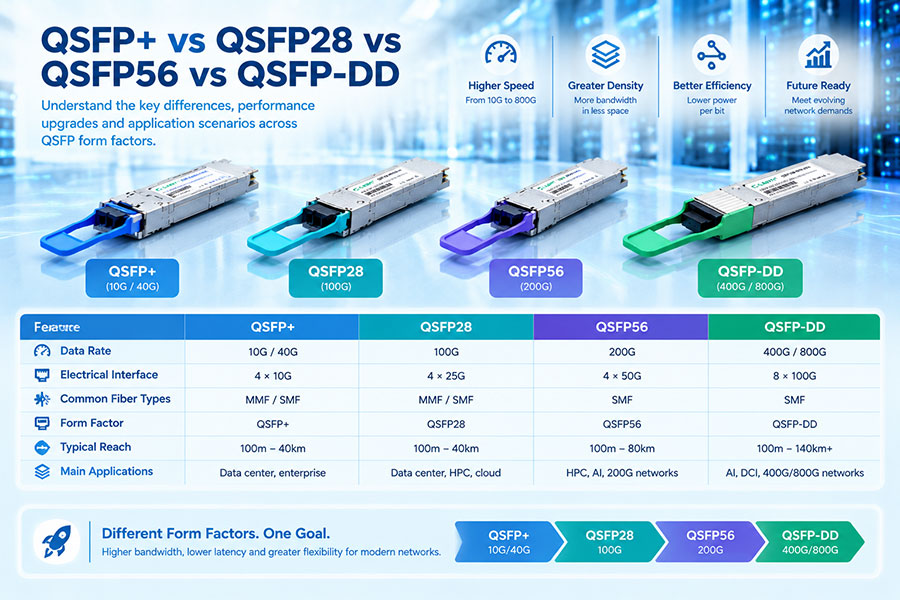
C-LIGHT's DWDM DCO portfolio covers 100G, 200G, 400G and 800G coherent configurations, with supported form factors including QSFP28, CFP2, QSFP-DD and OSFP. The portfolio includes 400ZR, OpenZR+ and 800ZR-related options, as well as tunable C-band DWDM configurations. Actual operating distance and supported modes depend on the selected module and optical line-system conditions.
WDM and OTN Transport Equipment
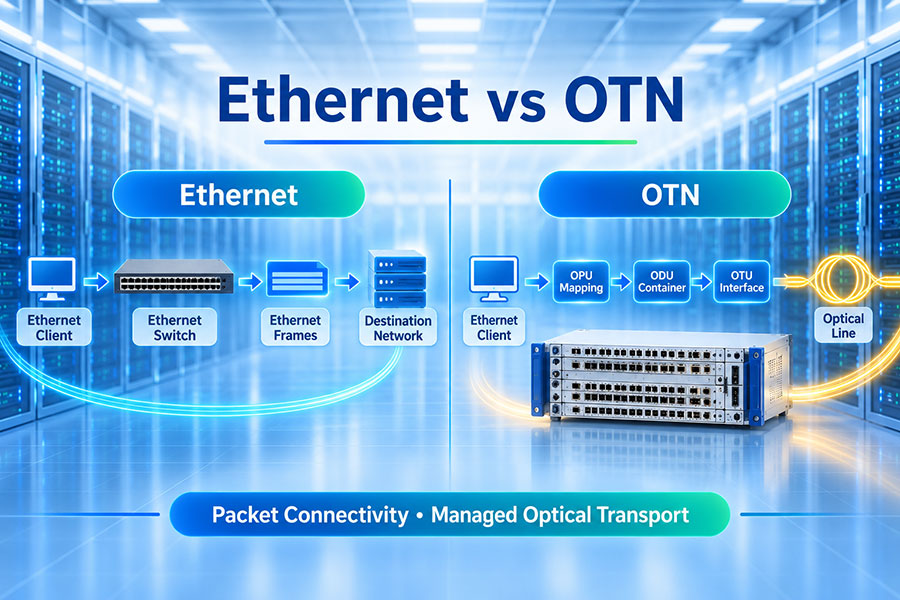
For DCI projects using dedicated optical transport infrastructure, C-LIGHT also offers WDM and OTN-related equipment, including DWDM MUX/DEMUX, EDFA, SOA, OADM/FWDM and other optical transport components. These products can form part of a wavelength-multiplexed architecture when matched to the required fiber route and channel plan.
For project-specific selection, the required data rate, transmission distance, fiber type, DWDM channel plan, host platform and optical line-system specifications should be reviewed together. This information helps determine whether a direct Ethernet transceiver, coherent DCO or transponder-based solution is appropriate.
11. Conclusion
Optical transceivers are fundamental components of modern Data Center Interconnect networks. They provide the high-speed optical interfaces required to connect distributed computing, storage and cloud infrastructure. Direct-detect modules support many campus and shorter-distance connections, while coherent DCO transceivers extend high-capacity connectivity across metro and regional DWDM networks.
As DCI traffic grows toward 400G, 800G and beyond, the combination of coherent optics, wavelength multiplexing, optical amplification and compatible switching platforms enables more efficient use of fiber infrastructure. Successful deployment depends on matching the transceiver to the actual route, optical budget, OSNR requirements and host architecture rather than selecting a module by data rate alone.
Building a High-Capacity Data Center Interconnect Network?
Contact C-LIGHT for optical transceiver, coherent DCO and WDM product information based on your DCI bandwidth and transmission requirements.
Contact C-LIGHT >

 >
 >
 >
 >
 >
 >
 >