TEL:+86 132 6656 7067





AI inference infrastructure must move model data efficiently while responding to application requests within predictable time limits. As inference workloads expand from individual GPU servers to distributed clusters, network connectivity becomes an important part of overall system performance. Optical interconnects provide high-bandwidth links between servers, switches, and data center facilities, helping inference platforms scale beyond the limits of individual racks and nodes.
Unlike large-scale model training, inference workloads vary considerably. A small model may run entirely on one GPU server, while a large language model may be distributed across multiple GPUs or separate prefill and decode server pools. These different deployment patterns create different requirements for bandwidth, latency, network topology, and optical connectivity.
1. Why Optical Connectivity Matters in AI Inference
An inference cluster receives application requests, processes them through one or more models, and returns generated results. The workload may involve user prompts, input data, model weights, intermediate tensors, KV cache data, and communication between distributed serving components.
When all model computation takes place within one server, most GPU-to-GPU communication can remain inside that system's local interconnect. Once model execution is distributed across multiple servers, however, network traffic must travel through external network interfaces and switches.
Optical interconnects help address several infrastructure requirements:
High bandwidth: Optical links provide high-capacity connections between GPU servers and network switches.
Longer reach: Fiber supports connections across racks and equipment areas where short electrical cables may not be practical.
Signal integrity: Fiber links are not affected by electromagnetic interference in the same way as electrical copper connections.
Port density: High-speed optical interfaces help consolidate bandwidth in dense switching environments.
Infrastructure expansion: Optical cabling allows additional compute and network resources to be connected as inference capacity grows.
Optical links do not automatically reduce end-to-end inference latency. Application response time also depends on model execution, request scheduling, queueing, routing, memory access, and the number of network hops.
2. Where Optical Interconnects Fit in an Inference Network
An AI inference platform usually contains several network domains. Their responsibilities may be separated physically or logically according to workload size, security requirements, traffic volume, and operational design.
Frontend Network: Connecting Users and Applications
The frontend network carries requests from applications, users, agents, and external services to the inference platform. It also carries responses back to those clients.
Typical traffic includes:
API requests and generated responses
Application and service communication
Authentication and access-control traffic
Model-serving gateway and load-balancing traffic
Storage and shared-service access, depending on the architecture
The frontend network may use an existing enterprise data center fabric or a dedicated leaf-spine network. Optical transceivers are useful when inference servers and network switches are distributed across racks or when aggregate traffic exceeds the practical capacity of shorter electrical connections.
Backend Network: Connecting Distributed GPU Servers
The backend network carries east-west traffic between compute nodes. It becomes important when model execution spans multiple servers or when separate inference services exchange large volumes of data.
Backend traffic can include distributed tensor communication, model data movement, KV cache transfers, and coordination between serving components. High-bandwidth optical links can connect leaf and spine switches and provide connectivity between GPU server groups.
3. How Optical Links Support Different Inference Architectures
Inference is not one uniform workload. Model size, request volume, context length, response generation, and serving strategy all influence the network design.
Single-Node Inference
A model runs within one GPU server. Internal GPU connections handle most accelerator communication, while the frontend network carries application requests and responses. A separate backend GPU fabric may not be required.
Multi-Node Model Serving
A large model is divided across GPUs located in different servers. Network links carry inter-node tensor or model communication, making backend bandwidth and latency important.
Replicated Inference
Multiple independent model replicas serve incoming requests. The frontend network distributes traffic among available instances. Backend communication depends on whether replicas share services or resources.
Disaggregated Inference
Prefill and decode operations run in separate worker pools. Transferring KV cache data between these pools can create substantial east-west traffic and increase the importance of high-capacity network links.
4. Optical Connectivity in Prefill and Decode Architectures
Disaggregated serving is an important inference architecture for large language models. It separates two stages of token generation so that each can use computing resources configured for its own workload characteristics.
Prefill Stage
During prefill, the model processes the input prompt and generates the intermediate key-value cache used during subsequent token generation. Long prompts and large batches can create substantial compute and memory activity.
Decode Stage
During decode, the model generates output tokens sequentially. The decode workers use the KV cache produced during prefill to continue processing the conversation or request.
KV Cache Transfer Between Worker Pools
When prefill and decode run on separate servers, the KV cache must be transferred between the corresponding worker pools. Depending on model size, sequence length, batch size, and cache representation, this transfer can create significant network traffic.
High-bandwidth optical links can connect the switches serving these worker pools. The network design should account for concurrent transfers, congestion, traffic isolation, and the physical placement of compute nodes.
The optical link alone does not determine KV transfer performance. NIC capability, RDMA support where used, memory access, transport protocol, congestion control, and software scheduling also affect the result.
5. Why Bandwidth and Latency Both Matter
Inference applications often have response-time targets, but network bandwidth and latency represent different performance characteristics.
| Network Characteristic | Meaning | Inference Impact |
|---|---|---|
| Bandwidth | Amount of data that can be transferred per unit of time | Affects large model-data and KV cache transfers |
| Latency | Time required for data to travel between endpoints | Affects communication delay between distributed services |
| Jitter | Variation in packet delay | Can make response times less predictable |
| Congestion | Competition for available network resources | Can increase queueing delay and reduce effective throughput |
| Packet loss | Packets that fail to reach their destination | Can trigger retransmissions or other recovery behavior |
For interactive inference, predictable latency is particularly important. For large KV cache transfers or distributed model execution, sustained bandwidth can become a major consideration. A well-designed fabric must account for both rather than selecting optical modules based only on their maximum data rate.
6. Where 400G, 800G, and 1.6T Optics Are Used
Optical interface speeds are selected according to the bandwidth required at each network layer. Different inference clusters may use several generations of optical connectivity at the same time.
| Interface Generation | Potential Network Role | Deployment Considerations |
|---|---|---|
| 400G | Server connections, leaf-spine links, and medium-to-large inference fabrics | Port count, optical reach, breakout support, and traffic demand |
| 800G | High-capacity GPU fabrics and dense switch interconnections | Host compatibility, thermal design, and optical lane configuration |
| 1.6T | Next-generation high-density switching and higher-capacity inference networks | 200G-class lane support, module power, cooling, and platform readiness |
An 800G or 1.6T interface is not automatically necessary for every inference server. A cluster serving smaller models may operate effectively with lower-speed network connections. Higher-speed interfaces become more relevant when traffic volume, model distribution, or the number of concurrent transfers creates a need for additional capacity.
For high-density infrastructure, the move toward 800G and 1.6T can increase bandwidth per port and help reduce the number of physical ports needed for a given aggregate capacity. Actual network performance still depends on the switching fabric and endpoint configuration.
7. Optical Transceiver and Fiber Selection for Inference Clusters
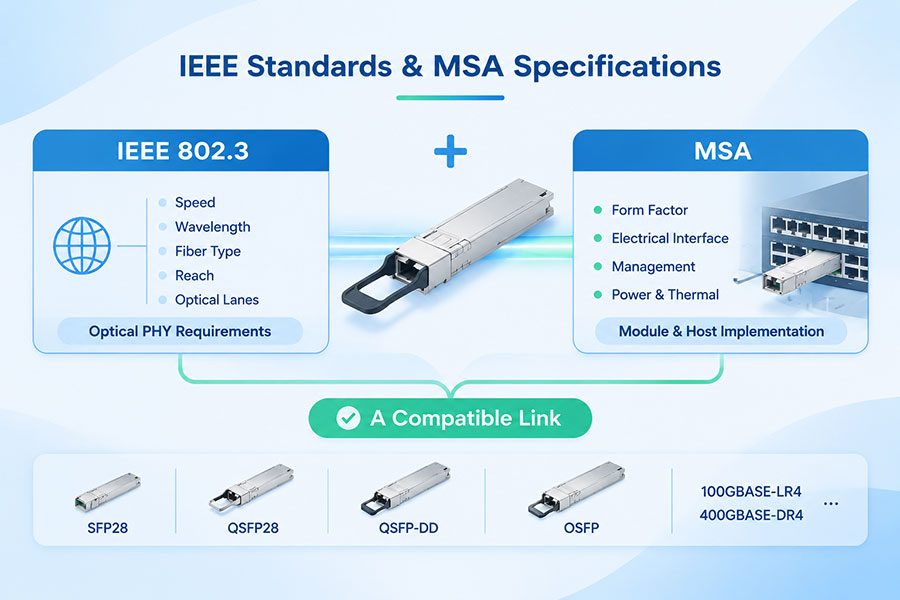
The correct optical solution depends on the connection's speed, distance, fiber type, connector, and host equipment. A transceiver should be selected as part of a complete link design rather than as an isolated component.
Short-Reach Connections
Within a rack or between nearby equipment, DAC, AEC, or AOC assemblies may be suitable depending on reach, data rate, power, and equipment support. Optical connectivity is especially useful when the required distance or cable-routing arrangement makes copper less practical.
Multimode and Single-Mode Fiber
Multimode fiber is used in supported short-reach optical applications, while single-mode fiber supports a broader range of data center distances and optical architectures. The transceiver and cable assembly must use matching fiber and connector specifications.
Parallel Optics and Duplex Links
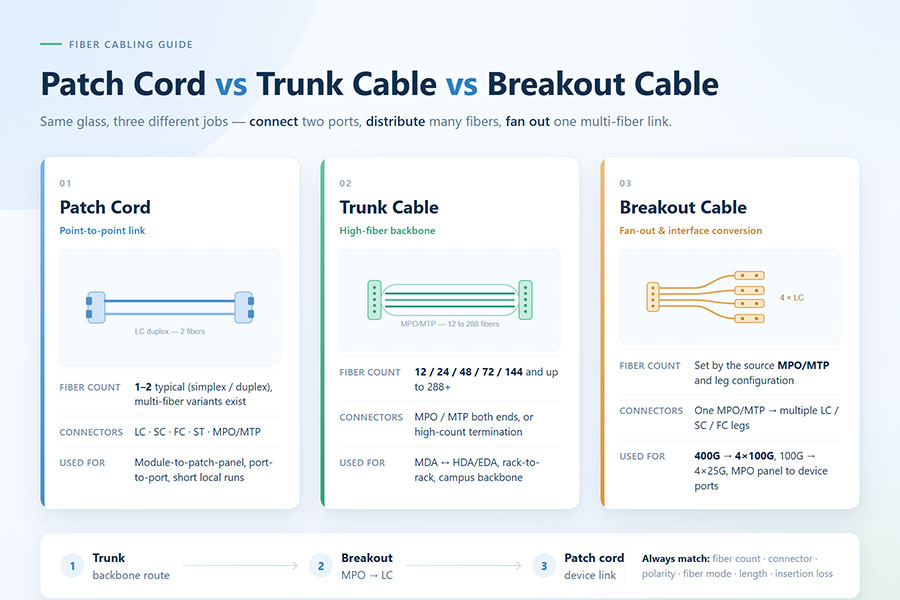
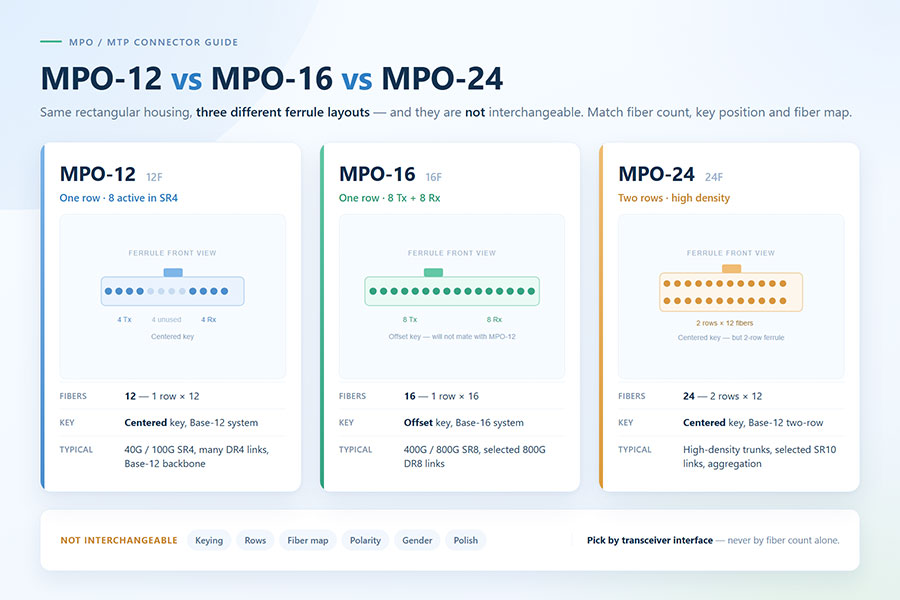
Parallel optical interfaces use multiple optical lanes and fiber strands, often through MPO-based connections. Duplex interfaces commonly use separate transmit and receive fibers, frequently with LC connectors. The physical cabling plan must match the selected optical module.
8. C-LIGHT Optical Connectivity for AI Infrastructure
C-LIGHT provides optical transceiver and high-speed interconnect product options for data center networking applications. These product categories can be considered when planning the optical links used by AI inference infrastructure.
800G Optical Transceivers
800G optical interfaces are relevant to high-capacity switch connections and GPU cluster fabrics. The C-LIGHT optical transceiver product range provides a starting point for reviewing available high-speed optical solutions.
Selection should be based on the required reach, optical architecture, host compatibility, connector type, and network protocol.
1.6T OSFP-RHS Optical Transceivers
The C-LIGHT 1.6T OSFP-RHS is designed for next-generation high-bandwidth data center applications. Its listed configurations include 2×DR4 for up to 500m and 2×FR4 for up to 2km over single-mode fiber.
This type of high-capacity interface may be relevant to future inference fabrics that require greater bandwidth per switch port. Host support, electrical interface, thermal conditions, and optical configuration must be verified before deployment.
MPO and MTP Fiber Assemblies
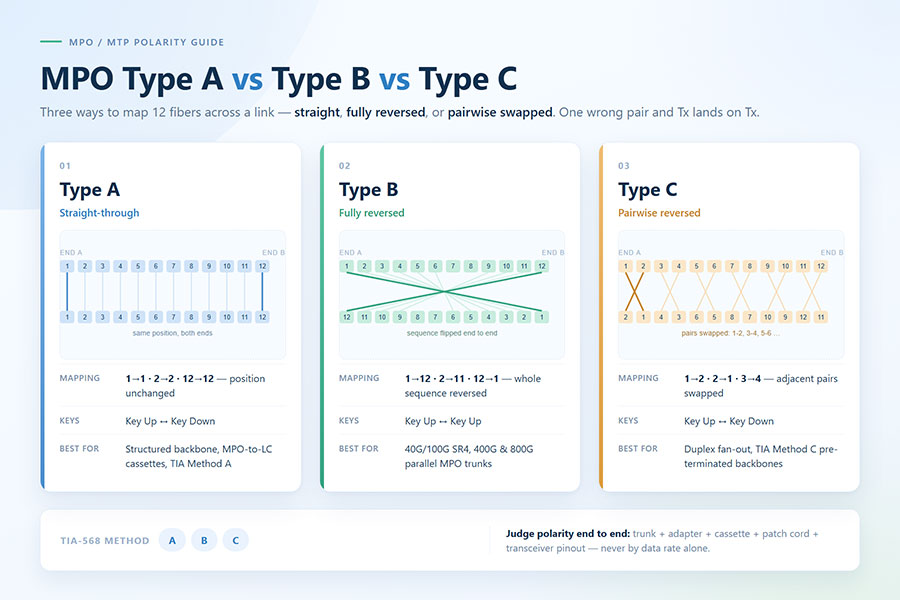
High-density parallel optical links require suitable fiber assemblies and connector arrangements. C-LIGHT offers MPO-MPO fiber patch cables and MTP-MTP fiber patch cables for supported fiber connectivity configurations.
Fiber count, polarity, connector gender, single-mode or multimode type, and insertion-loss requirements should be confirmed against the transceiver specifications.
9. How to Design a Scalable Optical Network for Inference
An inference network should be designed around the model-serving architecture and expected traffic patterns. Planning only by GPU count can lead to over-provisioned links in some areas and insufficient capacity in others.
Classify inference workloads: Identify single-node serving, replicated inference, multi-node model execution, and disaggregated prefill/decode workloads.
Map traffic flows: Separate user requests, application responses, model-data movement, KV cache transfers, storage access, and management traffic.
Determine network boundaries: Decide which traffic uses the frontend fabric and which requires a dedicated backend network.
Estimate bandwidth demand: Consider concurrent requests, model size, cache-transfer volume, and peak traffic rather than relying only on average utilization.
Select the topology: Plan leaf-spine capacity, network planes, redundancy, and the location of inference worker pools.
Choose optical interfaces: Match 400G, 800G, or 1.6T connectivity to the actual port and link requirements.
Validate the complete path: Test optical loss, link stability, interoperability, congestion behavior, and application-level response performance.
A scalable design should also reserve capacity for future server additions, additional inference replicas, and changes in model-serving architecture. Optical cable pathways, patch-panel space, switch ports, and cooling capacity should be included in the expansion plan.
10. What Limits Optical Network Performance in Inference Clusters?
Optical connectivity provides the physical transport capacity, but it does not remove every performance limitation in an inference system.
Network Congestion
Multiple worker pools may transfer data at the same time. If uplink capacity is insufficient or traffic is unevenly distributed, congestion can increase queueing delay and affect inference response times.
Server and NIC Limitations
A high-speed optical module cannot deliver its full interface capacity if the host NIC, PCIe connection, memory subsystem, or switch port is operating at a lower rate.
Software Scheduling and Placement
Poor placement of prefill and decode workers can create unnecessary traffic between racks or network zones. Keeping high-volume communication within an appropriate network domain can reduce the burden on the wider fabric.
Optical Link Budget and Thermal Conditions
Connectors, fiber segments, and passive components contribute to optical path loss. The complete link must remain within the supported transmitter and receiver specifications. High-density installations must also provide suitable airflow and thermal management for the installed transceivers.
Application-Level Latency
Inference response time includes model computation, queueing, memory operations, network transport, and service orchestration. Improving one optical link may not significantly change overall response time if another part of the serving pipeline is the dominant constraint.
11. Conclusion: Optical Interconnects Enable Distributed AI Inference
Optical interconnects support AI inference clusters by connecting GPU servers, switches, storage systems, and distributed serving components. They are especially important when model execution spans multiple nodes or when disaggregated inference requires high-volume KV cache transfers between prefill and decode workers.
The required optical infrastructure depends on the serving architecture. Single-node inference may need only frontend connectivity, while multi-node and disaggregated deployments can require dedicated high-bandwidth backend fabrics. 400G, 800G, and 1.6T interfaces provide different capacity options as infrastructure requirements evolve.
A successful deployment combines suitable optical modules, structured fiber cabling, adequate switch capacity, and workload-aware network design. The goal is not simply to maximize link speed, but to provide predictable connectivity that supports the actual inference workload.
Planning optical connectivity for an AI inference platform?
C-LIGHT provides optical transceiver and fiber connectivity options for data center networking applications.
Contact C-LIGHT >

 >
 >
 >
 >
 >
 >
 >